AI Yoga Mat Design Generator
A yoga mat is a very long, very narrow canvas that spends most of its life with a body lying on top of it. Roughly 24 by 68 inches — a 1 to 2.8 ratio — which means almost nothing designed as a square survives the trip, and the middle third, the part that reads best on a listing photo, is exactly the part a torso covers during half the practice. This AI yoga mat design generator works inside those proportions and shows the result on a real product mockup in about twenty seconds, at up to 4K, in six styles: mandala, muted landscape, alignment lines, terrazzo, celestial and boho border. Pick a style, describe your motif and palette, and see the mat before you order a sample.
Try It Now — Free
Pick the mat style first, then use the details box for your motif, your palette and the surface you are printing on. Every preset already carries what a yoga mat cares about — a composition that survives a 1 to 2.8 rectangle, a mid-tone or deep ground that hides sweat marks and studio floor dust, and a scale built for something looked at from standing height rather than held at arm's length.
AI Yoga Mat Design Generator
Pick a mat style, describe your motif and colours, and see it on a real product mockup
Mats From the AI Yoga Mat Design Generator
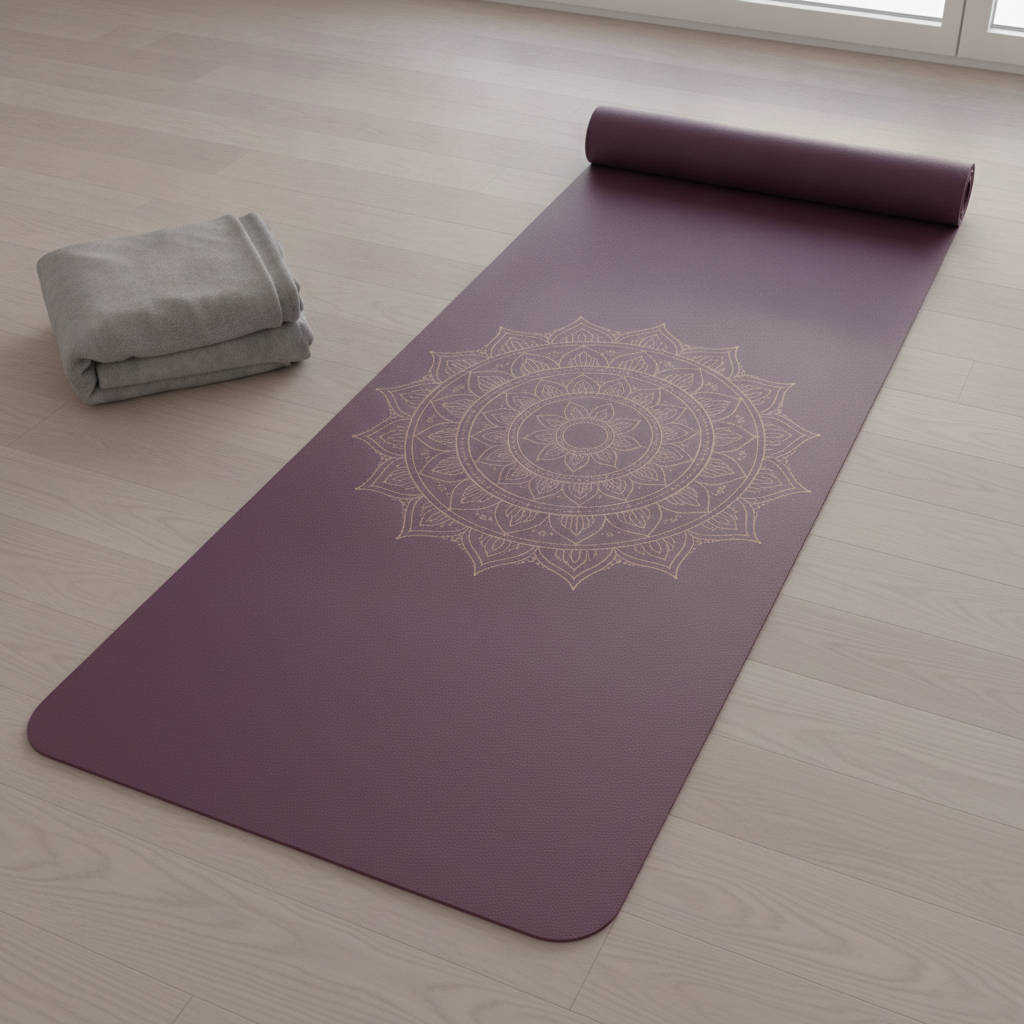
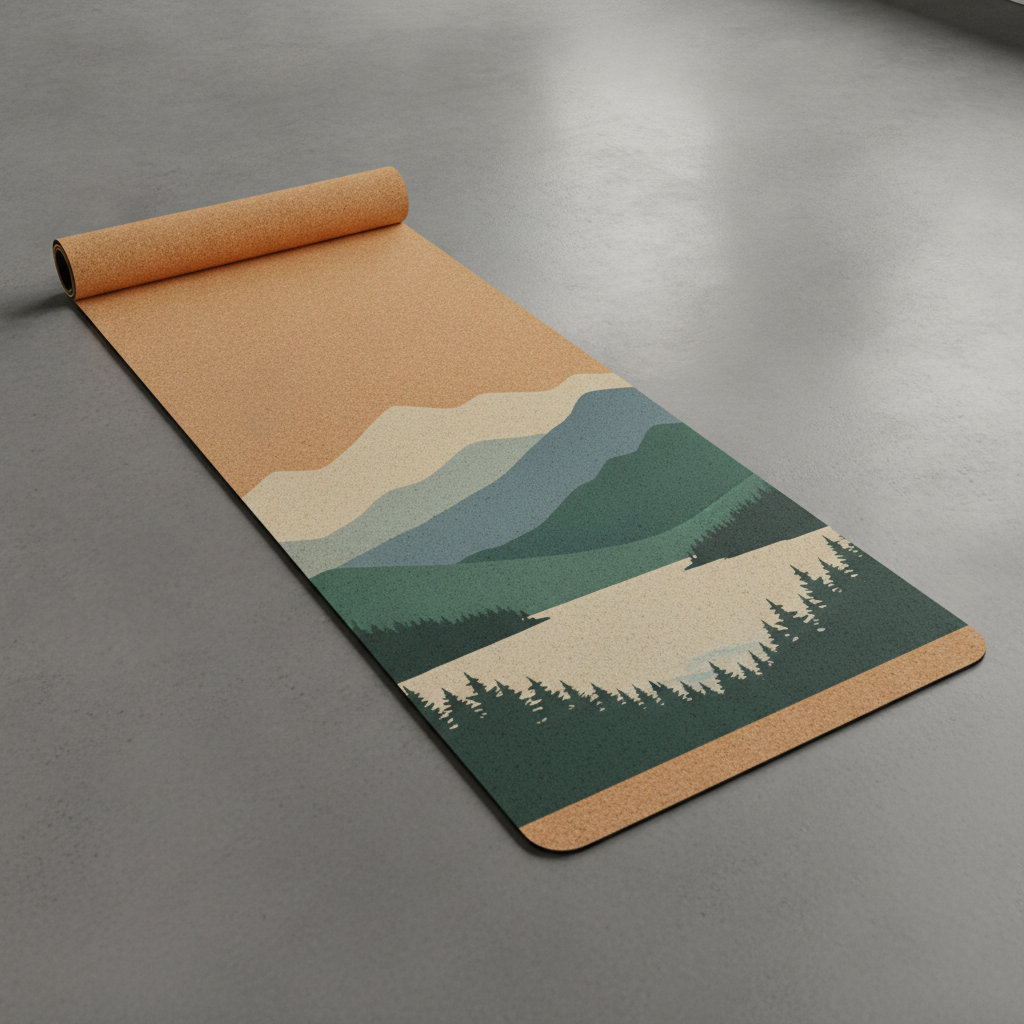
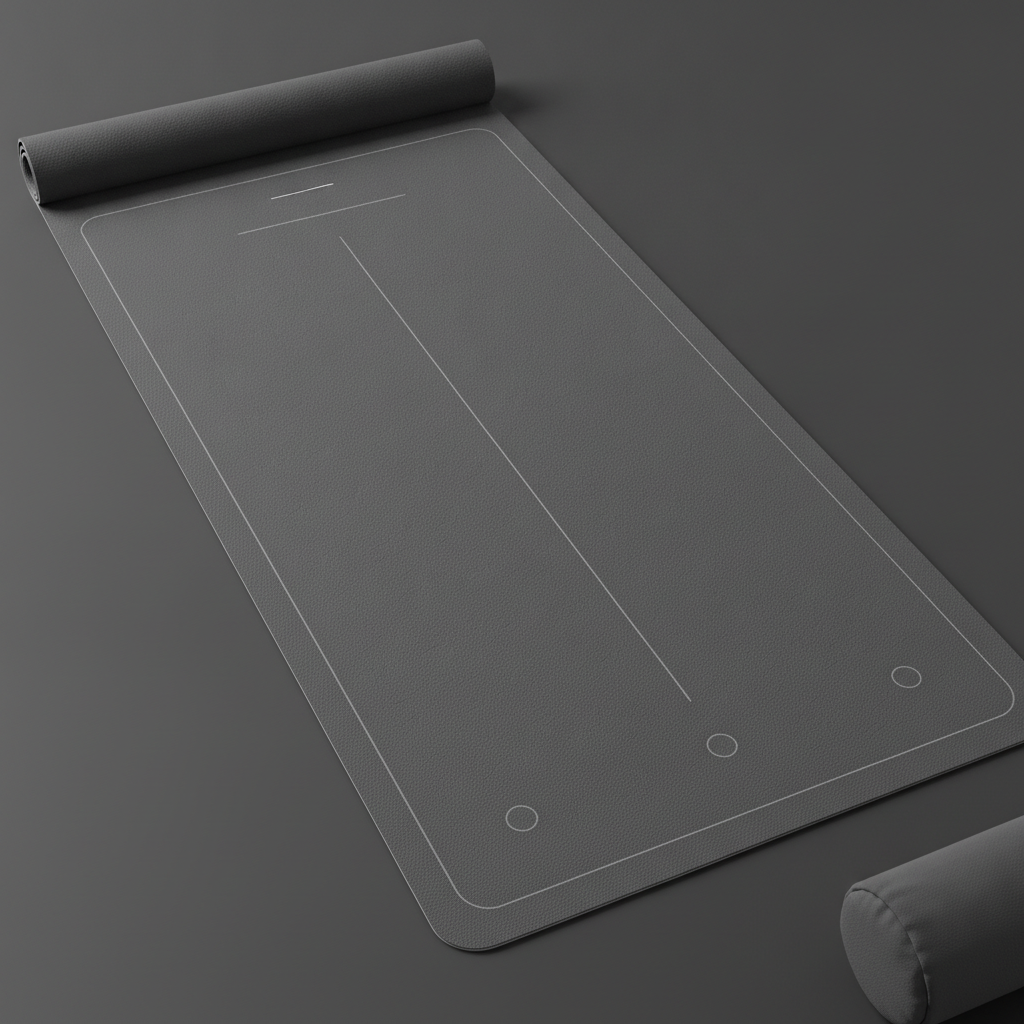
Mandala, muted landscape, alignment lines, terrazzo, celestial and boho border — the six directions that cover almost every yoga mat anybody actually buys
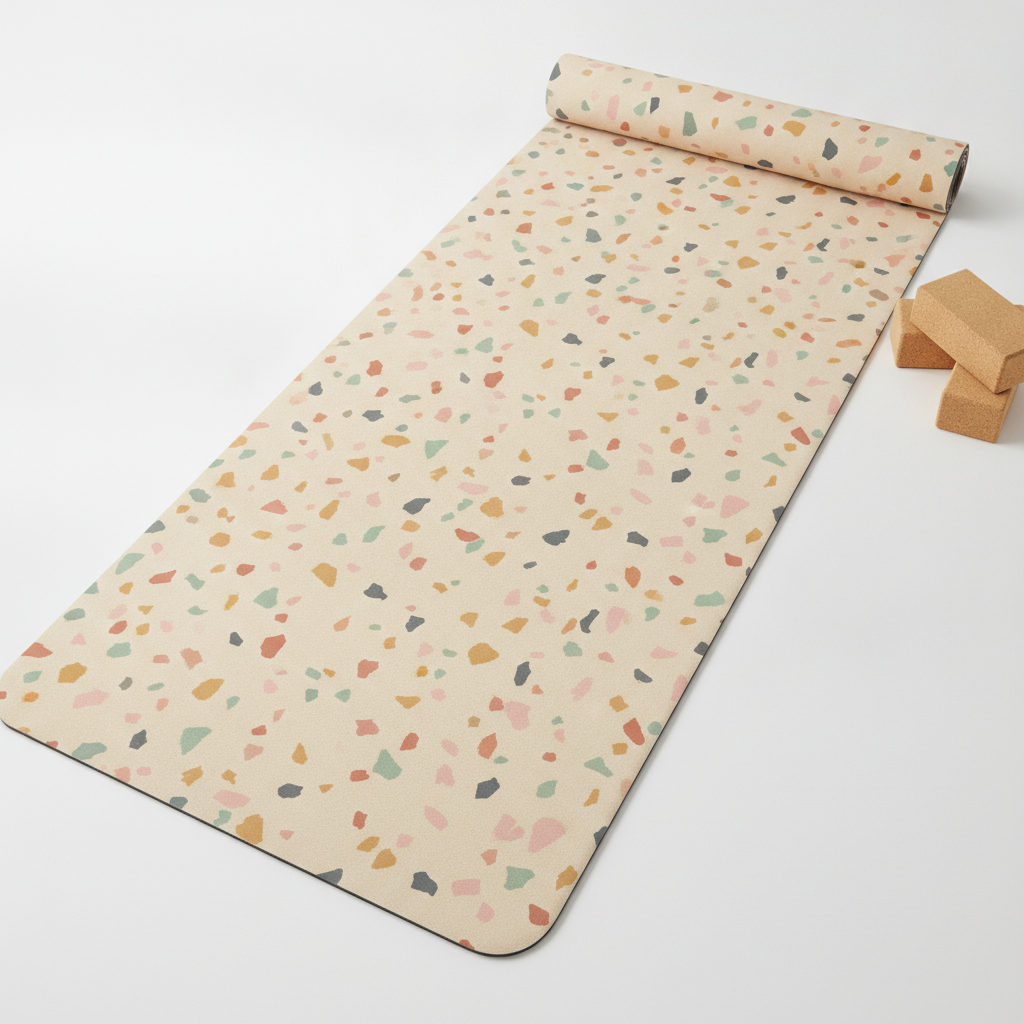
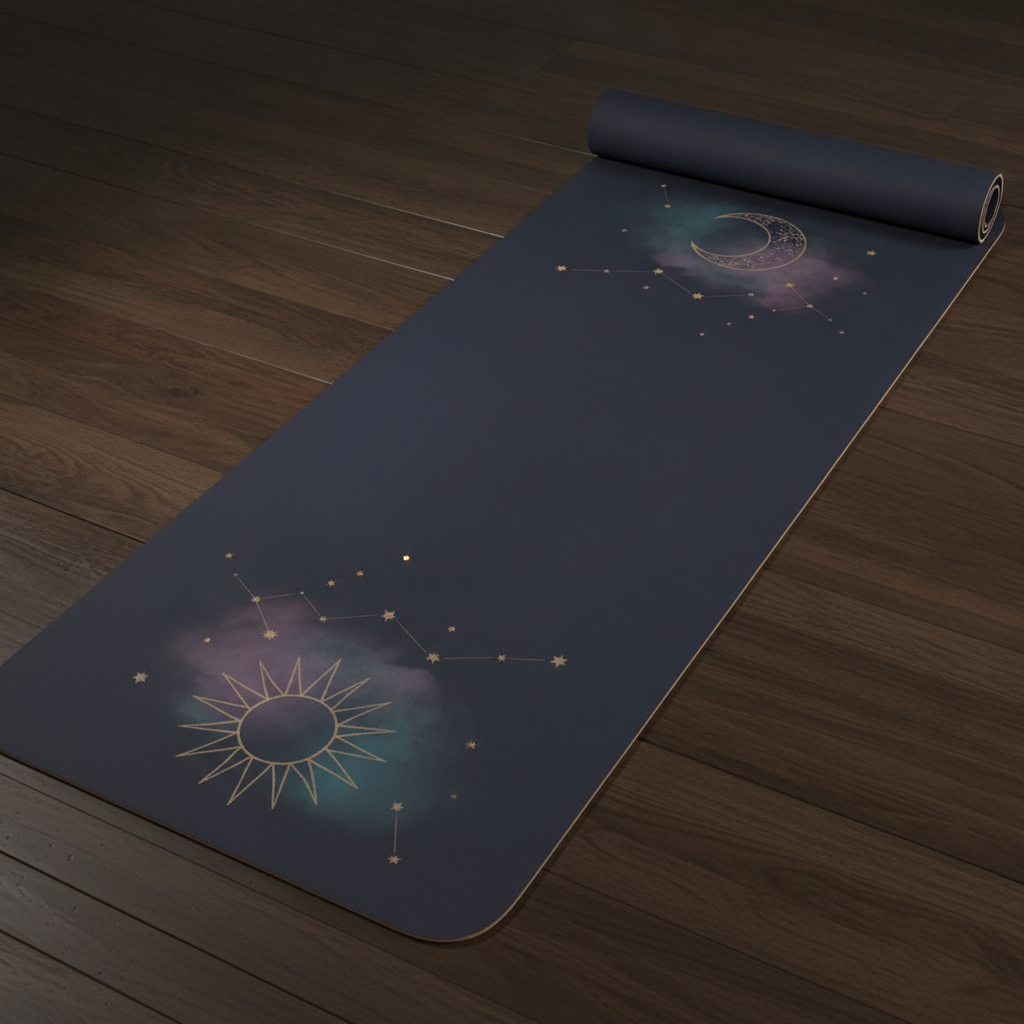
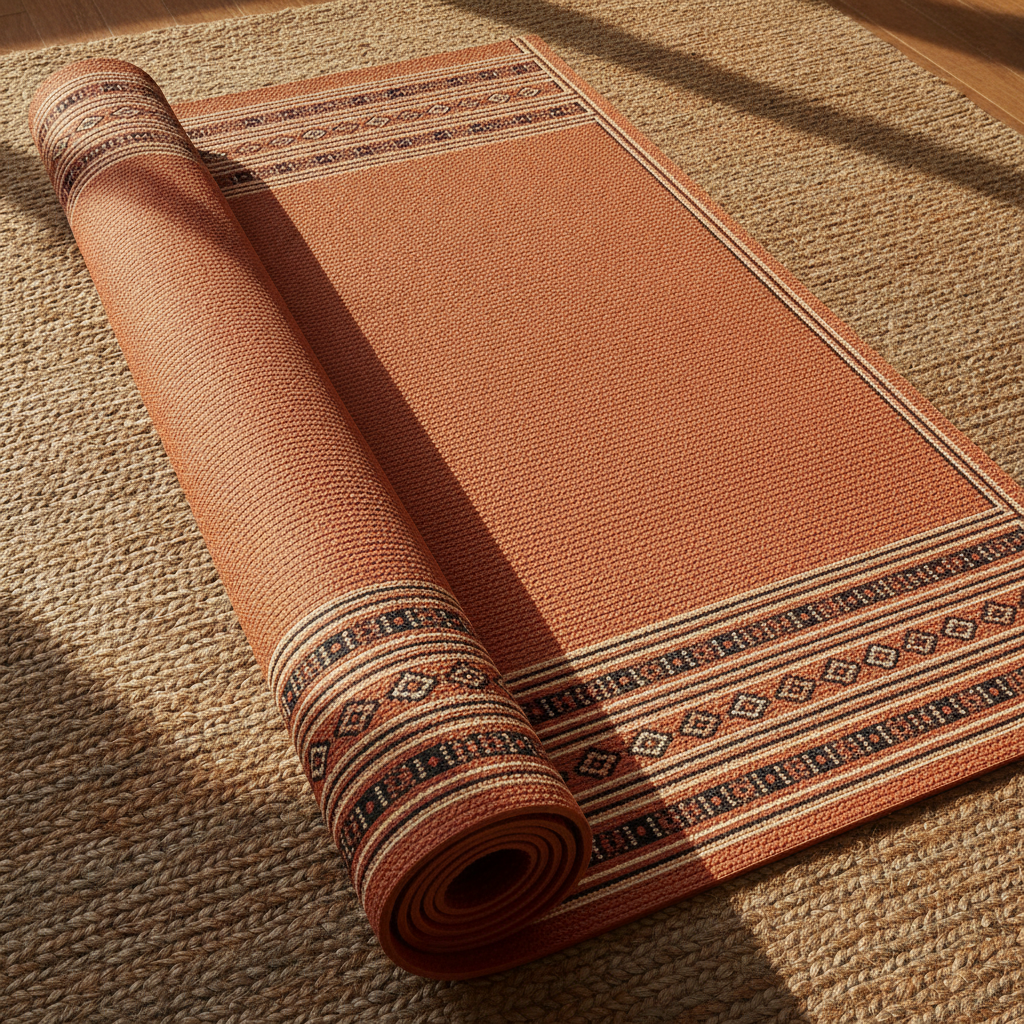
How the AI Yoga Mat Design Generator Works
Three steps from an idea to artwork a print-on-demand supplier can work from
Start With Who Practises On It
Yoga mats split into four markets that want almost opposite things. A retail gift mat is bought for its looks, photographed from above for a listing, and usually never sees a hot class — it can be pale, decorative and busy. A serious practitioner’s mat is chosen for grip and thickness first and pattern last, which is why the best-selling premium mats are plain black, charcoal or deep jewel tones with at most a small mark. A studio mat carries a brand rather than a motif: one logo or a restrained repeat, in the studio’s colours, on a surface that survives being wiped with disinfectant several times a day. And an alignment mat is a teaching tool where the printed lines are the product and decoration actively gets in the way. Say which of the four you are making in the details box and the design comes back suited to a real mat instead of to a flat mockup.
Describe the Motif, the Palette and the Layout
Three things carry a yoga mat design. Name one motif and its scale, because a 24 by 68 inch rectangle punishes indecision — a single centred medallion, an all-over repeat, or a border at the two ends are the layouts that hold, and a scattered collection of unrelated elements is the layout that reads as clutter from standing height. Name four or five colours and stop, then pick the ground with the room in mind: a white or pastel mat shows every sweat mark and every scuff of studio floor grit within a month, black hides everything but looks severe under warm lighting, and the mid-to-deep tones between them — aubergine, forest, navy, terracotta, charcoal — are what almost every mat brand actually ships. Then say where the artwork sits, because the long middle third is where a body lies and where a torso will cover whatever you put there during half the practice.
Generate, Then Take It to a Supplier
Each design arrives in about twenty seconds at up to 4K on a photographed mat, so you can judge scale, contrast and whether a motif still reads once it is stretched down a very long rectangle rather than sitting in a square. Use it two ways. As a sample, it is the mockup you put in front of a studio owner, a collaborator or a customer poll before anybody pays for a print run. As a brief, it is what you hand to whoever makes it: a print-on-demand service wants a flat artwork file at its exact mat template, typically around 24 by 68 or 24 by 72 inches at 150 DPI, and a manufacturer running a real production order will want the same artwork rebuilt as vector or as a seamless repeat. Ask for the flat artwork on a plain background when you need the working file, and restate your finished proportions, because these presets generate square and a yoga mat is emphatically not.
Why Use an AI Yoga Mat Design Generator
Six things that decide whether a yoga mat design survives the proportions, the sweat and the machine that has to print it
A 1 to 2.8 Rectangle Breaks Most Artwork
A standard yoga mat is about 24 inches wide and 68 inches long, with 72 and 74 inch versions for taller practitioners and 26 inch widths sold as extra-wide. That is a ratio close to 1 to 2.8, and it is the single reason most yoga mat designs fail. Artwork drawn as a square and stretched to fit turns every circle into an ellipse and every mandala into an egg, which is instantly visible on a symmetrical motif and the most common giveaway of a rushed print-on-demand listing. Artwork drawn at the right ratio but composed like a poster puts its focal point in a middle third that a body covers during most of the practice. The layouts that survive are the ones built for the shape: a single medallion sized to the mat width and centred, an all-over repeat that has no focal point to lose, or a band of decoration at the head and foot ends with the long middle left open. Decide which of those three you are making before you choose a motif, because the layout constrains the motif far more than the other way around.
The Middle Third Is Occupied
This is the constraint nobody thinks about until the first sample arrives. A yoga mat is not looked at while it is being used — for most of a practice the person is lying, kneeling or standing on top of the exact area that carries the design. The centre of the mat is covered by a torso in savasana, by knees and shins in every seated pose, and by a whole body in anything supine. What is actually visible during use is the perimeter, the two ends, and whatever sits in the wide space beside the hips. What is visible in a photograph — the listing image, the studio shot, the social post — is everything, which is why so many mats are designed for the photo and disappoint in the room. There is no single right answer, but there is a right question: is this mat sold on a picture or lived with in a studio? Retail gift mats can lean into the centred medallion because the photograph is the product. Studio and practitioner mats do better with a border layout or an all-over repeat, where nothing important is ever hidden.
PVC, TPE, Rubber and Cork Print Completely Differently
Mat material decides what artwork is even possible. PVC is the cheap, durable, closed-cell standard and takes a printed top layer well, which is why almost every heavily patterned mat you see online is PVC — bright colour, sharp detail, low cost. TPE is the lighter recyclable alternative and prints acceptably but with slightly softer edges and a more limited colour range. Natural rubber is the grippy premium choice and it starts dark, so a design is either printed onto a bonded polyurethane or microfibre top layer or it does not happen at all; you will not get a pale pastel on raw rubber. Cork is the material with the strongest opinion of its own: it is warm, speckled and mid-toned, every printed colour sits over that grain rather than on white, pale inks disappear into it, and the honest approach is to design with the cork tone as a colour in your palette instead of fighting it. Pick the surface before you fall in love with a palette the surface cannot reproduce.
It Is a Product That Gets Sweated On
A yoga mat spends its life absorbing sweat, being wiped with alcohol or vinegar sprays, rolled, thrown in a car boot and unrolled on floors that have not been mopped since Tuesday. That is a design constraint, not a footnote. Pale grounds — white, cream, blush, mint — look beautiful in the product photograph and show a grey shadow at the hands and feet within a couple of months of real use, which is why they sell well to occasional practitioners and generate returns from serious ones. Pure white is the worst offender. Deep and mid-tones survive: aubergine, forest, navy, charcoal, terracotta, and any busy all-over pattern, which is exactly why so much of this category is patterned rather than plain. The finish matters too. A printed top layer on a hot yoga mat has to survive repeated wiping without hazing, and a design with large flat areas of a single dark colour will show wear at the contact points long before a terrazzo or a mandala does.
Alignment Lines Are a Real Feature, Not a Decoration
A meaningful slice of this market is bought for the printed guides rather than the pattern: a centre line for symmetry, hand placement marks for downward dog and plank, foot markers at a shoulder or a warrior width. If that is the mat you are making, treat the lines as engineering. They need to be geometrically accurate and genuinely symmetrical about the long axis, thin enough not to dominate, in a single high-contrast colour, and positioned to real body proportions rather than to whatever looks balanced in the composition. This is also the one style where a generated image needs the most human correction: an image model will produce lines that look right and are not measurably right, and a mat whose centre line is a degree off or whose hand bars are asymmetric is a product complaint waiting to happen. Use the preset to settle the look, the palette and the mat colour, then rebuild the geometry precisely in a vector tool before anything goes to production.
Free to Start, $9.98 to Go Further
You can generate yoga mat designs free without a credit card, which is enough to find out whether a motif holds up at mat proportions and against the surface colour you had in mind before you pay for a sample or a designer’s time. Paid plans start at $9.98 for real work: testing one design across six mat colours, building a coordinated studio set where the mat, the towel and the bag share a mark, or the repeated passes it takes to get a repeat scaled right for a 68 inch rectangle rather than a screen. Output reaches 4K without a watermark and is cleared for commercial use, which is what matters once designs are going to a print-on-demand supplier or a manufacturer. Against a custom yoga mat sample costing thirty to sixty dollars and taking one to three weeks to arrive from overseas, seeing a dozen directions on a photographed mat before choosing one usually changes which mat gets made.
Frequently Asked Questions
Common questions about using an AI yoga mat design generator
Design the Yoga Mat in Twenty Seconds
Pick a style, describe your motif and colours, and see it on a real yoga mat mockup at up to 4K — mandala, muted landscape, alignment lines, terrazzo, celestial or boho border. Powered by Nano Banana Pro. Free to start, plans from $9.98.
A Very Long Canvas With Somebody Lying On It: the AI Yoga Mat Design Generator
Designing a yoga mat used to start with the most expensive step. You picked something from a supplier's catalogue or briefed a designer, ordered a sample, waited one to three weeks for it to arrive from overseas and paid thirty to sixty dollars for the privilege — and only when the parcel was unrolled did you find out that the mandala you approved as a square has been squeezed into an oval by the shape of the mat. An AI yoga mat design generator inverts that order. You describe the practitioner, the motif and the palette, and the design arrives on a photographed mat in about twenty seconds, which makes the deciding cheap and leaves only the making expensive. On a product with a long sampling lead time, trying a dozen directions before choosing one is worth far more than it costs.
The six presets exist because a yoga mat is a different design problem from every other printed textile. Its proportions are extreme — roughly 24 by 68 inches, near enough 1 to 2.8 — which is why the centred medallion, the all-over repeat and the two-end border are the only layouts that hold, and why anything composed like a poster looks wrong from one end and upside down from the other. Its middle third is occupied by a body for most of the time it is in use, so a design built for the listing photograph and a design built for the studio are genuinely different briefs. Its surface is a material decision before it is an aesthetic one: PVC takes bright sharp print, natural rubber starts dark, and cork puts a warm speckled mid-tone under every colour you choose. And it gets sweated on and wiped down several times a week, which is the real reason the mats that survive contact with practice are patterned, deep-toned, or both.
Two habits improve nearly every yoga mat design. Choose the layout before the motif, because the 1 to 2.8 rectangle constrains what a motif can be far more than the motif constrains the layout. And commit to a scale that suits the viewing distance — a medallion close to the full mat width, or a repeat with chips about the size of a thumbnail — since the delicate detail floating in the middle of a 68 inch mat is the one that reads as an accident from standing height. Practitioner, motif, palette: three decisions, and the supplier does the rest.
What the AI Yoga Mat Design Generator Will Not Do
It will not make a yoga mat, and it will not produce a production-ready file. What you get is artwork shown on a real mat, which is what you need for judging layout, scale and contrast and for a listing photo while you test demand — but a print-on-demand supplier wants a flat file at its exact template dimensions, and preparing that is a separate step. Generate the design you like, run it again asking for the flat artwork on a plain background, then clean it up with the AI background remover and enlarge it with the 4K image upscaler so the detail survives being printed at 68 inches.
It will not guarantee the finished mat either, because rubber is not pixels. Printed colour shifts on a TPE surface, a design on cork sits over a speckled amber ground that eats pale inks, natural rubber will not take a pastel at all without a bonded top layer, and alignment lines that look symmetrical in a generated image are not measurably symmetrical — so approve a physical sample before a production run and rebuild any functional geometry by hand. For neighbouring jobs there are better fits: the AI pattern generator is the place to work on a seamless repeat itself, the AI logo generator builds the studio mark that goes on the mat in the first place, the AI towel design generator and the AI tote bag design generator carry the same mark onto the rest of the studio kit, the AI rug design generator handles the larger floor pieces, and the AI mockup generator places a finished design into styled shop photography. For any lettering, text in images explains what type the model can reliably set.
Within those limits the work is yours to use. Output reaches 4K with no watermark and is cleared for commercial use, which covers Etsy and Shopify listings, print-on-demand shops, wellness brands, yoga studio merchandise and client jobs alike. Keep other people's property out of it — licensed characters, brand marks and the style of a specific named living artist. Check the AI policy of whichever marketplace you sell through, and know that in the United States purely AI-generated images are not registrable for copyright, so selling the mat is fine but stopping an imitator may not be. It is free to start with no credit card and plans begin at $9.98. Pick a style, name your motif, and see the mat before you order the sample.
Try the AI yoga mat design generator free today. Pick one of six yoga mat design styles, describe your motif and colours, and see it on a real product mockup at up to 4K. No credit card required to start. Paid plans from $9.98.