
AI Rug Design Generator
A rug is the biggest piece of pattern anyone puts in a room, and the only one that gets walked on, half covered by a sofa and looked down at from standing height rather than across at eye level. The design has to hold up at two and a half metres wide, survive having a coffee table parked in the middle of it, and still make sense to whoever is tufting or weaving it. This AI rug design generator builds artwork around those constraints and shows it on a real floor in about twenty seconds, at up to 4K, in six styles: modern abstract, Persian medallion, Scandinavian geometric, tufted shag, natural fibre and kids playroom. Pick a style, describe your motif and palette, and see the floor before you buy a single cone of yarn.
Try It Now — Free
Pick the rug style first, then use the details box for your motif, your palette and the room it has to sit in. Every preset already carries what a floor covering cares about — a composition that still reads when a sofa covers a third of it, a palette that survives daylight and dirt, and shapes the chosen construction can physically produce.
AI Rug Design Generator
Pick a rug style, describe your motif and colours, and see it laid on a real floor
Floors From the AI Rug Design Generator
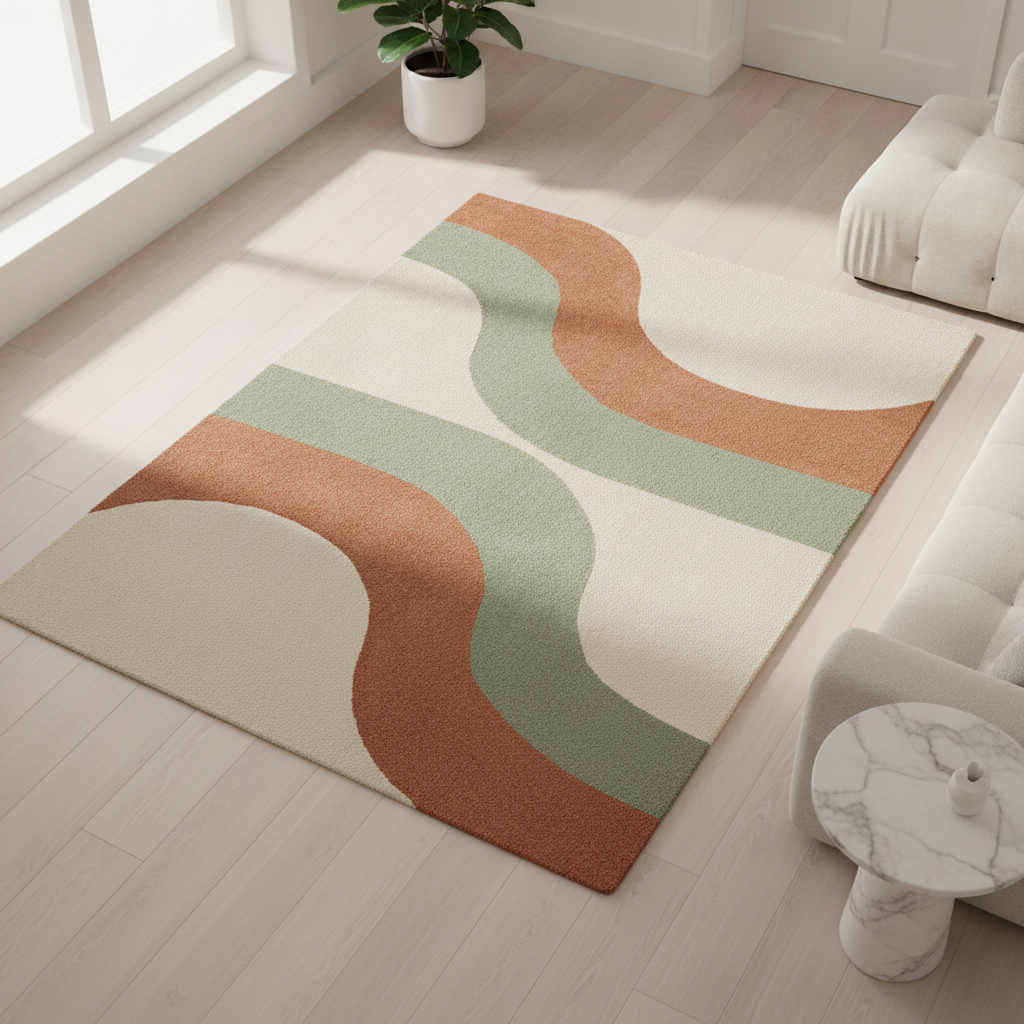
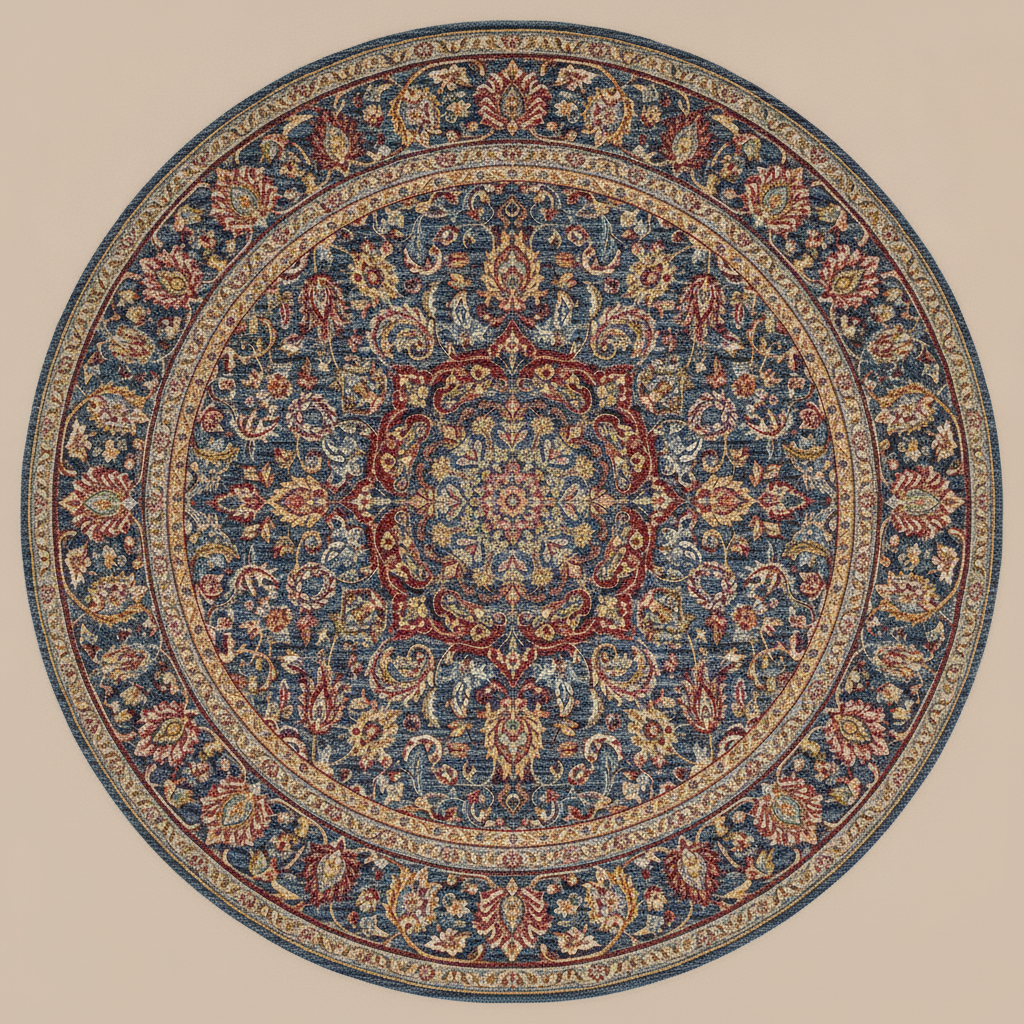
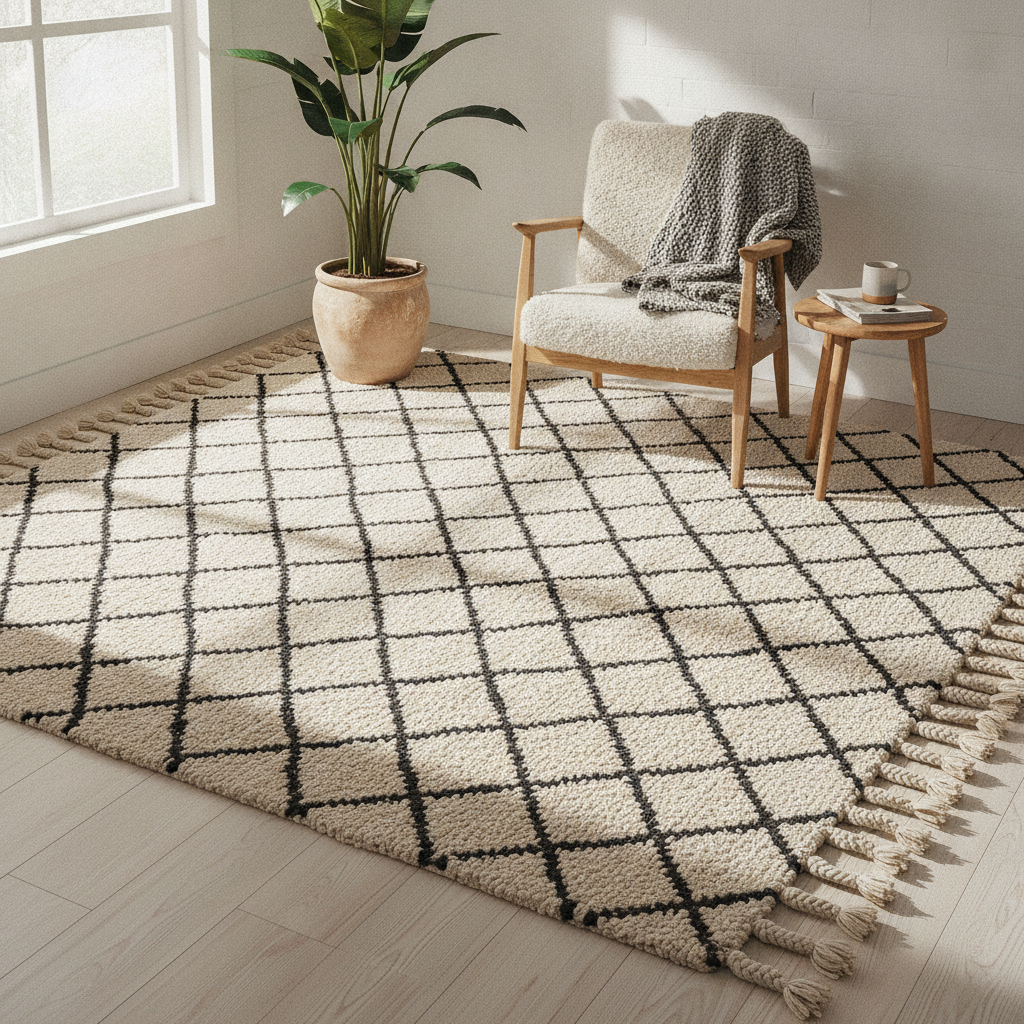
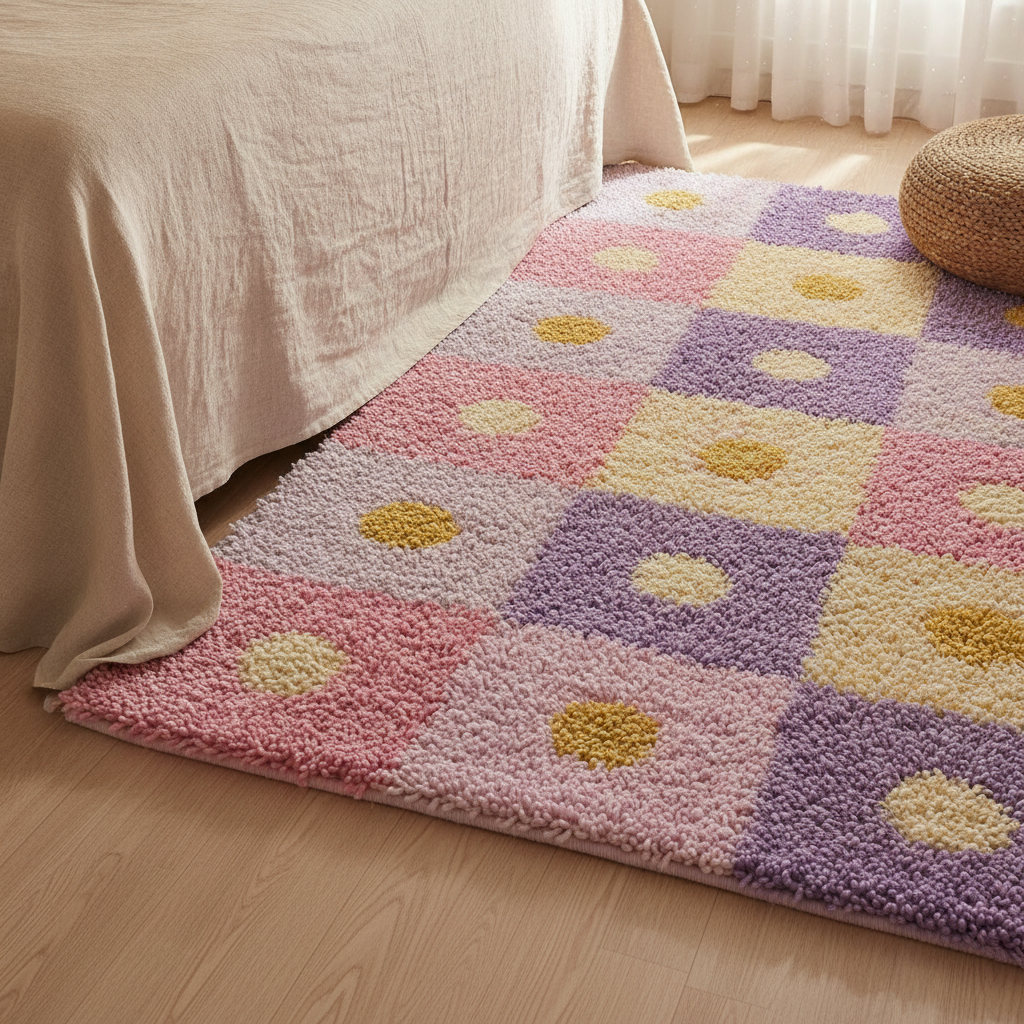
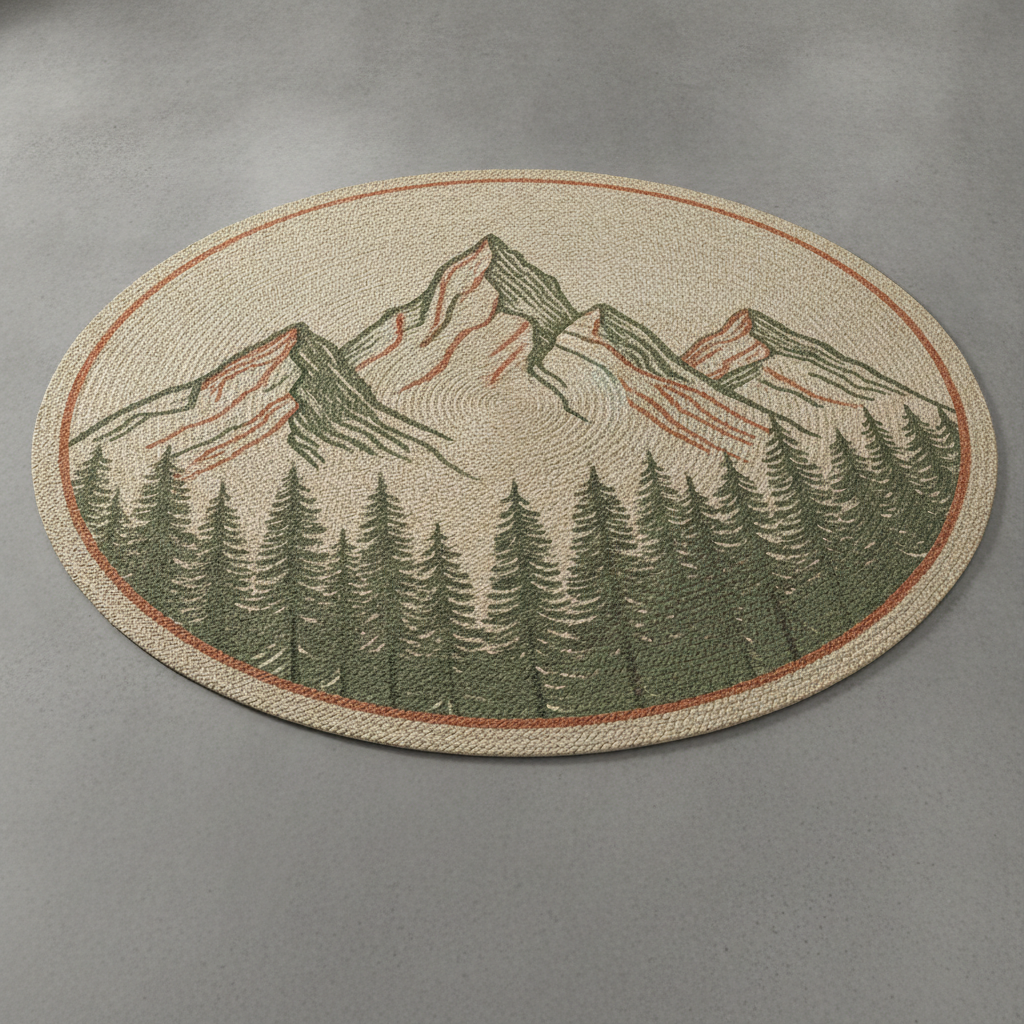
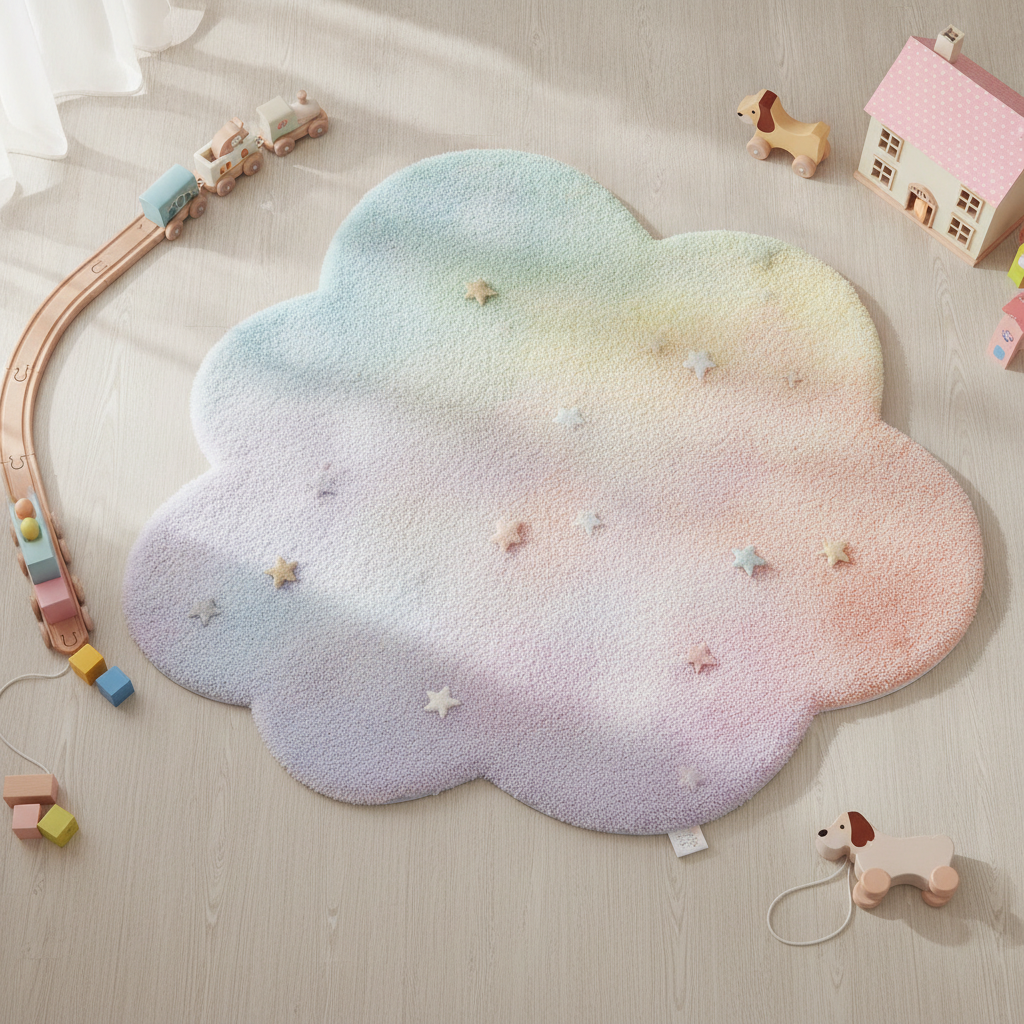
Modern abstract, Persian medallion, Scandi geometric, tufted shag, natural fibre and a kids playroom rug — the six formats that cover almost every area rug anybody actually buys
How the AI Rug Design Generator Works
Three steps from an idea to artwork a tufter, a weaver or a printer can work from
Pick the Construction, Because It Decides the Artwork
A rug is not one product, and the four ways of making one accept completely different designs. A tufted rug is punched by hand with a gun, so it wants large closed shapes with thick outlines and flat fills — nothing finer than the yarn itself, which in practice means no detail under about a centimetre. A flatweave or kilim is built from coloured yarn on a loom, so it can only give you hard edges, stepped diagonals and a handful of colours, and it physically cannot do a smooth curve or a gradient. A hand knotted rug is the one that holds fine detail, which is why Persian medallions and dense floral fields evolved there. A printed or chenille rug behaves like paper and takes full colour, photographs and soft shading, which is what almost every print-on-demand area rug on the market actually is. Choose the construction first and you stop designing watercolours for a loom that cannot weave one.
Describe the Motif, the Palette and the Room
Three things carry a rug design. Name one motif and its scale rather than a scene, because a rug is enormous and mostly seen in fragments — a repeat whose element is twenty or thirty centimetres across, or one large composition that fills the field, both work; a delicate little motif floating in the middle does not. Name four or five colours and stop, because yarn is dyed in lots and every extra colour costs money on a tufted or woven rug, and because a rug is the largest colour decision in a room and it has to answer to a sofa, a wall and a floor it did not choose. Then name the room and the floor, since that changes the result more than people expect: a rug on pale oak needs different contrast than one on dark walnut or grey concrete, and a design that looks striking in isolation can flatten completely once the floor around it is in frame.
Generate, Then Take It to a Maker
Each design arrives in about twenty seconds at up to 4K, shown on a real floor so you can judge scale, contrast and whether the pattern still works with furniture standing on it. Use it two ways. As a sample, it is the mockup you put in front of a client, a manufacturer or a customer poll before anyone commits to yarn. As a brief, it is what you hand to whoever makes it: a tufter needs a flat, high contrast design with closed shapes to project or trace onto the backing cloth, a mill wants a flat artwork file at the finished rug proportions with the colour count stated, and a print-on-demand service wants a flat file sized to each of their rug templates. Ask for the flat artwork on a plain background rather than the photographed floor when you need the working file, and remember to restate your rug proportions, because these presets generate square.
Why Use an AI Rug Design Generator
Six things that decide whether a rug design survives furniture, daylight, dirt and the machine that has to make it
Furniture Covers a Third of Your Design
A rug is the only textile in a house that gets furniture parked on top of it. In a standard living room layout the sofa sits on the top edge, a coffee table lands squarely in the centre and two chairs take the corners, which means the parts of the design a buyer sees are the borders and the field between the seating — not the middle. This is exactly backwards from how most people design one, because a centred medallion looks magnificent as a flat file and then spends its life under a table. Traditional rug design solved this centuries ago with a strong border and a field that stays interesting all the way to the edge, which is why old Persian layouts still work in modern rooms. The practical version: decide the furniture layout before the artwork, keep the strongest colour and the clearest shapes in the outer third, and never let one small central motif carry the whole design.
Scale Is the Decision People Get Wrong
Rugs are far bigger than the screen you design them on and the mismatch catches almost everyone. A standard living room rug is 5 by 8 feet — about 152 by 244 centimetres — and the large sizes run to 9 by 12 feet, so a motif that looks nicely detailed in a browser window arrives the size of a dinner plate, and a fine texture that reads as subtle on screen becomes invisible underfoot. Work the other way round: pick either one composition that fills the whole field, or a repeat whose individual element is at least twenty to thirty centimetres across, and check it against a piece of furniture rather than against the frame. Generating the design already lying on a floor with a chair and a plant beside it is precisely what makes that judgement possible in seconds instead of after a sample.
Rugs Are Rectangles, Not Squares
Almost every area rug sold is a rectangle in a small set of standard proportions — 3 by 5, 5 by 8, 8 by 10 and 9 by 12 feet — plus runners at roughly 2.5 by 8 for a hallway and rounds at four to eight feet across. That matters because a design generated as a square does not survive being stretched into a 5 by 8: a circular medallion turns into an oval, an even lattice turns into a squashed one, and a border that was equal on four sides ends up thick at the ends and thin at the sides. Treat what you get here as the motif, the density and the colourway, then rebuild it at the real proportions before anything is made — or ask for the design at your target aspect ratio directly in the details box. Borders in particular need laying out at the finished shape, since they are the element that most visibly reveals a stretched file.
Every Construction Has a Different Colour Rule
Colour behaves differently on each rug type and getting it wrong costs a sample round. Hand tufting and weaving both work from dyed yarn, so every colour is a separate cone with its own dye lot and its own cost — five to eight colours is a comfortable working range and thirty is a conversation you do not want to have with a workshop. Neither can produce a gradient in the way a screen does; the closest they get is a blend of two yarns, and a flatweave cannot even do that cleanly. Printed and chenille rugs are the opposite and will happily take photographic colour and soft shading, at the price of looking printed rather than made. Wool also takes dye differently from a backlit screen, so expect everything to land slightly warmer and a shade deeper than it looks here. Match the design to the process at the start and skip the round where the maker explains what you cannot have.
A Floor Gets Walked On, and It Shows
A rug is the only piece of decor in the room with a maintenance problem built into its design, and this is where a beautiful file meets an unhappy customer. A pale solid ground shows every footprint, crumb and paw print, especially in a hallway or under a dining table where chairs drag across it constantly. Mid-tone, multi-coloured and patterned designs hide soil almost completely, which is not a coincidence — it is a large part of why traditional rugs are patterned edge to edge and why hospitality carpet is never plain. Pile height plays the same game: high shag looks luxurious and traps everything, low pile survives traffic and vacuums properly, and a flatweave is the one that goes under a dining table. Design for the room the rug will live in. A pale minimal rug is right for a bedroom and a bad recommendation for a family hallway.
Free to Start, $9.98 to Go Further
You can generate rug designs free without a credit card, which is enough to find out whether a motif holds up at floor scale before you pay for yarn, a sample or a workshop’s time. Paid plans start at $9.98 for real work: testing one design in six colourways to match a client’s room, building a collection that shares a palette across several sizes, or the repeated passes it takes to get the scale of a repeat right for a 5 by 8. Output reaches 4K without a watermark and is cleared for commercial use, which is what matters once designs are going to a manufacturer or onto stock you have paid for. Against a custom rug design costing several hundred and a sample taking weeks, seeing twelve directions on a real floor before choosing one usually changes which rug gets made.
Frequently Asked Questions
Common questions about using an AI rug design generator
Design the Floor in Twenty Seconds
Pick a style, describe your motif and colours, and see it laid on a real floor at up to 4K — modern abstract, Persian medallion, Scandi geometric, tufted shag, natural fibre or a kids playroom rug. Powered by Nano Banana Pro. Free to start, plans from $9.98.
Two and a Half Metres of Pattern: the AI Rug Design Generator
Designing a rug used to start with the most expensive step. You briefed a designer or a workshop, waited weeks, paid several hundred for the drawing and then paid again for a sample corner — and only when it arrived did you find out that the motif was too small to read across a room, or that the palette argued with the floor it was meant to sit on. An AI rug design generator inverts that order. You describe the construction, the motif and the palette, and the design arrives on a photographed floor in about twenty seconds, which makes the deciding cheap and leaves only the making expensive. On a product where yarn is bought by the kilo and a sample takes weeks, trying a dozen directions before choosing one is worth far more than it costs.
The six presets exist because the construction dictates the artwork. Hand tufting punches yarn through a backing cloth, so it needs large closed shapes with thick outlines and nothing finer than the yarn. A flatweave builds the pattern from coloured yarn on a loom, so it gives hard edges, stepped diagonals and a handful of colours with no curves at all. Hand knotting is the construction that holds fine detail, which is why Persian medallions and dense floral fields grew up there. Natural fibre rugs lead with texture and want very little pattern. A kids rug wants soft rounded shapes and a forgiving mid-tone palette. And printed area rugs — the bulk of what print-on-demand actually sells — will take anything a screen can show.
Two habits improve nearly every rug design. Plan around the furniture, because a sofa and a coffee table will cover the centre of the field and leave the borders doing the work. And commit to a scale — one composition that fills the field, or a repeat whose element is twenty or thirty centimetres across — since the small motif floating in the middle of two and a half metres is the one that reads as an accident. Construction, motif, palette: three decisions, and the maker does the rest.
What the AI Rug Design Generator Will Not Do
It will not make a rug, and it will not produce a factory-ready file. What you get is artwork shown on a floor, which is what you need for judging scale, contrast and placement and for a listing photo while you test demand — but a mill wants flat artwork at the finished rug proportions with a stated colour count, a tufter wants a clean high contrast design to project onto backing cloth, and preparing those is a separate step. Generate the design you like, run it again asking for the flat artwork on a plain background, then clean it up with the AI background remover and enlarge it with the 4K image upscaler so the detail survives being scaled up to nine feet.
It will not guarantee the finished rug either, because yarn is not pixels. Wool takes dye warmer and deeper than a backlit screen suggests, pile height blurs any detail below about a centimetre, a woven version of a design always steps its diagonals, and every rug looks different once daylight rakes across the pile in one direction — so always approve a physical sample before a production run. For neighbouring jobs there are better fits: the AI pattern generator is the place to work on a repeat itself, the AI pillow design generator carries the same palette onto the cushions above it, the AI wall art generator extends the motif to the print on the wall, the AI interior design generator and the AI living room design generator show the whole room the rug has to live in, and the AI mockup generator places a finished design into styled shop photography. For any lettering, text in images explains what type the model can reliably set.
Within those limits the work is yours to use. Output reaches 4K with no watermark and is cleared for commercial use, which covers Etsy and Shopify listings, print-on-demand shops, tufting commissions, homeware lines, hotel and interior projects and client jobs alike. Keep other people's property out of it — licensed characters, club crests and the style of a specific named living artist — because rugs attract exactly those requests. Check the AI policy of whichever marketplace you sell through, and know that in the United States purely AI-generated images are not registrable for copyright, so selling the rug is fine but stopping an imitator may not be. It is free to start with no credit card and plans begin at $9.98. Pick a construction, name your motif, and see the floor before you buy the yarn.
Try the AI rug design generator free today. Pick one of six rug design styles, describe your motif and colours, and see it on a real floor at up to 4K. No credit card required to start. Paid plans from $9.98.