
AI Shower Curtain Design Generator
A shower curtain is the largest single piece of pattern most bathrooms will ever hold — roughly six feet by six feet of fabric, hung a metre from the person looking at it, in a room too small to step back in. It is also the only textile in the house that hangs in permanent vertical folds, gets wet twice a day and is judged from the doorway before anything else in the room. This AI shower curtain design generator builds artwork around those constraints and shows it hanging on a real product mockup in about twenty seconds, at up to 4K, in six styles: botanical jungle, coastal ocean, boho mudcloth, modern minimal, kids print and art deco luxe. Pick a style, describe your motif and palette, and see the curtain before you order a sample.
Try It Now — Free
Pick the curtain style first, then use the details box for your motif, your palette and the bathroom it has to live in. Every preset already carries what a hanging curtain cares about — a pattern that still reads through vertical gathers, a ground colour that hides hard water and mildew at the hem, and a scale built for seventy-one by seventy-four inches rather than a phone screen.
AI Shower Curtain Design Generator
Pick a curtain style, describe your motif and colours, and see it hanging on a real product mockup
Curtains From the AI Shower Curtain Design Generator
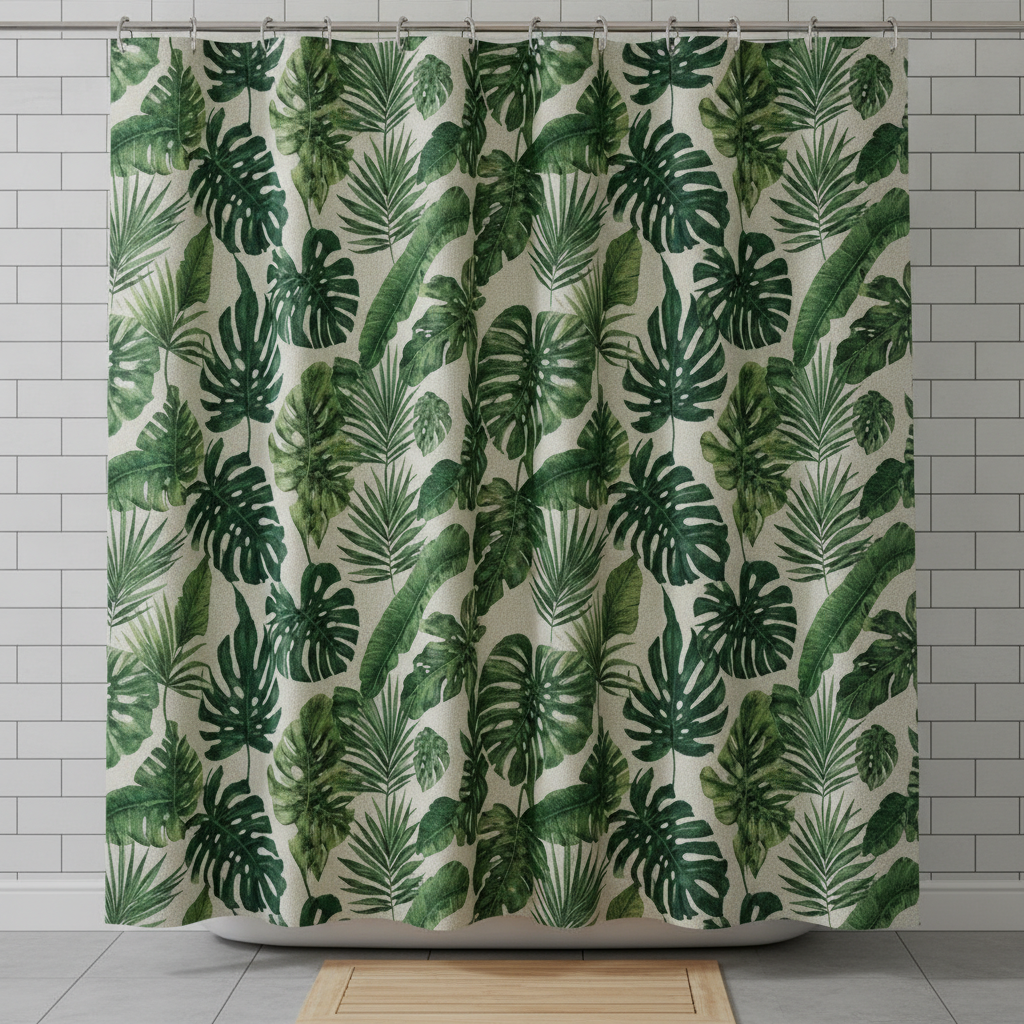
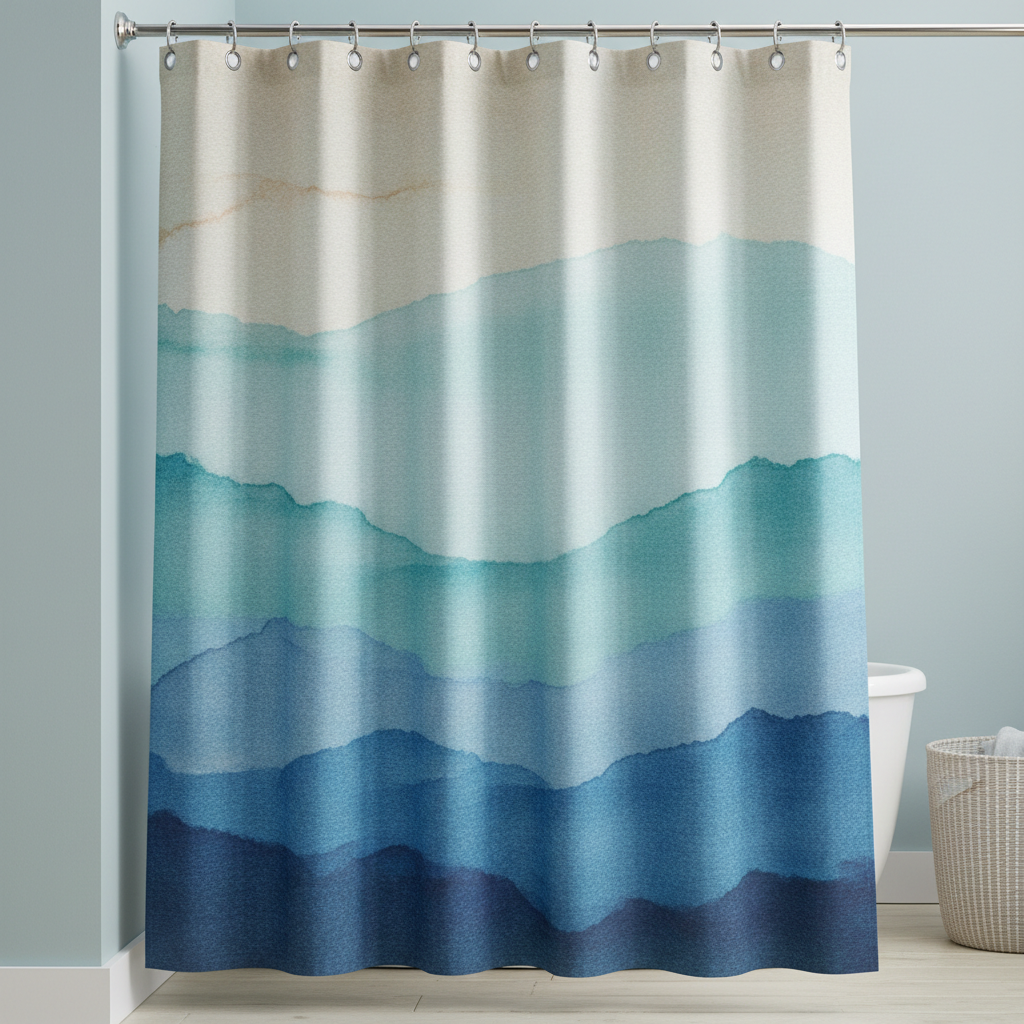
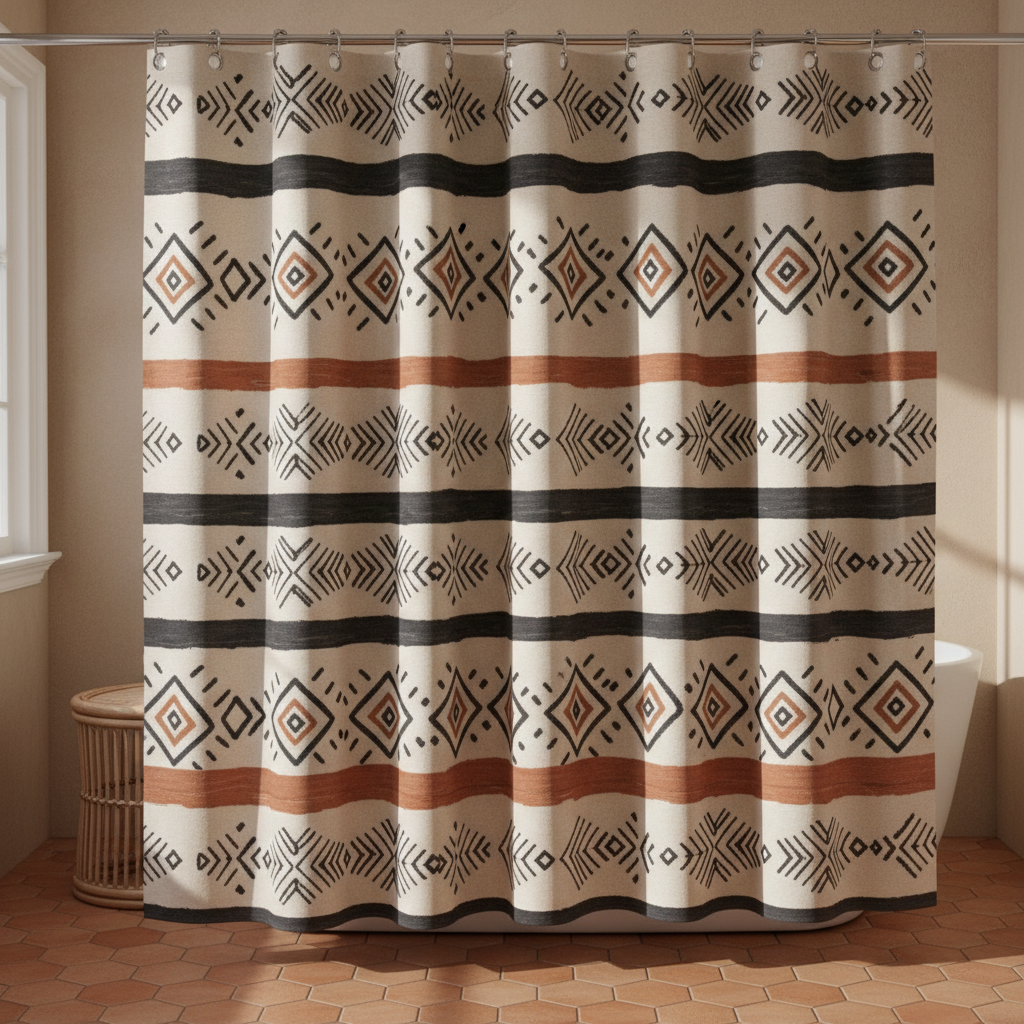
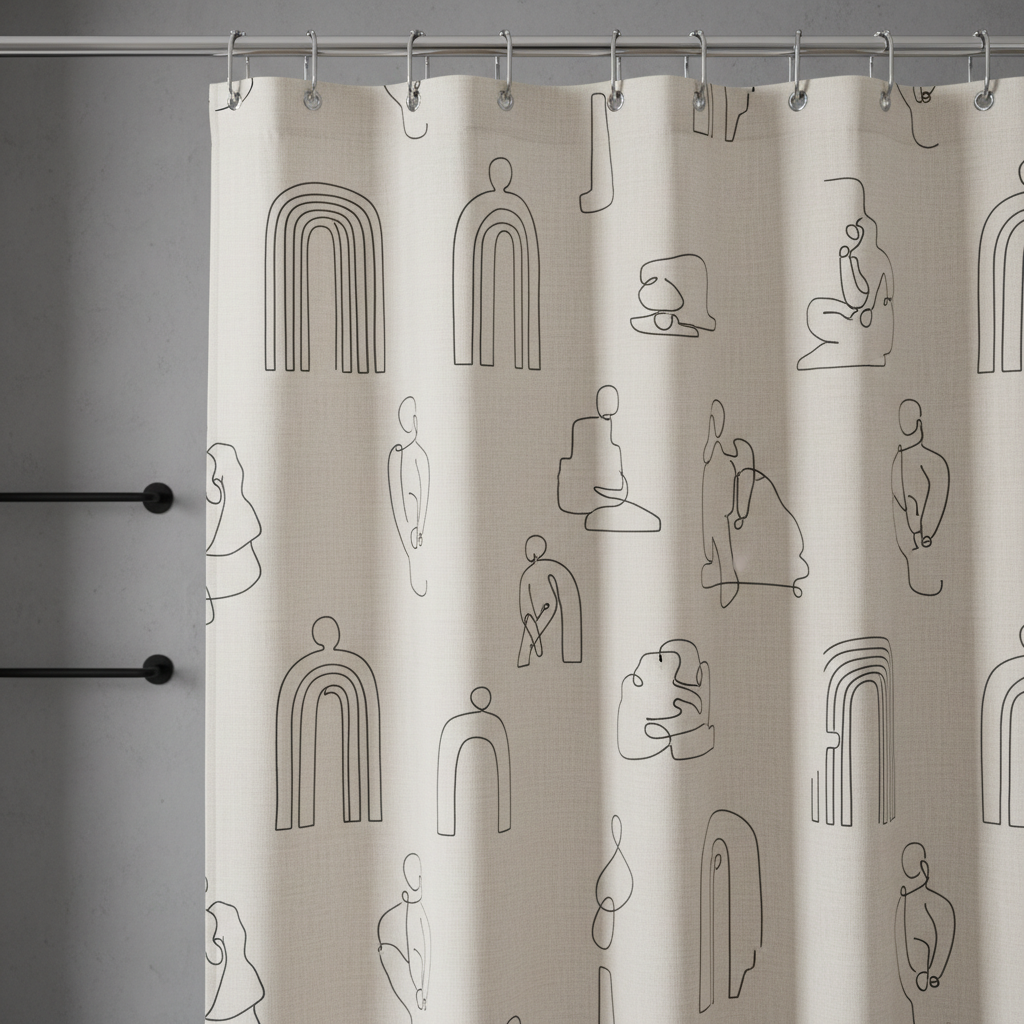
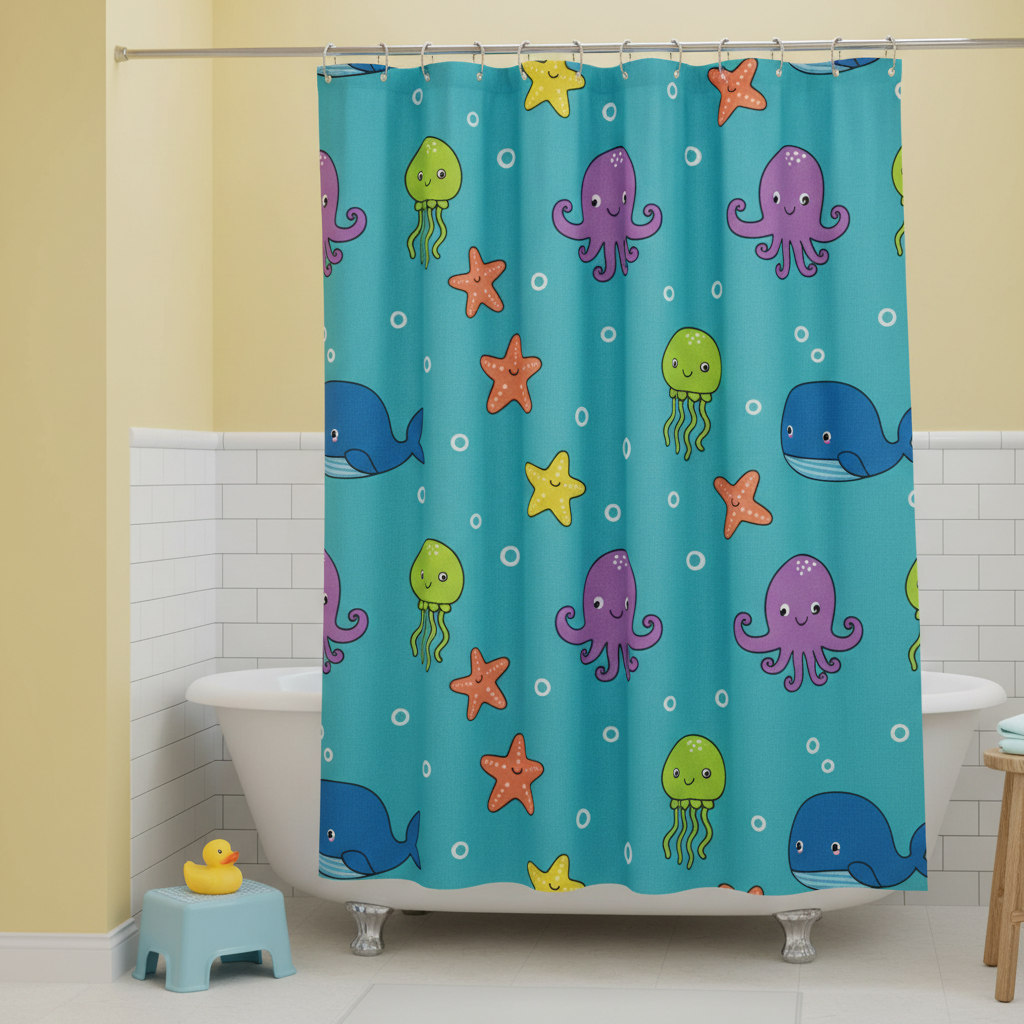
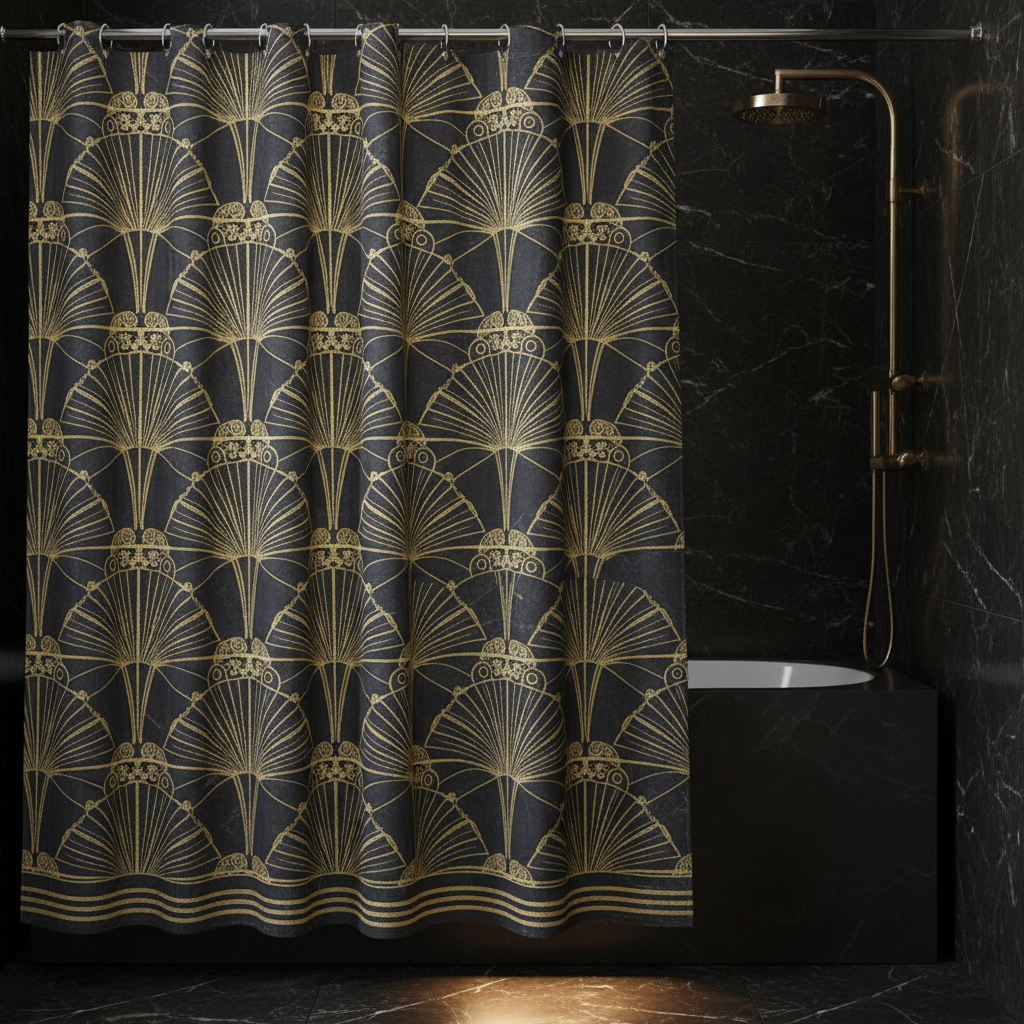
Botanical jungle, coastal ocean, boho mudcloth, modern minimal, kids print and art deco luxe — the six directions that cover almost every shower curtain anybody actually buys
How the AI Shower Curtain Design Generator Works
Three steps from an idea to artwork a print-on-demand supplier can work from
Start With the Room, Not the Motif
A shower curtain is not decor that sits inside a scheme — in most bathrooms it is the scheme, because it is the only large soft surface in a room otherwise made of tile, glass and white porcelain. That inverts the usual order of decisions. Look at what is already fixed and cannot change: the tile colour, the vanity, the floor, whether there is a window, and how far back a person can actually stand. A small windowless bathroom is punished by a dark saturated ground, which closes the room in and makes the curtain read as a wall; a large bright bathroom can carry one. White subway tile takes almost anything, patterned floor tile is already competing and wants a quieter curtain, and a bathroom with brass or black fittings has a metal colour that the artwork either flatters or fights. Name those constraints in the details box and the design comes back suited to a real room rather than to a mockup.
Describe the Motif, the Palette and the Scale
Three things carry a curtain design. Name one motif and its scale rather than a scene, because the curtain hangs in permanent vertical folds and roughly a third of the printed width is hidden inside them at any moment — a tossed all-over repeat whose element is the size of two hands survives that, while a single centred illustration gets folded in half the first time somebody pulls the curtain across. Name four or five colours and stop, since a tight palette is what makes a bathroom look styled rather than busy, and pick the ground colour with the hem in mind because that is the part that gets splashed. Then say where the curtain lives and who uses it: a guest bathroom can be bold because nobody sees it daily, a family bathroom needs a mid-tone that hides toothpaste and hard water, and a rental wants something that suits a tile colour you are not allowed to change.
Generate, Then Take It to a Supplier
Each design arrives in about twenty seconds at up to 4K, shown hanging on a real product mockup so you can judge scale, contrast and whether the pattern still works through the gathers rather than only flat. Use it two ways. As a sample, it is the mockup you put in front of a client, a supplier or a customer poll before anybody commits to a print run. As a brief, it is what you hand to whoever makes it: a print-on-demand service wants a flat artwork file sized to its exact shower curtain template at 150 DPI or better, with the top few inches kept clear of anything critical because the grommet row and the rod sit there. Ask for the flat artwork on a plain background rather than the photographed curtain when you need the working file, and restate your finished proportions, because these presets generate square and a shower curtain is not.
Why Use an AI Shower Curtain Design Generator
Six things that decide whether a curtain design survives the folds, the damp and the machine that has to print it
It Hangs in Folds, and the Folds Eat the Design
Almost every other printed textile is judged flat — a tea towel on a rail, a rug on a floor, a poster on a wall. A shower curtain never is. It hangs from twelve rings in permanent vertical gathers, and depending on how wide the rod is, somewhere between a quarter and a third of the printed width is folded away from the viewer at any moment. That single fact kills more curtain designs than any other. A large centred illustration is stunning as a flat file and gets creased down the middle the first time the curtain is drawn. A tightly spaced fine pattern turns into visual noise because the folds compress it further. Wide horizontal bands survive well since they simply narrow; strong vertical elements survive best of all, because the folds run the same direction. The reliable answer is an all-over tossed repeat with an element large enough to stay recognisable when half of it is hidden — and the only way to be sure is to look at the design hanging rather than flat, which is exactly what this tool shows you.
Six Feet of Fabric Is Bigger Than You Think
A standard shower curtain is 71 by 74 inches — about 180 by 188 centimetres — with stall sizes around 54 by 78 and extra-long versions running to 72 by 96. That is comfortably the largest single printed surface in a normal bathroom, and it is viewed from three or four feet away in a room where nobody can step back further. The mismatch with the screen you design on catches almost everyone: a motif that looks nicely detailed in a browser window arrives the size of a dinner plate, and a delicate texture that reads as subtle on a monitor becomes an insistent pattern across six feet of polyester that you then have to look at every morning. Work from the room backwards. Pick either a repeat whose element is roughly the size of two hands, or a bold structure — bands, a gradient, a few large motifs — that organises the whole panel, then check it hanging at a distance rather than zoomed in.
The Top Three Inches Belong to the Grommets
Every fabric shower curtain has a reinforced header at the top with twelve grommets or buttonholes punched through it, spaced roughly every six inches, and that band is not design space. The metal rings sit in it, the rod sits above it, and on many bathrooms the whole header is partly hidden by the rod or by a valance. Anything you place there — the top of an arch, the crown of a tree, a name — gets punched through, covered, or cropped. Suppliers publish a safe area for exactly this reason and it is the first thing they reject files over. The bottom hem has the opposite problem: it is the part that touches the tub, collects splash and gets tugged, so it is where a pale ground shows every mark. Design the panel as a middle with two sacrificial ends. Keep critical detail out of the top few inches, let the pattern run off the bottom edge rather than resolving into a border that will sit behind a bath mat, and nothing important ends up where the hardware is.
Polyester and Sublimation Set the Colour Rules
Nearly every custom fabric shower curtain in print-on-demand is 100% polyester printed by dye sublimation, and that process has firm rules worth knowing before you design rather than after. It is generous with photographic colour, smooth gradients and fine detail, and because the dye becomes part of the fibre the print will not crack, peel or wash off — which is why sublimated curtains hold up in a wet room for years. But it cannot print white: anywhere your design is white, what you are seeing is the fabric itself, so a design built on a bright white ground is fine and a design that needs white ink over a dark ground is not possible. It prints one side only, so the back of the curtain is plain white and the pattern will not show from the far side. And sublimation colours dry a touch duller and slightly darker than they look on a backlit screen, so a design that is already dark loses more than you expect. Design to the process and you skip the round where the supplier explains what you cannot have.
It Is the Only Textile That Lives in a Wet Room
A shower curtain gets splashed twice a day, dries slowly in a humid room and hangs there for years, which changes what a good design is in ways that have nothing to do with taste. Mildew forms at the bottom hem where water sits, hard water leaves pale mineral spotting, and both are far more visible on a plain light ground than on a mid-tone or a busy pattern — which is a large part of why traditional shower curtains are patterned edge to edge rather than minimal. It is worth knowing that a printed fabric curtain is water-resistant, not waterproof, so most setups hang a clear plastic liner behind it; that liner takes the direct spray and it also sits behind your artwork, very slightly lightening everything, which is another reason not to design at the pale end of your palette. And curtains get washed. Sublimated polyester survives a cool machine wash indefinitely, but the fabric creases, so a hard geometric grid will show wrinkle lines that an organic pattern hides completely.
Free to Start, $9.98 to Go Further
You can generate shower curtain designs free without a credit card, which is enough to find out whether a motif holds up at curtain scale and against your own tile before you pay for a sample or a designer’s time. Paid plans start at $9.98 for real work: testing one design in six colourways against a fixed tile colour, building a coordinated bathroom set where the curtain, the mat and the towels share a palette, or the repeated passes it takes to get the scale of a repeat right for seventy-one by seventy-four inches. Output reaches 4K without a watermark and is cleared for commercial use, which is what matters once designs are going to a print-on-demand supplier or onto stock you have paid for. Against a custom curtain sample costing thirty to fifty dollars and taking a week or two to arrive, seeing twelve directions hanging in a bathroom before choosing one usually changes which curtain gets made.
Frequently Asked Questions
Common questions about using an AI shower curtain design generator
Design the Curtain in Twenty Seconds
Pick a style, describe your motif and colours, and see it hanging on a real curtain mockup at up to 4K — botanical jungle, coastal ocean, boho mudcloth, modern minimal, kids print or art deco luxe. Powered by Nano Banana Pro. Free to start, plans from $9.98.
Six Feet of Pattern in a Small Room: the AI Shower Curtain Design Generator
Designing a shower curtain used to start with the most expensive step. You picked something from a supplier’s catalogue or briefed a designer, ordered a sample, waited a week or two and paid for the privilege — and only when the parcel arrived and the curtain was on the rod did you find out that the motif was too small to read from the doorway, or that the ground colour argued with tile you are not allowed to replace. An AI shower curtain design generator inverts that order. You describe the room, the motif and the palette, and the design arrives hanging on a photographed curtain in about twenty seconds, which makes the deciding cheap and leaves only the making expensive. On a product where a single sample costs thirty to fifty dollars and takes a week, trying a dozen directions before choosing one is worth far more than it costs.
The six presets exist because a curtain is a different design problem from every other printed textile. It is one large panel rather than a repeating product, so unlike a blanket or a cushion it can carry a composition that runs from top to bottom — the coastal gradient is exactly that, and it is a design you could not do on a rug. But it hangs in permanent vertical folds, which is why an all-over tossed botanical and a chunky kids print behave so well and a delicate centred illustration does not. It is printed by dye sublimation on one side of a polyester panel, which gives you photographic colour and gradients but no white ink and a plain white back. And it lives in a humid room with a plastic liner behind it and a hem that collects mildew, which quietly rules out the palest, most minimal thing you were probably about to make.
Two habits improve nearly every shower curtain design. Design for the folds, because a curtain is never seen flat and a pattern that carries across the whole panel will always beat one composition placed in the middle. And commit to a scale that suits the viewing distance — a repeat whose element is about the size of two hands, or a bold structure that organises all seventy-one by seventy-four inches — since the delicate motif floating in the middle of six feet of polyester is the one that reads as an accident. Room, motif, palette: three decisions, and the supplier does the rest.
What the AI Shower Curtain Design Generator Will Not Do
It will not make a curtain, and it will not produce a production-ready file. What you get is artwork shown hanging on a real curtain, which is what you need for judging scale, contrast and the folds and for a listing photo while you test demand — but a print-on-demand supplier wants a flat file at its exact template dimensions with the grommet header kept clear, and preparing that is a separate step. Generate the design you like, run it again asking for the flat artwork on a plain background, then clean it up with the AI background remover and enlarge it with the 4K image upscaler so the detail survives being scaled up to six feet.
It will not guarantee the finished curtain either, because polyester is not pixels. Sublimation ink dries slightly duller and darker than a backlit screen suggests, the process cannot print white at all, the back of the panel stays plain, and the gathers will always hide part of your pattern — so approve a physical sample before a production run. For neighbouring jobs there are better fits: the AI pattern generator is the place to work on a seamless repeat itself, the AI bathroom design generator shows the room the curtain has to live in before you choose a palette, the AI rug design generator and the AI blanket design generator carry the same palette onto the bath mat and the rest of the house, the AI tote bag design generator takes the motif onto a different print-on-demand product, and the AI mockup generator places a finished design into styled shop photography. For any lettering, text in images explains what type the model can reliably set.
Within those limits the work is yours to use. Output reaches 4K with no watermark and is cleared for commercial use, which covers Etsy and Shopify listings, print-on-demand shops, homeware lines, hotel and holiday-let projects and client jobs alike. Keep other people's property out of it — licensed characters, team logos and the style of a specific named living artist — because bathroom decor attracts exactly those requests. Check the AI policy of whichever marketplace you sell through, and know that in the United States purely AI-generated images are not registrable for copyright, so selling the curtain is fine but stopping an imitator may not be. It is free to start with no credit card and plans begin at $9.98. Pick a style, name your motif, and see the curtain hanging before you order the sample.
Try the AI shower curtain design generator free today. Pick one of six shower curtain design styles, describe your motif and colours, and see it hanging on a real product mockup at up to 4K. No credit card required to start. Paid plans from $9.98.