
AI Wreath Design Generator
A wreath is a ring of botanical material bound onto a base, hung on a door where the weather gets at it. This AI wreath design generator settles the part a picture can settle — material, palette, coverage and how the ring reads on a door — and is straight with you about the diameter, the binding and the lifespan it quietly leaves out.
Start Designing FreeTry the AI Wreath Design Generator — Free
Pick the material first, then name the palette, the coverage and the door behind it. Every preset is written as wreath product photography rather than seasonal illustration, and every preset refuses monograms, house numbers and door plaques, because lettering is where this model breaks and a door is where lettering turns up.
AI Wreath Design Generator
Pick a material, describe the palette and coverage, and get wreath product shots at up to 4K
Wreaths Designed With This AI Wreath Design Generator
These came from the presets above, flaws included, and the captions say what each one gets right and what it quietly invents. The fifth is not a finished wreath at all but a row of bare bases, because the base decides how the material attaches and it is the one part of a finished design you never get to see. It is also the frame that failed most instructively: five bases were asked for and four came back. Read the set for material, palette and coverage. Treat every binding point, every diameter and every hanging cord as a question for whoever is going to build it.
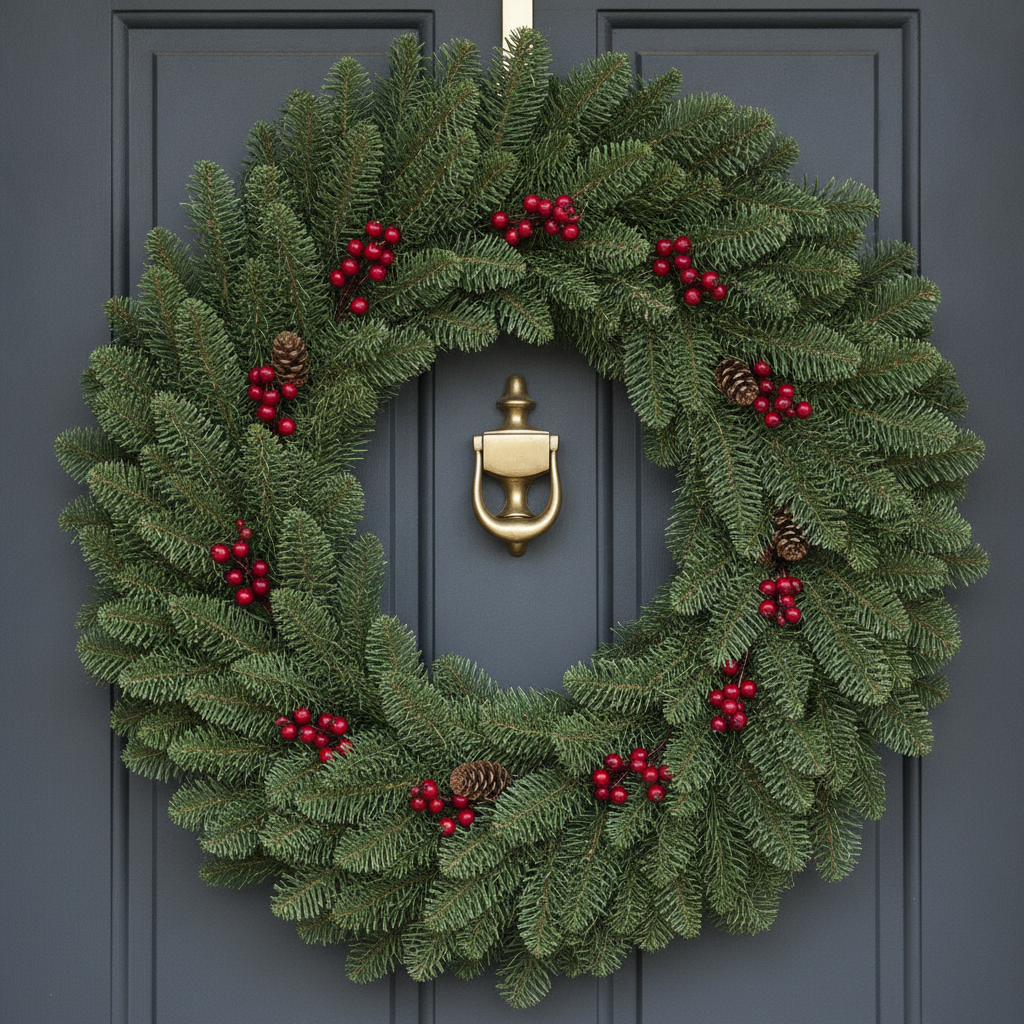
AI wreath design generator result: a dense fresh fir wreath with red berry clusters and small cones, hung on a panelled door above a brass knocker. The needles are the part that convinces, matte and slightly dusty with the bunches overlapping in one consistent direction the way a wired wreath is genuinely built, and the branch tips catching a little more light than the shaded interior of the ring. Two things came back other than as asked. The door was specified as matte charcoal and arrived slate blue, a colour substitution the model makes freely. And every berry cluster and every cone sits on top of the foliage with no wire, no pin and no glue anywhere, while the ivory hanging strap runs off the top of the frame attached to nothing you can see
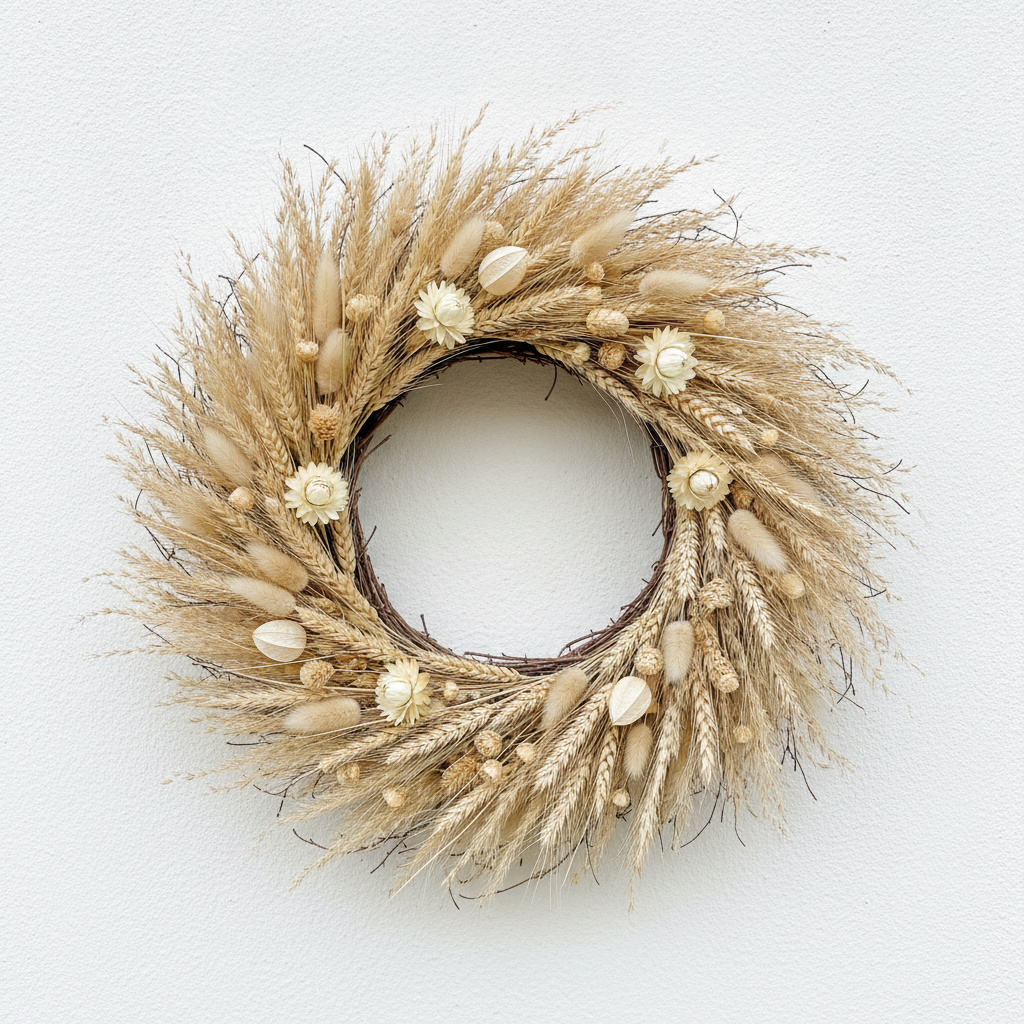
A dried everlasting wreath on a bare twig ring: bleached wheat, bunny tail grasses, papery cream strawflowers, plume grass and small seed heads in a sand and oatmeal palette. The material genuinely reads as dried rather than fresh, brittle and matte with the light passing through the thinnest petals, and the twig base stays deliberately visible around the inner edge instead of being buried. What is missing is any evidence that it is hanging. There is no loop, no wire and no hook, and the plaster wall behind carries no shadow at all, so what is presented as a wall piece is really a flat lay photographed from above
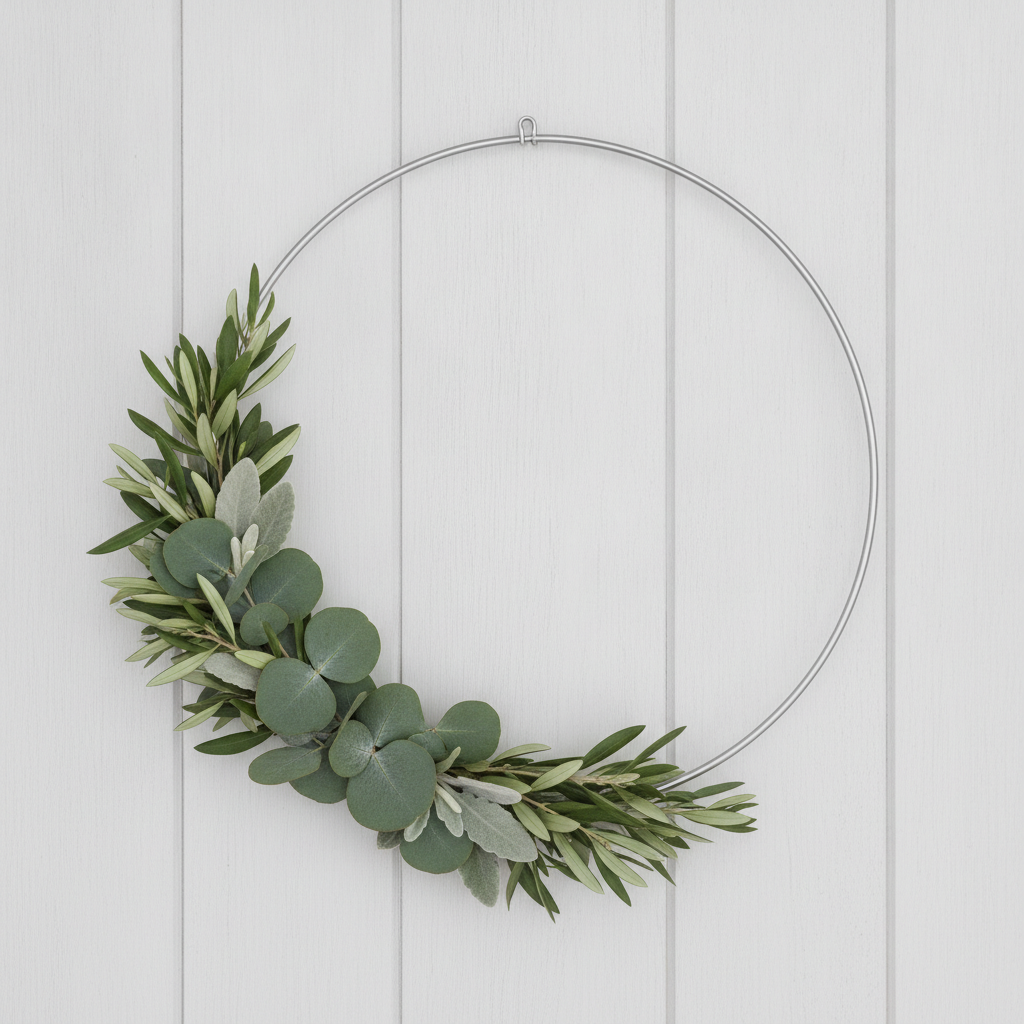
The asymmetric hoop, and the one preset where the composition instruction held exactly: foliage covers the lower left third and the rest of the ring is left bare, which is the opposite of what the model does when left alone. Eucalyptus, olive and lambs ear read correctly, and it even rendered a real fixing, a small hook screwed into the wall with the hoop hanging on it. Two specs were quietly swapped: the hoop was asked for in gold and came back chrome silver, and the pale oak door became white painted planks. Look at where the greenery meets the bare ring at either end, where the stems simply disappear behind the metal with no wire, tape or binding of any kind
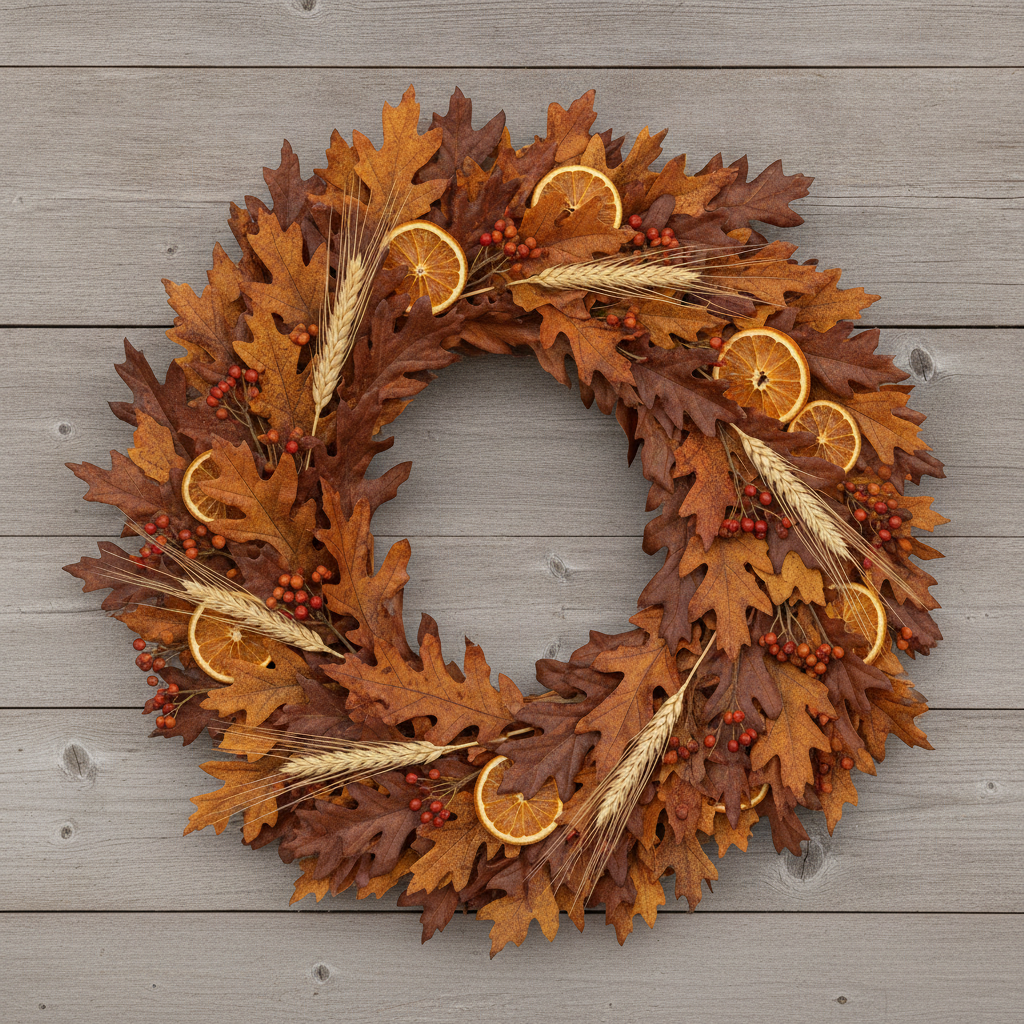
A preserved autumn wreath on weathered barn boards, and the best piece of construction on the page: the leaves are layered like scales in one continuous direction around the ring, which is how a real foliage wreath is actually built, and the inner opening is irregular rather than a perfect circle in the way handmade ones are. The preserved look is right too, leathery and matte with the light coming through the thinner leaves. The prompt asked for oak and maple and got oak only, the commoner of the two, which is the usual pattern when two species are named. The orange slices and berry clusters lie on the surface with nothing holding them, and there is no hanging point anywhere on the ring
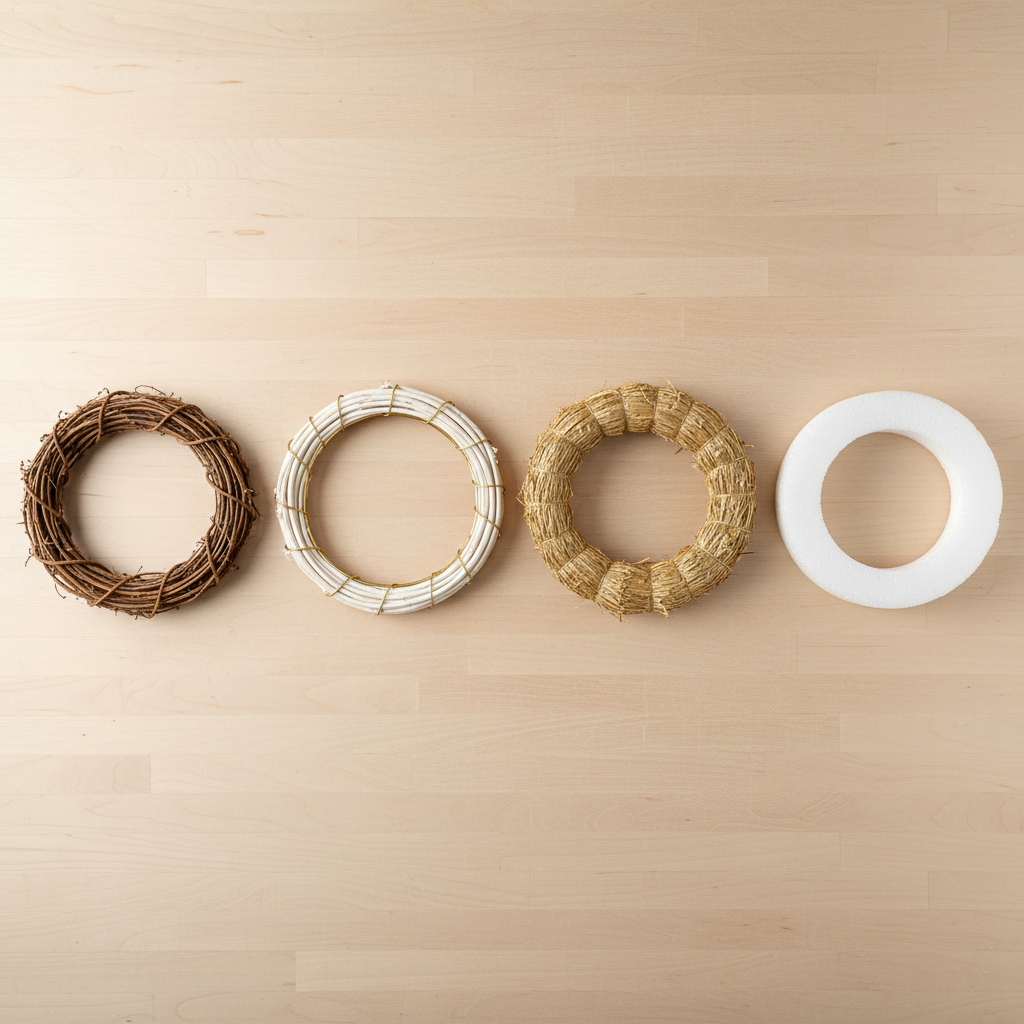
The comparison row, and the most useful failure on the page. Five bare bases were specified and four arrived: grapevine, straw and white foam are all correct, and the peeled willow ring and the bare metal wire ring have been fused into a single object, a white coiled ring bound at intervals with gold wire. So the rig did not drift a variable this time, it dropped an item and merged two others. The profiles also differ enough that the outer diameters are not the identical set that was asked for. Read it for what each base looks like and what it would take a stem, and count the objects in any comparison render rather than trusting the number in your prompt
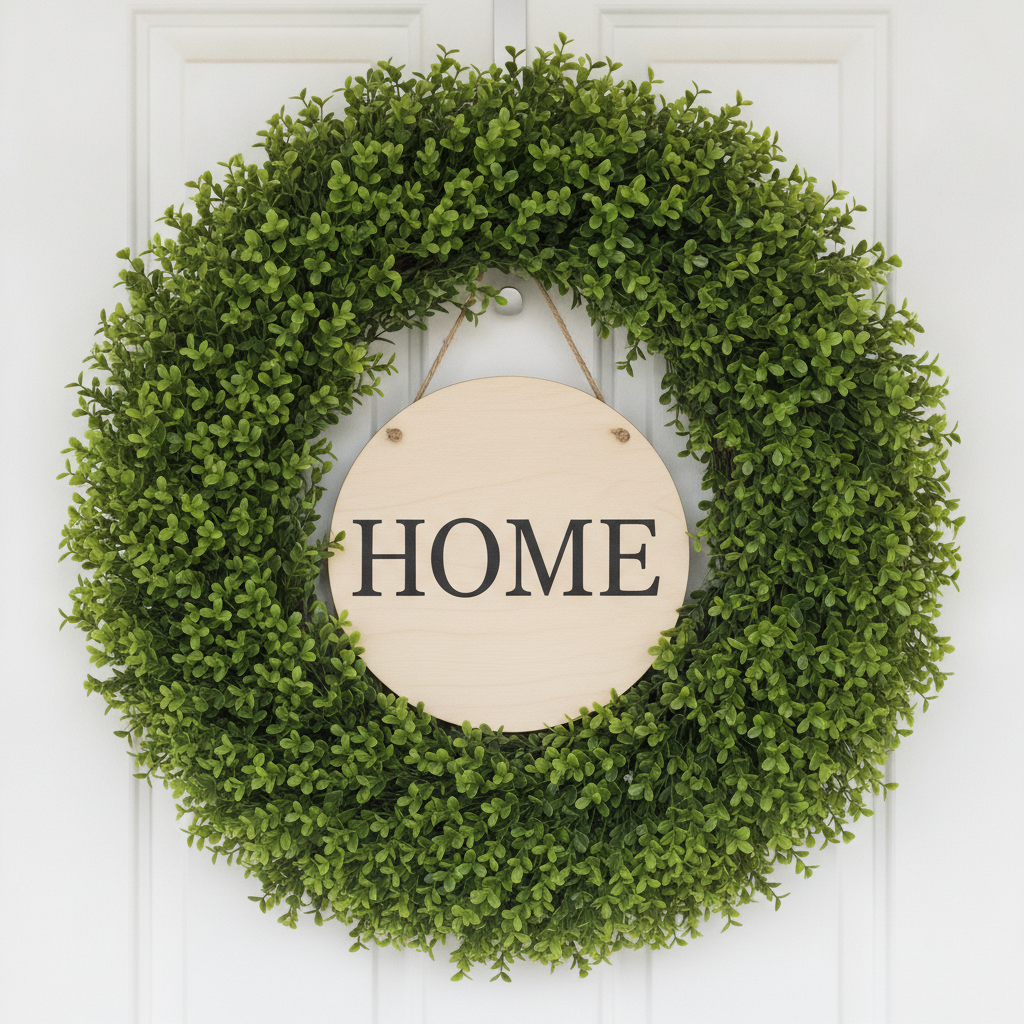
A clipped boxwood ring with a round wood sign in the centre reading HOME, spelled correctly on the first attempt. Four common capitals set large on a clear surface is the safe end of what this model does with type, and a surname, a street name or a house number is where it starts inventing letters. The sign is also built correctly, with the twine running through two drilled holes and over a small white hook screwed into the door. Now look at what that hook is carrying: the sign, and only the sign. The wreath around it hangs from nothing at all. The boxwood also reads as artificial rather than living, which is the honest reminder that a render cannot tell you whether a wreath lasts three weeks or five years
How the AI Wreath Design Generator Works
Pick the material
Fresh evergreen, dried everlasting, preserved foliage, faux stems or clipped boxwood. That one choice sets the palette, the season, the price, how the stems attach and how long the finished piece survives on an exposed door — far more of the design than the colour ever will.
Name the palette and the coverage
Say the colours, then say whether the ring is fully covered, three quarters covered or a crescent on one side with the base deliberately left bare. Coverage changes the character of a wreath more than any single stem does, and it is the instruction people forget to give.
Hand it over with the numbers attached
Concepts arrive in about twenty seconds at up to 4K. The render settles what the wreath looks like; you write down the three things it cannot hold — outer diameter, depth front to back and finished weight — and a maker turns the pair into a real piece.
What a Wreath Render Settles, and What It Hides
Six things decide whether a wreath design works on a real door, and an image carries about two of them. Knowing which two is the difference between a concept a florist can quote from and a beautiful picture of a ring that cannot be built or hung the way it appears.
Diameter is the whole product and it is invisible
Front door wreaths live between about forty five and sixty centimetres across, and the difference between the ends of that range is the difference between a smart door and a small dark spot seen from the street. A ring photographed alone on a plain door has nothing in frame to measure against, so it reads at whatever size you already had in mind. Fix the outer diameter as a number before anything else.
The base disappears and it decides everything
Grapevine, willow, wire, straw and foam are five different products with different weights, different ways of taking a stem and different costs. On a fully covered design you will never see the one you chose, so no render can tell you which is underneath. Choose it from how the material attaches and how heavy the finished ring will be, then write it down.
Surface is accurate, binding is invented
Needle texture, papery dried petals, the dusty bloom on eucalyptus and the leathery look of preserved oak all come back convincingly. What never appears is the paddle wire, the floral pins, the tape and the overlapping bunches that hold a real wreath together, and a rendered ribbon typically runs behind the ring and is tied to nothing. Believe the surfaces, question every fixing.
Lifespan is a choice no photograph shows
Fresh, dried, preserved and faux can all render as the same image and behave completely differently on a door. Fresh fir is glorious for a few weeks in cold air and sheds fast indoors. Dried fades in direct sun. Preserved foliage stays supple far longer and costs more. Good faux lasts years and gives itself away close up. Pick the lifespan in words, not from the picture.
Depth and door clearance are flattened
A wreath is a three dimensional object shot as a flat disc, so the one dimension a photograph destroys is the one that has to fit. If a storm door or screen door sits in front, the gap is often under five centimetres and a deep wreath will simply stop it closing. Specify a maximum depth front to back alongside the diameter.
Weather and weight never make it into the frame
A door faces whatever the sky is doing. Direct afternoon sun bleaches dried flowers, driving rain matts them, and a large fresh evergreen ring can weigh three or four kilograms while it is still full of water, which decides whether an over-door hook or a magnetic hanger will hold. All of that is decided long after the render and none of it is visible in one.
Monograms, House Numbers and What to Keep Off the Render
A front door attracts lettering more than almost any other surface in a home, and lettering is exactly where this model is weakest. Here is the boundary, drawn from what actually rendered on this page.
Safe to render
One short common word in large plain capitals. HOME on the boxwood design above is the pattern to copy, and HELLO, JOY and NOEL behave the same way. Four or five letters, set large, on one line, with nothing else competing for the same surface. If the word is everyday English and it fits on one line, the model will spell it.
Keep out of the render
Family surnames, unusual first names, house numbers, street names, dates and any four digit year. Digit sequences are the weakest case of all, which matters here because a house number is the single most requested piece of door personalisation there is. Long strings come back with letters doubled, dropped or invented.
Do it the way makers do it
Nobody builds a personalised wreath as one object. The ring is made, and the sign, plaque or monogram is cut, printed or engraved separately and attached last. Design the ring here, leave a clear space in the centre or at the base for the sign, and produce the lettering in a file where the spelling is under your control.
Symbols find their own way in
A ring of radiating natural material drifts toward emblems on its own, the way a symmetrical arrangement of triangles falls into a six pointed star. The presets here refuse crosses, halos, stars and flags by name, along with licensed characters and known decor brand styling, which is why nothing on this page carries one.
Why Use This AI Wreath Design Generator
Six builds, not six colourways
Fresh evergreen, dried everlasting, an asymmetric foliage hoop, preserved autumn leaves and clipped boxwood differ in season, price, technique and how long they last outdoors. Switching preset changes what the object is rather than what shade it happens to be.
A base comparison built into the presets
One preset renders the bases bare and side by side instead of another finished ring, which answers the question the category actually turns on: what is underneath, how the stems attach to it, and how much of the weight and cost it accounts for. It is also a standing reminder to count the objects in a comparison render rather than trusting the number you asked for.
Written as product photography
Every preset names a door or a wall, a camera angle and a described light, so concepts arrive looking like the listing photograph a seasonal product eventually needs rather than a festive illustration floating in a red gradient.
Door lettering refused item by item
Monograms, family names, house numbers, welcome plaques, hanging tags and price stickers are banned individually rather than with one blanket instruction, which is the difference between a clean design and a concept with invented letters across the front of it.
Consistent across a whole range
Nano Banana Pro holds a described palette across separate generations, so keeping one colour story and one base while changing only the material gives you a seasonal collection that reads as a single line rather than six unrelated wreaths.
Cheap enough to test the whole season
About twenty seconds per concept and plans from $2.99 means a florist can put six colourways in front of a customer, or test which one gets saved most, before buying a single box of stems. That is exactly where seasonal stock decisions usually go wrong.
AI Wreath Design Generator FAQ
Related Seasonal Design Tools
AI Christmas Ornament Generator
The nearest neighbour on the tree rather than the door. Same trade in materials, one object instead of a ring, and the same lesson about surfaces rendering true while fixings get invented.
AI Doormat Design Generator
The other half of a front entrance. A flat printed or woven mat that takes lettering deliberately, where this page is a three dimensional object made of botanical material.
AI Christmas Card Generator
The flat seasonal sibling. A printed card with a greeting laid out on it, useful when you want the wreath as artwork on a page rather than as an object hanging on a door.
Design Your Wreath Now
Six wreath builds, foliage that renders with the right texture, a comparison row that shows what is actually underneath, and 4K product shots in about twenty seconds. Free to start, from $2.99 for more.
Start Designing FreeAbout This AI Wreath Design Generator
An AI wreath design generator is genuinely useful on one part of the job and quietly misleading on the rest, so it is worth drawing the line before you start. Making a wreath is four decisions stacked on each other. The first is the base, which is really a decision about technique: a grapevine ring takes wire and glue anywhere along it and is handsome enough to leave exposed, a bare wire frame is what fresh evergreen gets clamped onto and vanishes completely under the foliage, a straw ring takes floral pins for dried work, and a foam ring comes in a wet version that holds water for fresh flowers and a dry version that must never see any. The second is the material, meaning fresh, dried, preserved or faux, which is simultaneously a decision about palette, price and how many weeks the finished piece survives on an exposed door. The third is dimension: outer diameter, depth front to back and finished weight, which between them decide whether the ring suits the door, whether a storm door can still close and which hanger will hold it. Only the fourth — material, palette, coverage and how the whole thing reads against a door — is something a photograph can settle, and it happens to be the part everybody argues about hardest and describes worst. That is what this tool does in about twenty seconds.
That is also why the six presets here are builds rather than colourways. A dense fresh fir ring, a dried everlasting wreath of wheat and strawflowers, a bare gold hoop with a crescent of eucalyptus on one side, a layered wall of preserved autumn oak and a tightly clipped boxwood ring are five genuinely different objects with different seasons, different costs and different lifespans. Recolouring one of them from green to plum is a much smaller decision than switching between them. Coverage is not a small decision either, and it is the instruction people most often forget to give: a fully covered ring is a traditional wreath, a three quarter covered ring reads as a modern florist piece, and a crescent on one side with three quarters of the base left deliberately bare is a completely different look that also uses a fraction of the material. Say which one you want in words, because if you do not, you will get a full ring every time. The comparison preset exists for the same reason: instead of another finished wreath it renders the bases bare and side by side, which is the one part of a real wreath you never get to see once it is built and the part that decides how everything else attaches. It is worth reading sceptically as well as usefully, because that row was asked for five bases and returned four, with the willow ring and the wire ring fused into a single object. Comparison renders are the most valuable thing you can ask this model for and the easiest to over-trust, so count what is in the picture rather than what was in the prompt.
The most useful thing to know about this AI wreath design generator is where its text rendering stops, because a front door invites lettering more than any other surface in a house. Short common words are safe. The single word HOME on the boxwood design above is the pattern to copy, and HELLO, JOY and NOEL behave the same way: one word, four or five letters, set large in a plain face with nothing competing for the same surface. Family surnames, unusual first names, street names, dates and four digit years are a different matter, and house numbers are the worst case of all, since digit sequences are the weakest thing this model renders and a house number is the single most requested piece of door personalisation there is. The fix is the one every real maker already uses. Nobody builds a personalised wreath as one object: the ring is made, and the plaque, monogram or number is cut, printed or engraved separately and attached at the end. So design the ring here, leave a clear space in the centre or at the base where the sign will sit, and produce the lettering in a file where you control the spelling.
The second thing worth carrying away is a limit that turns up on every product page in this series, in a form that is unusually easy to see on a wreath. The model renders what a surface looks like and invents how the object is held together. Needle texture, the papery quality of dried petals, the dusty bloom on eucalyptus and the leathery translucence of preserved oak all come back convincingly. The binding does not. A real wreath is built from overlapping bunches, each one wired or pinned so its stems are hidden by the head of the next, and in a render the material simply exists on the ring with no wire anywhere and no consistent direction of overlap. A ribbon usually runs behind the ring and is tied to nothing. The same blindness covers balance, because a piece that hangs from one point rotates until its weight settles and a render always hangs perfectly straight, and it covers the back of the ring entirely, which is where the wire ends and the hanging loop actually live. Treat every binding point, the diameter, the depth and the finished weight as a written specification that travels beside the image rather than inside it. Do that and the tool earns its keep. It runs on Nano Banana Pro, which holds a described palette across separate generations, so one colour story can carry a whole seasonal collection; it is free to start and paid plans begin at $2.99; and it turns the slow, expensive, argumentative stage of a seasonal product — deciding what the thing will actually look like — into six pictures you can put in front of a customer months before you buy a single stem.