
AI Christmas Ornament Generator
An ornament is a small object that has to hang straight, survive a box for eleven months of the year and look right on a lit tree. This AI Christmas ornament generator settles the part a picture can settle — shape, material, colour and surface finish, rendered as real product photography — and is straight with you about the size, the cap, the kiln and the construction it quietly invents.
Start Designing FreeTry the AI Christmas Ornament Generator — Free
Pick the material first, then name the colour, the surface finish and the cord. Every preset is written as ornament product photography rather than festive illustration, and every preset refuses characters, keepsake trade dress and personalised lettering, because those are the three things that make a concept unusable.
AI Christmas Ornament Generator
Pick a material, describe the shape, colour and surface finish, and get ornament product shots at up to 4K
Ornaments Designed With This AI Christmas Ornament Generator
These came from the presets above, flaws included, and the captions say what each one gets right and what it quietly invents. The third is not a product shot at all but a comparison row of five identical teardrops in five finishes, and it answers more about this category than another hero shot would. Read the set for shape, material, colour and surface finish. Treat every cap, every cut and every fixing as a question for whoever is going to make it.

AI Christmas ornament generator result: a hand-blown deep green glass sphere on a bare twig, with a brass crown cap, an ivory silk ribbon and warm fairy lights thrown out of focus behind it. The glass is the convincing part, with a hard specular highlight on the upper left, a soft transmitted glow through the lower body and a faint pontil ring at the base. Two things did not come back as asked. The painted band was specified as fine white frost crystals and arrived as cedar foliage, because feathered branching arms is a description that maps to a conifer sprig long before it maps to ice. And the ribbon runs through the cap loop and then simply disappears behind the branch, tied to nothing
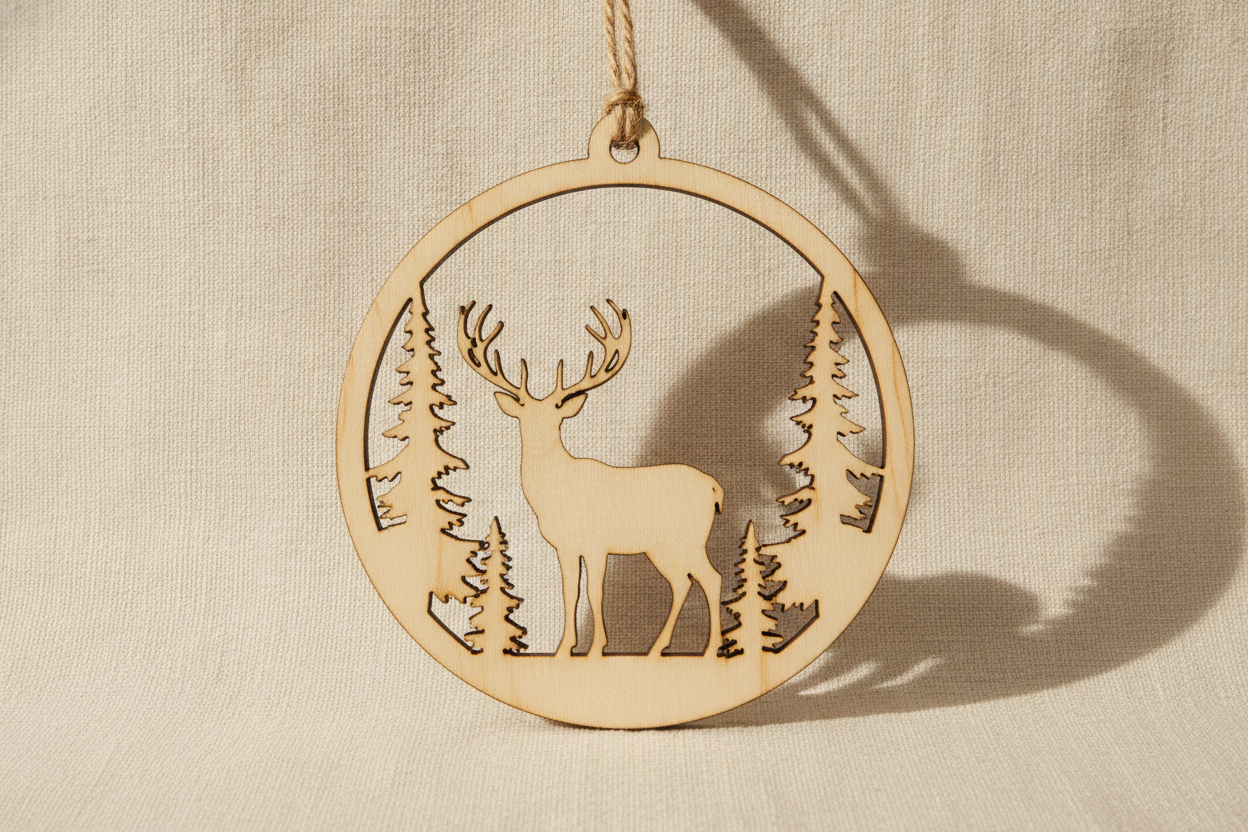
A flat laser-cut birch plywood disc with a stag among pine trees pierced clean through the panel and the cut edges scorched a warm caramel brown against the pale sanded face. The scorch line is the giveaway that a laser rather than a saw made the cut, and the structure is sound in the way a cut-through design has to be: the trees carry the outer ring, a ground bar carries the stag, and nothing floats free in a hole. What the frame does not give you is the edge. The three plywood plies were asked for as visible stripes on the outside of the disc and came back as a plain pale band, which is the one detail that tells a buyer whether a piece is plywood or MDF
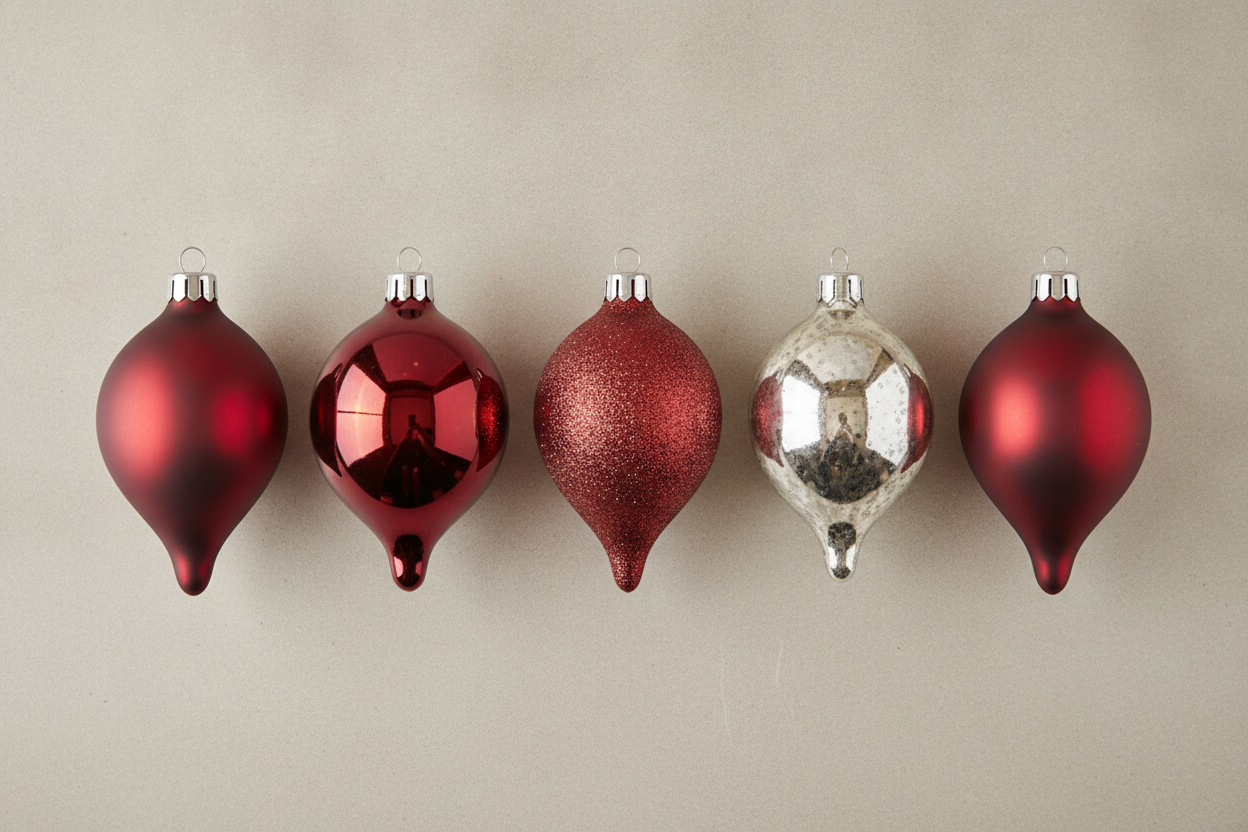
The comparison row, and the frame that earns its place on the page: five teardrops shot straight down, same shape, same size, same silver cap, with the surface finish as the only thing that was supposed to change. This is the first rig in this series where the scale held perfectly, five identical heights and no drift. Two other variables moved instead. The fourth was asked for mercury glass in the same deep red as its neighbours and abandoned the colour entirely to come back silver. And the fifth, specified as frosted, is indistinguishable from the matte at the far left. What is presented as five finishes is really three, plus a mercury that changed the subject
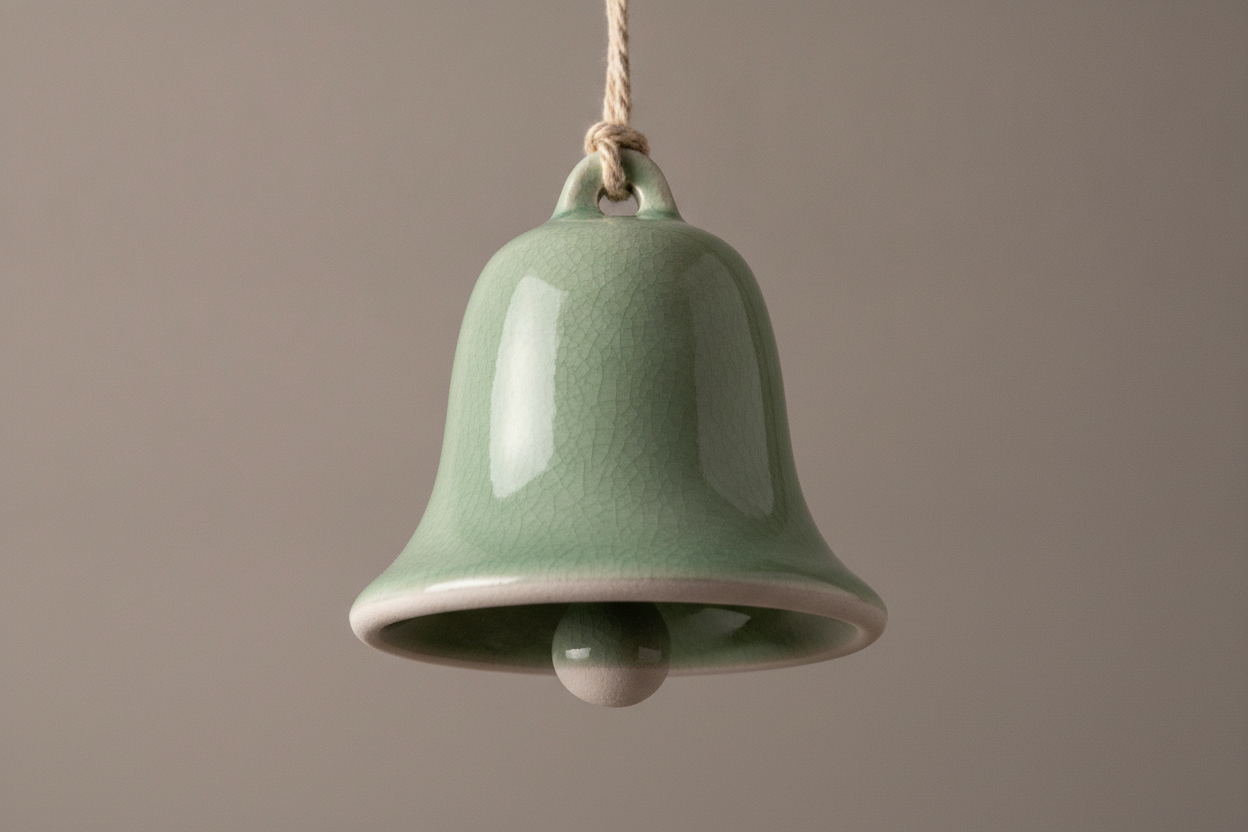
A hand-thrown glazed porcelain bell in pale celadon, with an even crackle across the glaze and a clean band of unglazed white bisque at the rim that reads as a genuine change of texture rather than just a change of colour. It also quietly overturns the rule this series had settled on. The interior was expected to come back as a flat shadow the way guitar f-holes did, and instead the inside of the skirt is fully lit and a rounded clapper hangs in the mouth of the bell. Look at what holds that clapper up: nothing at all. The camera could see into this object, so the model drew the space and then invented the mechanism inside it

A brass snowflake against midnight blue, and the clearest failure on the page. The preset asked for pierced sheet brass with hundreds of open piercings, so the dark ground would show through a lace of metal, and what arrived is a solid stamped blank with the pattern raised in relief across its face. Nothing is cut through it anywhere. The patina is right, brighter on the raised edges and darker in the recesses, and the outline is the standard decorative snowflake rather than the delicate feathered crystal that was specified. Surface accurate, construction invented, which is the same split the wood and leather pages found
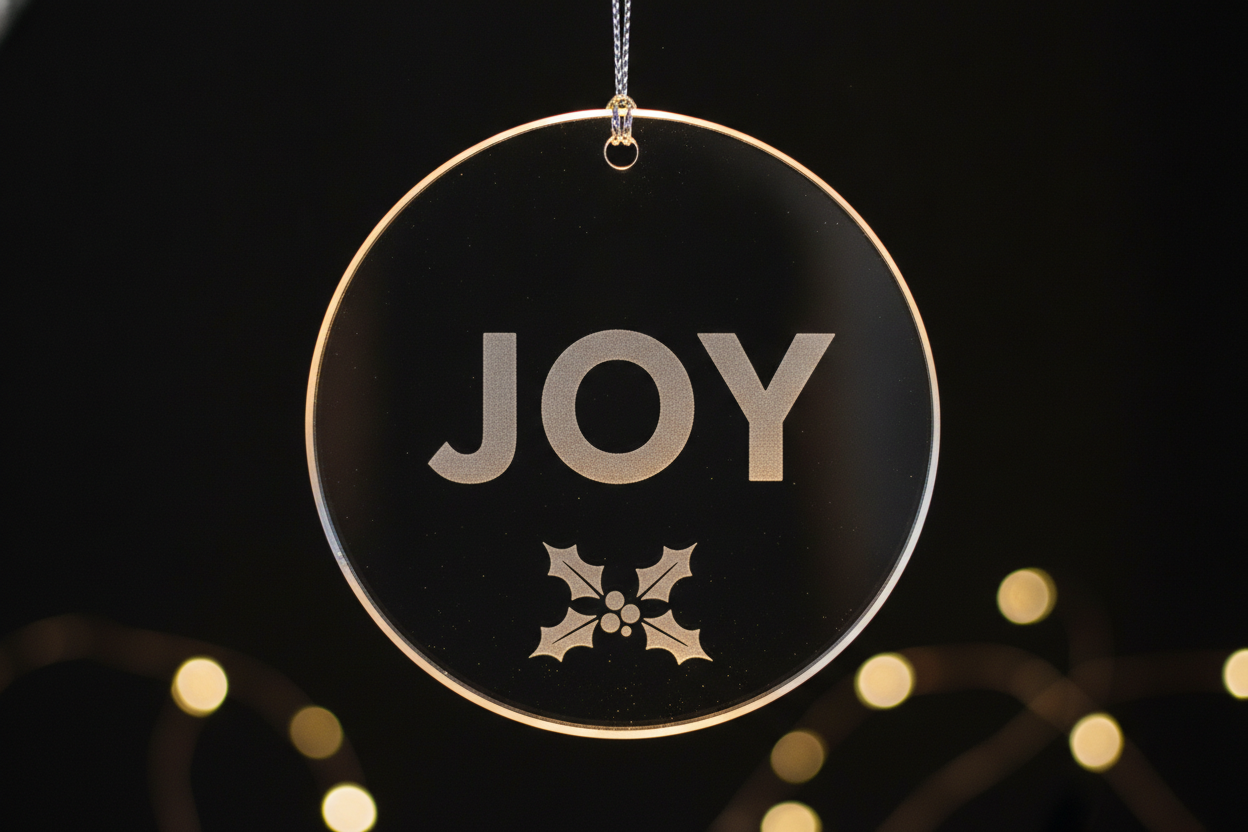
A clear acrylic disc with the single word JOY laser-engraved into the back face in frosted white, a sprig of holly beneath it, and the cut outer edge glowing where light enters the sheet. The spelling is correct first time, which is the honest boundary of what this tool does with type: three common capital letters set large are safe, and a family name or a four-digit year is where it starts inventing letters. The edge glow is real physics rather than a flourish, since acrylic pipes light along the sheet and dumps it at any cut or engraved edge, which is why engraved acrylic ornaments are sold with a lit base
How the AI Christmas Ornament Generator Works
Pick the material
Blown glass, laser-cut plywood, glazed porcelain, pierced metal or engraved acrylic. That single choice decides how the piece is made, what it costs, what quantity it wants behind it and how it catches light on a tree — far more of the design than the colour ever will.
Name the shape, colour and finish
Say sphere or teardrop or flat disc, say the colour, and say matte or gloss or glitter or frosted or mercury. Describe the shape you want in positive terms rather than banning the one you do not, and leave names and dates out entirely — those belong in the production file, not the render.
Hand it over with the numbers attached
Concepts arrive in about twenty seconds at up to 4K. The render settles what the ornament looks like; you write down the three things it cannot hold — diameter, material thickness and finished weight — and a maker turns the pair into a sample.
What an Ornament Render Settles, and What It Hides
Six things decide whether an ornament design works, and an image carries about two of them. Knowing which two is the difference between a concept a maker can quote from and a confident picture of an object that could not be produced the way it appears.
Size is the whole product and it is invisible
Real ornaments run from about fifty to a hundred and ten millimetres, and the gap between a sixty millimetre ball and a hundred millimetre one is the gap between a filler and a feature on the tree. An object shot alone on a plain ground has nothing in frame to measure against, so it reads at whatever size you already imagined. Fix the diameter as a number in text before anything else.
The cap and the loop are a bought part
Crown caps, wire hangers, cords and rings come in standard sizes, and the neck diameter of a blown ball has to match the cap you can actually buy. In every render the cap is drawn as a shape sitting on the object rather than a part clamped into it. Treat it exactly as you would treat rendered hardware anywhere else: it says brass, roughly this size, in roughly this place.
Hanging balance never shows in a still
An ornament hangs from one point, so where the loop sits relative to the centre of mass decides whether it hangs straight or lolls forward on the branch. Every render on this page hangs perfectly, because the model draws objects in the pose you asked for rather than the pose gravity would give them. Asymmetric and flat pieces are where this bites, and it only ever shows up in a physical sample.
Surface is accurate, construction is invented
The brass ornament here was specified as pierced sheet metal and came back solid, with the pattern in relief and nothing cut through it. The bell has a clapper hanging from nothing. The ribbon on the glass ball is tied to no branch. Meanwhile the patina, the crackle, the scorch line and the way glass transmits light are all right. Believe the surfaces and question every cut, joint and fixing.
Kilns move glazes and clay shrinks
A rendered glaze is a perfectly controlled surface, and a real one is a suspension that flows in the firing, pools where the form curves, crazes as it cools and comes out a slightly different colour on a different clay body. Porcelain also shrinks roughly twelve percent between wet and fired. The render is a target to aim a test tile at, not a description of what will come out of the kiln.
Durability and storage are not in the frame
These objects spend eleven months of the year in a box and one month being handled by people including children. Glass breaks, glitter sheds, thin plywood snaps across the grain at a narrow bridge, and a chain hanger tangles where a cord does not. None of that is visible in a beautiful studio shot, and all of it decides whether a piece gets a second season or a refund.
Names, Dates and the One Thing to Keep Off the Render
Personalisation is why most custom ornaments get bought, and it is the one part of this object you should deliberately leave out of the picture. Here is the boundary, drawn from what actually rendered on this page.
Safe to render
Short, common, familiar words in a plain typeface. JOY came back correct on the first attempt on the acrylic disc above, and NOEL, PEACE and CHEER behave the same way. One word, three to five letters, set large. If the word is on your shortlist of everyday English and it fits on one line, the model will spell it.
Keep out of the render
Family surnames, unusual first names, four-digit years, dates, and phrases like a first Christmas with a year attached. Long or unfamiliar strings are where letters get doubled, dropped or invented, and digit sequences are the weakest case of all. A misspelled name is the one defect a keepsake cannot survive.
Do it the way makers do it
Real personalised ornaments are not printed as one piece. The blank is made in quantity and the name goes on last, with a laser engraver, a vinyl cutter or a sublimation press. Design the blank here, leave a clear area for the text, and add the lettering in the production file where the spelling is under your control.
Characters and keepsake lines
Ornaments are among the most heavily licensed objects in retail, so the model reaches for studio characters, sports teams and well known collectible styling by reflex. The presets refuse those item by item, which is why nothing on this page carries one. Check any concept you plan to sell against that same list before you order tooling.
Why Use This AI Christmas Ornament Generator
Six materials, not six colourways
Blown glass, laser-cut plywood, glazed porcelain, pierced brass and engraved acrylic differ in how they are made, what they cost, what quantity they want and how they behave on a lit tree. Switching preset changes what the object is rather than what shade it happens to be.
A comparison rig built into the presets
One preset renders five identical teardrops in five finishes instead of another hero shot, which answers the question this category really turns on: how differently five ornaments from the same mould read once they are hanging in among the lights.
Written as product photography
Every preset specifies a named background, a named camera angle and a described light, so concepts arrive looking like the listing photograph they will eventually need rather than a festive illustration floating in a red gradient.
Characters and lettering refused item by item
Licensed characters, keepsake trade dress, names, dates, year numbers, gift tags and price stickers are banned individually rather than with a blanket instruction, which is the difference between a clean blank and a concept you cannot sell.
Consistent across a whole set
Nano Banana Pro holds a described style across separate generations, so reusing one palette and one cord while changing only the material gives you a collection that reads as a single line rather than six unrelated ornaments.
Cheap enough to show a client the whole range
About twenty seconds per concept and plans from $2.99 means a maker can put an entire coordinated set in front of a customer before booking a kiln or ordering a sheet, which is exactly the stage where seasonal product decisions usually go wrong.
AI Christmas Ornament Generator FAQ
Related Holiday Design Tools
AI Christmas Card Generator
The nearest neighbour, and the split is clean. That page designs a flat printed card with a greeting laid out on it. This one designs the three-dimensional object that hangs on the tree.
AI Wrapping Paper Design Generator
The other half of a coordinated holiday range. Repeat-pattern artwork printed on a flat sheet, where this page is about a made object with a material and a maker behind it.
AI Cutting Board Design Generator
The closest technical sibling outside the season. Same lesson in a different material: the render gets species, figure and finish right and invents how the thing is actually held together.
Design Your Christmas Ornament Now
Six ornament materials, surfaces that render with the right sheen, a comparison row that shows what each finish does on a lit tree, and 4K product shots in about twenty seconds. Free to start, from $2.99 for more.
Start Designing FreeAbout This AI Christmas Ornament Generator
An AI Christmas ornament generator is useful on one part of the job and quietly misleading on the rest, so it is worth drawing the line before you start. Making an ornament is four decisions stacked on each other. The first is the material, which is really a decision about process: blown glass is hand work with a minimum order and a breakage rate, laser-cut plywood and engraved acrylic are a vector file and a machine minute, ceramic is a mould plus two firings plus about twelve percent shrinkage, and stamped or cast metal is tooling that only pays back across a real quantity. The second is dimension, meaning diameter, thickness and finished weight, which decide whether the piece reads as a filler or a feature and whether the branch it hangs on can hold it. The third is the hanging hardware, which is a catalogue of standard caps, loops, rings and cords rather than anything you design. Only the fourth — shape, colour, surface finish and how the material catches light — is something a photograph can settle, and it happens to be the part everybody argues about hardest and describes worst. That is what this tool does in about twenty seconds.
That is also why the six presets here are materials rather than colourways. A blown glass sphere, a flat laser-cut plywood disc, a glazed porcelain bell, a pierced brass crystal and an engraved acrylic round are five genuinely different objects with different costs, different minimum quantities and different failure modes in a storage box. Changing an ornament from green to plum is a much smaller decision. The surface finish is not a small decision either, and that is what the comparison row on this page is for: five identical teardrops, one shape, one colour, one cap, with only the finish changing. Matte chalk scatters light and sinks into the shadows of a tree. High gloss throws a hard highlight and collects every fairy light near it. Fine glitter reads as texture close up and as a lighter shade from across the room. On a lit tree, which is where these things spend their entire working life, that choice matters more than the colour underneath it. The row is worth reading for a second reason as well, because two of its five teardrops did not do as they were told: the mercury glass dropped the specified red and came back silver, and the frosted one at the end is indistinguishable from the matte one at the start. Comparison renders are the most useful thing you can ask this model for and the easiest to over-trust, so count the variables in the picture rather than the variables in the prompt.
The most useful thing to know about this AI Christmas ornament generator is where its text rendering stops, because personalisation is why most custom ornaments get bought in the first place. Short common words are safe. The word JOY on the engraved acrylic disc above came back correct on the first attempt, and NOEL, PEACE and CHEER behave the same way: one word, a handful of letters, set large in a plain face. Family surnames, unusual first names and four-digit years are a different matter entirely, and digit sequences are the weakest case of all. That would be a small annoyance on most products and it is close to fatal here, because a misspelled name on a keepsake is the one defect nobody forgives. The fix is also how the real trade already works. Personalised ornaments are not made as one piece; a blank is produced in quantity and the name goes on last with an engraver, a vinyl cutter or a sublimation press. So design the blank here, leave a clear area where the lettering will sit, and add the text in the production file where you control the spelling.
The second thing worth carrying away is a sharper version of a limit that turns up on every product page in this series. The model renders what a surface looks like and invents how the object is built. The brass ornament here was specified as pierced sheet metal with the ground showing through a lace of openings, and it came back solid, with the whole pattern raised in relief and nothing cut through it anywhere, while the patina and the tooling marks were entirely convincing. The bell has a clapper hanging from nothing. The ribbon on the glass ball runs through the cap and is tied to no branch. Note that the interior itself was not the obstacle this time: the inside of the bell skirt rendered perfectly well, which refines the rule rather than repeating it. Where a camera could physically see, you get a picture; where something has to be cut, joined, fixed or hung, you get a plausible drawing of a thing that does not work. The same goes for hanging balance, which never appears in a still image because the model draws an object in the pose you asked for rather than the pose gravity would put it in, and for kiln behaviour, since a rendered glaze is perfectly controlled where a real one flows, pools, crazes and shifts colour on a different clay body. Treat every fixing, the balance, the diameter, the material thickness and the finished weight as a written specification that travels beside the image rather than inside it. Do that and this tool earns its keep. It runs on Nano Banana Pro, which holds a described style across separate generations, so one palette and one cord can carry a whole coordinated collection; it is free to start and paid plans begin at $2.99; and it turns the slow, expensive, argumentative stage of a seasonal product — deciding what the thing will actually look like — into six pictures you can put in front of a customer months before anyone books a kiln.