
AI Surfboard Design Generator
A surfboard is two objects at once. One is a graphic you argue about for weeks; the other is a curve and a volume figure that decide whether the thing works. This AI surfboard design generator settles the first in about twenty seconds — outline, tail, tint and artwork, rendered as surf-shop product photography — and is straight with you about the second, which no photograph has ever been able to hold.
Start Designing FreeTry the AI Surfboard Design Generator — Free
Pick the board first, then name the colour, the tint and the artwork. Every preset is written as surf-shop product photography against a plain ground, and every preset refuses branding, because a concept wearing somebody else's laminate is not a concept you can take to a shaper.
AI Surfboard Design Generator
Pick a board, describe the colour, the tint and the artwork, and get surf-shop product shots at up to 4K
Boards Designed With This AI Surfboard Design Generator
All six came from the presets above unedited, flaws included and captioned. Two are not hero shots at all: the third is a comparison row of five outlines and the fourth is a dead side-on profile that goes after the rocker, which is the one hidden number a photograph can nearly reach. Read the set for outline, tail, tint and artwork. Treat every fin, every stated length and every claim about the material as a question for whoever is going to shape it.
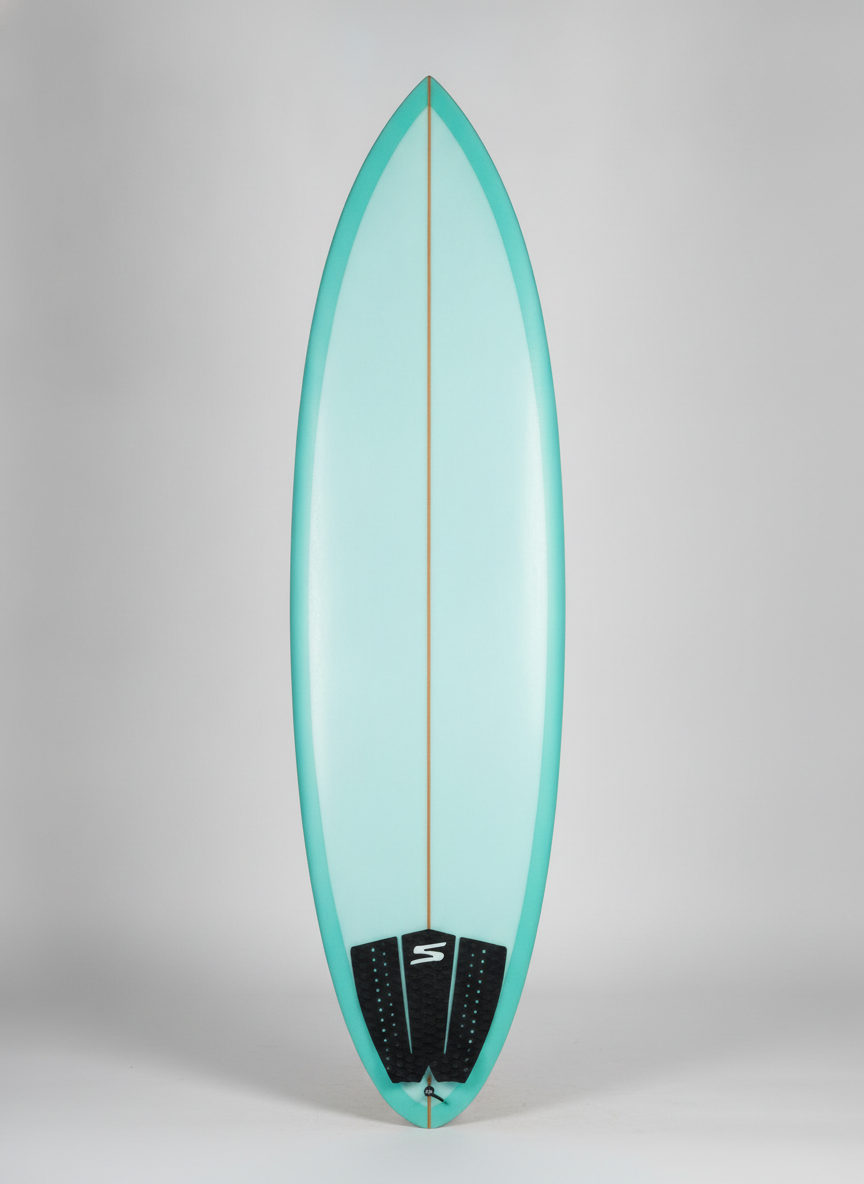
AI surfboard design generator result: an unbranded performance shortboard stood against a plain studio wall, and the only frame of six that leaked a mark. The traction pad carries a white swoosh, which is a logo, on a preset that banned logos, stickers and lettering item by item. Two other drifts. The preset asked for a squash tail and the tail came back rounded, and it asked for three fin boxes with three black fins fitted, of which not one is visible. The tint also inverted: it was written as a panel across the deck fading out before the rails, and what arrived is a teal border hugging the rails with a pale centre. The stringer is right, though — one thin wood line, dead centre, running the full length
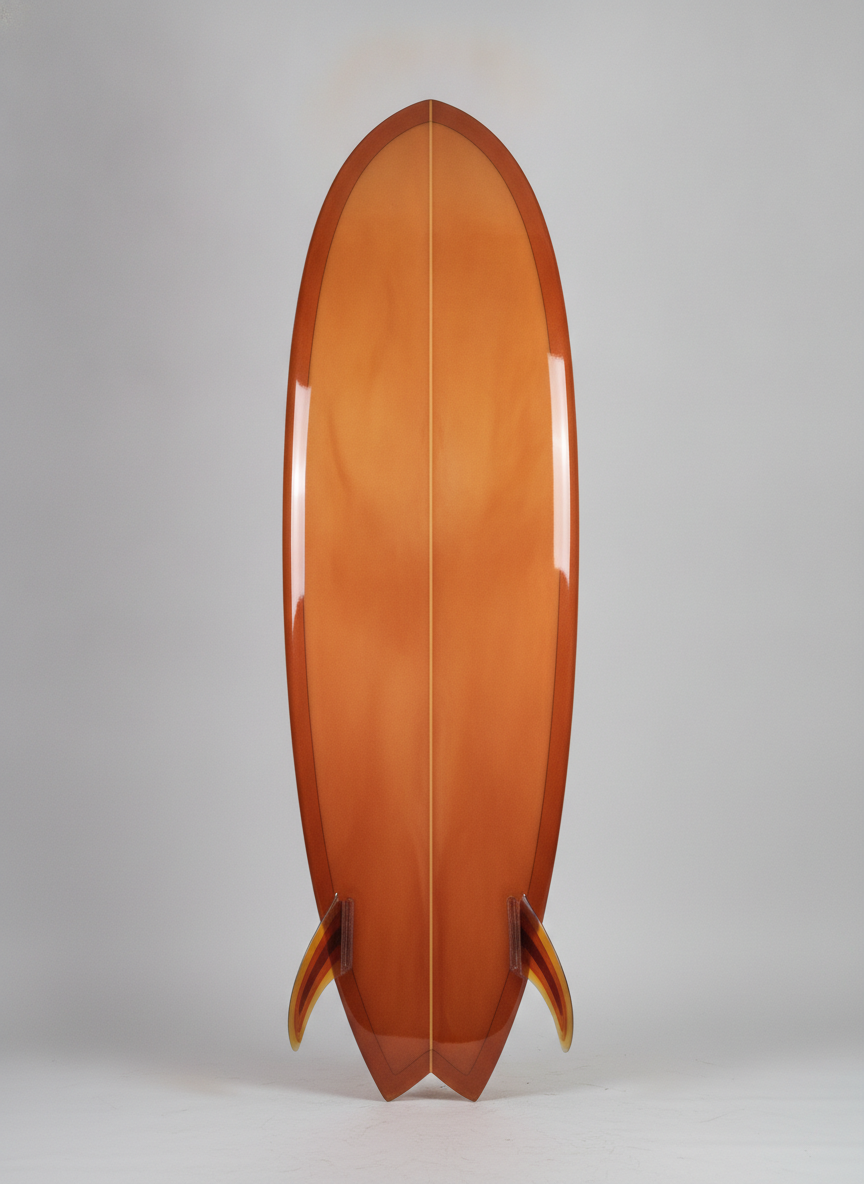
A retro twin-fin fish in amber-to-rust, and the best object in the set. The deep swallow tail is genuinely correct: two clean points with a crescent cut between them, which is the one tail shape on this page the model can actually draw. Both keel fins arrived, raked and layered in translucent amber, and the rail pinline is there. What is wrong is the material. A hand-poured resin tint has pour lines, cloth weave and colour that pools unevenly at the rails; this is a smooth airbrushed gradient with none of that, which is a different process and a different price. The outline is also narrower than a fish should be — this is a stubby egg wearing a swallow tail
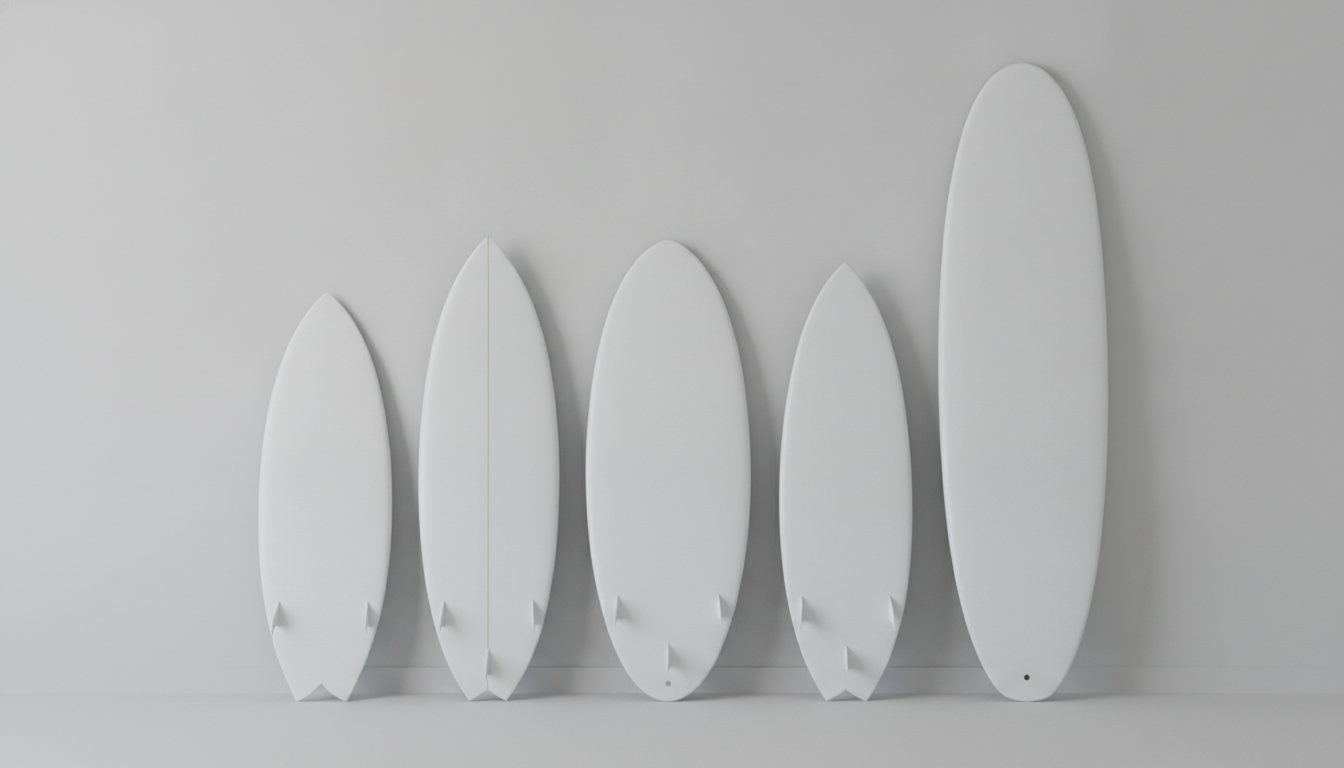
The five-outline comparison row, and the frame that fails most usefully. Five boards, identical white finish, one variable: the outline, running 5′6 fish, 6′0 shortboard, 6′8 egg, 7′6 mid-length pin and 9′2 log. The finish, the lighting and the shared floor line all held. Nothing else did. The fourth board is visibly shorter than the third, so the length ordering breaks in the middle of a row whose entire job is to compare lengths. Four of the five came back with swallow tails when exactly one was asked for, and no squash tail and no pin tail appear anywhere. Every board grew fins that were never requested, moulded in the same white as the foam, and only the second has a stringer
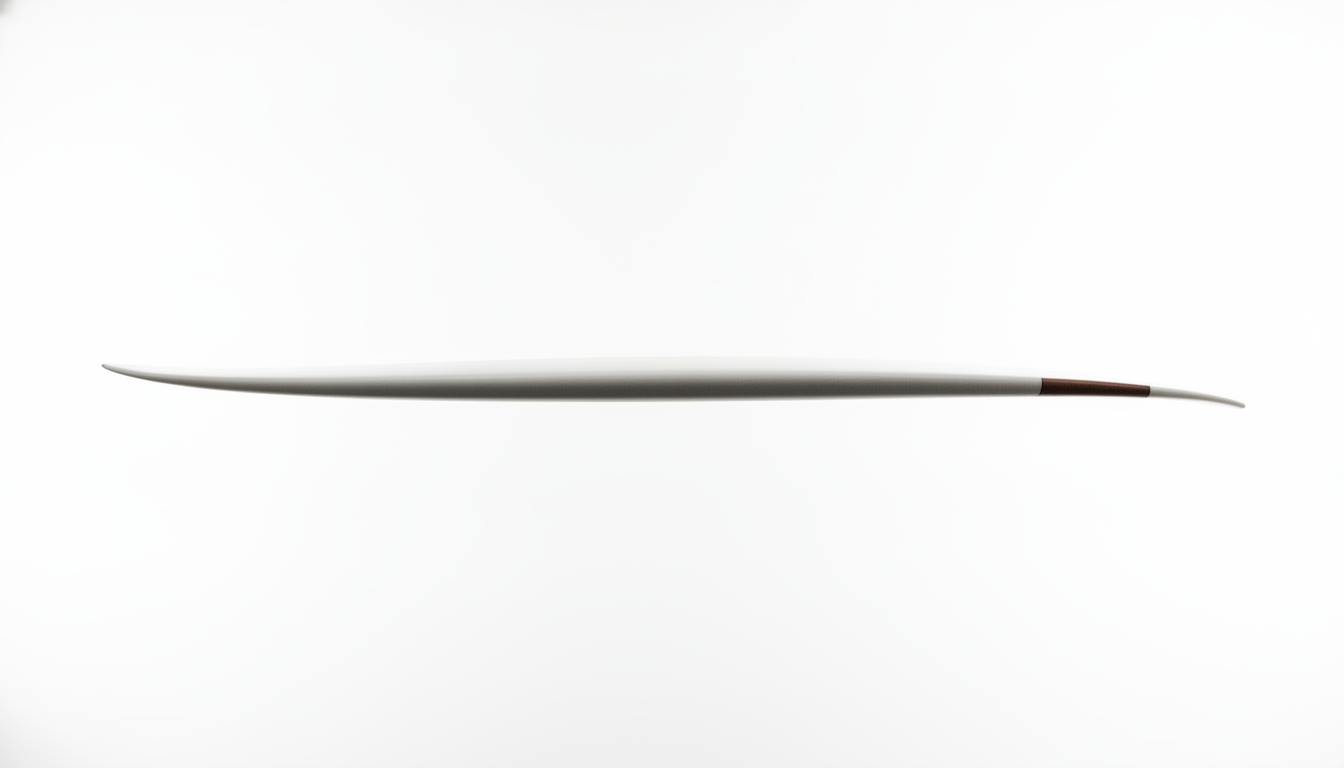
The rocker profile: one board photographed dead side-on so the curve reads as a single line. This is the frame that reaches the thing the other five cannot, and it mostly works. Nose lift at the left, tail kick at the right, and a foil that thickens correctly through the middle and thins toward both ends. Two things to read honestly. The last few inches taper to a knife edge no laminator could glass, and the wood that was asked for as a full-length stringer along the rail shows up only as a short brown patch near the tail. And the preset asked this silhouette to show the rail turning from soft to hard, which it can never do, because a rail is a cross-section and this is an outline
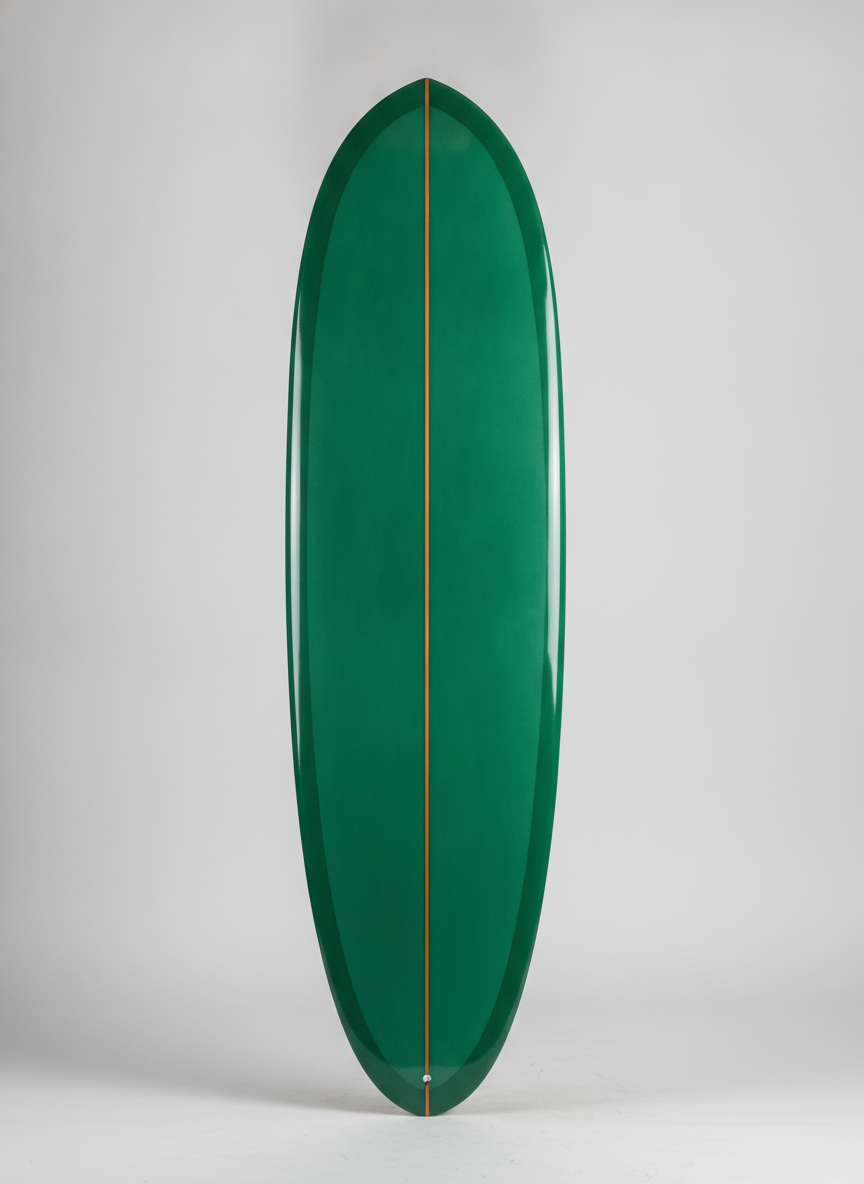
A single-fin log in volan green, and the clearest demonstration of what an AI surfboard design generator cannot hold. The preset asked for nine foot two; this reads as about a seven foot egg, because the length-to-width ratio is roughly three to one where a real log is nearer four and a half to one. The single fin — the entire point of the preset, the reason the board is called a log — is not fitted at all. A triple stringer came back as one thin line. And the fibreglass weave that should show faintly through a volan tint is absent, so the surface reads as flat automotive paint rather than green resin over cloth. The outline and the gloss are lovely and neither is the board that was ordered
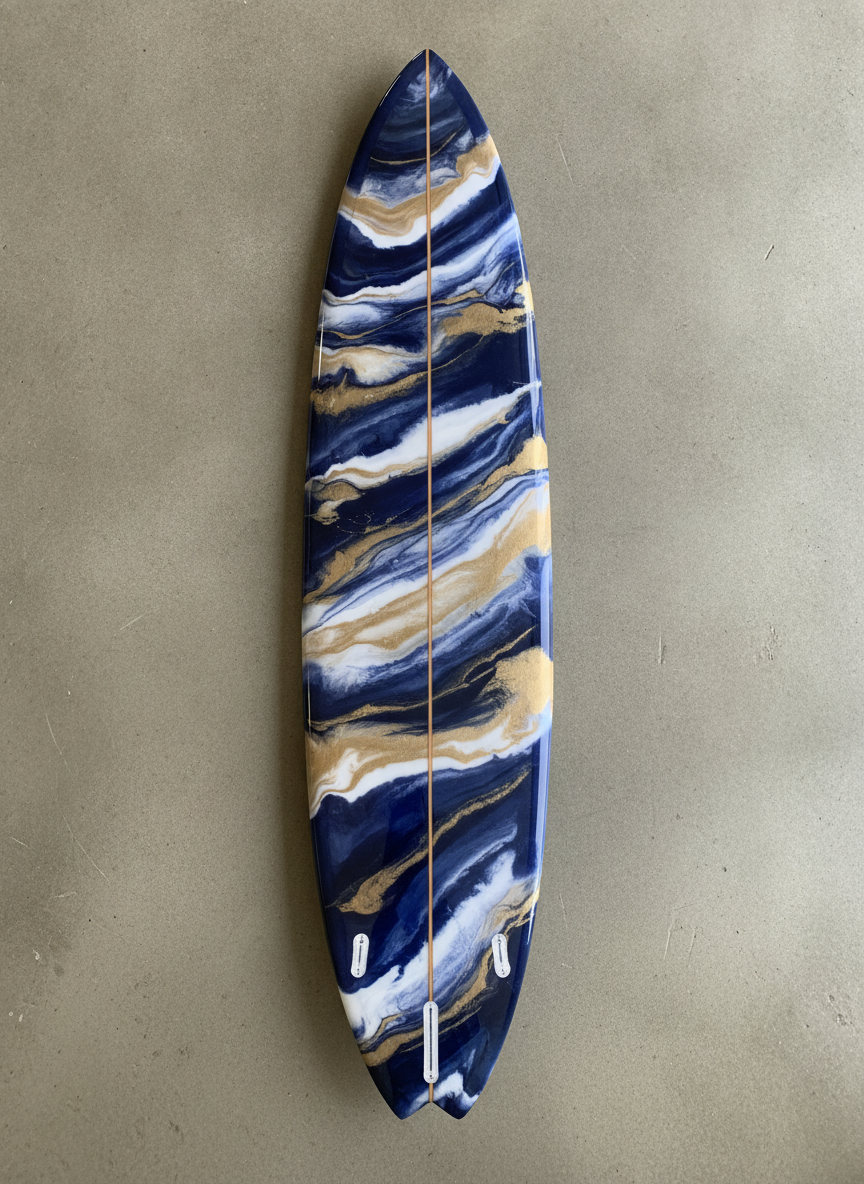
A poured resin swirl shot from directly overhead on a scuffed concrete floor, and the frame that shows what this tool is genuinely for. The indigo, white and pale gold marbling feathers along the board the way poured pigment actually behaves, and it is the only surface on this page that looks like resin rather than paint. It is also the one preset whose hardware came back exactly as specified: three empty fin boxes, no fins, precisely as asked. The failure is the outline. This was written as a nine foot big-wave gun, long and drawn out with a narrow pin tail, and it arrived stubby with a swallow tail — the one tail you would never put on a gun, on the one board where the tail is a safety decision
How the AI Surfboard Design Generator Works
Pick the board, not the colour
A performance shortboard, a retro twin fish, a single-fin log, a drawn-out gun, a comparison row or a side-on rocker profile. That one choice decides the outline family, the fin cluster the board can take, roughly what it weighs and who can ride it — far more of the design than the shade of the tint ever will.
Name the tint, the stringer and the artwork
Say amber resin tint or opaque seafoam or a poured indigo swirl, say wood stringer or none, say black pad or bare deck. Abstract pours render beautifully. Describe the tail geometrically rather than by name, because tail vocabulary collapses to whatever the model has seen most.
Send it to the shaper with the dims attached
Concepts arrive in about twenty seconds at up to 4K. The render settles what the board looks like; you write down the six things it cannot hold — length, width, thickness, volume in litres, rocker and fin setup — and the shaping bay turns the pair into an actual board.
What a Surfboard Render Settles, and What It Hides
Roughly eight things decide whether a surfboard works, and a photograph carries two of them. Knowing which two is the difference between a concept a shaper can quote from and a beautiful picture of a board that would not float you.
An object alone in frame has no scale
This is the whole problem in one sentence, and it generalises far past surfboards. Length only exists as a ratio to something else, and a board photographed against a plain wall has nothing else in the picture. Ask for nine foot two and you get a shape at surfboard proportion. The log on this page came back reading about seven foot and the nine foot gun came back stubby. If length matters, put a known object in frame or accept that the number lives in text.
Volume is the number and it is nowhere
Litres decide whether a board floats you, paddles into anything and suits your weight, and volume is a function of length, width, thickness and foil acting together. A deck-up photograph shows you the first two, hints at the third and says nothing about the fourth. There is no prompt that fixes this. Settle volume in a calculator against your weight and ability before you fall in love with a render.
Rocker is reachable, rails and concave are not
The side-on preset on this page proves the useful half: shot dead square with the rail toward the lens, the board reads as one continuous curve with genuine nose lift and tail kick. But that same frame was asked to show the rail turning from soft to hard and simply cannot, because a rail is a cross-section and a silhouette is an outline. Bottom contour is on the face the camera is not looking at.
Fins fall off the board
Two of the three presets that asked for fitted fins returned none, including the single-fin log, whose one fin is the entire concept. The preset that asked for empty boxes got exactly three empty boxes. Fins live on the bottom of a board and the model wants to render a clean deck-up silhouette, so anything protruding past the tail is the first thing to go. Ask for an angled or bottom-up shot if the fin cluster matters.
It renders how a surface looks, not what it is made of
Poured resin swirl came back genuinely convincing — pigment feathering along the board the way it actually moves. Flat resin tint came back as automotive paint, with no pour lines, no pooling at the rails and no cloth weave showing through the colour. Those absences are exactly how a surfer tells a lamination from a spray job, and they are the difference between two quotes.
Comparison frames change more than one variable
The five-outline row held its finish, its lighting and its floor line and broke almost everything else: the fourth board came out shorter than the third, four of five tails collapsed to swallows, and every board grew fins nobody asked for. Any prompt that requires several things held constant while one changes will quietly move the others. Render one board per generation and compare them yourself.
Why Use This AI Surfboard Design Generator
Six boards, not six colourways
A shortboard, a twin fish, a log, a gun, a comparison row and a rocker profile differ in outline family, fin cluster, volume and who can ride them. Switching preset changes what the board is rather than what shade it happens to be.
A profile preset that chases the hidden curve
One preset shoots the board dead side-on instead of taking another hero shot, which is the only angle that puts rocker and thickness foil in a photograph at all. It is the least pretty frame here and the most useful one.
Resin artwork it actually gets right
Poured swirls, marbling and colour blocking are where this tool earns its keep. The indigo and gold pour on this page feathers the way real pigment moves through resin, which is exactly the decision customers agonise over longest.
Written as surf-shop photography
Every preset specifies a plain ground, a named camera angle and soft large-source light, so concepts arrive looking like the rack shot they will eventually need rather than an illustration floating in a gradient.
Branding refused item by item
Logos, laminates, shaper signatures, stringer dimensions, fin marks and stickers are banned individually, which is why five of six frames came back completely clean. The sixth put a swoosh on the traction pad and is captioned rather than hidden.
Cheap enough to show a customer six decks
About twenty seconds per concept and plans from $2.99 means a shaper or a rider can compare six artwork directions before anyone blows foam, which is exactly the stage where custom orders usually stall.
AI Surfboard Design Generator FAQ
Related Design Tools
AI Skateboard Design Generator
The closest sibling on the site. A deck is the same problem with one variable removed, because a skateboard has no volume to get wrong and the graphic really is most of the product.
AI Guitar Design Generator
The same lesson in a different material. Outline and finish come out convincing, the joinery gets invented, and the numbers that decide whether anyone enjoys the object are invisible.
AI Car Wrap Design Generator
If the artwork is the whole job and the object underneath is already decided, start here. Wrapping a known shape is the case where this kind of render is at its most reliable.
Design Your Surfboard Now
Six board presets, resin swirls that actually look poured, a comparison row and a side-on rocker profile, all at up to 4K in about twenty seconds. Free to start, from $2.99 for more.
Start Designing FreeAbout This AI Surfboard Design Generator
An AI surfboard design generator is excellent at one half of a surfboard and blind to the other, and the halves are unusually easy to separate. Ordering a custom board is really two conversations. The first is numbers: length, width and thickness, volume in litres measured against your weight and how often you surf, entry rocker and tail kick, rail profile, bottom contour, the fin cluster and which box system it uses, the foam and the glassing schedule. Every one of those changes how the board rides and not one of them is visible in a photograph. The second conversation is the deck — the outline you like the look of, the tail, the tint, the stringer and above all the artwork. That one is slow, subjective and expensive to get wrong, because the airbrush is the step nobody wants to redo. It is also the entire job this tool does, in about twenty seconds.
The six presets here are boards rather than colourways for that reason. A performance shortboard, a retro twin fish, a single-fin log, a drawn-out gun, a five-outline comparison row and a dead side-on rocker profile differ in outline family, in fin cluster, in volume and in who can ride them, and switching between them changes what the object is. Two of the six are deliberately not hero shots. The comparison row exists because outline is the thing people find hardest to picture from words, and the side-on profile exists because rocker is the one hidden number that a camera can nearly reach. That profile frame is the quiet success of the whole set: shot square with the rail toward the lens, the board reads as a single continuous curve with real nose lift, real tail kick and a foil that thickens correctly through the middle. It is the least attractive image on the page and the one a shaper would actually look at.
The failures are worth reading carefully, because they are consistent and they point at a rule that travels well beyond this category. Fins vanish: two of the three presets that asked for fitted fins returned bare tails, including the log whose single fin is the whole point, while the preset that asked for three empty boxes got exactly three empty boxes. Length does not survive at all: a nine foot two log came back reading about seven feet and a nine foot gun came back stubby, because an object photographed alone against a plain ground has nothing in frame to be measured against, and length is only ever a ratio to something else. Tail vocabulary collapses, with four of five boards in the comparison row arriving as swallows when one was requested. And the row broke its own ordering, putting the fourth board shorter than the third, which is the general hazard of any prompt that asks for several variables held constant while exactly one moves.
The most useful distinction this surfboard design generator draws is between how a surface looks and what it is made of. Asked for a poured resin swirl, it produced indigo and gold marbling that feathers along the board the way pigment genuinely moves through resin, and that frame is the best argument for the tool. Asked for a flat resin tint over fibreglass, it produced automotive paint: a smooth airbrushed gradient with no pour lines, no colour pooling at the rails and no cloth weave visible through the colour — which is precisely how a surfer tells a tinted lamination from a spray job, and precisely what separates two very different quotes. So use it for what it is good at. It runs on Nano Banana Pro, which holds a described style across separate generations, so one palette can carry a whole quiver that reads as a single line; it is free to start and paid plans begin at $2.99; and it turns the slowest, most argued-over stage of a custom order into six decks you can put in front of a rider before anyone blows foam. Then write the dims underneath, because the picture will never carry them.