
AI Guitar Design Generator
A guitar is an outline everyone argues about, wrapped around a set of numbers nobody can see. This AI guitar design generator settles the argument in about twenty seconds — body shape, wood, figure, finish and hardware colour, rendered as real instrument photography — and is honest about the numbers, the joinery and the interior it cannot reach.
Start Designing FreeTry the AI Guitar Design Generator — Free
Pick the construction first, then name the wood, the finish and the hardware colour. Every preset is written as instrument product photography on a plain studio ground, and every preset refuses branding, because a concept wearing a famous logo on the headstock is not a concept you can use.
AI Guitar Design Generator
Pick a construction, describe the wood, the finish and the hardware, and get instrument product shots at up to 4K
Guitars Designed With This AI Guitar Design Generator
Five of these came from the presets above unedited, flaws included; the acoustic is a regeneration and the caption explains why. The third is not a product shot at all but a comparison row of five identical bodies in five finishes, and it answers more about a guitar than another hero shot would. Read the whole set for outline, wood, figure, finish and hardware colour. Treat every claim about joinery, every piece of hardware and everything supposedly visible inside the body as a question for whoever is going to build it.
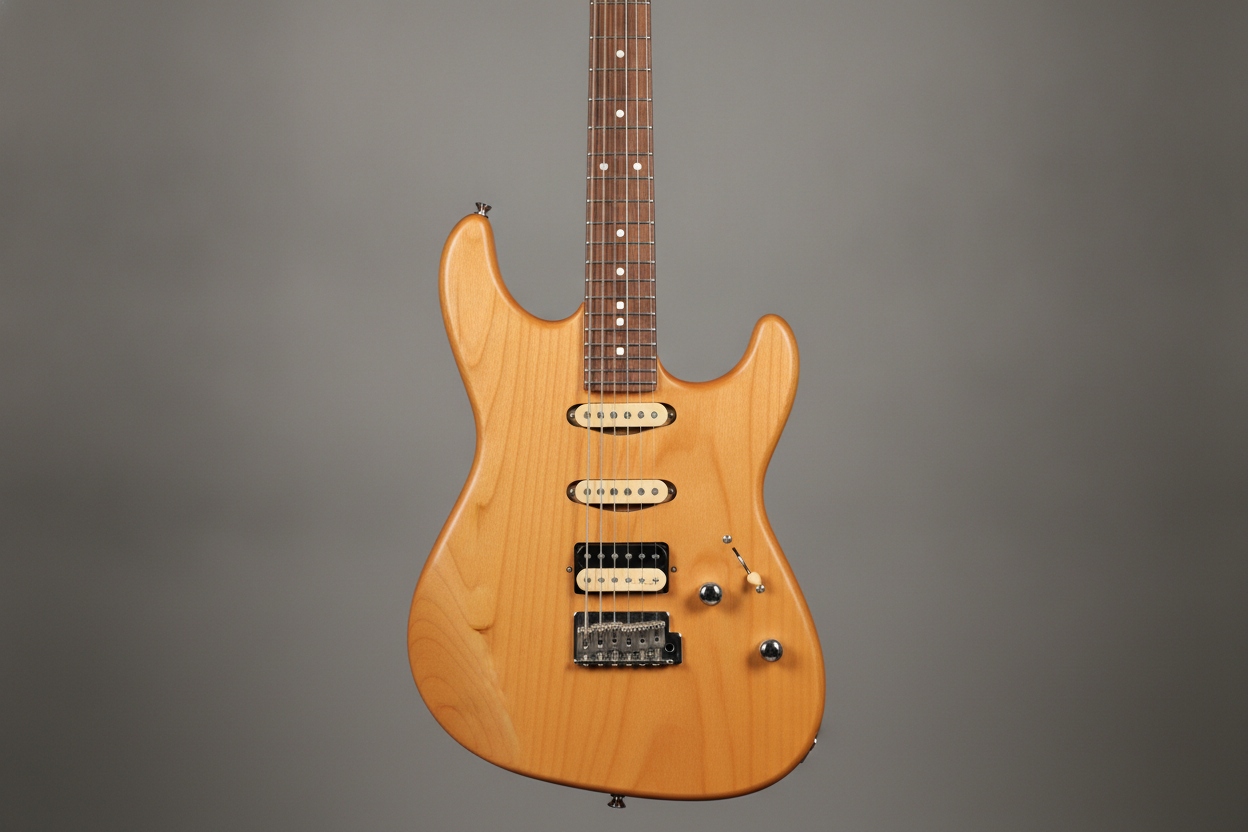
AI guitar design generator result: an unbranded offset solid-body electric in satin natural ash, and the first of three frames on this page that quietly ignored the shape instruction. The preset banned the famous double-cutaway outlines by name and what came back sits within touching distance of the most copied body shape in the world. Two smaller drifts are worth reading. The preset asked for three control knobs and a five-way blade switch and the render supplied two knobs and a vibrato arm instead, which is the archetype control set rather than the one specified. And the frame crops the headstock away entirely, so the part of a guitar that carries the branding is simply not in the picture
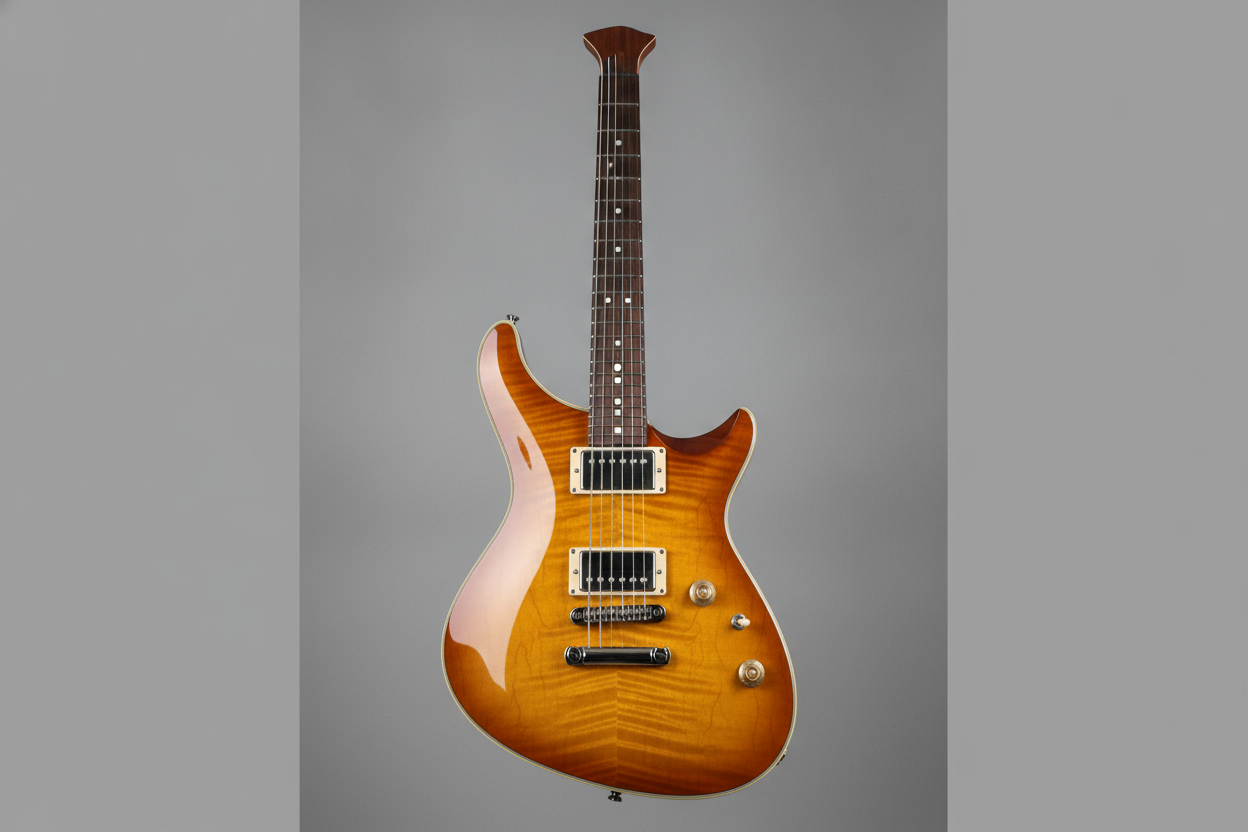
A carved top with a book-matched flame maple cap over mahogany, cream binding and a tune-o-matic bridge feeding a stopbar tailpiece. The figure, the amber burst and the binding are all convincing. The outline and the construction are not. The preset asked for a single-cutaway and what arrived has two horns, which is the archetype drift again on a frame where it is easy to miss. The preset asked for a glued-in set neck with a smooth sculpted heel, and the neck joint is the one thing a straight-on product shot cannot show you, so the single most consequential decision in the whole build is hidden behind the body. Look at the headstock instead: it is a bare paddle with no tuning machines on it anywhere, six strings running to nothing. This is also the frame that came back portrait and was letterboxed into the wide canvas it was asked for
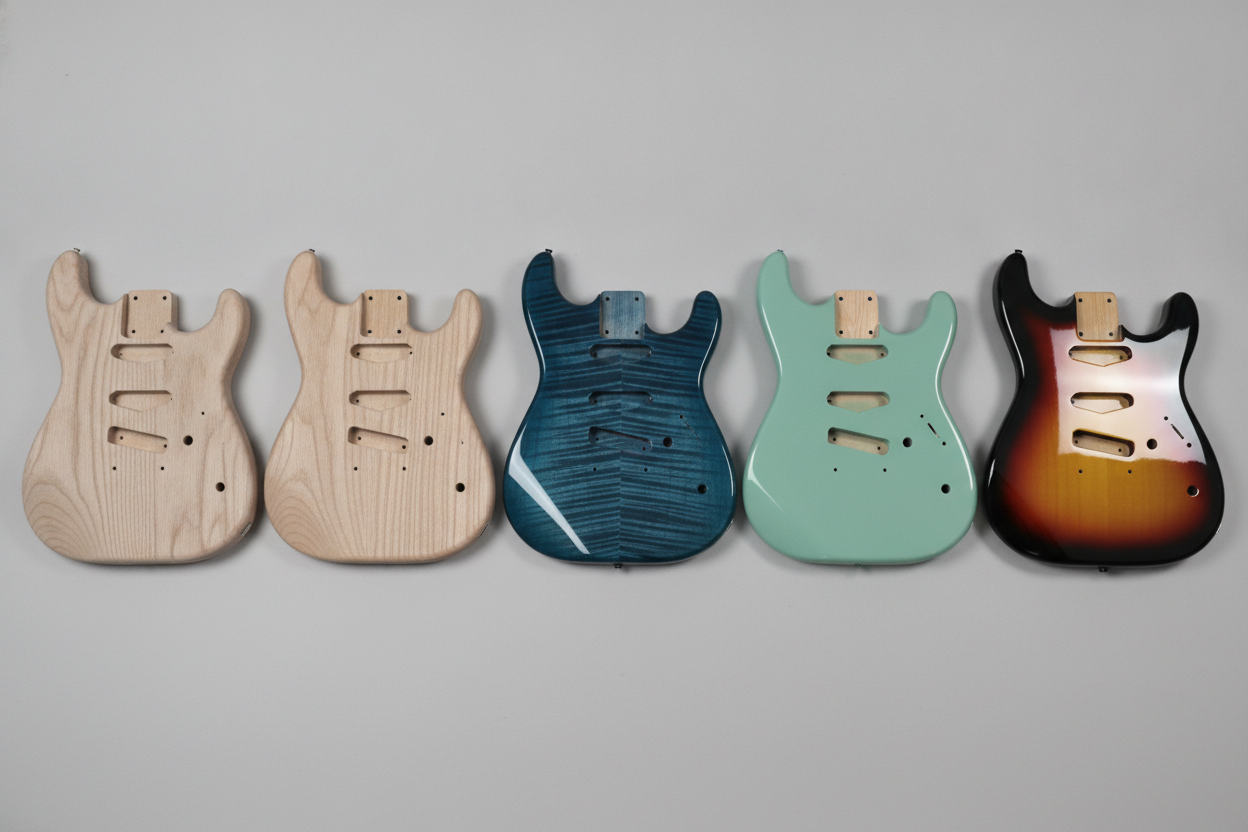
The comparison row, and the frame that earns its place on the page: five identical guitar bodies photographed from directly above, same shape, same routes, same scale, with the finish as the only thing that was supposed to change. Left to right, bare sanded ash, satin oil, translucent blue over flame, opaque seafoam and a gloss sunburst. The oil finish is almost invisible next to the bare wood, the opaque colour hides every trace of grain, and the two translucent finishes need figure underneath or they have nothing to say. But the rig also changed a second variable behind our backs, because bodies one and two are plain ash and body three arrived as flame maple. One thing it got right unprompted: the neck pockets on the finished bodies are masked back to bare wood, which is exactly what a real spray shop does
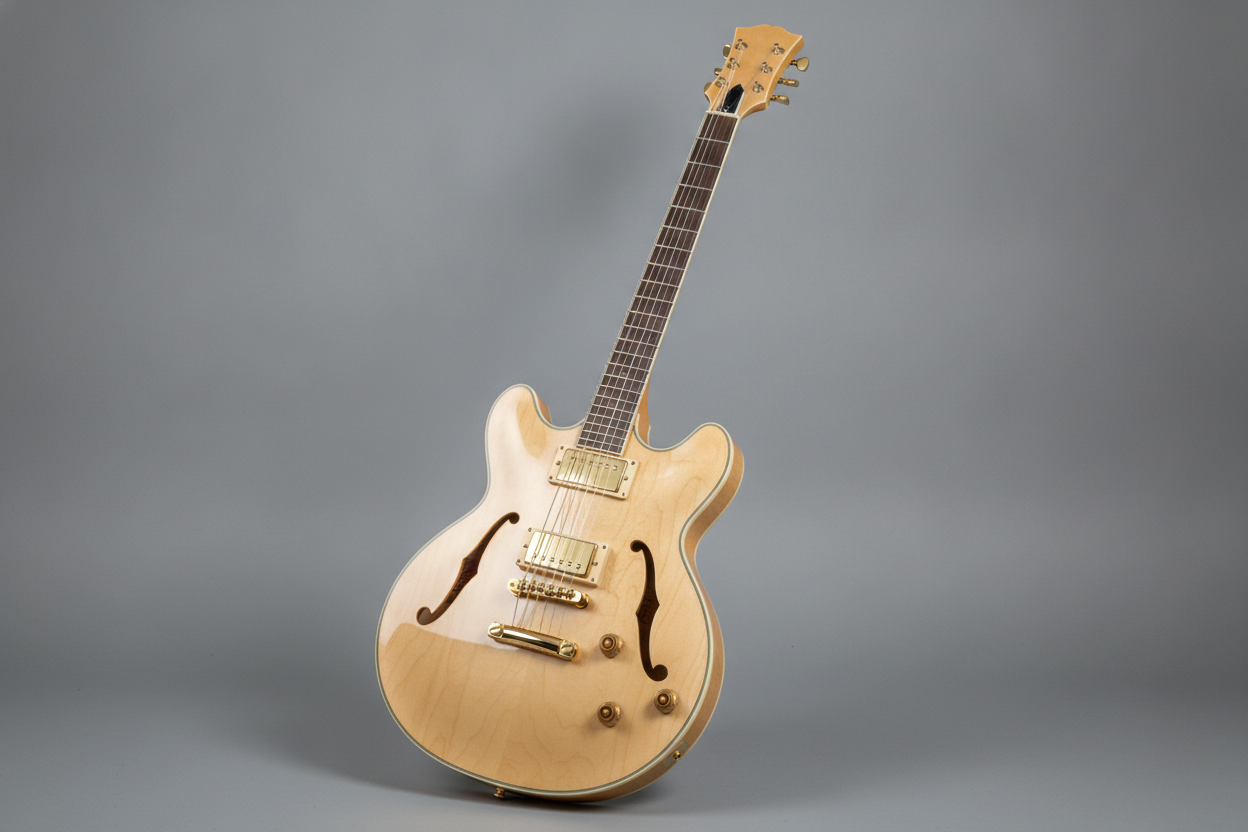
A semi-hollow thinline in natural blonde maple with gold hardware, and the cleanest object of the six. It is also the clearest demonstration of what an instrument render cannot reach. The preset asked for the solid centre block to be visible inside the treble f-hole, because the block is the entire difference between a semi-hollow and a hollow guitar, and both f-holes came back as flat black voids. The trapeze tailpiece that was asked for arrived as a stopbar. The rim depth and the f-hole edge thickness read well from this angle, which was the point of shooting it three quarters on, and the rounded double-cutaway outline is once again the category archetype rather than the original shape requested
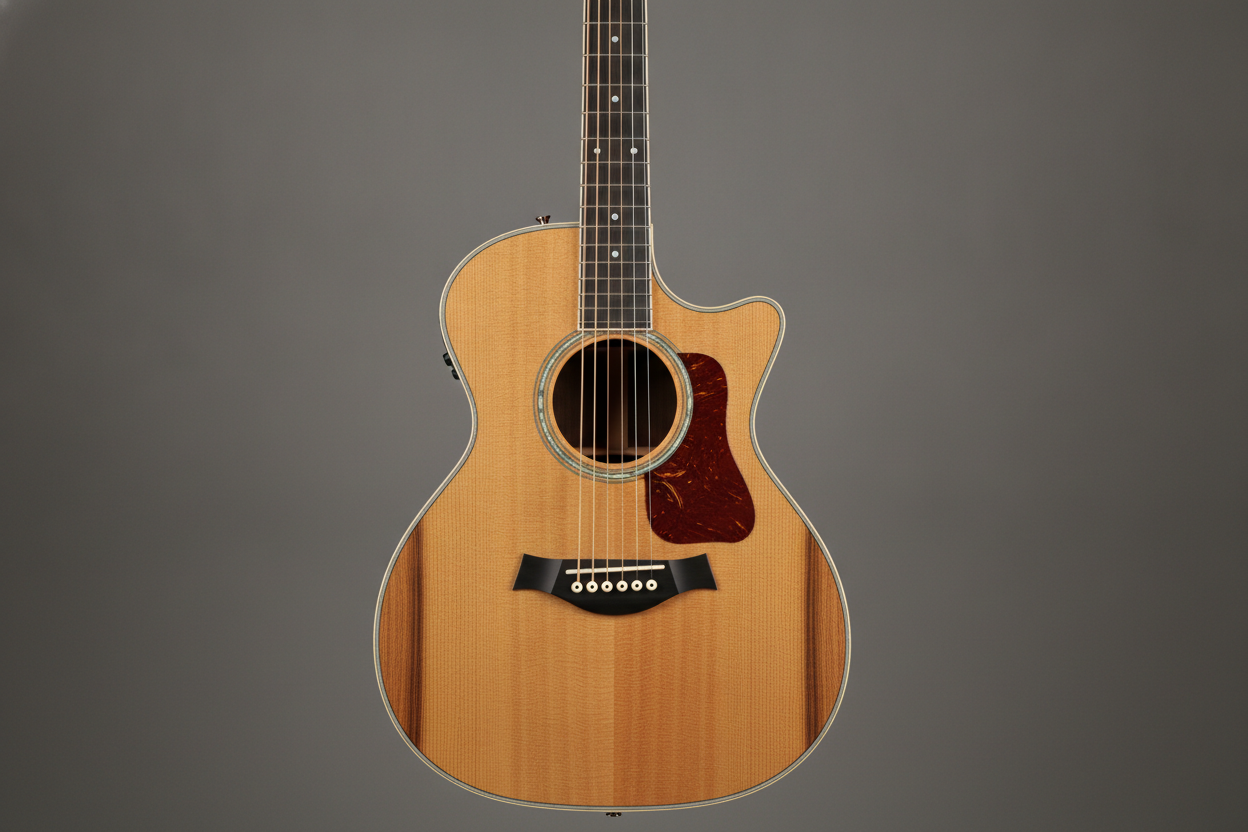
An acoustic grand auditorium with a Venetian cutaway, a solid spruce top and rosewood back and sides. This frame is a regeneration: the first attempt put a script logo decal on the headstock in defiance of an itemised ban, and the fix was to stop banning and start describing, specifying a bare polished headstock face positively. The model complied by cropping the headstock out of the shot altogether. Two substitutions survived. The herringbone wood rosette and purfling that were asked for came back as a pearl ring and a plain white line. And the X-bracing that was supposed to be visible inside the soundhole is a black hole, which matters because on an acoustic the bracing pattern is most of the instrument
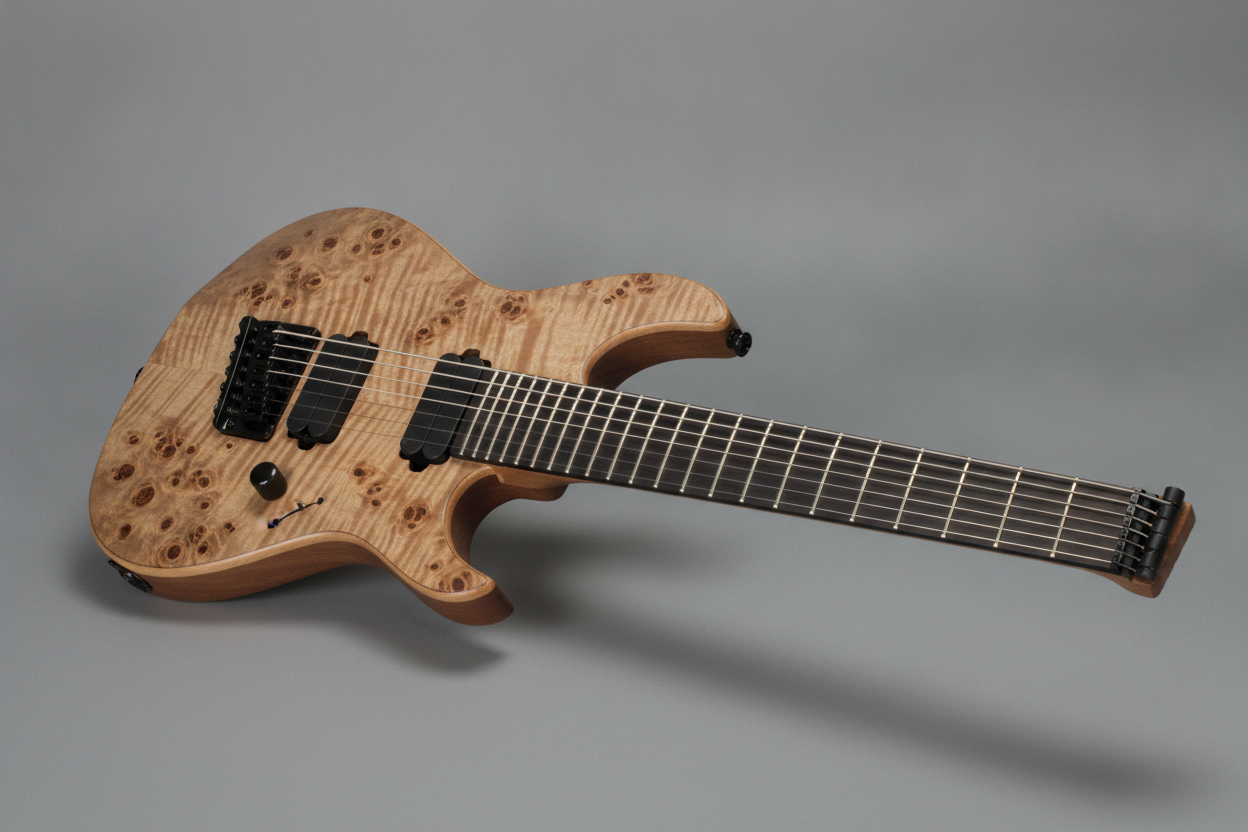
A headless build in roasted ash with a burl cap, ergonomic contours, hardware at the tail and a string clamp at the nut end. It is the only genuinely original outline in the set, and the reason is the argument of this whole page: headless guitars have no dominant archetype for the model to fall back on, so it had to invent instead of remember. Two failures worth naming. The preset asked for visibly fanned frets, which is the defining geometry of a multiscale instrument, and the frets came back square to the neck. And the cap carries burl clusters and flame figure at the same time, which is two different pieces of wood in one board. The pickups sit directly on the top with no mounting screws anywhere
How the AI Guitar Design Generator Works
Pick the construction
A bolt-on solid body, a carved top with a set neck, a semi-hollow thinline, an acoustic flat-top or a headless multiscale build. That single choice decides the neck joint, the bridge family the instrument can take, roughly what it weighs and most of what it costs to make — far more of the design than the colour ever will.
Name the wood, finish and hardware
Say swamp ash or mahogany or flame maple, say opaque or translucent or oiled, and say chrome or gold or black. The model renders figure and sheen accurately, and describe the outline you want in positive terms rather than banning the famous one, because that is the instruction that actually moves the shape.
Hand it over with the numbers attached
Concepts arrive in about twenty seconds at up to 4K. The render settles what the instrument looks like; you write down the five things it cannot hold — scale length, nut width, fingerboard radius, fret size and neck profile — and a builder turns the pair into a full-scale plan.
What a Guitar Render Settles, and What It Hides
Six things decide whether a guitar design works, and an image carries about two of them. Knowing which two is the difference between a concept a builder can quote from and a confident picture of an instrument that could not be assembled the way it appears.
Scale length is the instrument and it is invisible
Nut to bridge sets string tension at pitch, fret spacing, hand travel and most of what players call feel. Twenty four and three quarter inches is slinky and warm, twenty five and a half is tight and bright, twenty seven is baritone. Photographed alone on a plain ground a guitar gives away none of it, because there is nothing in frame to measure against. Fix the number in text first.
The neck is where playability lives and none of it shows
Neck profile, nut width, fingerboard radius and fret size decide whether an instrument suits a hand, and a front-on product shot cannot carry a single one. A vintage seven and a quarter inch radius and a modern compound radius look identical in a photograph and feel nothing alike. These are specification lines, not visual choices, and they belong beside the render rather than in it.
The neck joint hides behind the body
Bolt-on, set neck or neck-through changes cost, repairability, upper-fret access and resale, and it is the decision a straight-on render is least able to show. The carved-top image on this page was asked for a glued-in set neck with a sculpted heel and simply does not display the joint at all. If the joint matters to you, say which one in words and check the heel in a second angle.
The interior is the design and cameras do not enter it
A semi-hollow body is defined by the centre block inside it and an acoustic is defined by its bracing pattern, and both came back on this page as black voids behind the soundhole and the f-holes. Renders photograph outsides. Anything structural that lives under the top has to be specified, drawn and argued about in text, because no prompt will ever make a photograph transparent.
Hardware is a catalogue with fixed footprints
Bridges, tuners, pots, switches and pickups are bought parts, and their dimensions constrain the guitar rather than the reverse: post spacing, tuner hole diameter, route sizes, shaft lengths. Custom tooling only pays back in the thousands. The renders here put a bare headstock on six strings with no tuning machines, mounted pickups with no screws and swapped a trapeze tailpiece for a stopbar, which is the honest summary of how far you can trust rendered parts.
Weight, balance and finish thickness are not in the frame
Two ash bodies from the same board can differ by two pounds, a light body with a long headstock will dive on a strap, and a thick polyester gloss adds weight where thin nitrocellulose does not. The comparison row shows what each finish does to figure and can say nothing at all about how thick the film is or how it will age, which is the half of the finish decision that costs money.
Why Use This AI Guitar Design Generator
Six constructions, not six colourways
A bolt-on solid body, a carved top with a set neck, a semi-hollow thinline, an acoustic flat-top and a headless multiscale build differ in neck joint, bridge family, weight and price. Switching preset changes what the instrument is rather than what shade it happens to be.
A comparison rig built into the presets
One preset renders five identical bodies in five finishes instead of another hero shot, which answers the question this category really turns on: how much of the wood you paid for survives the finish you chose to put over it.
Written as instrument photography
Every preset specifies a plain studio ground, a named camera angle and soft large-source light, so concepts arrive looking like the catalogue photograph they will eventually need rather than an illustration floating in a gradient.
Branding refused item by item
Logos, decals, wordmarks, serial numbers and truss rod cover lettering are banned individually and the headstock face is described as bare, which is why five of the six images on this page carry no marking at all. The sixth is documented rather than hidden.
Consistent across a range
Nano Banana Pro holds a described style across separate generations, so reusing one wood and one hardware colour while changing only the construction gives a family of instruments that reads as a single line rather than six unrelated guitars.
Cheap enough to show a customer six options
About twenty seconds per concept and plans from $2.99 means a builder can put six versions of a commission in front of a client before touching a plank, which is exactly the stage where custom instrument projects usually go wrong.
AI Guitar Design Generator FAQ
Related Design Tools
AI Album Cover Generator
The other half of what a musician needs made. That page owns the artwork the record goes out in; this one owns the instrument it was played on.
AI Cutting Board Design Generator
The closest technical sibling, because both pages are really about reading wood in a render. Same lesson there: species and figure come out right, joinery gets invented.
AI Furniture Design Generator
Bigger objects, same problem. Useful if the thing you are designing is held together by joints a photograph cannot show you.
Design Your Guitar Now
Six guitar constructions, woods that render with the right figure, a comparison row that shows what each finish costs you in visible grain, and 4K instrument shots in about twenty seconds. Free to start, from $2.99 for more.
Start Designing FreeAbout This AI Guitar Design Generator
An AI guitar design generator is genuinely useful on one part of the job and actively misleading on the rest, so it is worth drawing the line clearly. Building an electric guitar is four decisions stacked on each other. The first is geometry: scale length, and the fret positions that follow from it, the neck pocket or tenon, and where the bridge sits relative to the pickup routes. The second is the neck, meaning the profile, the nut width, the fingerboard radius and the fret size, which together decide whether a player likes the instrument or quietly never picks it up. The third is electronics and hardware, which is a parts list and a wiring diagram rather than a drawing. Only the fourth — outline, wood, figure, finish and hardware colour — is something a photograph can settle, and it happens to be the one everybody argues about hardest and describes worst. That is the part this tool does in about twenty seconds.
That is also why the six presets here are constructions rather than colourways. A bolt-on solid body, a carved top with a glued-in set neck, a semi-hollow thinline with a centre block, an acoustic flat-top and a headless multiscale build differ in how they are assembled, what bridge family they can accept, what they weigh and what they cost to make. Changing a guitar from butterscotch to seafoam is a much smaller decision. The wood is not a small decision, though, and one of the useful things a render does is show you how a stain sits over figure: the comparison row on this page puts five identical bodies side by side with only the finish changing, and the result is quick to read. Opaque colour hides grain completely, which means the wood underneath only has to be sound rather than pretty. Translucent stain needs figure beneath it or it has nothing to say. And the difference between bare sanded wood and a satin oil finish is close to invisible in a photograph even though it transforms how the instrument feels in the hand.
The most interesting failure on this page is about shape, and it draws a boundary worth carrying to every other product category. The presets ban the famous body outlines and headstocks by name, because guitar silhouettes are registered trademarks and the companies that own them do enforce against small builders. The ban on branding works: five of six images carry no logo, no decal and no lettering anywhere. The ban on outlines does not work at all. The solid body came back within touching distance of the most copied shape in the world, the comparison row repeated a near-identical outline five times over, and the semi-hollow returned the category archetype. The one preset that produced a genuinely original shape was the headless build, and the reason is instructive: headless guitars have no single dominant archetype for the model to fall back on, so it had to invent. The rule that falls out of this is simple and general. A negative instruction can remove something added to an object, like a logo or a decal or a stamp. It cannot remove the outline of the object itself, because that outline is what the model believes the object to be. To move a shape you have to describe the geometry you do want, in positive terms, with the waist, the horns, the cutaway and the bout widths named.
The second thing this guitar design generator taught is that the interior is unreachable. The semi-hollow preset asked for the centre block to be visible inside the treble f-hole, because that block is the whole difference between a semi-hollow and a hollow instrument, and the f-holes came back as flat black voids. The acoustic preset asked for the X-bracing to be visible inside the soundhole, and the soundhole came back as a black hole, which matters more than it sounds, since the bracing pattern is most of what decides how an acoustic top moves and therefore how it sounds. Nothing in a prompt fixes this, because a photograph shows the outside of things and these are the inside. Treat the interior, the neck joint, the scale length, the neck profile, the fingerboard radius and the fret size as a written specification that travels beside the image, not inside it. Do that and this tool earns its keep: it runs on Nano Banana Pro, which holds a described style across separate generations, so one wood and one hardware colour can carry a whole family of concepts; it is free to start and paid plans begin at $2.99; and it turns the expensive, slow, argumentative stage of a custom instrument — deciding what the thing will look like — into six pictures you can put in front of a customer before anyone cuts a plank.