
AI Potting Bench Design Generator
See the bench standing against your own wall before you buy a single board. This AI potting bench design generator turns a description into a finished bench photographed where it stands, in about thirty seconds — classic weathered oak, reclaimed scaffold board, open soil trough, compact, minimalist pale oak and painted sage green. All six results are below exactly as they came back, with what the prompt asked for and what actually arrived.
Design a Potting Bench FreeTry the AI Potting Bench Design Generator — Free
Pick a style, then use the box for what is specific to you — the timber, the stain or paint colour, a second shelf, a slatted top that drops compost through, a zinc trough, a boarded back with a tool rail, the wall or fence you already have behind it. Each preset already carries the joinery, the connections, the camera position, the weathering and the no-lettering list, all tightened after reviewing what came back the first time.
AI Potting Bench Design Generator
Choose a style, name your timber, shelves, trough and finish, and get a photorealistic potting bench built and standing on the grass. Up to 4K.
Six Benches From the AI Potting Bench Design Generator, Shown Exactly As They Came Back
Nothing here was regenerated or retouched. Each caption says what the prompt asked for and what actually arrived, because the gap between those two is the part nobody publishes.
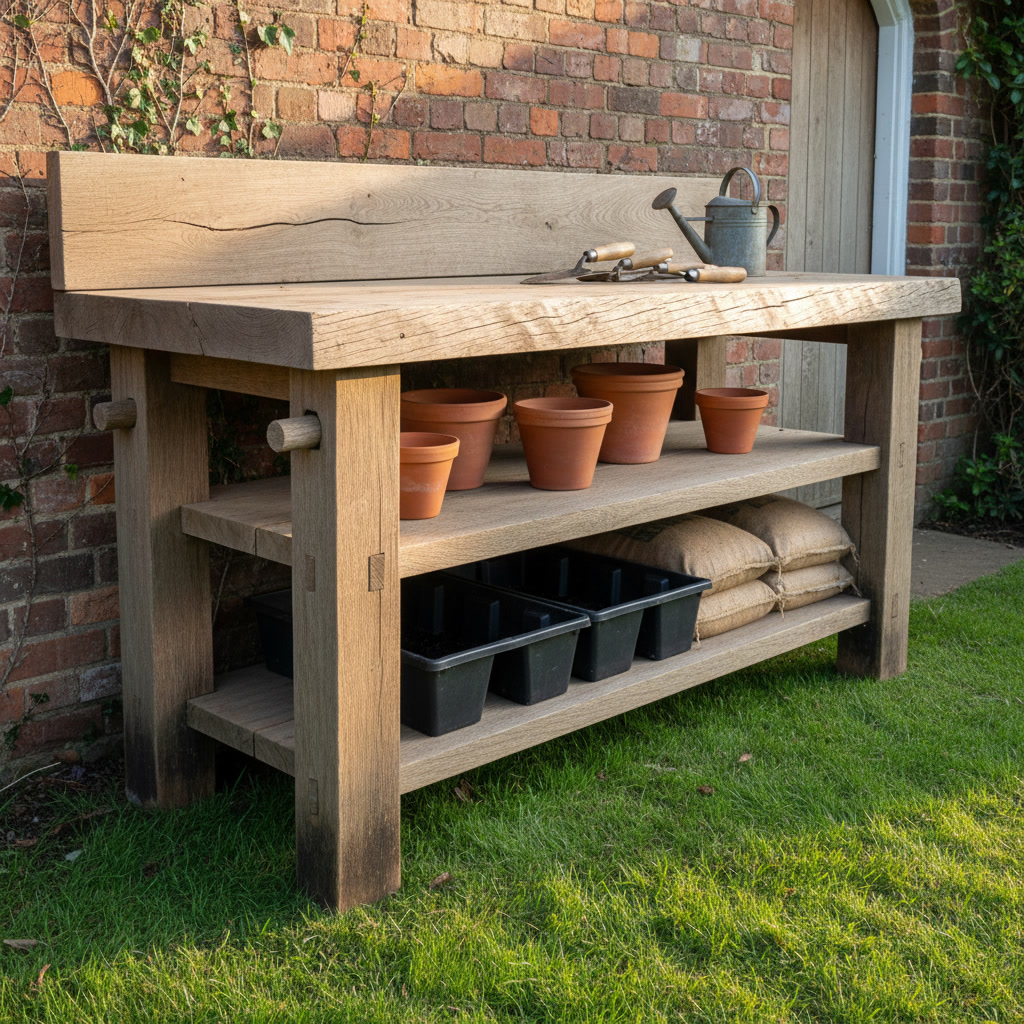
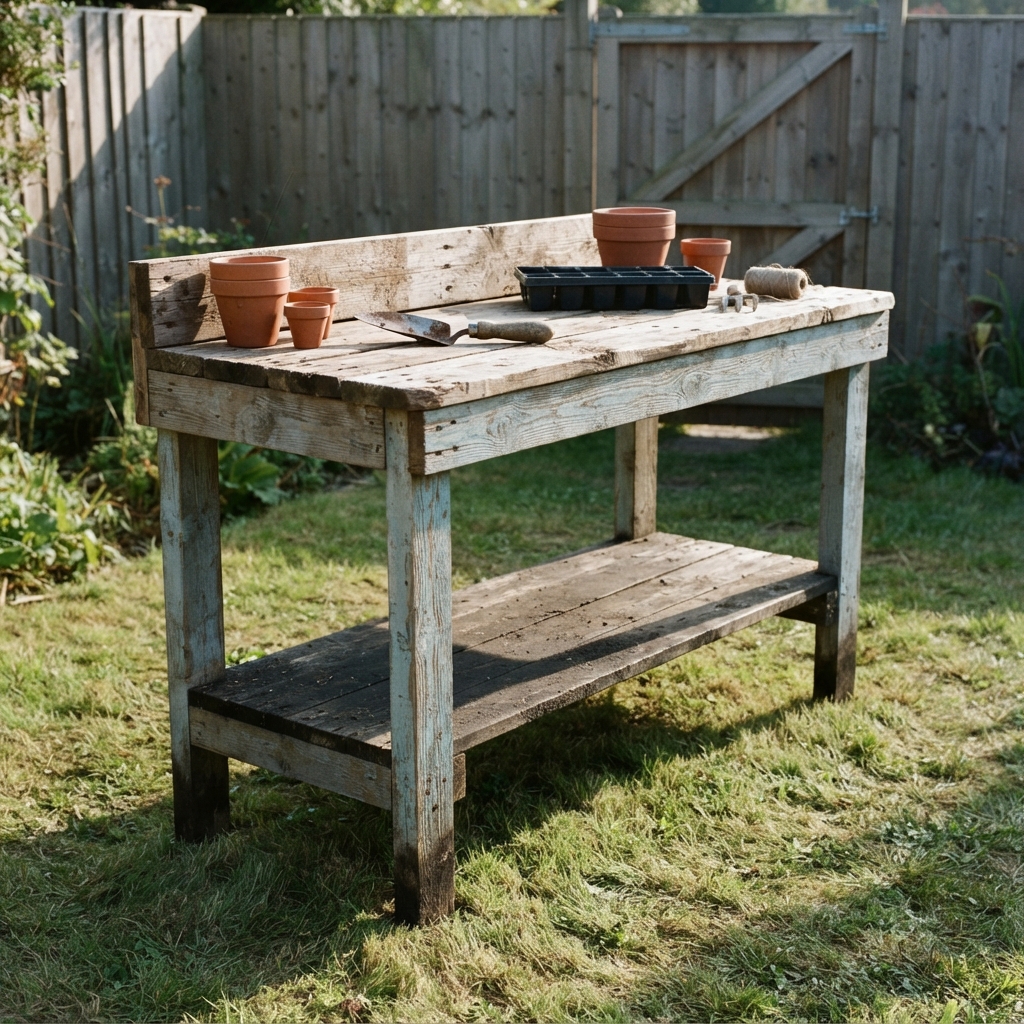
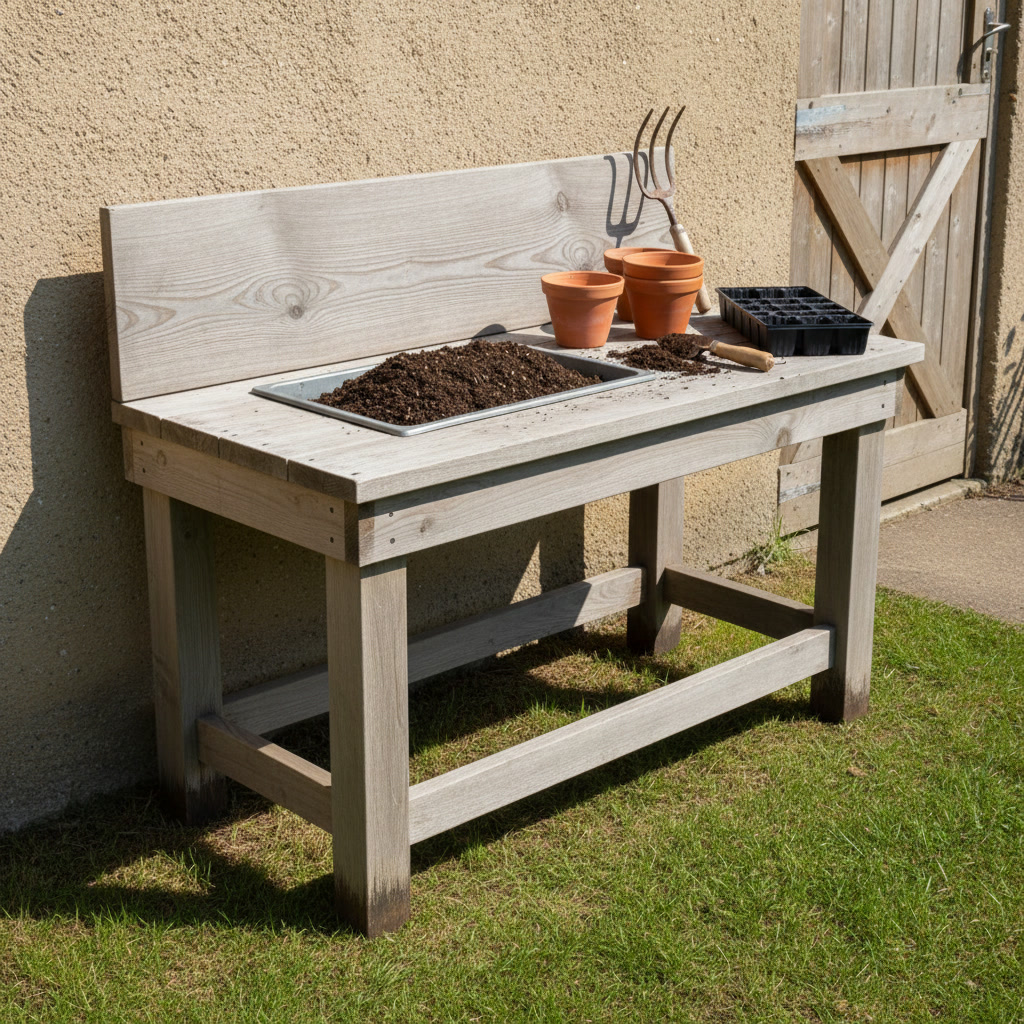
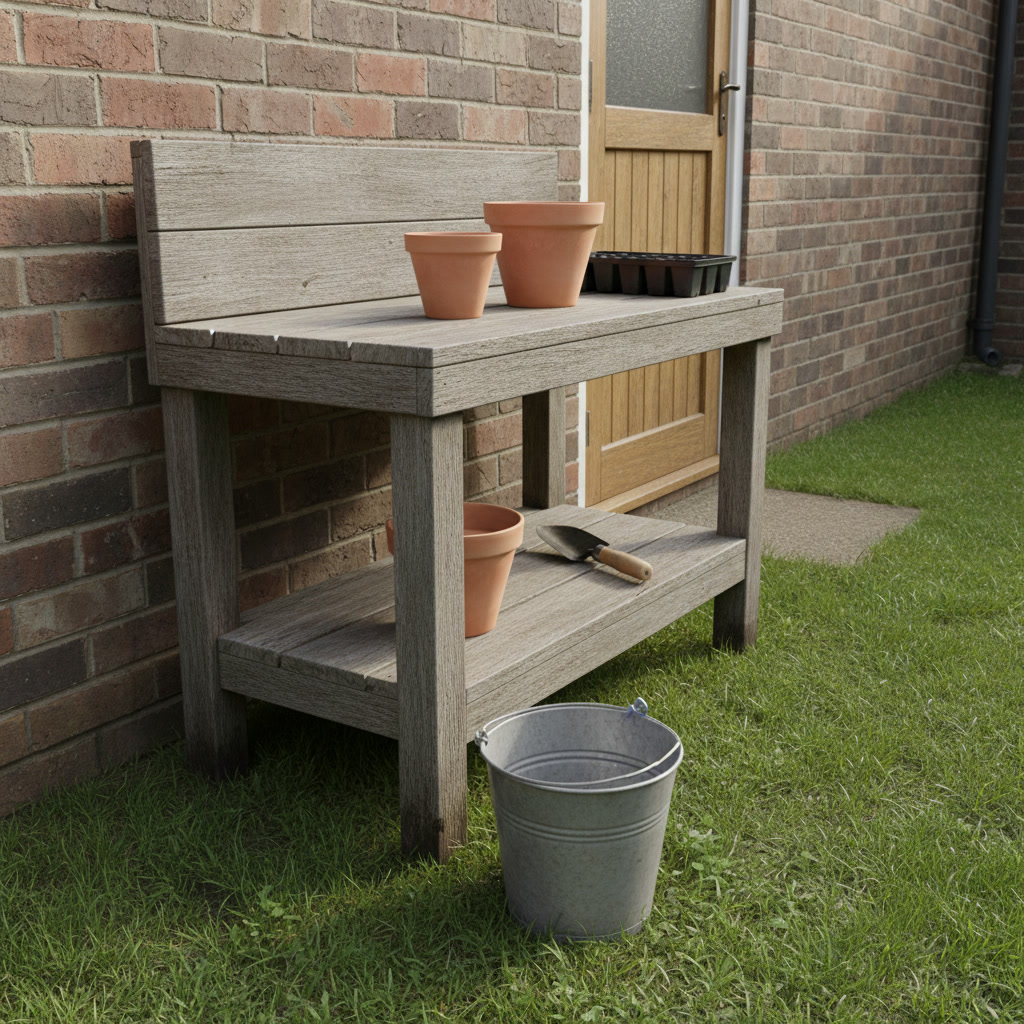
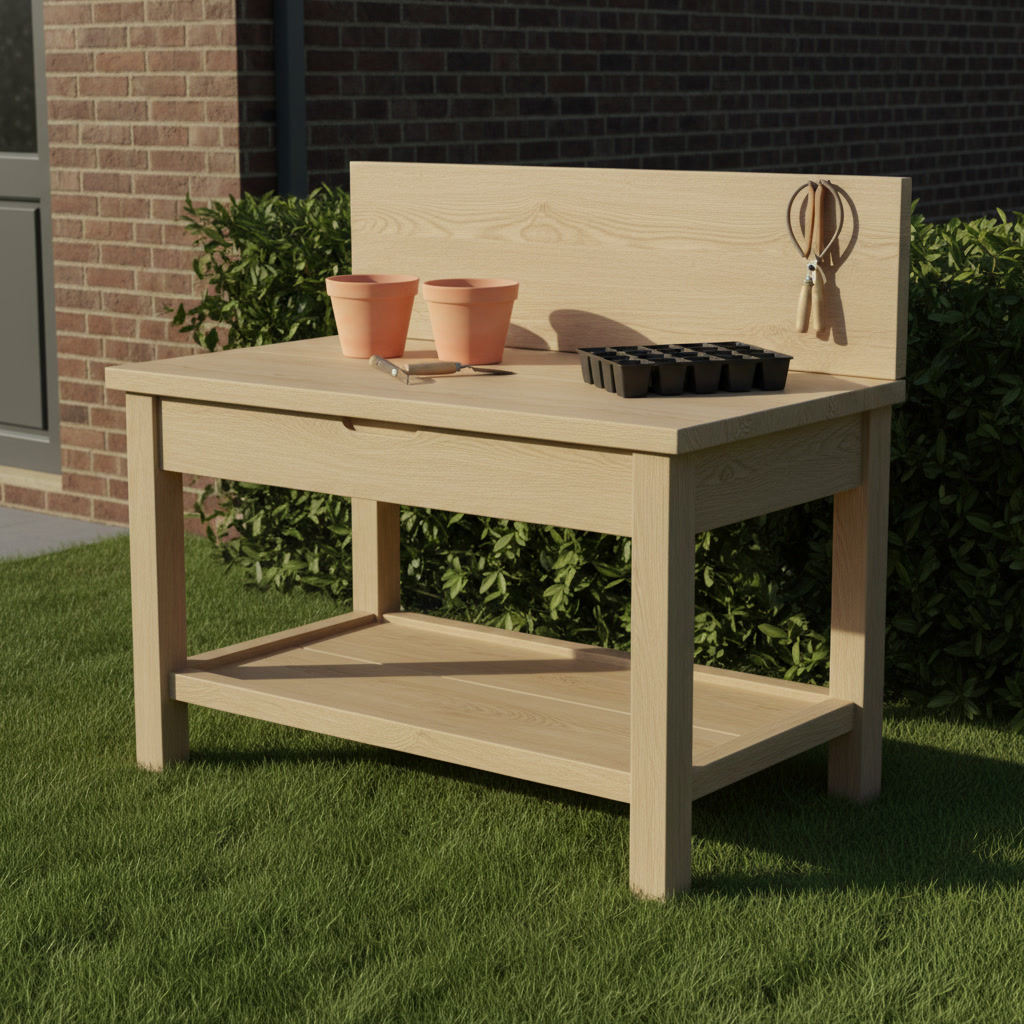
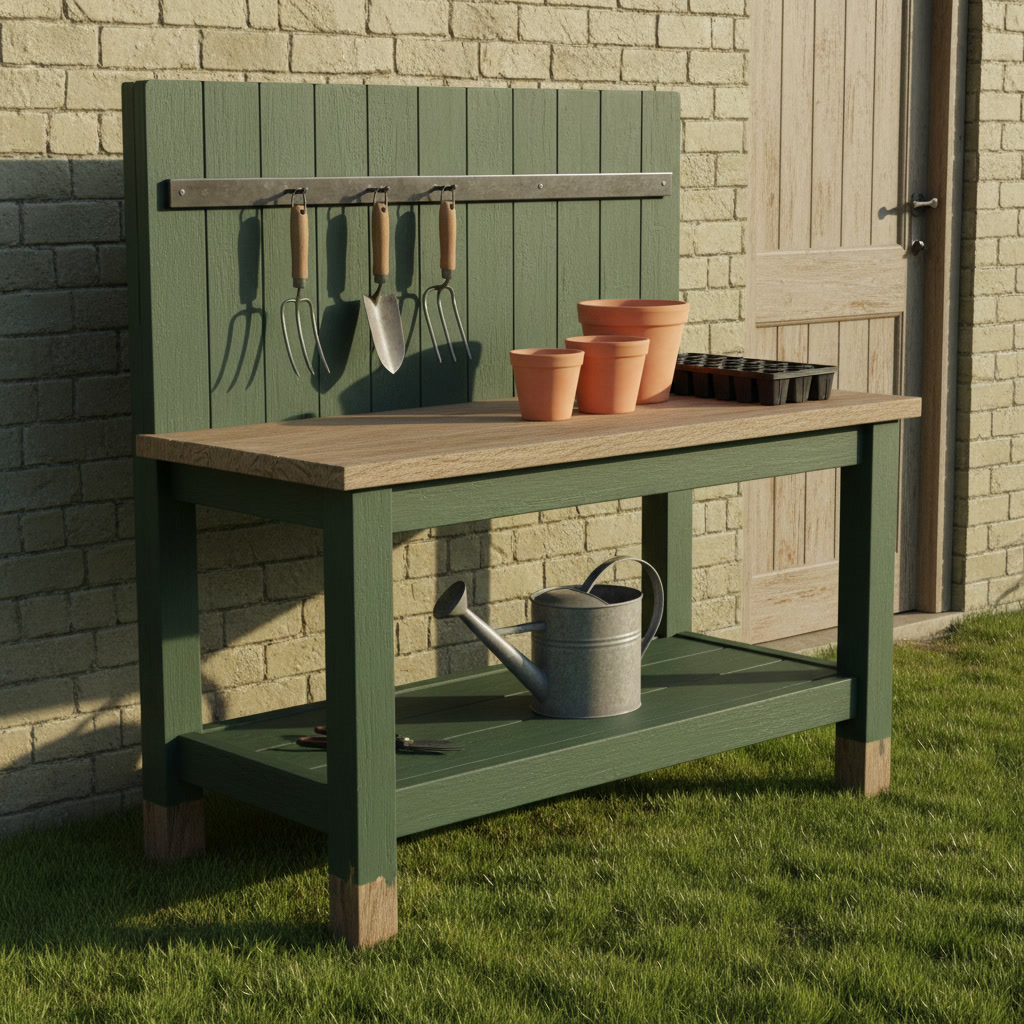
What the AI Potting Bench Design Generator Gets Right and Wrong
A potting bench is a simple frame with a very strong garden archetype behind it, and almost every interesting failure comes from that archetype pushing back.
Describe a built-in trough as geometry, not as a name
Asking for a bench with a built-in soil trough gets you a tray standing on top of the worktop. What lands is the sequence written out as geometry: a rectangular hole cut clean through the worktop, a shallow tray dropped into that hole, only its turned-over rim proud of the timber, the whole body hanging hidden below. The second half is the fill. A loose material inside a closed body gets painted onto the outside face instead of drawn inside, so the trough has to be open at the top with the compost heaped above the rim.
Legs hold the camera, and the angle has to be named separately
Small garden objects normally drag the camera up and over, and the usual fix is an anchor object standing in the foreground. A potting bench needs none: height built into the design held the view at standing eye level in five of these six frames, and not one preset contains an anchor clause. The angle is a separate fight, because a bench seen from the front is close to symmetrical and symmetry pulls the lens square on. Naming it explicitly won it six times out of six — the camera stands well off to one side, and the wall behind and the architrave of a door in it are both named as being in shot.
A fresh pale finish deletes every wear clause
The clearest A/B on this page. The same weathering language that greys the feet of the oak bench, leaves old paint down in the grain and splits a worktop does nothing whatever once the timber is described as new, pale or minimalist. Clean, plain and smooth is the vocabulary of a visualisation, and it quietly overrules a whole paragraph asking for a photograph.
Old paint works when you say where it survives
Pale-on-darker wear normally comes back as flicked white paint, and asking what a surface became gets you nothing. Naming where the old finish survives is what lands: ancient pale blue surviving only down in the grain of the wood, worn clean away from the raised parts. Same for chipping — pinned deliberately at the very foot of each leg, it arrives exactly there, which is worth knowing because unpinned chipping always migrates to the plinth on its own.
One sentence per part — and it scales past three
A property given to two matching parts in a single phrase reliably lands on one of them, and a list of three gets sampled rather than filled. The fix is to spend the words: describe each part in its own full sentence and never refer back to an earlier one. On the painted bench that carried four parts — legs, rails, boarded backboard and lower shelf — and all four came back correct, against a previous build page where a colour handed to three parts in one phrase landed on two. Every preset here also writes the near front leg and the far front leg as two separate sentences rather than saying both legs.
Grass holds the view, gravel loses it
What the potting bench stands on matters as much as the bench itself. A patterned ground — gravel, paving, decking boards — reads as a pattern worth photographing and pulls the camera up into a high three-quarter or overhead view. Mown grass holds the camera down at standing height. All six presets stand the bench on grass for exactly that reason, even though a real potting bench usually lives on a hard standing.
Describe a part as an object, not by what holds it up
The shared joinery paragraph describes the lower shelf as carried on its own cross rails fixed into all four legs. On the trough bench that was the only place the shelf was mentioned, and what arrived was the rails and no shelf at all — a bare stretcher between the legs with nothing lying on it. A part named only through its support can collapse into that support. Name the object first in the scene description, then follow it to what carries it.
A named light direction lands about two thirds of the time
Stating where the sun comes from is the single biggest lever against a render, and it is not reliable. Four of these six frames have exactly the light that was asked for. One flipped outright, with midday sun written as coming from the left arriving from the right. One ignored the instruction and came back flat and overcast with no cast shadows at all — and lost most of its photographic quality with them. It is worth restating the direction in the same sentence as the shadow it throws, which is what the four that worked all do.
Pre-declare the props a garden scene brings anyway
Terracotta pots, seed trays and hand tools arrive whether you ask for them or not, and each one is a surface that wants printing on it. Banning them outright tends to fail, because they are part of what the subject is. Settling their form in advance works: any terracotta pot is plain and unstamped, any seed tray is plain, empty and black, any tool has a plain wooden handle. The prop arrives either way — the only question is whether you described it.
How It Works
Pick the style
Six presets for the potting bench design generator: a classic three-level bench in weathered oak, a bench built from reclaimed scaffold boards, one with an open soil trough let into the top, a compact bench for a narrow garden, a modern minimalist bench in pale oak with a drawer, and a painted sage green bench with a boarded back and a steel tool rail. Each already carries the joinery, the connections, the camera position, the weathering and the no-lettering list.
Add your bench
Put the specifics of your potting bench in the box: the timber, the stain or paint colour, one shelf or two, a slatted top, a zinc trough, a boarded back with hooks, the wall or fence behind it. Describe materials physically rather than naming a style, and say what each part lands on — the worktop on its rails, the rails into the legs, the legs on the grass.
Check it, then download
About thirty seconds later you have a potting bench photographed where it stands. Before you judge the look, check three things: does every leg carry on down until its foot stands flat on the ground, is the lower shelf actually sitting on rails rather than floating between the legs, and did both front legs come back the same. Then generate two or three more. Downloads go up to 4K.
Writing a Prompt That Produces a Buildable Potting Bench Design
Four habits that separate a design worth showing a joiner from one you regenerate, all learned from the six results in the gallery above.
Write the fixing through the timber
Not bolted together, but a peg driven right through the front leg and the rail it carries, with both sawn ends standing proud of the face. A fixing you can see from both sides gets drawn; one described only by the joint it closes gets implied, and an implied fixing is a floating one. Point it somewhere the camera can see, too — a fixing hidden behind the bench gets relocated into the grass.
Ask for the wear that gets drawn
A leg stained dark and greyed where it meets the grass lands every time, and fading gradually upward keeps it from arriving as a hard black band. A ring of wear on the worktop never lands, and a stain asked for on a timber top comes back as a hole cut through it. For the top, ask for an open split running along the grain — and give it a thick slab to split, because thin boards do not.
Give size a thing to be measured against
Stated measurements never land. A compact bench reads as small because a plain galvanised bucket stands in front of the near leg with its rim at exactly the same height as the lower shelf, and because the full-size version is banned from the frame by name. Proportion against something familiar in shot is the only size instruction that works — and say which object is in front, or the two tangle.
Say where the light comes from, then add texture
No stated light direction gives you a render every time, but naming one is not enough on its own. Put a real material on the bench itself — rough-sawn faces, grain standing proud, darker end grain, knots, old paint left in the grain. Texture on the wall behind the bench does not save a flat one.
Who Uses an AI Potting Bench Design Generator
Weekend woodworkers
A potting bench is the classic second outdoor build — simple enough to finish in a weekend, and endlessly variable. The plans you find online are cutting lists and nothing else. None of them tells you whether the trough is worth cutting, or what reclaimed scaffold board actually looks like beside your fence. Generate the same frame three ways and the decision is made before the first board is cut.
Gardeners buying rather than building
The catalogue photograph is taken on a white sweep with three identical terracotta pots on it. Seeing the same bench on grass, at eye level, against your own brick wall and in your own afternoon light is a comparison nobody sells you, and it answers the question the product shot dodges: will it look like garden furniture or like flat-pack in two years.
Garden and landscape designers
The working end of a garden is the part clients cannot picture from a plan. A photographed bench against the boundary wall is worth more in a presentation than a CAD block, especially when you are arguing for a boarded back and a tool rail instead of the open frame everybody already imagines.
Allotment and community garden groups
A shared potting bench gets built out of whatever timber turns up, and the argument is always about layout rather than looks: one shelf or two, trough or flat, back board or open. Generating each option settles it in an evening, and reclaimed scaffold board is one of the six presets because that is what actually arrives.
Small-space and balcony growers
The compact bench is its own decision — low and narrow enough to fit a side return, deep enough to actually pot up on. The preset shows one at a believable size beside a familiar object rather than quoting a width, which is more useful than a product listing with dimensions you cannot picture.
Joiners and garden carpenters quoting a job
Showing a customer a configuration you have not built yet normally means a sketch or a CAD render that looks like a render. These come back looking photographed — greyed feet, grain standing proud, old paint in the grain — which sells the build better, as long as the spec and the cutting list go on a separate sheet.
AI Potting Bench Design Generator FAQ
Related Design Tools
AI Greenhouse Design Generator
For the building the bench usually stands in or beside. Glazing, framing, staging and ventilation, when the question is the structure rather than the furniture.
AI Picnic Table Design Generator
The same joinery thinking applied to outdoor seating. A-frame legs, attached benches and bare oak tops, with the same weathering vocabulary.
AI Shed Design Generator
For where the tools live when they are not on the rail. Cladding, doors, windows and roofs, at the scale above a bench.
See It Against the Wall Before You Buy the Timber
Six styles — classic weathered oak, reclaimed scaffold board, open soil trough, compact, minimalist pale oak and painted sage green — each photographed where it stands in about thirty seconds, in your garden and in your light. Up to 4K. Free to start, from $2.99.
Design a Potting Bench FreeAn AI Potting Bench Design Generator for Woodworkers, Gardeners and Anyone Pricing a Garden Workstation
A potting bench is the easiest garden build to get wrong, because every source of information about one is either a cutting list or a studio photograph. The plan gives you board widths and shelf heights and tells you nothing about how the finished thing sits against a brick wall. The catalogue shot is taken square on against a white sweep with three matching terracotta pots on it, no grass, no wall and no scale. Neither answers the question people actually have, which is whether a trough cut into the worktop is worth the trouble, whether reclaimed scaffold board will look like character or like a skip, and whether the thing will fit the side return they have. That is the gap an AI potting bench design generator fills. Describe the timber, the shelves, the trough, the backboard, the finish and the wall behind it, and about thirty seconds later you have a photograph of the bench standing there. Every preset on this page is written that way, and the six results above are published exactly as they came back, failures included.
The six styles cover the shortlist a real project actually has. A classic three-level bench in heavily weathered oak, which is what most people picture when they say potting bench. One built from reclaimed scaffold boards with old paint still down in the grain, because that is what most people actually build from. One with an open soil trough let into the worktop, the feature that changes how the bench is used and the one nobody can visualise from a plan. A compact bench for a narrow town garden, where the whole decision is proportion. A modern minimalist bench in pale oak with a drawer, for anyone who wants the form without the allotment associations. And a painted sage green bench with a boarded back and a steel tool rail, because paint on something that lives outdoors permanently is a decision you want to see aged rather than new.
The pattern in what came back teaches more than a feature list. Joinery described end to end is the solved half: a peg driven right through the front leg and the rail it carries with both sawn ends proud, a shelf carried on its own rails fixed into all four legs, a leg that carries on down until its sawn foot stands flat on the grass with a real contact shadow. Built-in features are solved too, but only when written as geometry rather than named — a hole cut clean through the worktop, a tray dropped into it, only the rim proud, the body hidden below, and the trough open at the top so the compost draws inside it instead of being painted on the outside. Weathering is solved in one direction only: a leg stained dark and greyed where it meets the grass lands every time, old paint surviving down in the grain lands, and a ring of wear on the worktop never does. The camera is solved for free on this subject, because a bench has legs, and height built into the design holds the view at standing eye level without any of the foreground tricks smaller garden objects need.
The working rules follow directly, and they are all in the presets now. Write each fixing through the timber it passes through rather than across the gap it closes, and point it somewhere the camera can see, because a fixing hidden behind the bench gets relocated into the grass as a detached object. Describe the near front leg and the far front leg as separate sentences, because both legs is read as one leg, and never hand a single property to a list of three parts. Ask for the wear that actually gets drawn — greyed feet fading gradually upward, old paint surviving in the grain, an open split in a thick slab — not a stain ring on the top. Give size something in the frame to be measured against instead of a number, and say which object stands in front. Name a direction for the light and then put a real material on the bench itself, because texture behind the subject does not save a flat one. Stand the potting bench on grass rather than gravel or paving, which are patterns that pull the camera up and over. And keep enumerating everything a garden scene brings that carries print — the plant label, the seed packet, the compost sack and the empty holder where a label would sit — while pre-declaring the pots, trays and tools that turn up uninvited, because a prop you have described is a prop that cannot surprise you. Inside those limits this is a genuinely good way to spend twenty minutes before you spend on timber: the layout gets settled, the household agrees on something it can point at, and the joiner gets a picture instead of an argument.