
AI Headboard Design Generator
See the headboard standing against your own wall, at your own height, before anybody buys timber or fabric. This AI headboard design generator turns a description into a finished headboard photographed behind a made bed in about thirty seconds: reclaimed weathered oak planks, upholstered oatmeal linen, woven cane in black steel, painted Shaker panels, slatted walnut with shelves let into it, and a pine storage headboard with cubbies. All six results are below exactly as they came back, with what the prompt asked for and what actually arrived.
Design a Headboard FreeTry the AI Headboard Design Generator — Free
Pick a style, then use the box for what is specific to you — oak, walnut, pine, cane, steel or linen, the height above the mattress, whether it carries shelves or storage, and the wall you already have behind the bed. Each preset already carries the construction wording that keeps every board and slat housed into both rails, the count formula that fixes panel and cubby numbers, the camera position, the named light direction and the no-lettering list.
AI Headboard Design Generator
Choose a style, name your timber, fabric and finish, and get a photorealistic headboard standing behind a made bed. Up to 4K.
Six Headboards From the AI Headboard Design Generator, Shown Exactly As They Came Back
Nothing here was regenerated or retouched. Each caption says what the prompt asked for and what actually arrived, because the gap between those two is the part nobody publishes.
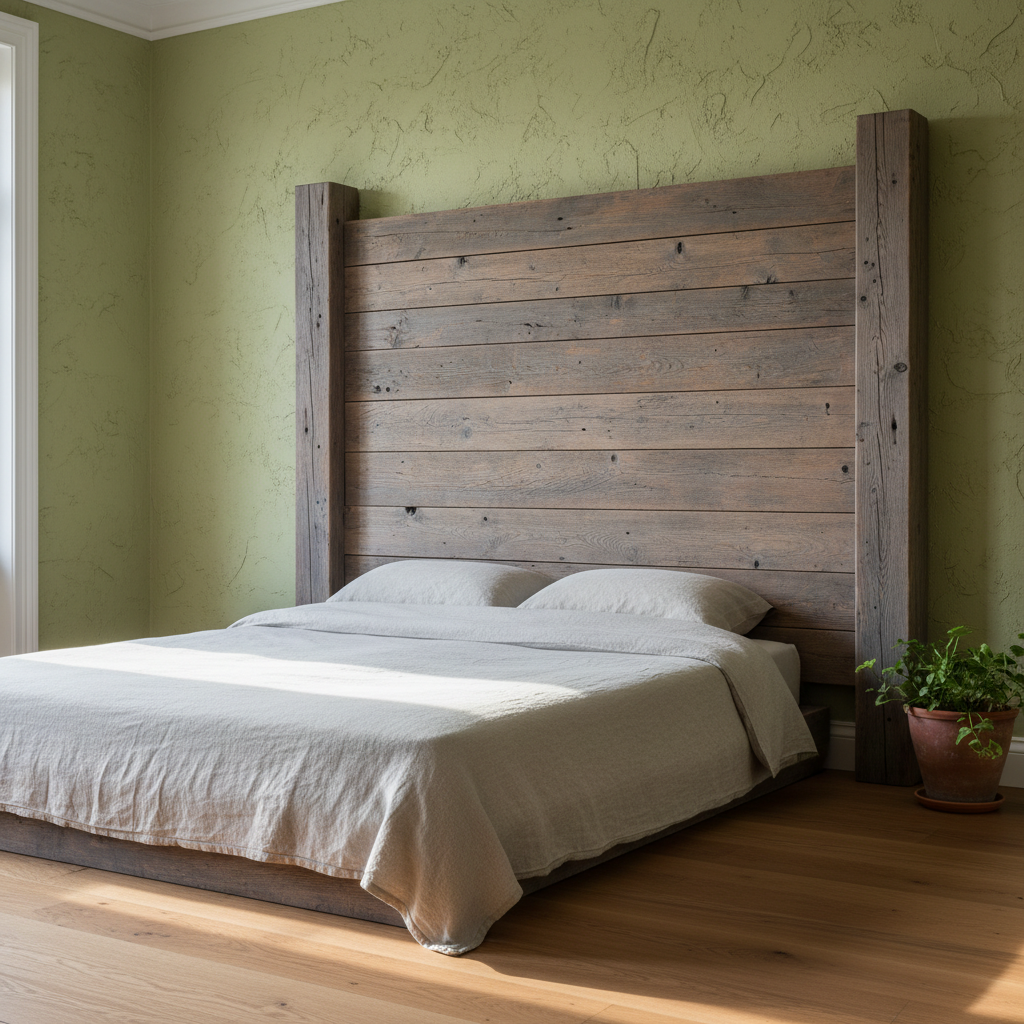
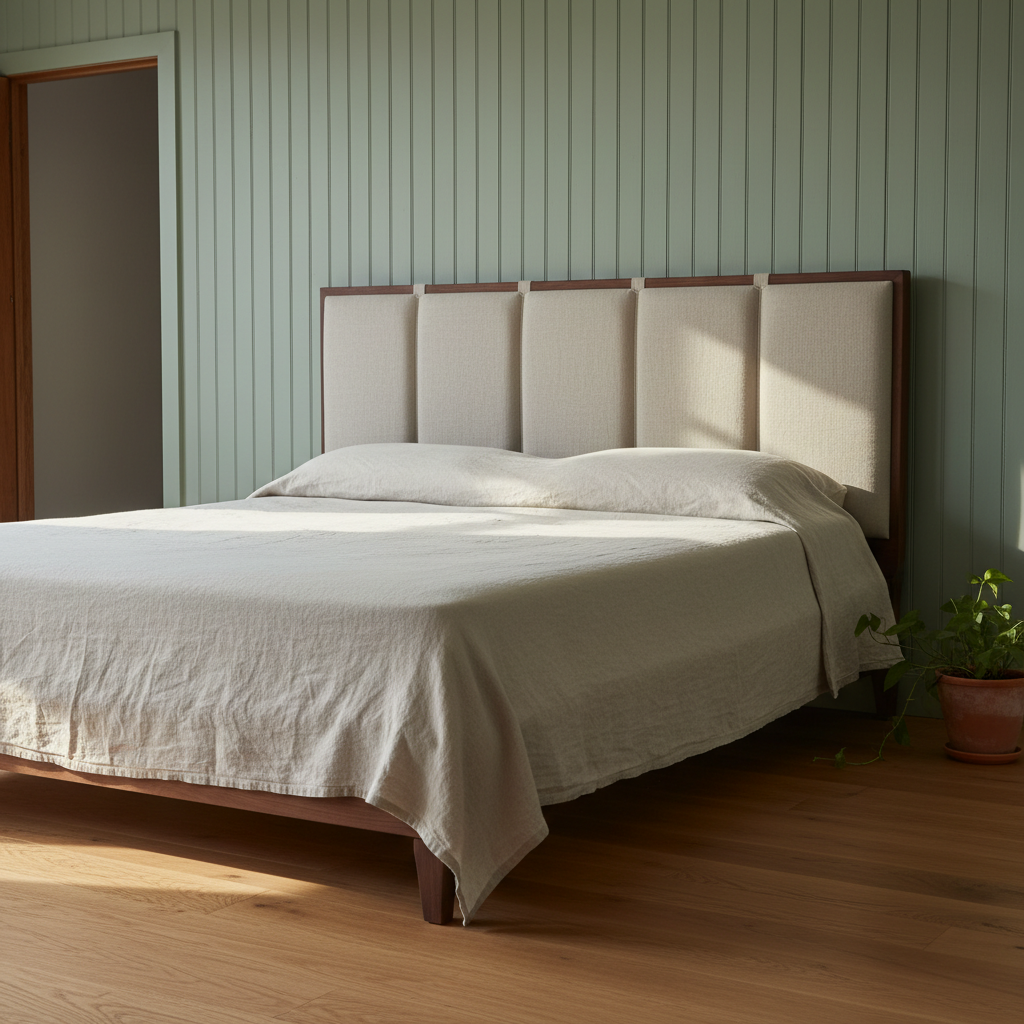
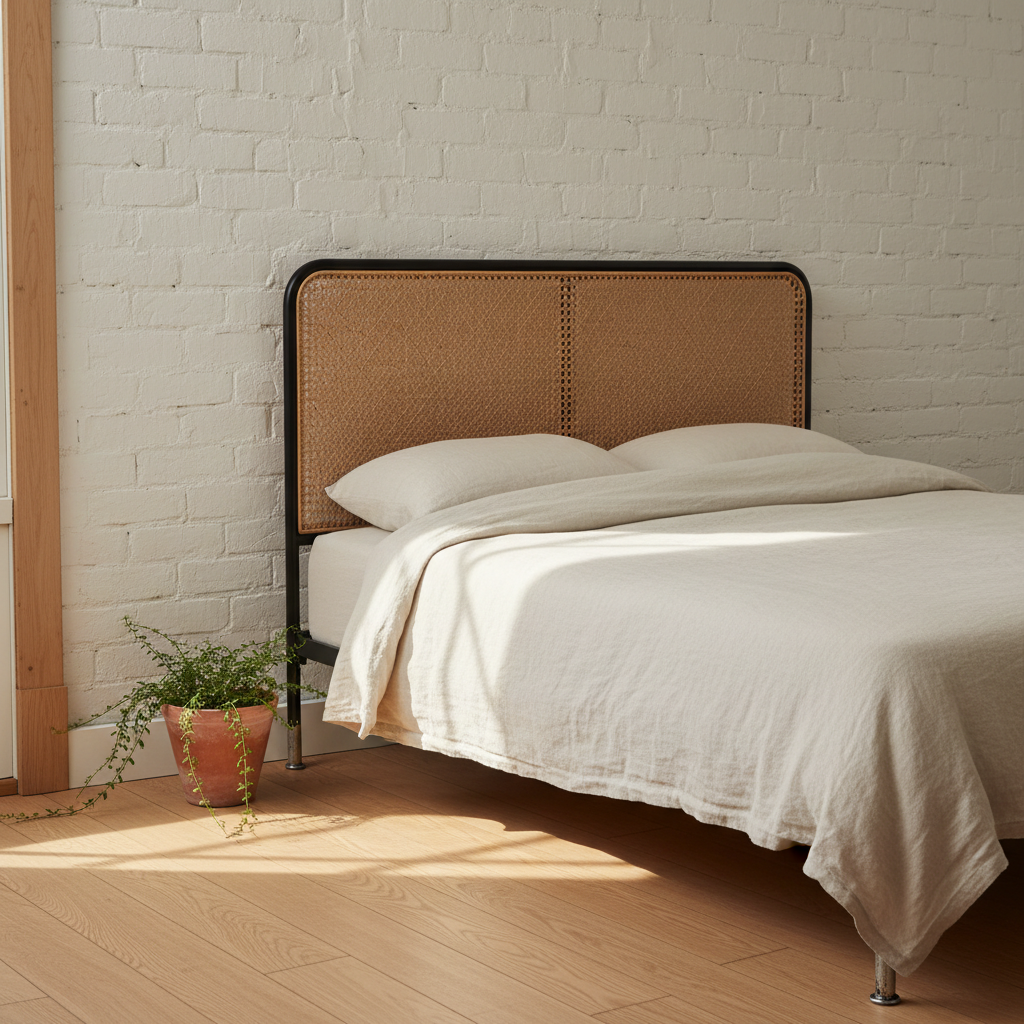
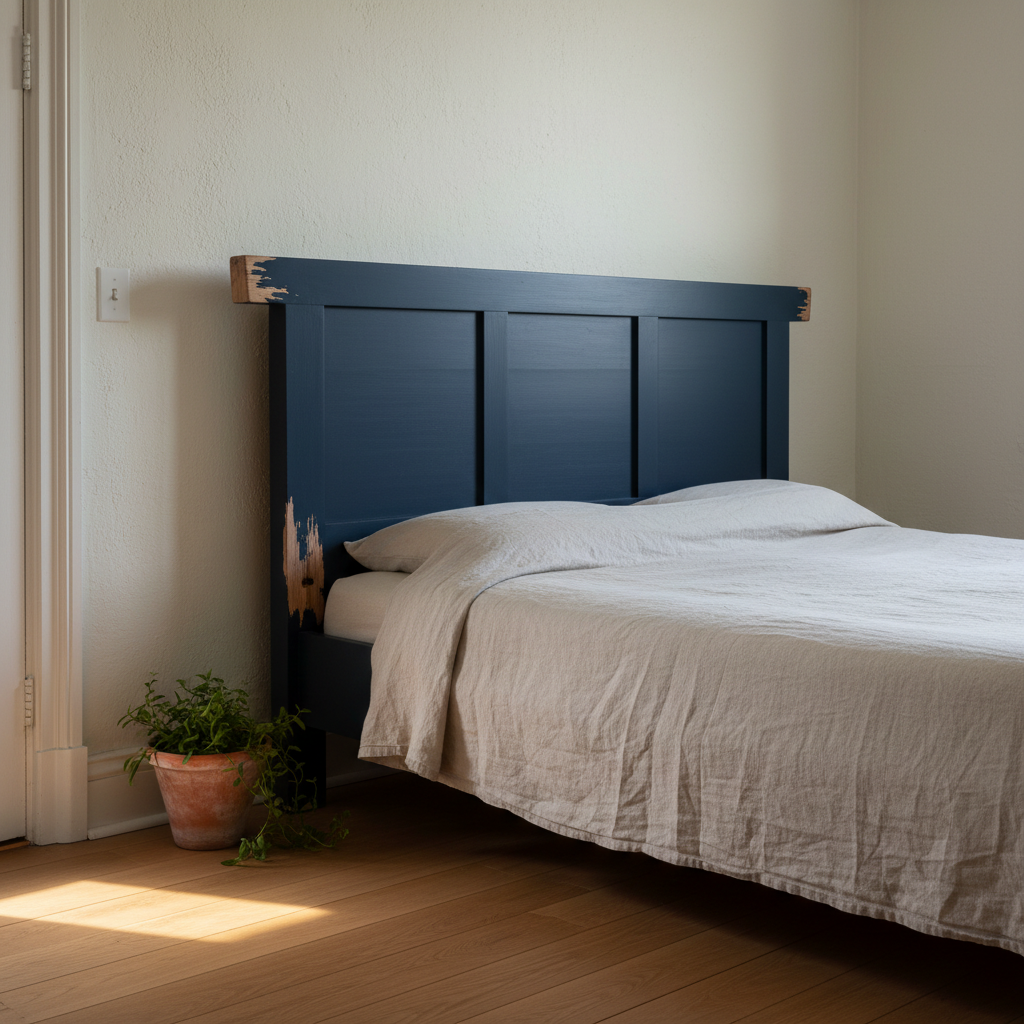
What the AI Headboard Design Generator Gets Right and Wrong
A headboard is a flat object pressed against a wall with a mattress hiding its bottom edge, and almost everything interesting that happened here happened because of one of those three facts.
Height in the design holds the camera, every time
All six frames came back at standing eye level, including the cane panel. Woven mesh has pulled the lens upward in every previous subject it appeared in, beating foreground anchors and proud uprights alike — and it lost here to the simple fact that a headboard stands up tall. If your subject has real height, you can stop spending words on camera tricks.
Rigid members obey the both-ends rule; padded ones do not
The headline finding. The wording that stops battens dangling and slats floating — each member runs the whole way from one rail to the other and is housed into both — produced perfect plank and slat work in two frames and failed completely on upholstered channels, which broke away from the top rail into tabs. Describe soft surfaces as a face with seams pulled into it, not as parts in a frame.
A count with a structural reason lands; a bare number drifts
Two counts, two exact results. Three recessed panels because three bays sit between the two inner stiles, and four cubby holes because three upright partitions stand inside one box. Both held. Stating a number on its own has drifted upward throughout this project, usually by one, because the model matches a familiar object rather than counting what it draws.
A wall-spanning headboard flattens into an elevation
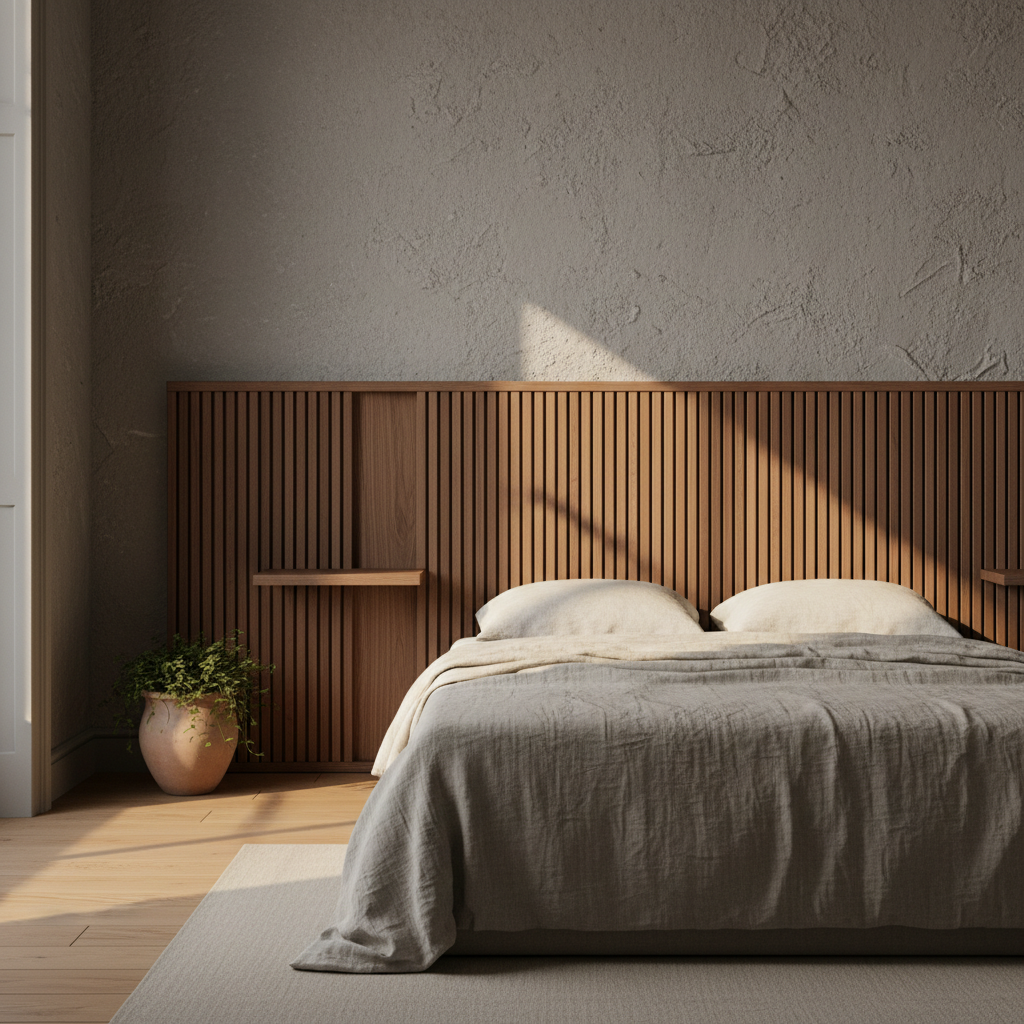
Five of six were photographed from an angle with the door architrave at the edge of the frame, from the same camera sentence. The sixth runs the full width of the wall and came back dead square to the lens. Say the headboard is the width of the bed and stops well short of the corners if you want the three-quarter view.
The mattress hides the bottom edge, so wear pinned there moves
Chipped paint pinned to the bottom edge of the Shaker frame migrated up to the top corners and arrived as blocky patches. Two oak pegs driven right through the stiles at the same low height vanished altogether — and a peg driven through a body with both ends proud is normally the strongest fixing available. Keep wear and fixings above mattress height.
Built-in shelves work as a geometry sequence
Both walnut shelves landed, properly let into the slatwork rather than perched on brackets, because they were written as a sequence of operations: a slot cut right through the slats, the shelf dropped in, its front edge proud of the slat faces, its back end hidden inside. Described as furniture they come back as furniture; described as geometry they come back built in.
Pale damage dies on dark paint
Black steel chipped back to bare bright metal at the feet left almost no trace, which matches every previous attempt to put a pale mark on a dark matt surface. On bare or waxed timber the opposite holds: silvering in the raised grain, grime in the chips and an open split in a thick slab all landed cleanly in the same run.
An open split beats a stain ring on any timber top
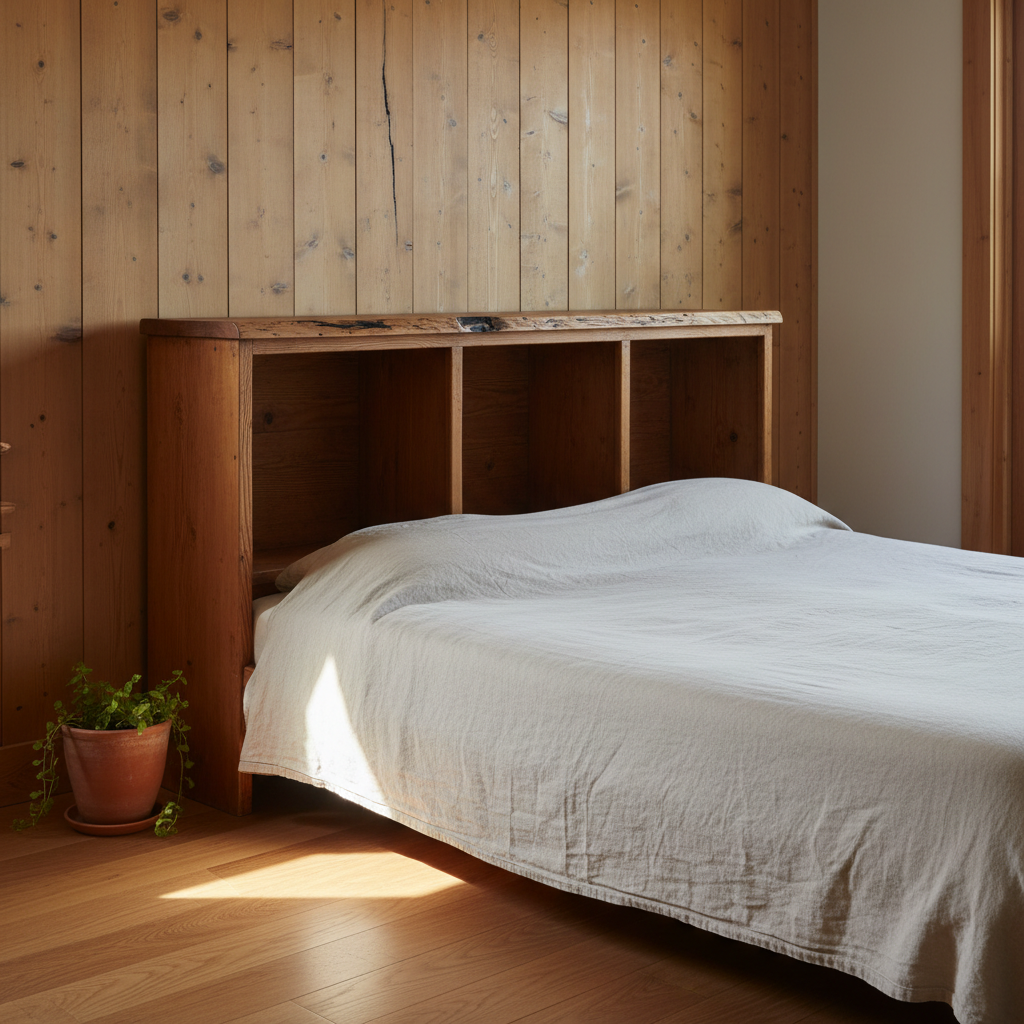
The dark split asked for along the thick slab top of the pine storage headboard arrived exactly as described. A ring of wear in that same position has now failed four times out of four across this project, coming back as a hole cut clean through the timber or as a metal collar. Split, never ring.
A stated finish loses to the material’s default
The wall behind the pine headboard was specified as limewashed vertical boarding and arrived as bare natural pine. Stock materials bring their own finish with them and overrule the adjective, which also means a headboard and a wall in the same timber will compete rather than separate. Put a different material behind the piece.
A clad or textured wall is what stops a render
The two most convincing frames stand against painted tongue-and-groove boarding and painted-over brick with every mortar joint readable. The least convincing stands against plain pale plaster. A named light direction is necessary but not sufficient — the wall needs a real material on it as well, which is cheap to ask for and transforms the result.
Wet-junction wear has no indoor equivalent
Dark staining at the foot of a post where it meets the ground has landed every single time outdoors on grass. Asked for here where the posts meet a clean timber floor, it quietly disappeared. The instruction depends on a junction that is actually wet; indoors, pin discolouration to a hand-contact spot above the mattress instead.
Pre-declaring the prop kit gave six text-free frames
A bedroom summons framed pictures above the bed, books, an alarm clock and printed packaging more insistently than almost any other scene. Declaring the form of every prop in advance — one terracotta pot, plain undyed linen, no bedside table at all — produced six frames with no lettering of any kind, which is the cleanest text result this subject could give.
How It Works
Pick the style
Six presets for the headboard design generator: reclaimed weathered oak boards housed into two chunky posts, upholstered oatmeal linen on walnut legs, woven cane in a slim black steel frame, painted Shaker panels in deep inky blue, slatted walnut with shelves let into the slatwork, and a waxed pine storage headboard with cubbies. Each one already carries the construction, camera and lighting wording that made the pictures in the gallery above.
Add your room
Put the specifics in the box: your timber or fabric, how high above the mattress it stands, whether it is the width of the bed or wider, whether it carries shelves or storage, and above all the wall behind it — boarding, brick, plaster or panelling. The wall matters more than anything else you can type, because a clad wall is what keeps the result looking like a photograph rather than a render.
Check it, then download
About thirty seconds later you have a headboard photographed behind a made bed. Before you judge the look, check three things: does every board, slat or channel actually reach both rails rather than stopping in mid air, is the panel or cubby count the number you asked for, and did the wear land where you pinned it rather than drifting up to the corners. Then download at up to 4K.
Writing a Prompt That Produces a Buildable Headboard Design
Four habits that separate a design worth showing a joiner from one you regenerate, all learned from the six results in the gallery above.
Make every member reach both rails
Not “horizontal boards” or “vertical slats”, but each board runs the whole way from the left upright to the right upright and is housed into both, and the boards fill the whole opening with no free ends. That wording produced faultless plank work and faultless slatwork here. It is the single highest-value sentence in a headboard prompt, and it is the one thing that separates a buildable drawing from a handsome arrangement of floating pieces.
Give every number a reason
Three recessed panels because three bays sit between the two inner stiles. Four cubby holes because three upright partitions stand inside one box. Both counts landed exactly. A bare number drifts, almost always upward, because the model reaches for a familiar object instead of counting what it is drawing. The reason has to constrain the structure — how the thing is actually built — rather than simply restating the number in other words.
Put a real material on the wall
A headboard occupies a small part of the frame and a wall occupies most of it, so the wall decides whether the picture reads as a photograph. Painted tongue-and-groove boarding and painted-over brick with readable mortar joints produced the two most convincing frames here; plain pale plaster produced the most render-like one. Name a light direction in the same sentence as the shadow it throws, then give that light something textured to rake across. And avoid cladding the wall in the same timber as the headboard, or the two will merge.
Keep wear and fixings above the mattress
Say the timber is old and silvered before you describe any wear, because a fresh pale finish deletes the whole paragraph. Then pin that wear somewhere visible: chipping aimed at the bottom rail here migrated to the top corners and two oak pegs at the same low height disappeared entirely, since a mattress hides the bottom of a headboard. Ask for open splits, grime and silvering on bare timber rather than pale chipping on dark paint, which leaves no trace at all.
Who Uses an AI Headboard Design Generator
Weekend woodworkers
A headboard is the classic first real furniture project, and the whole design is board width, post thickness and how high it goes — none of which show up in a cutting list. Seeing hand-wide weathered oak laid horizontally into two chunky posts, at chest height, against your own wall colour settles those three numbers in twenty minutes instead of three weekends.
Renters and first-flat furnishers
A headboard is the cheapest way to make a rented bedroom look deliberate, and it is reversible. Generating the same bed with a cane and steel frame, an upholstered panel and a slatted walnut piece, all against the wall you are actually stuck with, is a faster way to choose than scrolling listings that were all shot against white.
Upholsterers and soft furnishers
Fabric, height and seam pattern are the whole conversation with a client, and none of them photograph well on a swatch. Putting oatmeal linen with deep vertical channels next to a plain padded panel, both on the same bed and the same wall, turns an abstract argument about texture into a choice between two pictures.
Interior designers and stylists
The headboard sets the height line that everything else in the room answers to, and clients cannot picture it from a drawing. A photographed piece against the real wall finish, in the room’s real light direction, is worth more in a presentation than any amount of elevation drawing.
Holiday lets and small hotels
Six rooms need headboards that look like one deliberate scheme rather than six separate purchases. Generating the same construction in oak, in walnut and in painted timber, each against its own room’s wall, shows whether the scheme holds together before anybody commissions a batch.
Small-space and storage planners
Where there is no room for bedside tables, the headboard has to do their job. Seeing shelves genuinely let into slatwork, or a box with four cubbies behind the pillows, answers the only question that matters — whether it still reads as furniture or starts to look like shelving that happens to be behind a bed.
AI Headboard Design Generator FAQ
Related Design Tools
AI Bedroom Design Generator
The whole room the headboard sets the height line for. Layout, wall finishes, light direction and the furniture that answers to the bed.
AI Accent Wall Design Generator
The wall behind the bed, treated as the subject. Boarding, panelling, brick and plaster — the single biggest lever on whether a bedroom frame reads as a photograph.
AI Bunk Bed Design Generator
The same joinery problem with two of everything. Rails, ladders, and the matching-parts rule that decides whether both ends come back identical.
See It Behind Your Bed Before You Buy Timber
Six styles — reclaimed weathered oak, upholstered oatmeal linen, woven cane in black steel, painted Shaker panels, slatted walnut with built-in shelves and a pine storage headboard — each photographed against your own wall in about thirty seconds, in your room and in your light. Up to 4K. Free to start, from $2.99.
Design a Headboard FreeAn AI Headboard Design Generator for Woodworkers, Renters and Anyone Staring at a Blank Wall Behind a Bed
A headboard is the most consequential piece of furniture in a bedroom and the hardest one to picture, because everything that decides how it looks is missing from the places people go for information. The retailer photograph is a padded rectangle shot square on against a white sweep, with no wall behind it, no daylight and nothing to read its height against. A plan drawing gives you a width and tells you nothing about whether hand-wide weathered oak laid horizontally reads better against green plaster than narrow walnut slats read against grey. Neither answers the questions anybody actually has, which are how high above the mattress it should stand before it looks deliberate rather than mean, whether to go timber or upholstered, whether it should be the width of the bed or run the whole wall, and what it will look like in the afternoon light of the room it is actually going in. That is the gap an AI headboard design generator fills. Describe the material, the construction, the height and the wall behind it, and about thirty seconds later you have a photograph of the headboard standing there. Every preset on this page is written that way, and the six results above are published exactly as they came back, failures included.
The six styles cover the shortlist a real bedroom actually has. Reclaimed weathered oak boards housed into two chunky square posts, which is the classic first woodworking project and the one most people picture when they say they want to build a headboard. Upholstered oatmeal linen on dark walnut legs, for a room where the bed should feel soft rather than built. Woven honey rattan cane in a slim black steel frame, for a rented flat or a light room where the headboard needs to be almost transparent. Painted Shaker panels in deep inky blue, for a house where the bedroom joinery has to match the rest of the joinery. Slatted walnut with thick shelves let into the slatwork, for a calm Japandi room with no space for bedside tables. And a waxed pine storage headboard built as a deep box of cubbies, for a small room where the headboard has to earn its footprint.
The pattern in what came back teaches more than a feature list, and on this subject it is mostly about construction and about what the mattress hides. The wording that makes repeated members behave — each board runs the whole way from one upright to the other and is housed into both, filling the whole opening with no free ends — produced faultless plank work and faultless slatwork, and then failed outright on upholstered channels, which broke away from the top rail into tabs with daylight showing through. Rigid members obey that rule and padded ones do not, which is new, and the fix is to describe a soft headboard as one continuous face with deep seams pulled into it rather than as parts held in a frame. Counts behaved perfectly wherever the number was given a structural reason: three recessed panels because three bays sit between two inner stiles, four cubby holes because three partitions stand inside one box. Built-in shelves landed because they were written as a sequence of operations rather than as objects — a slot cut right through the slats, the shelf dropped in, its front edge proud, its back end hidden. And the camera behaved itself in all six frames at standing eye level, including the one with a woven cane panel, which is worth noting because woven mesh has dragged the lens upward in every previous subject it has appeared in. A headboard stands up tall, and height built into the design has never once failed to hold the view.
The working rules follow directly, and they are all in the presets now. Make every board, slat and channel reach both rails explicitly, and say the opening is filled. Give every number a reason that constrains how the thing is built. Put a real material on the wall behind the bed — painted boarding or painted-over brick with readable mortar joints produced the two most convincing frames here, while plain pale plaster produced the most render-like one — and name the light direction in the same sentence as the shadow it throws, since the direction alone is necessary but not sufficient. Do not clad that wall in the same timber as the headboard, or the two will merge, and remember that a stated finish loses to a stock material’s own default, which is how limewashed boarding came back as bare pine. Say the timber is old and silvered before describing any wear, then pin that wear above mattress height: chipping aimed at the bottom rail migrated to the top corners and two oak pegs driven right through the stiles at the same low height vanished entirely, because a mattress hides the bottom edge of a headboard and anything hidden there is quietly dropped. Ask for open splits, grime and silvering on bare timber rather than pale chipping on dark paint, which leaves no trace. Keep the piece the width of the bed if you want a three-quarter photograph, because a headboard spanning a whole wall irons itself flat to the camera however firmly you position the lens. And pre-declare the prop kit, because a bedroom scene wants framed pictures, books and an alarm clock more insistently than almost any other subject — settling the form of one terracotta pot and plain undyed linen in advance, with no bedside table at all, produced six frames with no lettering of any kind. Inside those limits this is a genuinely good way to spend twenty minutes before you spend on timber, fabric and a free weekend: the proportion gets settled, the household agrees on something it can point at, and the joiner gets a picture instead of an argument.