
AI Desk Design Generator
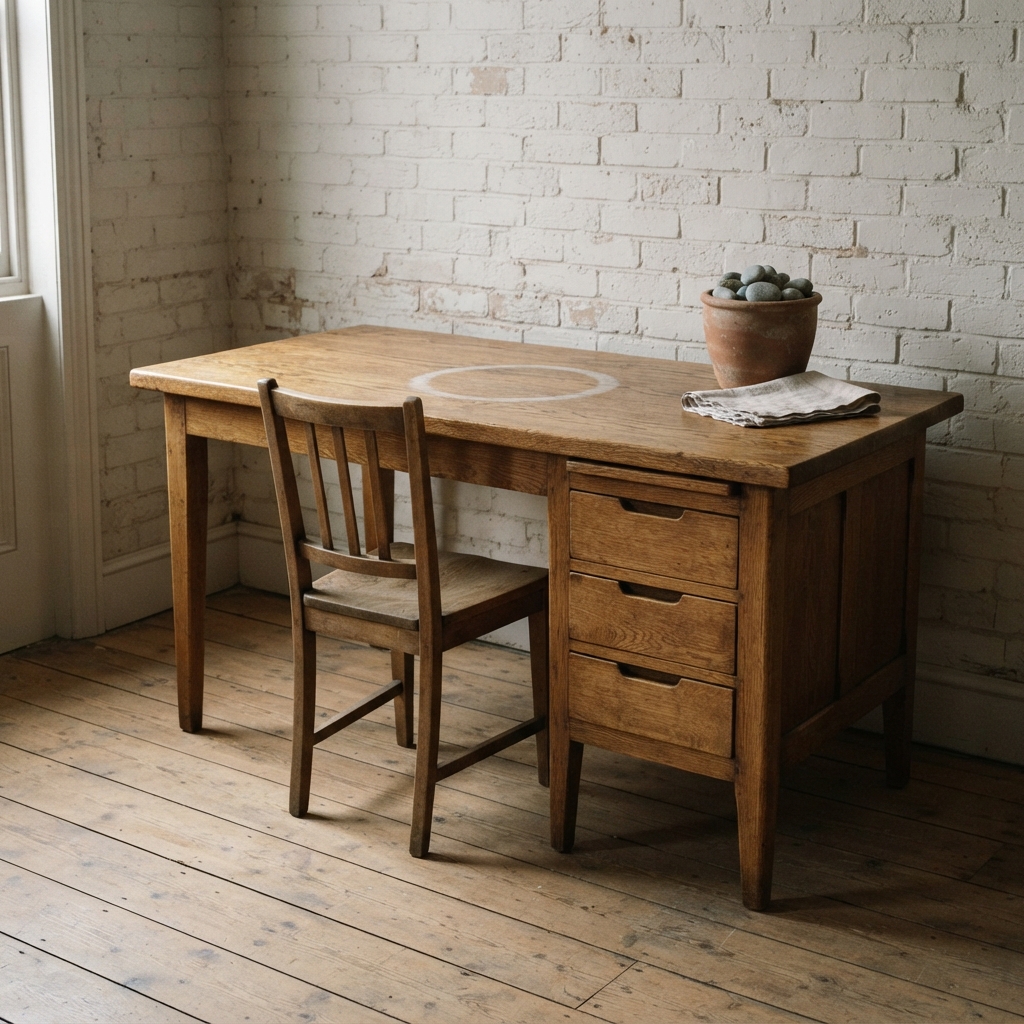
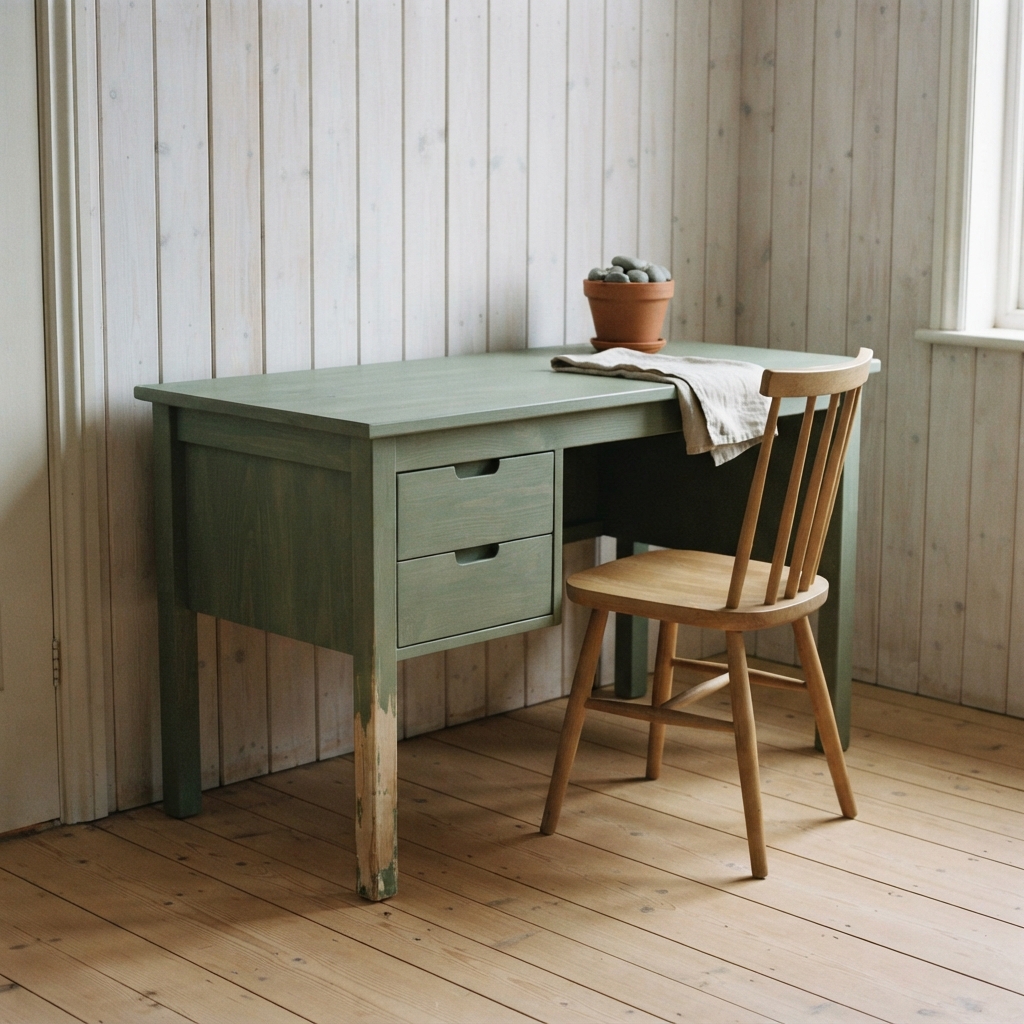
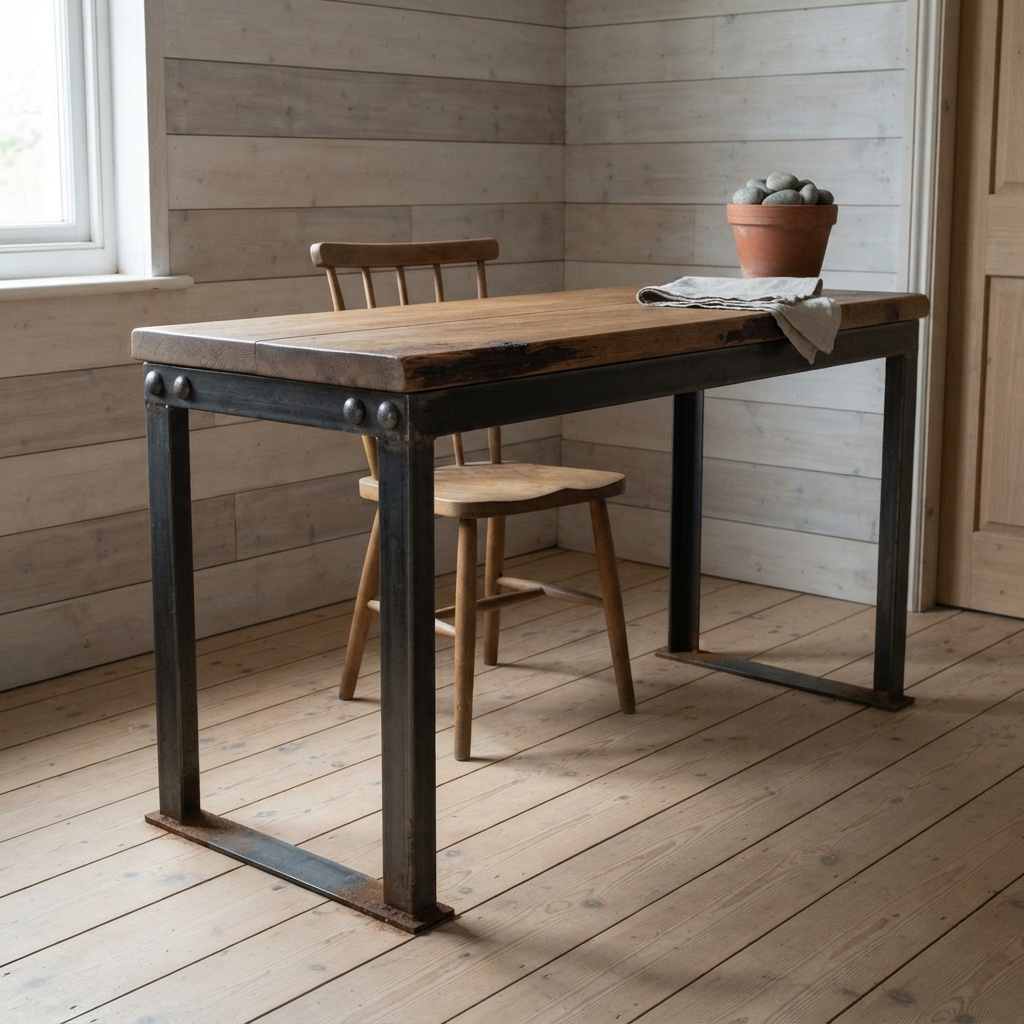
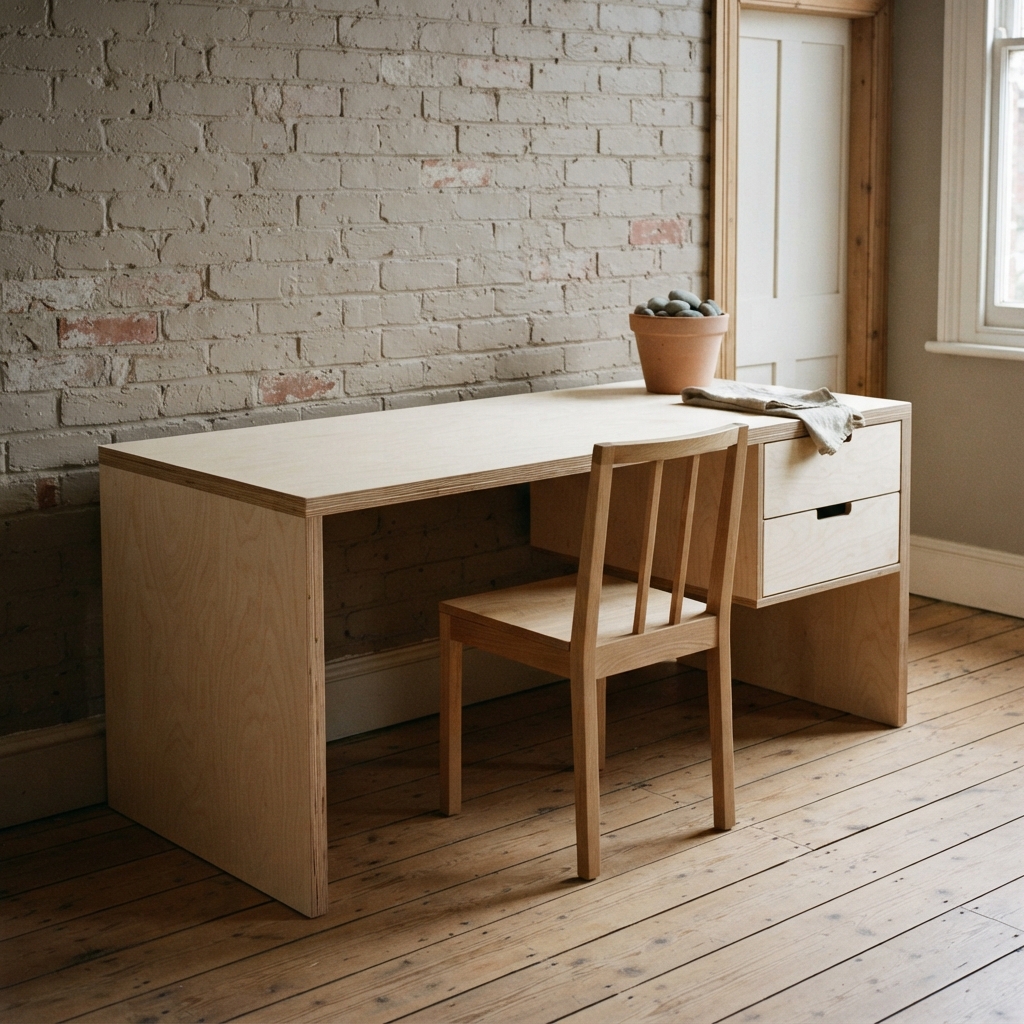
See the desk standing in your own room before you buy timber or anything else. This AI desk design generator turns a description into a finished desk photographed in place in about thirty seconds: an old oak writing desk with a three-drawer block, a sage painted desk with chipped feet, a blackened steel frame under a thick elm slab, a birch plywood desk on panel legs, reclaimed scaffold boards on pegged trestles, and a mid-century walnut desk on round tapered legs. All six results are below exactly as they came back, with what the prompt asked for and what actually arrived.
Design a Desk FreeTry the AI Desk Design Generator — Free
Pick a build, then use the box for what is specific to you — oak, elm, walnut, painted softwood or birch ply, how long the top runs, how many drawers the block holds, whether the knee space sits left or right, and above all the wall and floor you already have. Each preset already carries the structural drawer count, the routed finger pull wording, the visible fixings, the clad wall named twice and the no-lettering list.
AI Desk Design Generator
Choose a build, name your timber, your base and your drawers, and get a photorealistic desk standing in a real room. Up to 4K.
Six Desks From the AI Desk Design Generator, Shown Exactly As They Came Back
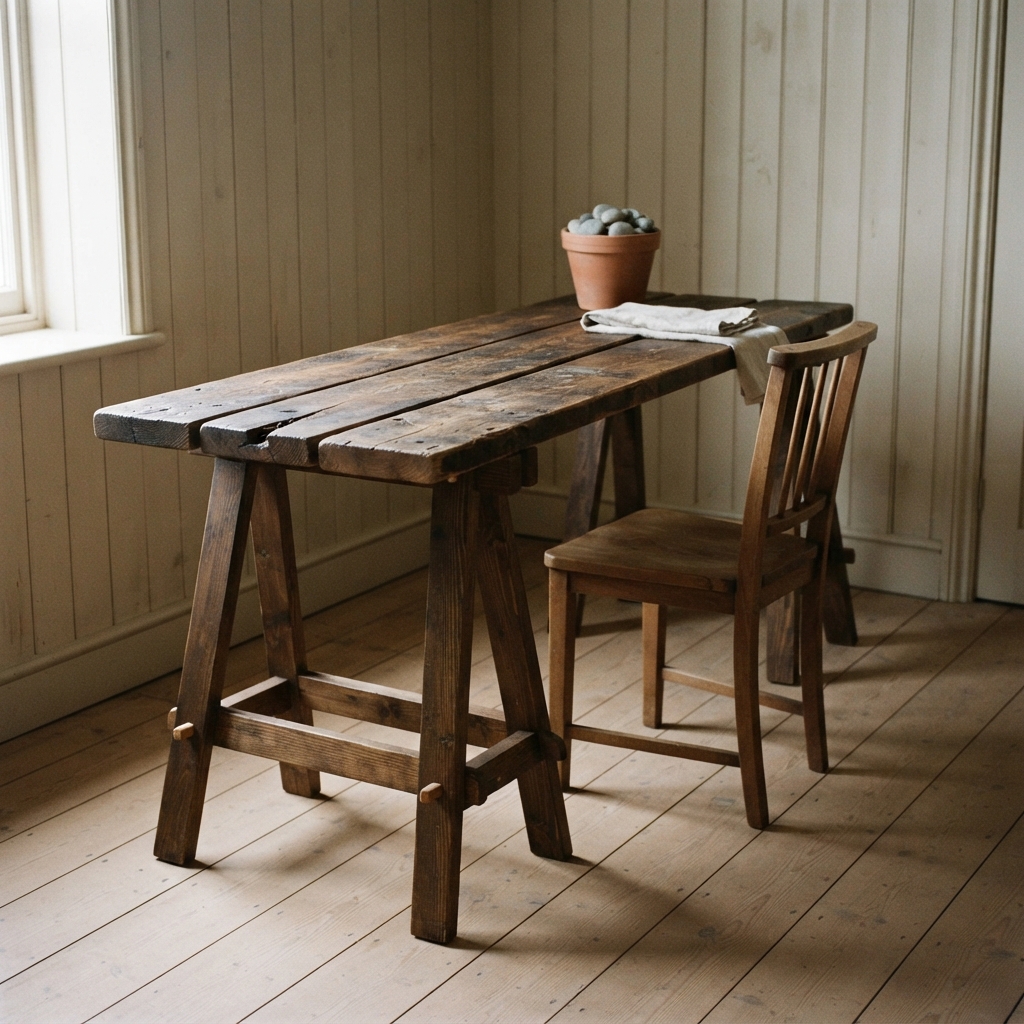
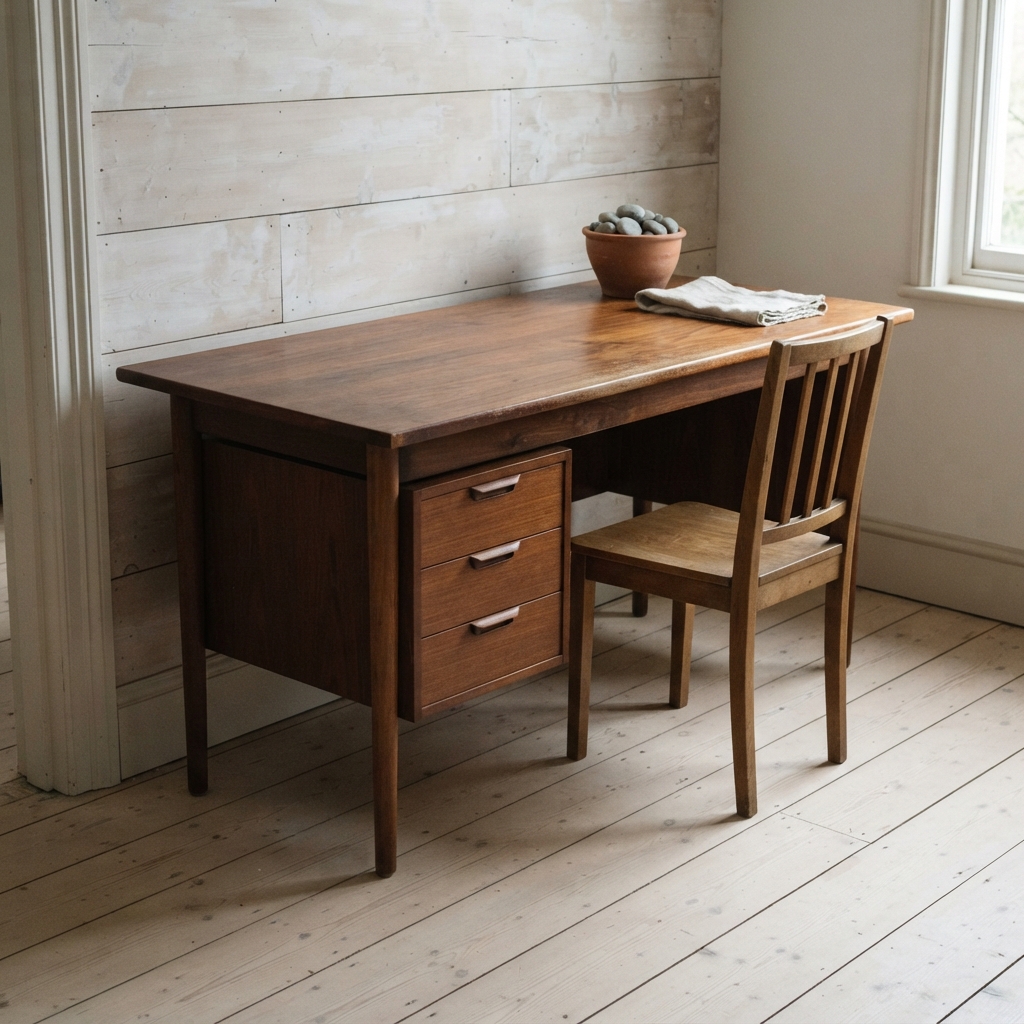
Nothing here was retouched. The captions say what the prompt asked for, what arrived, and which wording fixed what — including the two builds that took a second attempt and why the first one failed.
What the AI Desk Design Generator Gets Right and Wrong
A desk is a tall-legged object covered in printed props, and nearly everything interesting in this run came from those two facts.
Legs hold the camera at eye level by themselves
All six frames came back at standing eye height with no foreground anchor clause anywhere in the prompt. That is the fourth subject in a row where simply giving the design height — legs, a post, a tall freestanding body — has beaten the camera climb outright. It is the single biggest difference between a desk and a coffee table, where a low horizontal surface pulled the lens up and over in five frames out of six.
Counts hold when the number has a structural reason
Three drawers because the block is divided inside by two horizontal partitions, two drawers because a single partition divides the block: every drawer count on this page arrived exactly as asked. A bare number drifts, usually upward. The one exception here is interesting — three scaffold boards with no reason given also arrived as three, where the same bare count on another subject came back as five.
A routed finger pull lands on a drawer every time
Four of the six builds use a shallow finger pull routed into the lower edge of the drawer front instead of a handle, and all four drew it as a hollow in the timber with no hardware at all. The same instruction on a cupboard door turns into face-mounted hardware, so if you want a handleless door, describe how it opens instead of what the pull looks like.
Chipped paint lands exactly where you pin it
The painted build put its chipping on the front left foot and nowhere else, and that is where it is, rubbed back to bare pale timber with the other legs untouched. Paint chipped back to bare timber on a mid-toned paint remains the most dependable wear instruction available. On a pale or fresh finish the same sentence is simply deleted.
An open split on a slab can over-deliver into a gap
The industrial desk asked for an open split running in from one end of the elm top and got the top cut right through into two pieces with daylight between them. On a thick slab sitting on a timber frame that instruction has landed cleanly before; on a slab carried by a steel frame it read as a separation. Declaring the slab one single unbroken board with no gap and no second piece fixed it.
Pinned wear drifts onto the nearest big face
Grime asked for on the exposed plywood laminations along a drawer edge ignored the edge entirely and smeared across the whole drawer front as a dark blotch. Wear wanders towards the largest nearby surface. If the surface you are pinning to is small, either accept that risk or leave the wear out, especially on a fresh pale finish that was going to delete it anyway.
Write each matching part its own sentence
The near trestle and the far trestle were described in two complete sentences that never refer back to each other, and both came back as correct splayed A-frames. A property given to two parts in one shared phrase lands on only one of them, which in earlier runs produced two different stones, one brick wall and one timber wall, and a single shingled roof slope out of two.
Keep fixings on a face the camera already looks at
The bolts holding the elm slab are proud on the frame rail at knee height and are plainly drawn. Bolt heads described under a slab, pegs hidden behind a subject, and a ceiling fixing above a hanging seat have all been cropped out or silently dropped in other runs, even with both ends named. Visibility beats description.
A peg driven right through a leg is always drawn
The trestle pegs arrived with both cut ends standing proud, pale against the dark wax. A peg driven right through a member with its ends showing is still the strongest fixing wording in this project, stronger than a chunky bolt and much stronger than anything described as a bracket, strap or plate.
Rust lands when it is pinned to a junction of two parts
Rust was asked for on the steel foot plate where the plate meets the floorboards, fading gradually upward onto the leg, and it arrived on both feet from that one sentence. Wear pinned to a junction between two named parts lands dead on; wear pinned to a surface alone wanders. The gradual fade is what stops it arriving as a hard band.
Indoors the wall does the anti-render work
Painted brick with readable mortar joints, limewashed horizontal boarding, narrow vertical tongue-and-groove with patchy paint — every frame here has a clad wall with tone variation, and none of them reads as a render. A clad wall of one flat matt colour is not enough, and never clad the wall in a timber close in tone to the desk, because dark on dark merges into a single mass.
Replace the computer and the books, do not ban them
A desk is the most text-prone subject there is: monitors, keyboards, books, papers, sticky notes and a wall calendar all arrive uninvited. Six frames out of six came back with no lettering anywhere, and the move that does it is substitution — state that where this desk would carry a computer and books it carries a terracotta pot of river cobbles and a folded linen cloth.
How It Works
Pick the build
Six presets for the desk design generator: an old darkened oak writing desk with a three-drawer block and routed finger pulls, a sage painted desk with the paint chipped back on one foot, a blackened steel frame carrying a thick elm slab on visible bolts, a birch plywood desk on solid panel legs, three reclaimed scaffold boards on pegged trestles, and a mid-century walnut desk on round tapered legs. Each one already carries the joinery, camera and lighting wording that made the pictures in the gallery above.
Add your room
Put the specifics in the box: your timber, your base, how long the top runs, how many drawers the block holds and which end they sit at, and above all the wall and floor behind it. Boarding, shiplap, painted brick, panelling. The wall matters more than anything else you can type, because indoors a clad surface with readable joints and real tone variation is what keeps the result looking like a photograph rather than a render, and plain pale plaster is what pushes it the other way.
Check it, then download
About thirty seconds later you have a desk photographed in a room. Before you judge the look, check three things: did the drawer count arrive as asked, is every rail actually housed into the legs at both ends rather than stopping in mid air, and did the wear you asked for survive the finish you asked for. Then download at up to 4K.
Writing a Prompt That Produces a Buildable Desk Design
Four habits that separate a design worth showing a joiner from one you regenerate, all learned from the six results in the gallery above.
Count by structure, not by number
Not three drawers, but a block divided inside by two horizontal partitions, so three drawers. Not four legs, but a top with four corners and one leg under each corner. Every drawer count on this page arrived exactly as asked because each one had a reason that constrained the structure, while bare numbers drift, usually upward on small repeated parts. Position is weaker than count: a drawer block pinned to one end still wandered towards the middle, so describe what occupies the other end too.
Put fixings where the lens already looks
Bolt heads proud on a frame rail at knee height get drawn. Bolt heads under a slab, pegs behind the subject and fixings up at ceiling level get cropped out or quietly dropped, even when both of their ends are named. The strongest wording available is still a peg driven right through a member with both cut ends standing proud, which arrived on every trestle leg here. Ban the words strap, plate and angle bracket by name, or catalogue hardware fills the gap.
Declare the timber old before any mark
A fresh pale finish deletes every wear clause in the prompt, so say old darkened oak, grey rough reclaimed boards or hazed lacquer first, then pin the damage to a named spot: paint chipped back to bare timber on one foot, rust where a steel plate meets the floor fading gradually upward, a pale dry ring where a hot cup has lifted the finish. Expect wear to drift onto the largest nearby face, and expect an open split on a slab to over-deliver if the slab is not declared one unbroken board.
Replace the computer, do not ban it
A desk arrives with a monitor, a keyboard, cables, books, papers and a wall calendar whether you ask or not, and every one of those carries lettering. Banning a prop the scene insists on only removes your control over it. Decide in advance what sits there instead: one terracotta pot of river cobbles and a folded undyed linen cloth. Say that where this desk would carry a computer and books it carries those instead, and pre-declare the chair as plain and unupholstered while you are at it.
Who Uses an AI Desk Design Generator
Home office builders
A desk is usually the first piece of furniture made to fit a specific alcove, and the whole design is top thickness, leg type, drawer side and overhang. None of those read off a cutting list. Seeing the desk against your own wall answers all four before a board is bought.
Anyone fitting a desk into a small room
The real question is proportion: how long a top the wall will take, whether a drawer block steals the knee space, and how much floor is left to pull a chair out. Generating the same desk at three lengths in your own room settles it faster than any measuring tape argument.
People choosing between timber and steel
A solid oak writing desk and a blackened steel frame under an elm slab give completely different rooms to live with, and the catalogues show both looking equally good. Seeing them in the same light, against the same wall and floor, makes the choice in about a minute.
Interior designers and stylists
A mood board of cut-out product shots says nothing about scale. A photograph of the proposed desk in a room with a real clad wall, a real floor and a named light direction is worth more in a client presentation than any amount of elevation drawing.
Small-batch furniture makers
Six builds generated in an afternoon is a product range to shoot a lookbook around, and it costs nothing to find out which silhouette people respond to before any of them exist. Settling the leg taper and the drawer spacing on screen is cheaper than getting it wrong in walnut.
Renters and first-flat furnishers
When the desk has to work with a wall you cannot change and a floor you did not choose, the useful test is the desk in that exact context. Generating it against your own boarding or brick, in the light you actually get, shows which build earns the space.
AI Desk Design Generator FAQ
Related Design Tools
AI Office Design Generator
The room the desk stands in. Layout, storage, wall finishes and the light direction that decides whether any of it reads as a photograph.
AI Coffee Table Design Generator
The same joinery rules on a low horizontal surface, where the camera climbs overhead and only an object cut by a frame edge brings it down.
AI Bookshelf Design Generator
Shelving, housed members and the substitution trick that keeps a wall of books from filling a frame with unreadable lettering.
See the Desk In the Room Before You Buy Timber
Six builds — an old oak writing desk, a sage painted desk, a steel and elm industrial frame, a birch plywood desk, scaffold boards on pegged trestles and a mid-century walnut desk — each photographed in your own room, against your own wall, in your own light, in about thirty seconds. Up to 4K. Free to start, from $2.99.
Design a Desk FreeAn AI Desk Design Generator for Home Office Builders, Small Rooms and Anyone Arguing About Oak or Steel
A desk is almost entirely a question of proportion against one specific wall, and proportion is the one thing missing from every place people go to look at desks. A retailer photograph shows the desk square on against a white sweep, floating, with nothing behind it and nothing beside it to measure it by, which is precisely the information you need and precisely what has been removed. A product listing gives three dimensions in centimetres and tells you nothing about whether a drawer block will eat the knee space, how much floor is left to pull a chair out, or whether a dark frame will swallow a small room. Those are the only questions anyone actually has, and that is the gap an AI desk design generator fills. Describe the build, the timber, the base, the wall behind it and where the light comes from, and about thirty seconds later you have a photograph of the desk standing there on your own floor. Every preset on this page is written that way, and the six results above are published exactly as they came back, failures included.
The six builds cover the shortlist a real room has. An old darkened oak writing desk with a three-drawer block and routed finger pulls, which is the desk most people picture when they say they want a proper one. A mid-toned sage painted desk, for anyone working from softwood and wanting to see how a colour lands against a boarded wall. A blackened steel frame carrying a thick elm slab on visible bolts, for a room that wants weight without bulk. A birch plywood desk on solid panel legs, the cheapest build here and the one that shows how a cut edge full of laminations reads as a detail rather than a compromise. Three reclaimed scaffold boards on pegged trestles, for anybody building from salvage. And a mid-century walnut desk on round tapered legs, the build most often got wrong, because the taper and the drawer line carry the whole thing.
The pattern in what came back teaches more than a feature list. A desk has legs, and height in the design holds the camera at standing eye level all by itself: all six frames here arrived as proper three-quarter views without a single foreground anchor clause, which is the opposite of what happens with a low horizontal piece like a coffee table. Drawer counts held in every build because each number was given a structural reason — a block divided inside by two horizontal partitions, so three drawers — while bare numbers drift upward. The routed finger pull landed as a hollow in the timber on every drawer it was asked for, as against the face hardware it becomes on a door. And visible fixings are drawn while hidden ones are not: chunky bolt heads proud on a frame rail at knee height arrived, and so did pegs driven right through the trestle legs with both cut ends standing proud, which remains the strongest fixing wording available.
The rules about wear and about lettering are the ones worth memorising, and they are all built into the presets. Declare the material old before you describe a single mark, because a fresh pale finish deletes every weathering clause in the prompt — the most repeated failure in this project, seen here again when grime asked for on the edge of a clean plywood drawer smeared itself across the whole drawer face instead. Pin wear to a junction between two named parts and it lands dead on, as rust did where the steel foot plate meets the floorboards, fading gradually upward onto the leg. Write a cup ring as a lifted finish rather than a stain and put it on timber declared old and dark. Keep an open split for a slab you have explicitly declared one unbroken board, or it comes back as a gap cut clean through the top, which is exactly what happened on the first attempt at the industrial build. And settle the props in advance rather than banning them: a desk arrives with a monitor, a keyboard, books, papers and a wall calendar uninvited, every one of them covered in text, and saying that where this desk would carry a computer and books it carries a terracotta pot of river cobbles and a folded linen cloth is what kept all six frames on this page free of lettering. Inside those limits this is a genuinely good way to spend twenty minutes before you spend on oak, steel and a free weekend: the proportion gets settled, the household agrees on something it can point at, and the joiner gets a picture instead of an argument.