
AI Coffee Table Design Generator
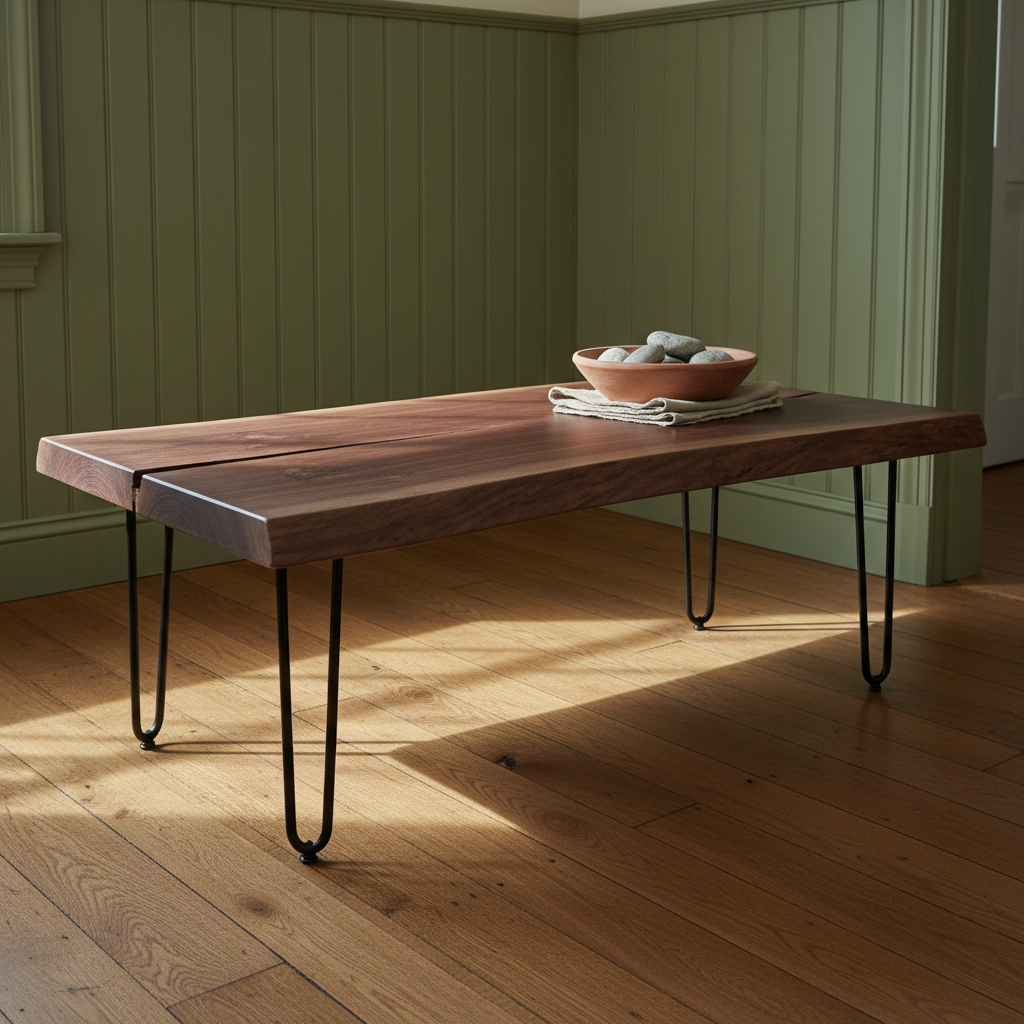
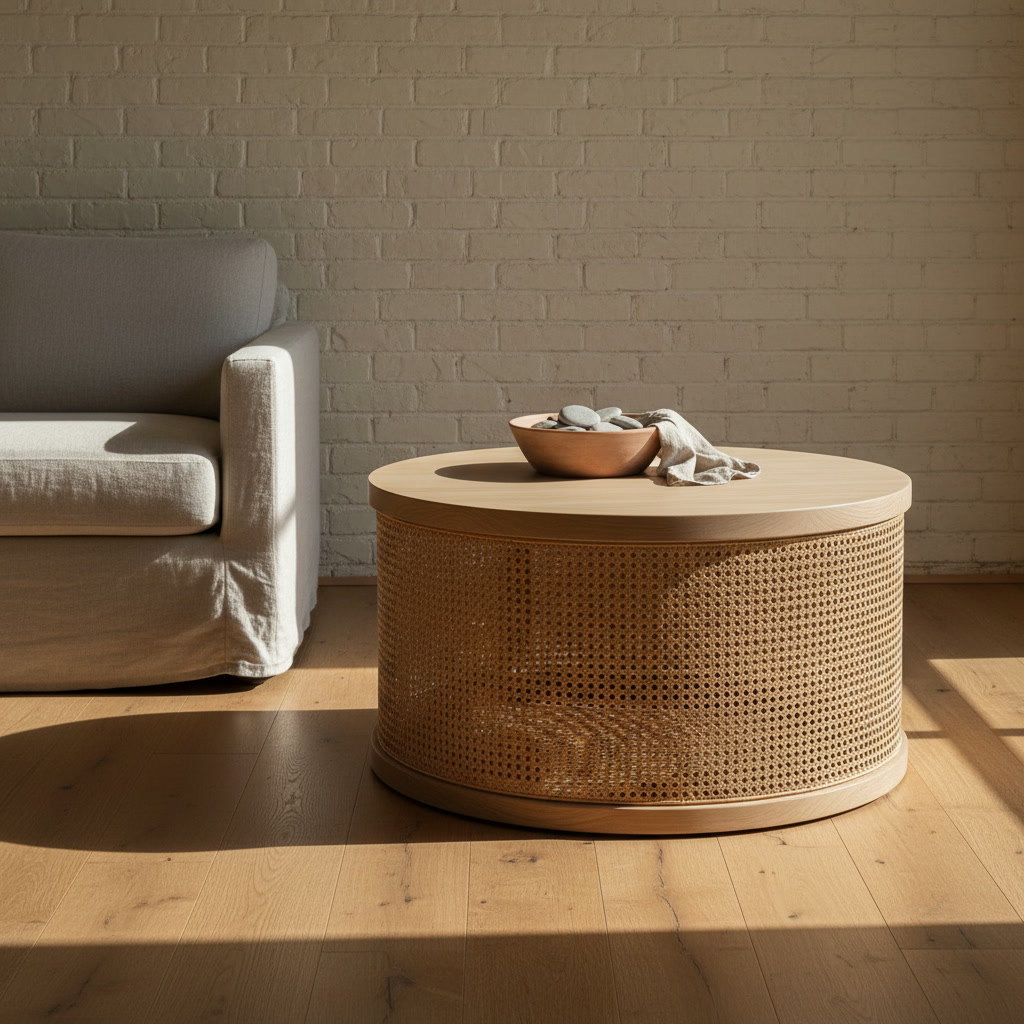
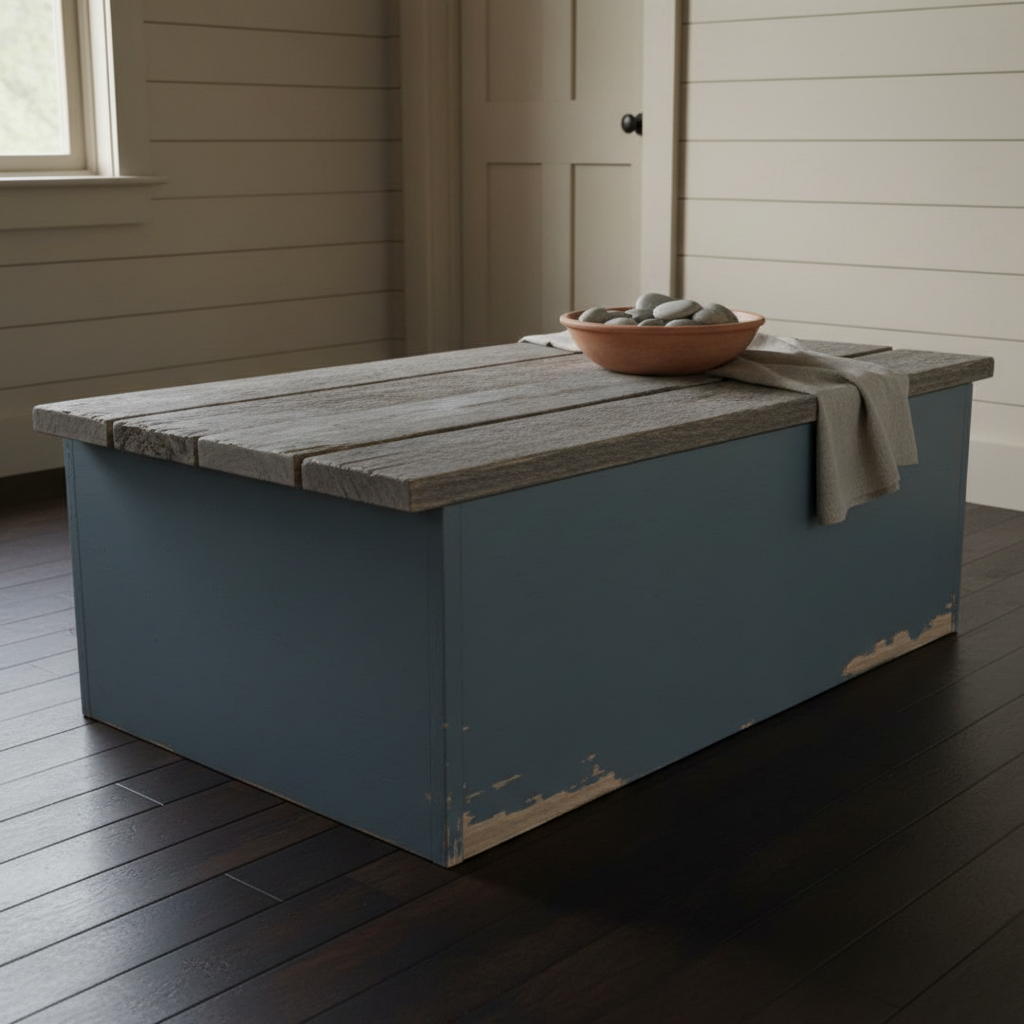
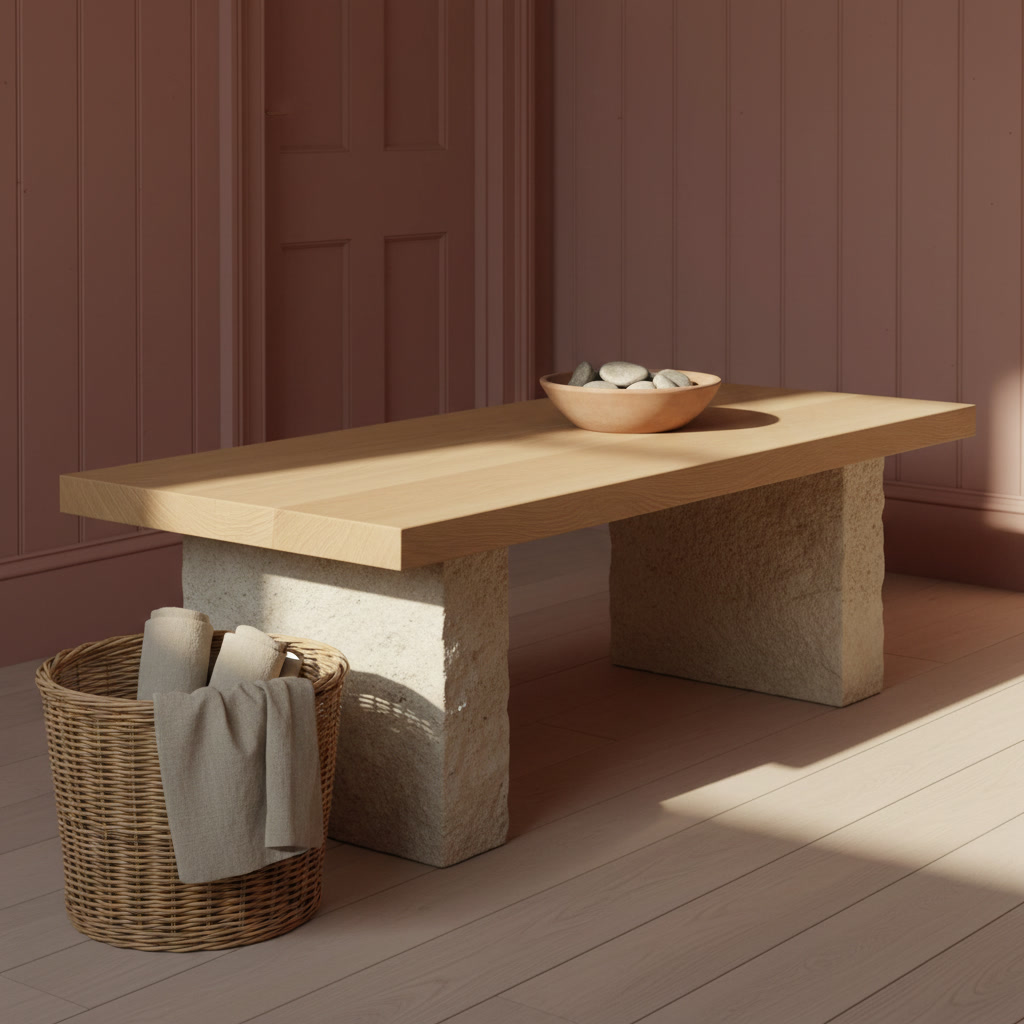
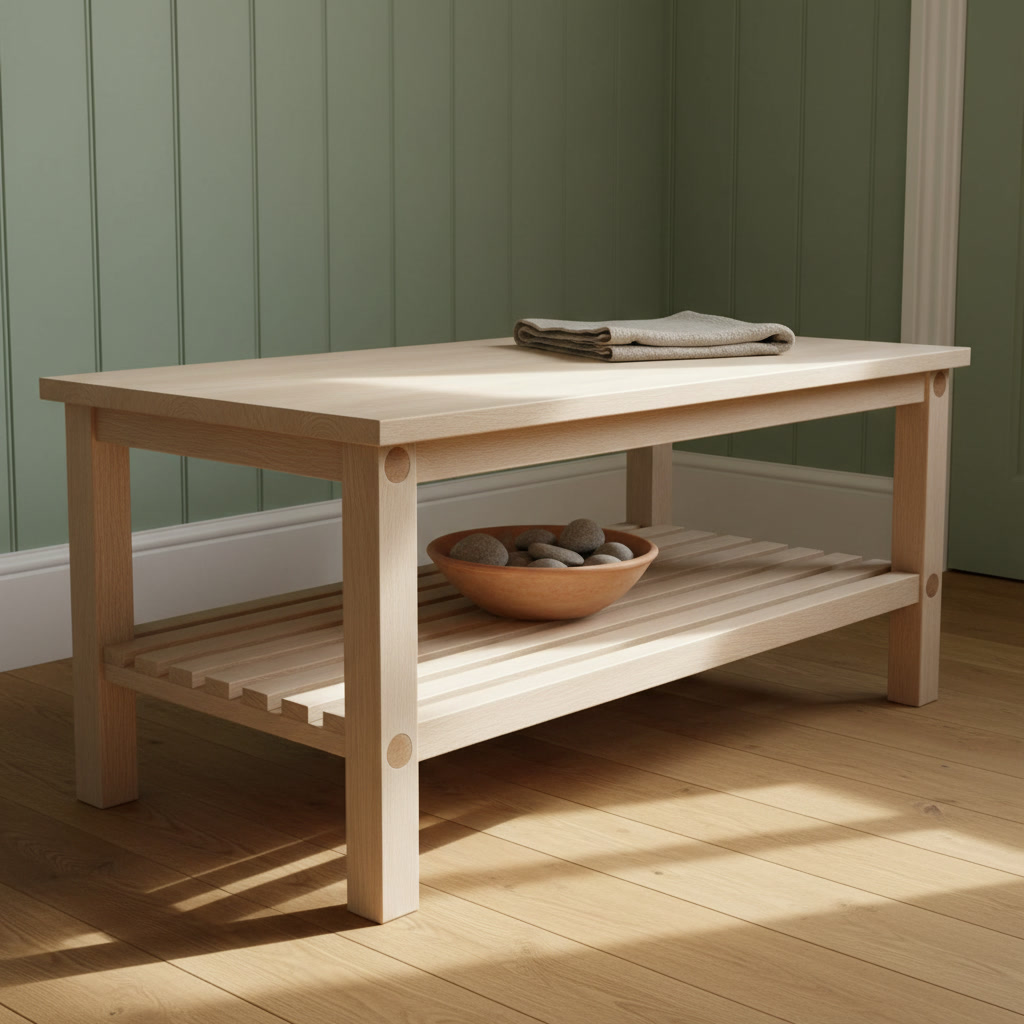
See the table standing in your own room before you buy timber or anything else. This AI coffee table design generator turns a description into a finished table photographed in place in about thirty seconds: a live-edge walnut slab on blackened hairpin legs, a round woven cane drum, chunky reclaimed boards on a painted plinth, a pale oak slab resting on limestone blocks, a mid-century teak table with one routed drawer, and a two-tier frame with a slatted lower shelf. All six results are below exactly as they came back, with what the prompt asked for and what actually arrived.
Design a Coffee Table FreeTry the AI Coffee Table Design Generator — Free
Pick a build, then use the box for what is specific to you — walnut, oak, ash, teak or cane, how long the table runs, how high it sits against your sofa, whether it needs a shelf or a drawer, and above all the wall and floor you already have. Each preset already carries the joinery wording that keeps every slat housed into both rails, the camera position that kept every frame off plan view, the named light direction and the no-lettering list.
AI Coffee Table Design Generator
Choose a build, name your timber and your base, and get a photorealistic coffee table standing in a real living room. Up to 4K.
Six Tables From the AI Coffee Table Design Generator, Shown Exactly As They Came Back
Nothing here was retouched. The captions say what the prompt asked for, what arrived, and which wording fixed what, because the gap between the two is the part nobody publishes.

What the AI Coffee Table Design Generator Gets Right and Wrong
A coffee table is a low horizontal surface in the middle of a room full of printed objects, and almost everything interesting in this run came from those two facts.
A low horizontal surface pulls the camera up
This is the defining problem of the subject. Five of the six frames came back from higher than the seated eye height the prompt asked for, and the painted plinth frame is almost looking down on the table. None went fully overhead, so the explicit camera sentence is doing real work, but it does not hold the lens down on its own. Plan for a slightly high view and get what you need into the frame anyway.
The height anchor only works if a frame edge cuts it
The cane drum frame is the one that sat at seated eye height, and the only difference is a sofa arm cut by the left edge of the picture. The stone frame had a floor basket standing taller than the table and the camera still climbed, because the basket sits whole inside the picture. An object that is cropped by an edge sets the viewpoint; an object that is fully visible is just another thing on the floor.
A fixing under the subject is never drawn
The walnut slab was told its leg-plate bolt heads sit proud of the underside where the camera can see them, and there is no sign of them. A fixing hidden behind or beneath the subject has failed in every run of this project, including ones where both of its ends were named. If a fixing matters, put it on a face the lens already looks at.
A peg driven through a leg is drawn every time
The same prompt that lost its hidden bolts kept its visible pegs: the two-tier frame shows round oak pegs at the top rail and at the shelf rail on the legs nearest the camera. A peg driven right through a member remains the strongest fixing description available, with one caveat seen here — the cut ends finished flush with the timber rather than standing proud as asked.
Both-ends wording fixed every slat and board
Each slat told to run the whole way from the front rail to the back rail and to be housed into both rails arrived doing exactly that, and the slats fill the opening. This is the most dependable sentence in any furniture prompt here. It applies to rigid members only — the same wording on upholstered channels in another run produced separate panels broken away from the frame.
Counts hold when the number has a structural reason
Four legs were never counted; the prompt said the top has four corners and one leg goes under each corner, and four legs arrived in all four frames that have them. In the same run three scaffold boards laid side by side, a bare count with no structural reason behind it, came back as about five. A number tied to structure holds, a number on its own drifts upward.
Two matching parts in one phrase come back different
The stone frame asked for two solid blocks of rough honed limestone in a single shared phrase and got two visibly different stones, one chalky white and one sandy. This is the same failure that has turned two brick side walls into one brick and one timber. Write each part its own complete sentence and never refer back to the other one.
The first cup ring that ever worked
A ring of wear on a timber top has come back as a hole cut through the top in every previous attempt in this project, so the standing advice was never to ask for one. The teak frame got a clean pale ring, and the difference is the wording and the surface: a pale dry ring where a hot cup has lifted the finish, on old darkened teak, rather than a stain ring on a fresh pale top.
Declare the timber old before describing any mark
The two frames that kept their wear are the ones whose material was declared old first — grey rough reclaimed boards, and old darkened teak. The two fresh pale builds carry nothing, which is consistent with every other run: a fresh pale finish deletes weathering clauses wherever they are pinned, whether the surface is oak, paint or bare plywood.
Curvature survives as an object, not as an edge
The round drum came back a true circle with its cane weave running right round the body, while the live edge on the walnut slab, described as a wavy bark edge, came back close to straight. That split has now held across several subjects: a curve that defines a whole object is drawn, a curve that is only a profile along an edge gets ironed flat.
A clad wall is necessary but not sufficient indoors
Every frame here has boarding, shiplap, brick or panelling with readable joints, and two frames still look computed. Both are a fresh pale table against a wall that is one flat matt colour across most of the picture. The wall needs tone variation as well as joints, and never clad it in a timber close to the table, because the teak frame merged into its walnut panelling.
Replacing the books is what clears the lettering
Six frames out of six came back with no writing anywhere, in a room type that normally arrives full of books, magazines, framed prints and a remote control. The move that does it is substitution, not prohibition: state that where this room would carry books it carries one plain terracotta bowl of river cobbles and a folded length of undyed linen, and the printed objects simply never appear.
How It Works
Pick the build
Six presets for the coffee table design generator: a live-edge dark walnut slab on blackened steel hairpin legs, a round woven cane drum with a pale ash top, three reclaimed scaffold boards on a slate blue painted plinth, a thick pale oak slab resting on two honed limestone blocks, an old darkened teak table with one wide drawer and a routed finger pull, and a two-tier pale ash frame with a slatted lower shelf. Each one already carries the joinery, camera and lighting wording that made the pictures in the gallery above.
Add your room
Put the specifics in the box: your timber, your base, how long the table runs, how high it sits relative to your sofa seat, whether it carries a shelf or a drawer, and above all the wall and floor behind it. Boarding, shiplap, limewashed brick, panelling. The wall matters more than anything else you can type, because indoors a clad surface with readable joints is what keeps the result looking like a photograph rather than a render, and plain pale plaster is what pushes it the other way.
Check it, then download
About thirty seconds later you have a table photographed in a living room. Before you judge the look, check three things: did the camera stay down at seated eye height or climb overhead, does every shelf slat actually reach both rails rather than stopping in mid air, and did the wear you asked for survive the finish you asked for. Then download at up to 4K.
Writing a Prompt That Produces a Buildable Coffee Table Design
Four habits that separate a design worth showing a joiner from one you regenerate, all learned from the six results in the gallery above.
Put the camera somewhere, do not ban an angle
A low table invites a view from above, and telling the model not to shoot from above achieves nothing, because an absence cannot be drawn. Say instead where the camera stands: beside the table at seated eye height, roughly a metre above the floor, well off to one side so two sides show, with the long side running across the picture and a door architrave in shot. Then put something with real height at the same distance and let a frame edge cut through it — a cropped sofa arm held the camera down here, while a floor basket standing fully inside the picture did not.
Send every slat to both rails, and count by structure
Not “a slatted shelf”, but each slat runs the whole way from the front rail to the back rail, is housed into both, and the slats fill the whole opening so no gap is left at either side. Do the same with the leg count by giving it a reason rather than a number: the top has four corners and one leg goes under each corner. A count tied to structure holds; a bare number drifts, usually upward on small repeated parts and occasionally downward on long runs.
Clad the wall, and describe it twice
Indoors the anti-render work is done by the wall, not by the lighting. Boarding, shiplap, limewashed brick or panelling with every joint readable beat plain pale plaster in a direct comparison, and a clad wall mentioned only once has been silently swapped back for white plaster, so say it twice. Never clad the wall in the same timber as the table either, because pine on pine merges into one object. Name the light direction in the same sentence as the shadow it throws.
Replace the printed props instead of banning them
A living room arrives with books, magazines, framed prints and a remote control whether you ask for them or not, and banning a prop the scene insists on only removes your control over it. Decide in advance what sits there instead: one plain unglazed terracotta bowl of river cobbles and a folded length of undyed linen. Where a room would normally carry books, say it carries pots and cobbles. That substitution is the single most effective way to get a text-free interior.
Who Uses an AI Coffee Table Design Generator
Weekend woodworkers
A coffee table is the classic first real furniture project, and the whole design is slab thickness, leg type, height and overhang. None of those read off a cutting list. Seeing the table standing on your own floor against your own wall answers all four before you buy a single board.
Anyone with a sofa and a gap
The real question is proportion: how long a table the sofa will take, how much floor is left to walk past it, and whether the top should sit level with the seat cushion or below it. Generating the same table at three lengths in your own room settles an argument no retailer photograph can.
People choosing between slab and drum
A rectangular slab and a round drum give completely different rooms to live with, and the catalogues show both looking equally good. Seeing live-edge walnut and woven cane in the same light, against the same wall, on the same floor, makes the choice in about a minute.
Interior designers and stylists
A mood board full of cut-out product shots tells a client nothing about scale. A photograph of the proposed table in a room with a real clad wall, a real floor and a named light direction is worth more in a presentation than any amount of elevation drawing.
Small-batch furniture makers
Six builds generated in an afternoon is a product range to shoot a lookbook around, and it costs nothing to find out which silhouette people respond to before any of them exist. Getting the leg taper and the shelf spacing settled on screen is cheaper than getting it wrong in teak.
Renters and first-flat furnishers
When the table has to work with a wall you cannot change and a floor you did not choose, the useful test is the table in that exact context. Generating it against your own boarding or brick, at the time of day your light actually rakes across the floor, shows which build earns the space.
AI Coffee Table Design Generator FAQ
Related Design Tools
AI Living Room Design Generator
The room the table stands in. Sofa layout, wall finishes, flooring and the light direction that decides whether any of it reads as a photograph.
AI Room Divider Design Generator
The freestanding piece that shares all the same slat joinery. Housed members, broken symmetry and keeping a tall panel from flattening into an elevation.
AI Headboard Design Generator
Where the same both-ends joinery rule meets upholstery, and why a soft surface has to be written as one face with seams rather than parts in a frame.
See It In the Room Before You Buy Timber
Six builds — a live-edge walnut slab on hairpin legs, a round woven cane drum, reclaimed boards on a painted plinth, a pale oak slab on limestone blocks, a mid-century teak table with a routed drawer pull and a two-tier slatted shelf — each photographed in your own room, against your own wall, in your own light, in about thirty seconds. Up to 4K. Free to start, from $2.99.
Design a Coffee Table FreeAn AI Coffee Table Design Generator for Weekend Builders, Sofa Owners and Anyone Arguing About Slab or Drum
A coffee table is almost entirely a question of proportion against one specific sofa, and proportion is the one thing missing from every place people go to look at them. A retailer photograph shows a table shot square on against a white sweep, floating, with no wall behind it and nothing beside it to measure it by, which is precisely the information you need and precisely what has been removed. A product listing gives you three dimensions in centimetres and tells you nothing about whether the table will look generous in front of a long sofa or lost in front of a deep sectional, whether you will still be able to walk past it, or whether the top should sit level with the seat cushion or a hand below it. Those are the only questions anyone actually has, and that is the gap an AI coffee table design generator fills. Describe the build, the timber, the base, the wall behind it and where the sun comes from, and about thirty seconds later you have a photograph of the table standing there on your own floor. Every preset on this page is written that way, and the six results above are published exactly as they came back, failures included.
The six builds cover the shortlist a real room has. A live-edge dark walnut slab on blackened steel hairpin legs, which is the build most people picture when they say they want to make a coffee table. A round woven cane drum with a pale ash top, for a room where a rectangle would block the walk-through. Three reclaimed scaffold boards on a chunky painted plinth, for anybody working from salvage and wanting to see how grey rough timber lands against a painted wall. A thick pale oak slab resting on two honed limestone blocks, for a room that wants weight without a frame. An old darkened teak table with one wide drawer and a routed finger pull instead of a handle, because a drawer is where a coffee table earns its keep and a routed pull is the one handleless detail that reliably lands on a drawer front. And a two-tier pale ash frame with a slatted lower shelf, which is the build most often got wrong, because the slats are the part that floats unless you say where both of their ends go.
The pattern in what came back teaches more than a feature list, and on this subject it is mostly about the camera, about joinery and about what a finish will carry. A coffee table is a low horizontal surface, and a low horizontal surface has pulled the camera up and over it on every comparable subject in this project, so every preset here states positively where the camera stands — beside the table at seated eye height, well off to one side, long side running across the picture — rather than forbidding the view from above, because nothing described purely as an absence has ever been drawn. Every slat and board is told to run the whole way between its two rails and to be housed into both, which is the wording that has fixed dangling members on every rigid subject tested; it does not extend to soft or padded parts, which break away at one end anyway. Leg counts are tied to structure rather than counted, because a number with a reason holds and a bare number drifts. And indoors the anti-render work is done by the wall: boarding, shiplap, limewashed brick and panelling with readable joints beat plain pale plaster, so the cladding is named twice in every preset, since a wall mentioned once has been quietly swapped back for white plaster before now.
The rules about wear are the ones worth memorising, and they are all in the presets. Declare the material old before you describe a single mark, because a fresh pale finish deletes every weathering clause in the prompt — the most repeated failure in this whole project, seen on fresh oak, fresh paint and bare plywood alike. Pick damage the surface can actually show: paint chipped back to bare timber on a mid-toned painted finish is the most reliable wear instruction there is, which is why the plinth preset pins it to the bottom edge, where chipping migrates anyway. If you want a cup ring, write it as a lifted finish rather than as a stain and put it on a dark enough surface: every earlier ring of wear in this project was drawn as a hole cut clean through the top, and the one that finally worked was a pale dry ring where a hot cup has lifted the finish, on old darkened teak. An open split is the other damage that reliably lands, on a thick single slab and not on a top of thin boards. Never describe a horizontal surface by its pattern either, because the moment a surface exists to show off a pattern the camera climbs overhead to photograph it. And settle the props in advance rather than banning them: a living room arrives with books, magazines, framed prints and a remote control uninvited, and saying that where this room would carry books it carries one plain terracotta bowl of river cobbles and a folded length of undyed linen is what keeps lettering out of the frame. Inside those limits this is a genuinely good way to spend twenty minutes before you spend on walnut, steel and a free weekend: the proportion gets settled, the household agrees on something it can point at, and the joiner gets a picture instead of an argument.