
AI Cat Tree Design Generator
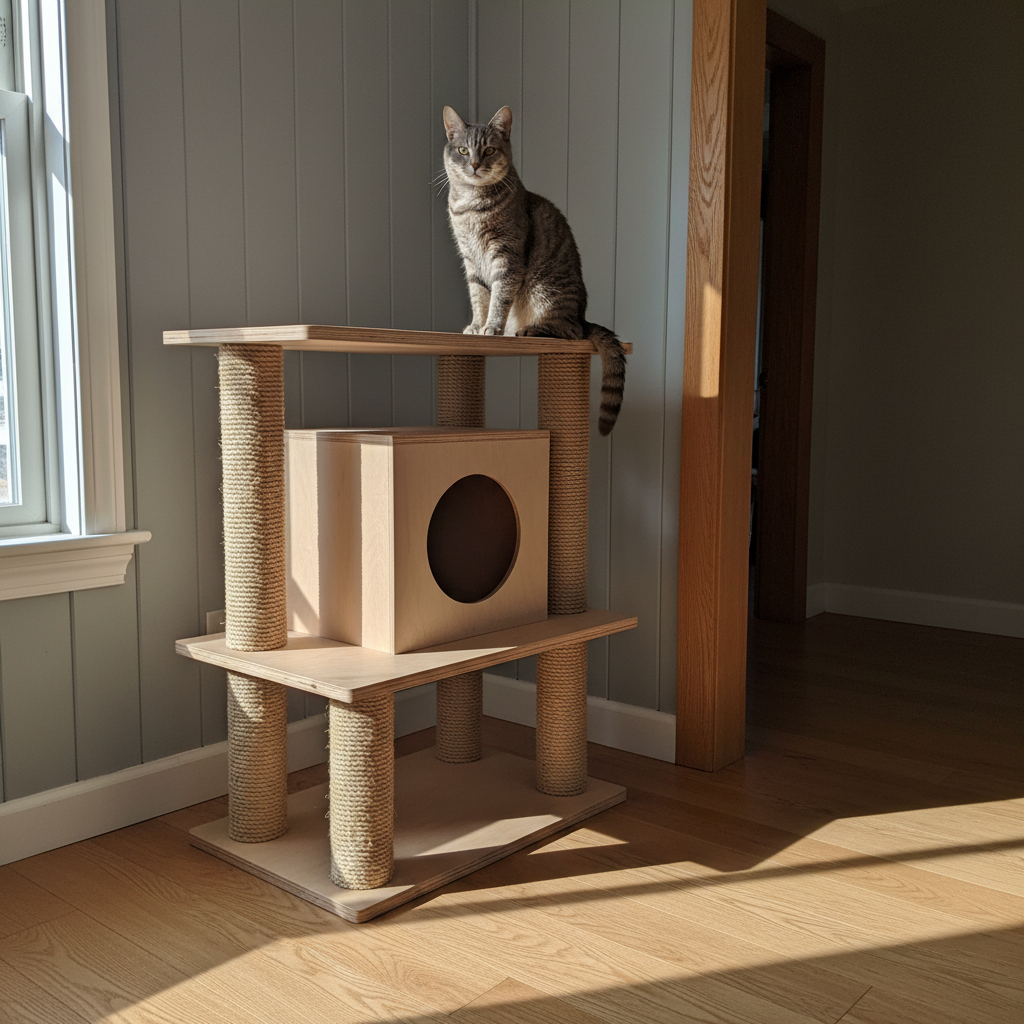
See it standing in the room before you cut a single sheet of ply. This AI cat tree design generator turns a description into one real cat tree photographed in a real room, in about thirty seconds — a birch plywood tower with a cut-through hide, a carpeted corner post, oak shelves climbing a wall, a build around a real branch, a furniture-style cabinet and a multi-cat frame with a canvas sling. All six are below exactly as they came back, including the one that had to be run twice.
Design a Cat Tree FreeTry the AI Cat Tree Design Generator — Free
Pick a build, then use the input for what is specific to yours — how many cats, how old they are, which corner of which room it goes in, what the floor and walls are already made of, and whether it has to fit under a window. Each preset already carries the camera held level at standing height, the piece kept clear of the wall so it does not flatten, the floor left plain so the camera does not climb, every fixing described at both ends, and every tag, label, collar and printed packet banned as an object.
AI Cat Tree Design Generator
Choose a build, name your platforms, your posts, your hide and your fixings, and get a photorealistic cat tree shot in a real room. Up to 4K.
Six Builds From the AI Cat Tree Design Generator, Shown Exactly As They Came Back
Nothing here was retouched, and the one frame that was generated twice says so in its caption. Each caption states what the prompt asked for and what actually arrived, because the gap between those two is the part nobody publishes.
What the AI Cat Tree Design Generator Gets Right and Wrong
One run of six frames settled a long-running question about the camera, produced the cleanest fixing result on this site, and failed the same way twice on the one thing that never works.
A tall freestanding subject needs no camera clause at all
Six frames out of six came back at standing height, and not one of these prompts contains a foreground anchor — no object standing close to the lens, taller than the subject, cut by the bottom edge. The anchor was invented on this site to stop the camera climbing above short, wide things. A cat tree is tall, it stands clear of the wall, and there is nothing above it to look down from, so the angle holds by itself. Save the anchor for knee-high subjects, where it does not work anyway.
A fixing lands when both of its ends bite into something named
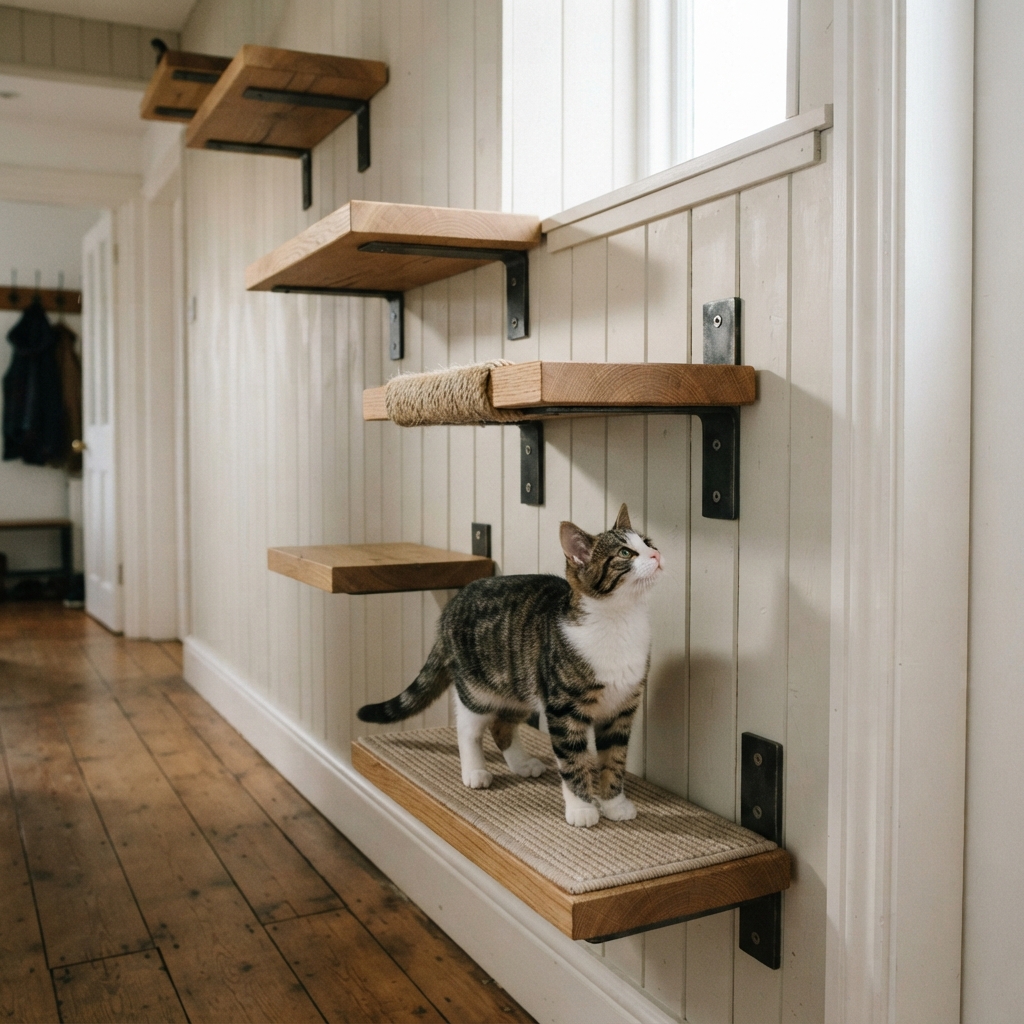
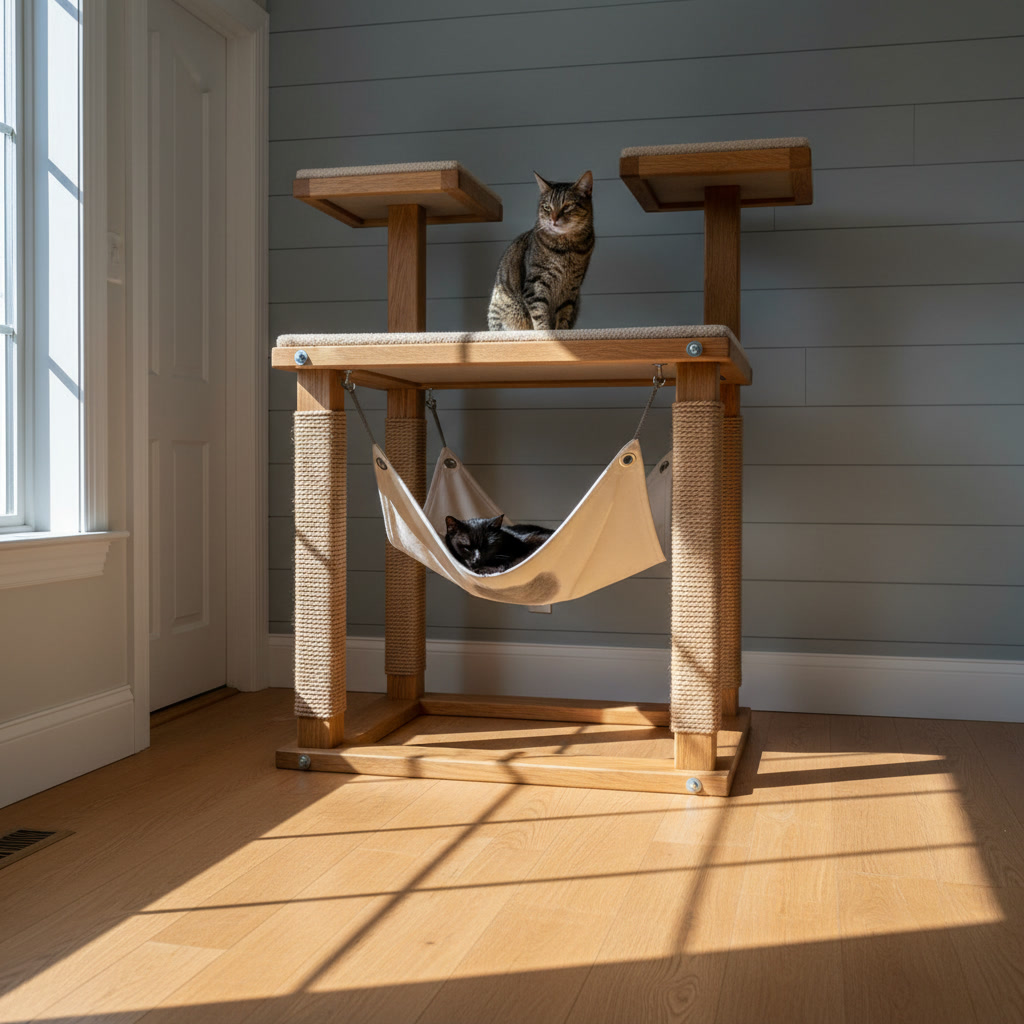
The wall shelves are the cleanest fixing result recorded here. Each bracket is chunky rather than thin, its upper arm screwed up into the underside of the slab and its lower arm screwed flat into the boarding, and the screw heads are drawn at both ends of every bracket. The canvas sling worked identically: eyelet, rail, screw head, all four corners. Fixings that float are the ones described by the span they cross, the ones too thin to draw, or the ones hidden behind the subject.
A ring of wear is still undrawable, in both directions
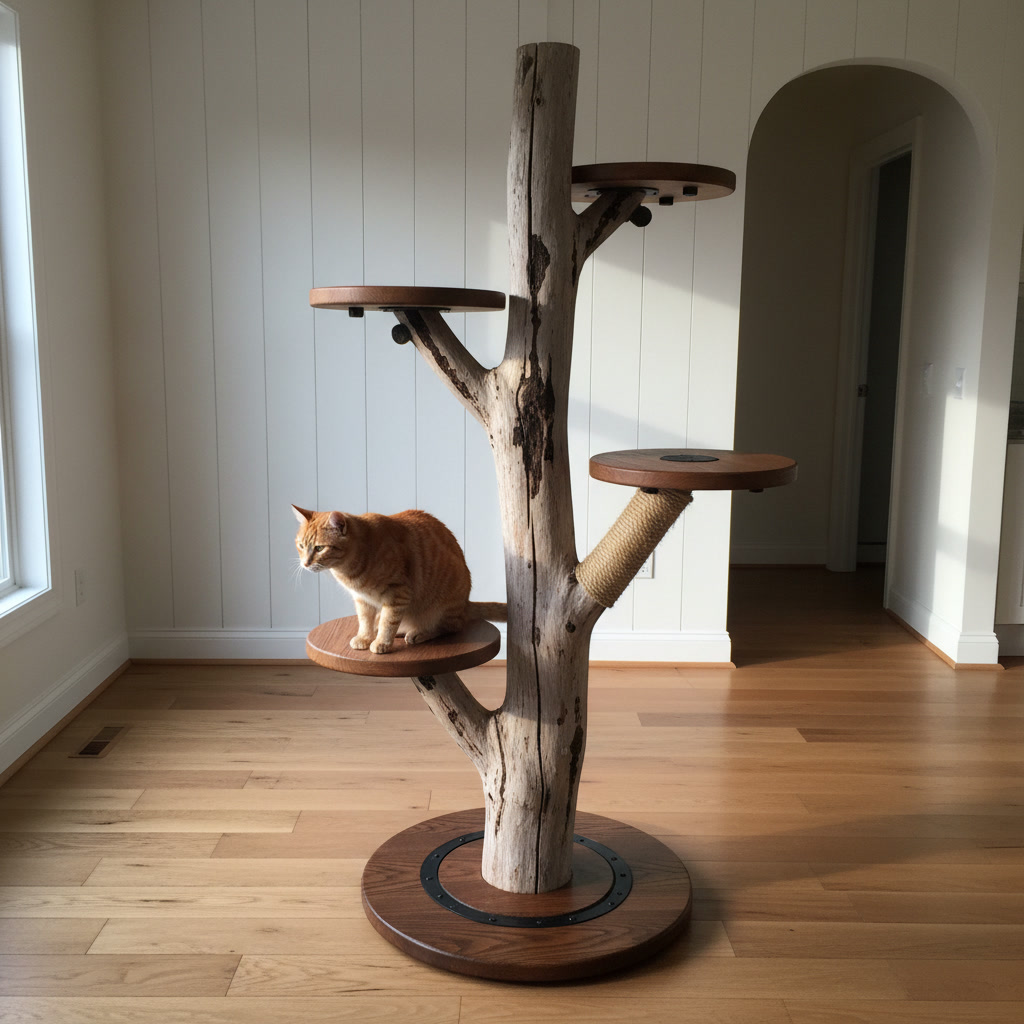
Two rings were asked for on this page. A dark stain where the branch meets its base came back as a black metal collar bolted round the trunk — a hard object standing in for a soft mark. A dark ring at the lowest point of the canvas sling simply did not appear at all. Rings have previously been drawn as a hole cut clean through a table top and as flicked white paint. Four distinct failure modes, no successes. Ask for a split, or for staining across a pair of objects that meet.
Pale wear on a darker surface is still flicked paint
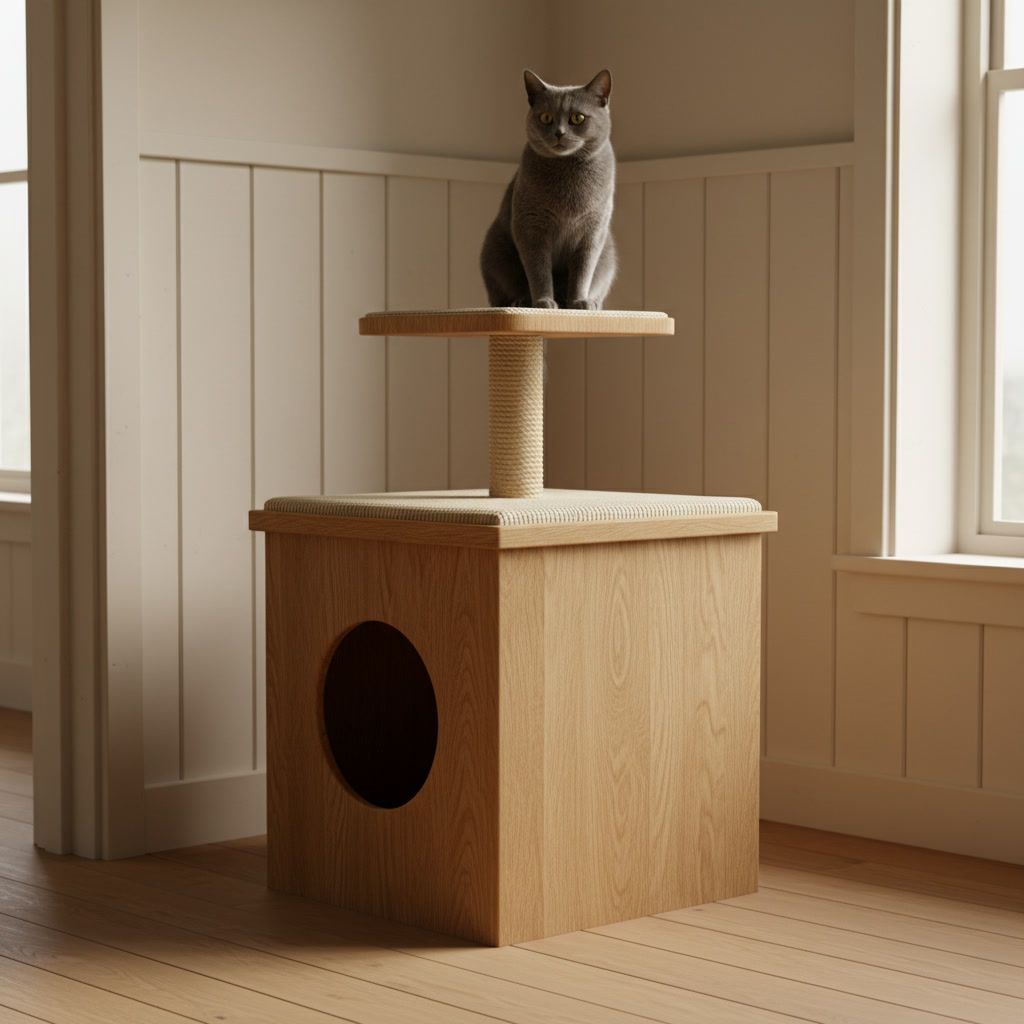
The oak cabinet first came back with white flecks sprayed across its bottom rail, from a clause asking for the oak to be scuffed pale back to bare timber where paws land. That is the same result this failure has produced on mud, on dark painted metal and on black surfaces. The fix when there is an old finish is to name where it survives rather than what the surface became. When there is no old finish, as here, the only fix is to delete the clause, which is what the rerun did.
Wear pinned at two matching spots still merges into one
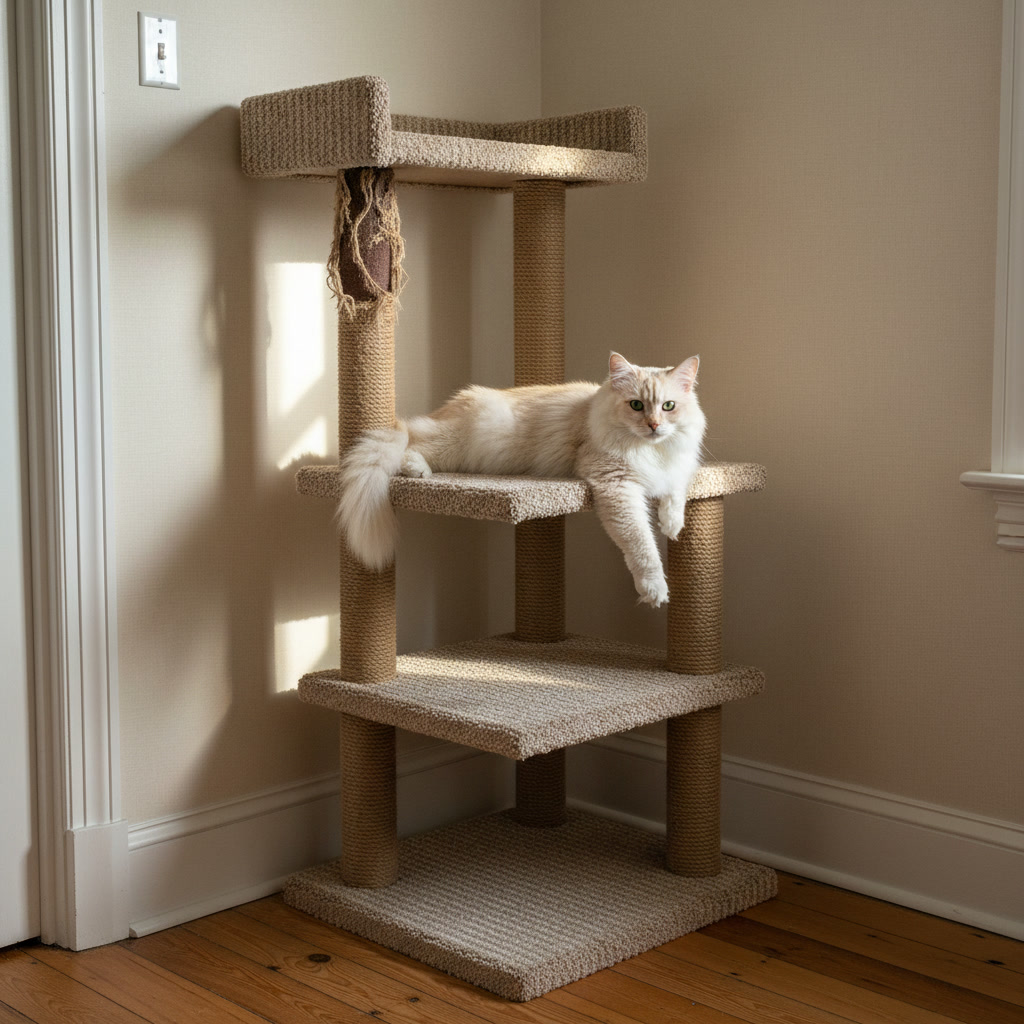
The sisal on the carpeted tower was to be frayed where it meets the platform above and where it meets the platform below. What arrived is a single torn shred hanging halfway between the two, on neither. This is now consistent across subjects: identical wear named at two matching places collapses into one event in the middle, and wear in general drifts off its pin. One spot, one object pair, one mark.
Not counting is a strategy, not a cop-out
A cat tree is nothing but repeated platforms, posts and rope turns, and repeated small parts have counted upward on this site more often than they have held. Every preset here deliberately leaves the number unstated and spends the words on materials and connections instead. Five shelves, three platforms, four sling corners — all arrived coherent. A number only holds when its reason constrains the structure, and nothing about a cat tree does.
How It Works
Pick the build closest to what you want
A birch plywood tower with a hide cut clean through its front, a tall carpeted corner post on sisal uprights, oak shelves climbing a boarded wall on steel brackets, a build around a real stripped branch, a furniture-style oak cabinet with a round entrance, or a multi-cat frame with a canvas sling slung between the posts. Each preset already carries the camera at standing height, the piece clear of the wall, a plain floor, and every tag and label banned as an object.
Add what is specific to yours
How many cats and how old, whether one of them cannot jump any more, the height you can live with, which room and which corner, what the walls and floor are already made of, and whether it has to sit under a window or beside a radiator. Describe materials and connections rather than styles, give sizes as a fraction of something already in the frame rather than in centimetres, and skip the platform count.
Generate, crop in, then buy the ply
About thirty seconds later you have a photograph of it. Crop in before you judge it — a shred of sisal hanging where no fraying was asked for, a metal collar standing in for a stain, screw heads that landed or did not, a hide whose hole goes through the wrong face are all things you only see at full size — then download up to 4K and use it as the brief for the actual build.
Built for the Way People Actually Plan a Cat Tree
Cat furniture, not a bookcase and not a pet shop
Left alone, a tall timber thing with shelves on it comes back as a shelving unit or a showroom display. Every preset names the bookcase, the shelving unit, the display stand, the plant stand, the dog crate, the rabbit hutch and the bird cage as things this is not, states that it stands between knee and shoulder height on an adult, and bans the pet shop display, the trade stand and the catalogue page outright. All six held as furniture built for a cat.
The plain floor is doing real work
Naming a patterned ground surface pulls the camera up to look at the pattern — gravel, paving and end-grain chequer have all done it on this site, even with a foreground anchor working. So every preset here specifies plain bare timber boarding running away under the piece and bans the rug, the mat, the patterned carpet and the tiles by name. Six frames, six at standing height.
Kept clear of the wall on purpose
A tall subject holds eye level, but pushing it flush against a wall flattens the shot into a one-point elevation, and a built-in that spans a whole wall flattens even with the camera written off to one side. Every freestanding preset states that the piece stands a hand-width or more clear of the wall behind it, and asks for the adjoining wall and a door architrave in shot so there is a corner to give the room depth.
Connections described end to end
Bolts through a branch fork with the heads showing on both faces, bracket arms screwed into both the slab and the boarding, sling corners taken from eyelet to screw head in the rail. A joint described only by what it spans splits in two; a joint hidden behind the subject is not drawn at all; a joint too slender to draw floats. Naming both ends and making the hardware chunky is the whole technique.
Texture on the piece, not only on the wall
Every preset states the light direction, because leaving it unstated guarantees a render. That is necessary and not sufficient — a frame that is mostly one flat matt colour still renders. What saves these is a material event on the object itself: layered ply edge grain, the twist of sisal fibre, visible carpet loops, a limb split open along the grain. Large areas of fresh flat timber are what still read as CG.
The cat is specified, and so is the bowl
A cat scene ships with a default prop kit, and banning props outright works less well than pre-declaring their form. So any bowl that appears is stated in advance as one plain unglazed stoneware bowl with nothing printed on it, never more than one. The cat is specified as wearing no collar, no name tag, no harness and no bandana, because a collar is the most reliable way to smuggle lettering into a frame like this.
AI Cat Tree Design Generator FAQ
Related Design Tools
AI Dog House Design Generator
The other animal build on this site, and the one where a hidden-body geometry lost to a strong object prior. Worth reading next to the cut-through hide here.
AI Bookshelf Design Generator
The same materials and the same bracket problem, plus the page that proved spine-inward books leak when books are the subject. Run it if the cat shelves are going in a study.
AI Reading Nook Design Generator
A built-in rather than a freestanding piece, and the page where a recess flattened into an elevation until the camera was written well off to one side.
See It Standing in the Room Before You Cut the Ply
Six cat trees, one description each, about thirty seconds per result. Start free and settle tonight whether yours is a freestanding tower or shelves up the wall, whether it gets carpet or bare timber, and whether the hammock is worth the two extra posts.
Design a Cat Tree FreeAn AI Cat Tree Design Generator for Sisal, Hides and the Argument About Carpet
A cat tree is a small build with a surprising number of decisions in it, and shop-bought ones settle almost none of them for you. Does it stand in the corner as a tower, or does it climb the wall as a run of shelves so the floor stays clear? Carpet on the platforms, or bare timber that will not hold fur and smell? One enclosed hide or none, and does the old cat who cannot jump any more need the lowest platform at knee height? Is a hammock worth the two posts it has to hang between? Plywood you can cut in an afternoon, or oak that will look like furniture in a living room rather than like equipment? Those are the arguments a photograph settles and a sketch does not. That is the gap an AI cat tree design generator fills: describe the platforms, the posts, the covering, the hide and how it all bolts together, and about thirty seconds later you have a picture of it finished. The six results above are shown exactly as they came back, failures included.
The six cover the shortlist a real decision has. A birch plywood tower with the layered edge grain showing and a round hole cut clean through the front of a hide box, which is what most people build first. A tall carpeted corner post on sisal uprights, the classic shape, put in the corner where it takes up the least floor. A run of oak shelves stepping up a boarded hallway wall on chunky steel brackets, for a flat with no floor to spare. A build around a real stripped branch with round oak platforms bolted through the forks, for a room where the cat tree has to look deliberate. A furniture-style oak cabinet with a round entrance cut through its side panel, for a living room where it has to pass as a side table. And a large multi-cat frame with a heavy canvas sling hung between two sisal-wrapped posts, for a household with more than one cat and an argument about the good spot.
The pattern in what came back matters more than a feature list. The headline finding is about the camera, and it is a negative result worth as much as a positive one. Every prompt on this page omits the foreground anchor clause this site normally relies on to stop the camera climbing above a subject, and all six frames still came back at standing height. A cat tree is tall and freestanding, and a tall freestanding subject holds eye level on its own. What would break it is standing the piece flush against a wall, which flattens the shot into an elevation, or naming a patterned floor, which pulls the camera up to look at the pattern — so every preset keeps the piece clear of the wall and states plain bare boarding underfoot. The second finding is the best fixing result recorded here. Brackets described chunky, with the upper arm screwed into the underside of the slab and the lower arm screwed into the boarding, arrived with visible screw heads at both ends on every bracket; sling corners taken from the eyelet in the canvas up to the screw head in the rail arrived the same way at all four corners, on a load-bearing joint that has come back as generic catalogue hardware on three previous runs.
The failures are worth knowing before you start. Rings of wear are now beyond rescue: a stain asked for where a branch meets its base came back as a black metal collar, and a stain asked for at the lowest point of a canvas sling came back as nothing at all, which joins the two earlier ring failures on this site where the same request produced a hole cut through a table top and a spray of white paint. Pale scuffing asked for on a darker surface produced flicked white paint again, on the oak cabinet, and the only cure without an old finish to point at was to delete the clause and rerun the frame — which is why that one caption says it was generated twice. Fraying pinned to two matching junctions merged into a single torn shred hanging between them, exactly as identical wear at two matching spots always has. Against that: six frames out of six at standing height, six out of six with no lettering anywhere on a subject whose stock photography is full of brand tags and name collars, six out of six reading as cat furniture rather than as shelving units or pet shop displays, and platform counts left deliberately unstated because a cat tree gives a number nothing structural to hold onto. Inside those limits an AI cat tree design generator is a genuinely useful half hour before anyone picks up a saw.