
AI Umbrella Design Generator
An umbrella canopy is not a canvas. It is six, eight or sixteen triangular panels, stitched into a cone, seen from below by its owner and from across the street by everyone else. This AI umbrella design generator is built around that geometry: six real constructions — classic stick, clear bubble dome, printed underside, compact folding, vented golf and sun parasol. Describe yours and get a design in about twenty seconds.
Start Designing FreeTry the Umbrella Design Generator — Free
Pick the umbrella construction first, then add your palette and motif. Each preset composes for the panel count, the curvature and the viewing distance that construction actually has.
AI Umbrella Design Generator
Choose an umbrella construction, describe the palette and motif, and get a canopy design at up to 4K
Umbrella Designs Made With This Generator
Six umbrella constructions rather than six decorative styles, generated with the presets above and left unedited — including the ones that argue against themselves. The first canopy was asked for one motif repeated once per panel and came back as a single continuous floral laid over the whole dome, which is exactly the mistake this page is about: the seams now run straight through the middle of the flowers. The beach umbrella makes two more points in one photograph, since the wave motif is crisp on the panels facing the camera, squeezed to an unreadable sliver on the ones turned edge-on, and cropped off at the top by the vent flap. The macro on the seam is the failure in close-up, with the same triangle repeat coming out at a different size on each side of the stitching. Against those, the printed underside shows what the geometry gives you when you work with it — eight gores mirroring one sunset into a radial design — and the rolled compact shows how little of any of it survives once the umbrella is shut.
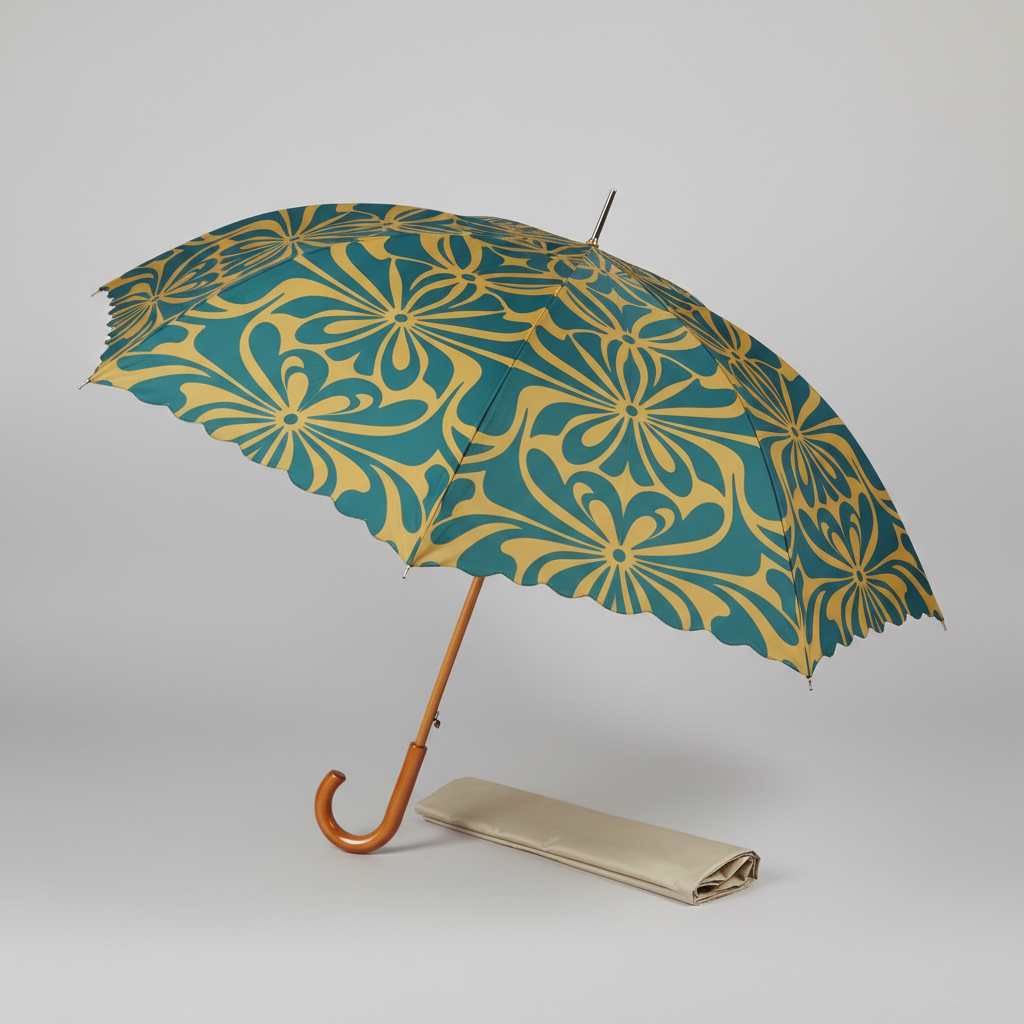
AI umbrella design generator result: an open stick umbrella in teal and mustard, where an art nouveau floral asked for as one motif per panel came back as a single continuous all-over print, so the seams run straight through the middle of the flowers
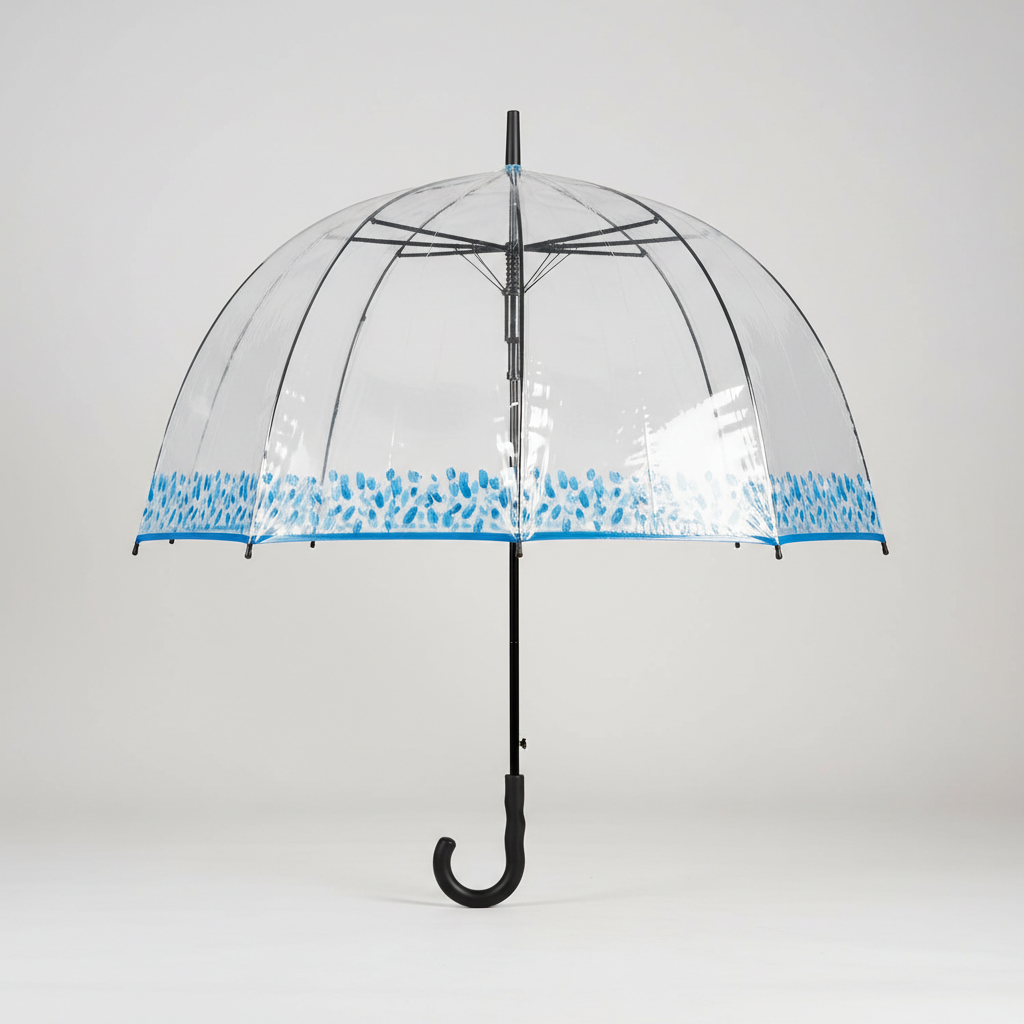
A clear bubble dome umbrella whose only printed decoration is a narrow band of blue brushstrokes sitting just above the hem binding, crossed by every seam, with the rest of the canopy left transparent
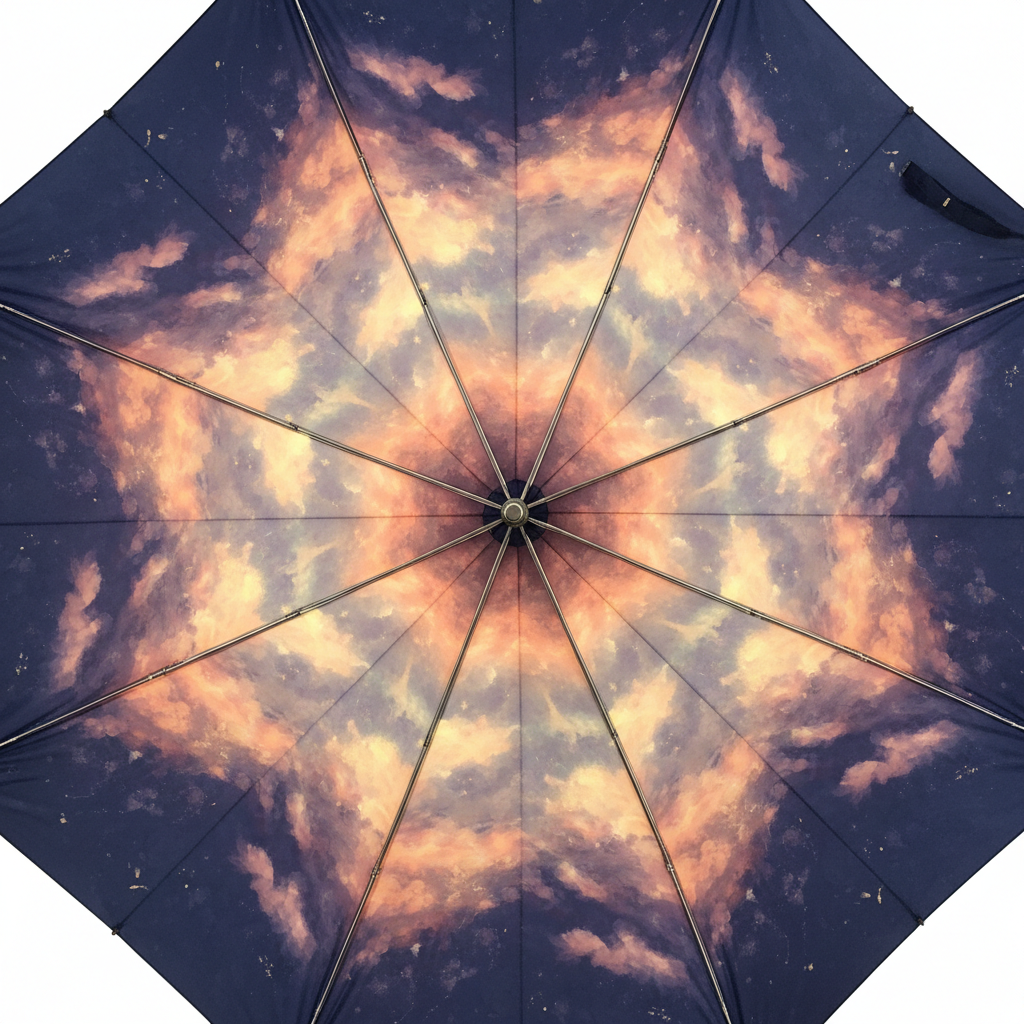
The view the owner actually gets: looking straight up into a printed underside where a painted sunset sky mirrors across each of the eight ribs, deep navy at the rim fading to gold at the centre hub
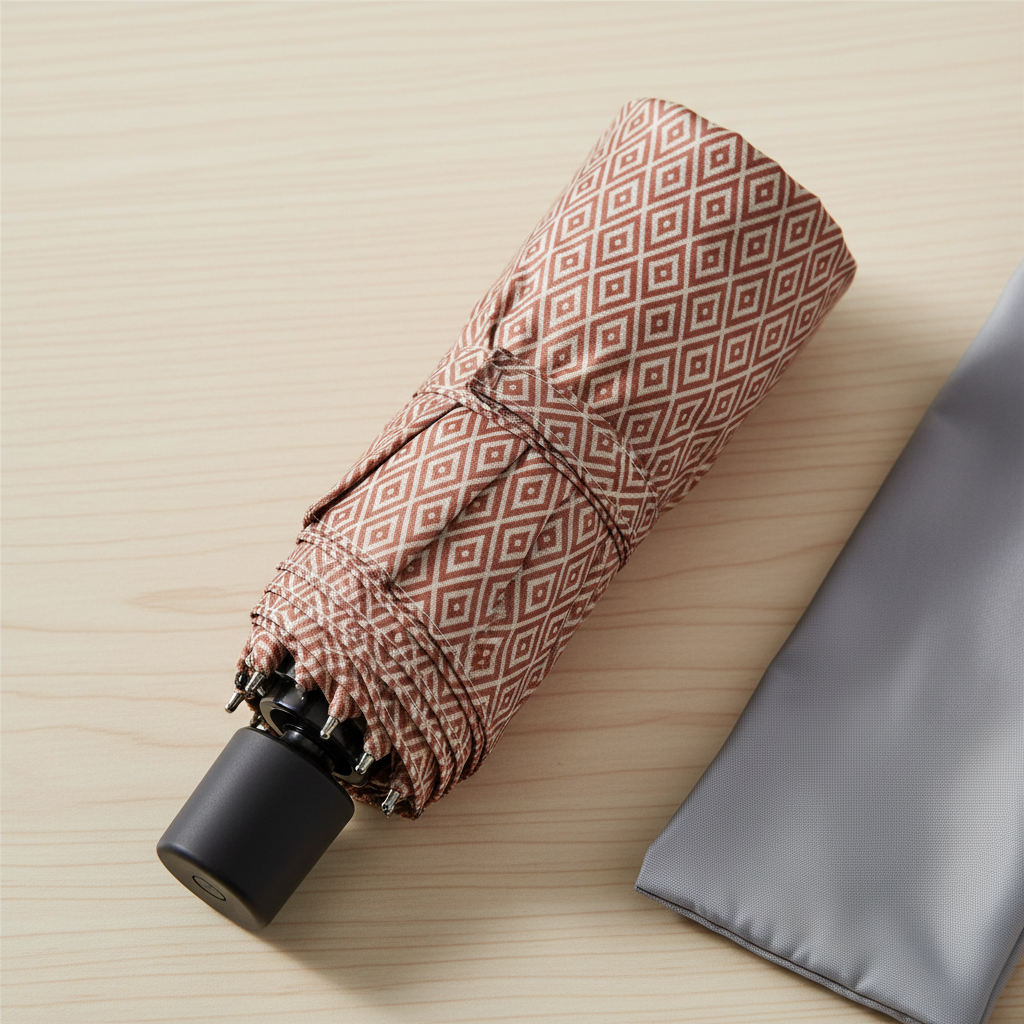
A compact folding umbrella rolled and strapped on a pale table, its terracotta and cream diamond repeat still legible on the broad part of the tube but crushed into unreadable fragments where the fabric gathers down at the rib tips

A vented beach umbrella with panels alternating solid navy and cream: the rust wave motif reads clearly on the panels facing the camera, is squeezed to a sliver on the panels turned edge-on, and has its top cropped away by the vent flap above it
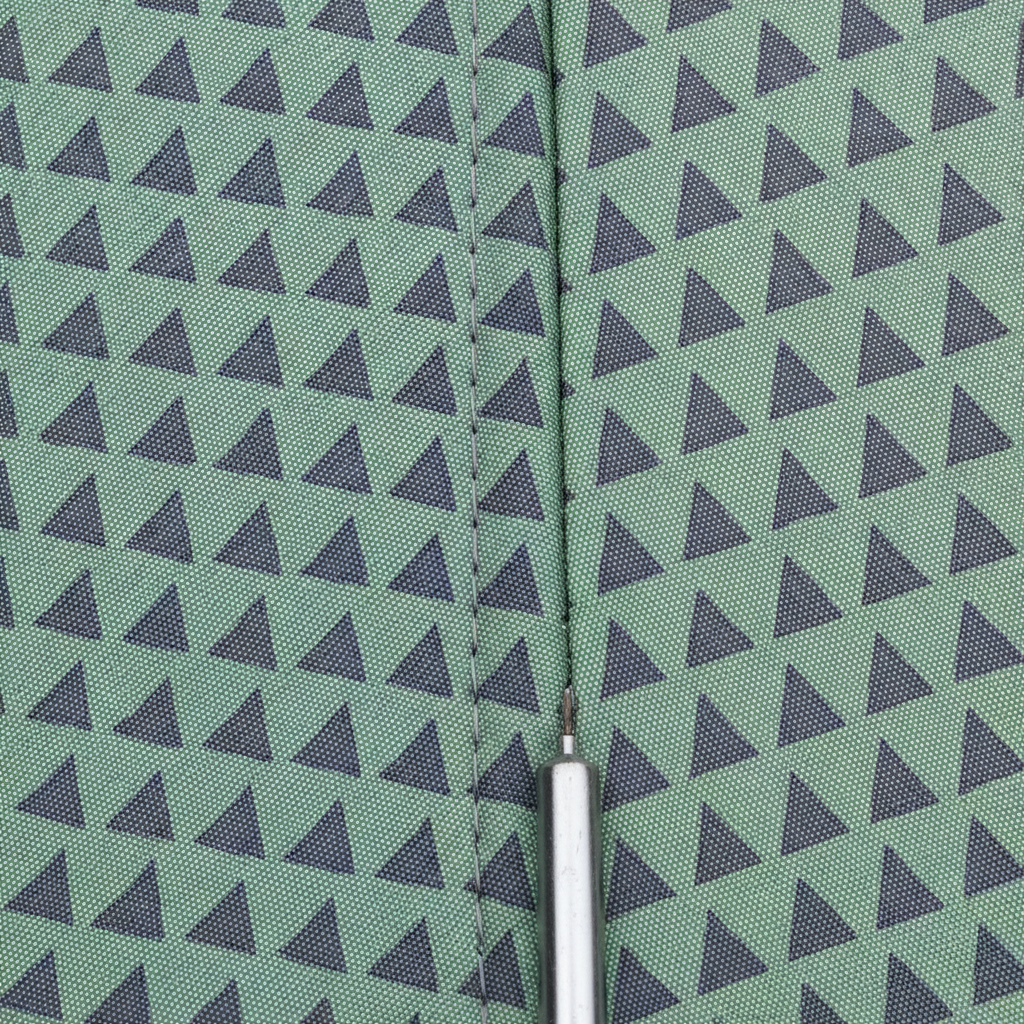
Macro on a canopy seam, where the same sage and charcoal triangle repeat comes out visibly larger and sitting at different heights on the right of the stitching than on the left, so the rows break at the seam instead of carrying across it
How the AI Umbrella Design Generator Works
Pick the construction
Classic stick, clear bubble dome, printed underside, compact folding, vented golf or sun parasol. The construction decides the panel count, the curvature and who is looking at it, so it decides the layout before any colour does.
Describe palette and motif
Add a colour story and a subject, and say how big the motif should be. Scale is the real decision on an umbrella: one oversized shape per panel reads across a street, a fine repeat only reads from under it.
Download, then rebuild on a gore template
Designs come back in about twenty seconds at up to 4K. Use them to lock the layout and palette, then have the artwork redrawn as a flat triangular gore at physical size with seam and hem allowance before a factory prints it.
What Actually Decides an Umbrella Design
Six constraints separate an umbrella from every other printed product. They are why this AI umbrella design generator renders constructions rather than filters, and why a beautiful flat design can still be a bad canopy.
The canopy is panels, not a disc
Six, eight or sixteen triangular gores are cut separately and stitched together, so every design is sliced along seams that radiate from the hub. The layouts that survive are the ones built for it: one motif repeated once per gore, panels alternating solid with patterned, or a band that follows the hem. A single illustration stretched across the dome gets cut into strips and loses its middle under the top cap.
Two audiences, two surfaces
Everyone else sees the outside from twenty metres away, foreshortened from street level or straight down from a window. The owner only ever sees the inside, from about forty centimetres, for as long as it is raining. Those are different briefs. A double canopy can print both, and the underside is the most under-used surface in print-on-demand — a sky or a canopy of leaves overhead beats the same art shrunk onto the top.
It is a cone, and it is mostly a tube
The ribs pull the fabric into a curved cone, so artwork drawn flat foreshortens towards the hem and bows between the ribs. And an umbrella spends most of its life closed, where all that shows is a three-centimetre strip of one panel. Stripes, gradients and dense repeats still look deliberate at that width; a picture does not.
The triangle stretches your repeat
A gore is a long triangle: motifs near the top point are squeezed into a few centimetres, while the same motif at the hem has three or four times the room. A repeat that is even on a flat rectangle grows visibly towards the edge of the canopy. Either scale the motifs down the panel deliberately, or use an all-over texture with no fixed rhythm to give away the distortion.
Sublimation has no white ink
Canopy fabric is nearly always coated polyester pongee printed by dye sublimation, which means every pale area of your design is unprinted fabric, not ink. White is a fabric choice. The coating and tight weave also mute the deepest colours slightly, while daylight passing through the thin fabric lifts everything — which is why a canopy looks different held against a bright sky than it does flat on a table.
A render is a decision, not a print file
A factory needs a flat gore template at physical size with seam allowance on both long edges and hem allowance at the base — around fifty centimetres tall for a compact, closer to eighty for a golf canopy, which is far past one generation at 300 DPI. What a render settles is the layout, the palette, the motif scale and the panel logic. Rebuilding it as vector artwork on the template is the next step, and a sample canopy comes before any batch.
Why Use This AI Umbrella Design Generator
Six constructions, not six filters
The presets differ in panel count, canopy depth, material and viewing distance — stick, bubble, underside, folding, golf, parasol — so switching preset changes the layout logic rather than just the palette.
Panel-aware compositions
Every preset composes for gores and seams: repeats that spin round the hub, alternating panels, or hem bands. That is the structure a canopy factory can actually cut, and the structure that still reads once the fabric curves.
The underside is a first-class layout
One preset renders the view from directly beneath the canopy, the only view the owner ever gets. It is the surface most umbrella designs forget, and the one with the longest dwell time.
Scale you can judge
Golf and parasol presets render at real viewing distance so you can see whether a motif survives being twenty metres away, while the folding preset shows what is left of a repeat once the umbrella is rolled shut.
4K for the rebuild
Downloads are large enough to work from when the design is redrawn on a gore template, and detailed enough to judge whether fine linework will hold on coated pongee.
Cheap enough to test the geometry
About twenty seconds per design and plans from $2.99 means trying four motif scales and three palettes costs less than a single sample canopy from a factory.
AI Umbrella Design Generator FAQ
Related Design Tools
AI Pattern Generator
The upstream tool: it makes the flat seamless tile. This page shows what happens to that tile once it has been cut into triangular gores and pulled over a frame.
AI Scarf Design Generator
The other accessory that hides most of its own artwork — a scarf by folding, an umbrella by rolling shut. Both are designed from the visible fraction inwards.
AI Tote Bag Design Generator
A flat single-panel print for comparison, where the artwork is not sliced by seams and the whole design is visible at once.
Design Your Umbrella Now
Six constructions, panel-aware layouts, top and underside prints and 4K downloads. Free to start, from $2.99 for more.
Start Designing FreeAbout This AI Umbrella Design Generator
An AI umbrella design generator has to solve a geometry problem before it solves a decorative one, because an umbrella canopy is not a surface you can simply print on. It is six, eight or sixteen triangular gores, each cut flat and then stitched to its neighbours along seams that radiate from the top hub down to the hem, and then pulled by the ribs into a shallow cone. Anything designed as one big picture is sliced along those seams, loses its centre under the top cap and bows outwards towards the edge. The six presets here — classic stick, clear bubble dome, printed underside, compact folding, vented golf and sun parasol — are written for that structure, so the layouts they produce are the ones a canopy factory can actually cut.
The second thing an umbrella design generator has to take seriously is who is looking. An umbrella has two completely separate audiences on two separate surfaces. Everyone else sees the outside from a distance, usually foreshortened from street level or straight down from a window, which rewards scale, contrast and one confident idea per panel. The owner sees only the inside, from about forty centimetres, for as long as the weather lasts — which makes the underside of a double canopy the most under-used surface in the whole print-on-demand catalogue. A sky, a leaf canopy or a constellation map overhead is a better experience than the same artwork shrunk onto the top, and it costs no more to print.
Material sets the rest of the rules. Canopy fabric is almost always coated polyester pongee printed by dye sublimation, and sublimation has no white ink, so every pale area in a design is unprinted fabric rather than pigment. The coating and the tight weave mute the deepest colours a little compared with a screen, while daylight coming through the thin fabric lifts everything, which is why a canopy held up against a bright sky never quite matches the flat proof. There is also the fact that an umbrella spends most of its life closed: rolled into a tube, a three-centimetre strip of one panel is all anyone sees, so stripes, gradients and dense repeats hold up where a single centred picture becomes a fragment.
This umbrella design generator runs on Nano Banana Pro, the same image model behind the rest of the tools on this site, and it renders canopy fabric convincingly — the sheen on coated pongee, the shadows the ribs throw across a printed underside, the scallop the hem makes between rib tips. Designs arrive in about twenty seconds at up to 4K. Treat what comes back as the design settled rather than the file finished: it fixes the panel logic, the palette, the motif scale and which surface carries the idea, and the step from there to a real umbrella is having the artwork rebuilt as a flat gore template at physical size with seam and hem allowance, then approving a sample canopy. It is free to start and paid plans begin at $2.99, so a full set of colourways costs a fraction of one factory sample.