
AI Sky Replacement Tool
Swapping a sky by hand means masking every bare twig on the treeline and then relighting the building underneath so it belongs under the new one. This AI sky replacement tool does both halves in about twenty seconds, with six skies to choose from. The masking is the part it does better than a person. The relight is the part to check — and this page shows you exactly where it stops short.
Replace a Sky FreeTry the AI Sky Replacement Tool — Free
Upload the exterior or landscape shot you already have and pick a sky. Choose one whose light direction is possible for the scene you photographed — a sunset behind a north-facing frontage will fight the shadows no matter how good the mask is. Then check the result against your original at full size.
AI Sky Replacement Tool
Upload an exterior or landscape photo and pick a new sky. The scene below is relit to match. Up to 4K.
Upload your photo, pick the sky you want, and click Generate
Six Skies, Six Different Problems
One frame per preset, across the cases that actually come up: a listing frontage, a hero exterior at golden hour, a flat-light coastal landscape, a dusk conversion, a piece of modern architecture and a night sky over water. The captions say what each frame gets right and where it gives itself away — including the two frames whose ground light did not fully follow the sky.
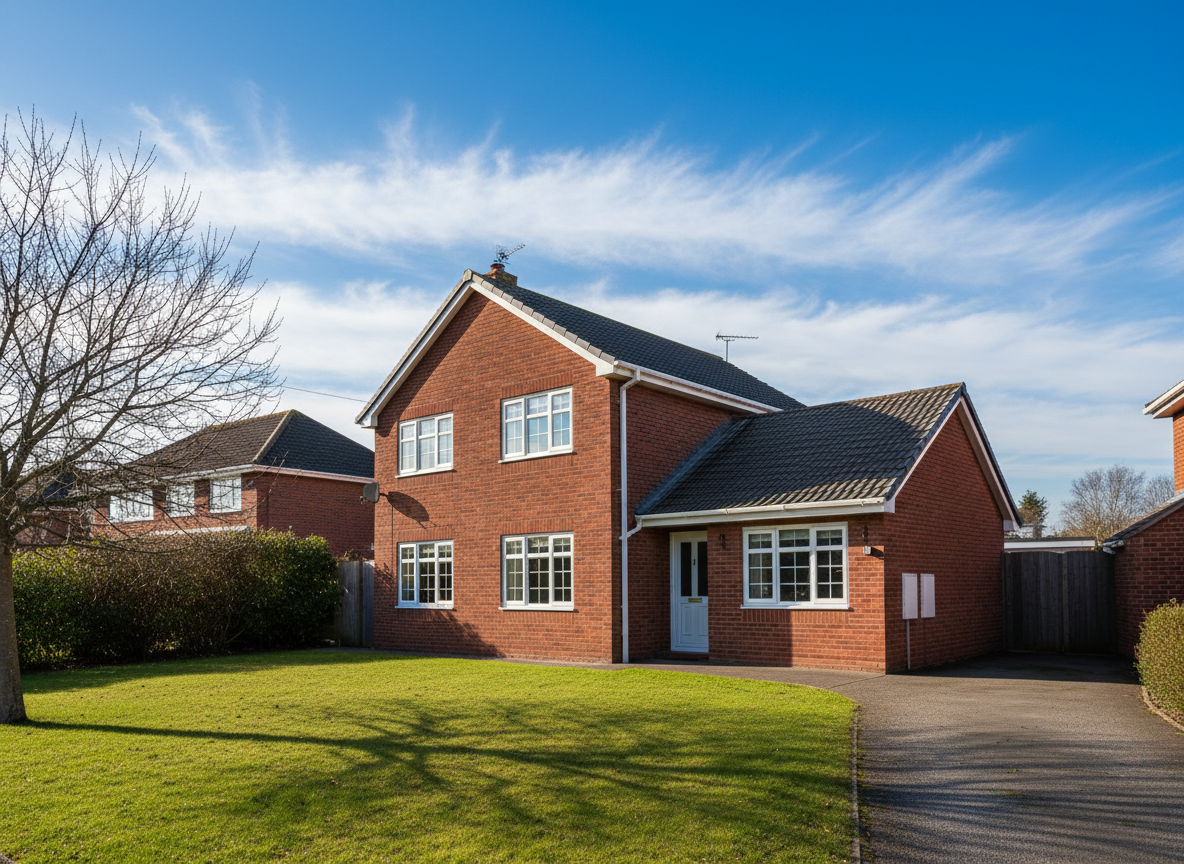
AI sky replacement tool result: a red brick suburban house under a bright blue replacement sky, shot in three-quarter view from the pavement. This is the everyday job and the frame to judge the edge quality on, because a leafless tree stands at the left with hundreds of fine bare twigs against the new sky — and every one of them survives, with no halo, no pale fringe and no twig chopped off, which is exactly where a manual selection in Photoshop falls apart. The roofline, the chimney, the aerial and the gutter all cut cleanly too. The relight is the real win: the sun sits high on the left, warm light lands on the front elevation, the eaves and the porch hold soft open shadow, and the tree throws a genuine shadow across the lawn that agrees with the sun position in the new sky. One honest miss — the brief asked for soft cumulus and what came back is high wispy cirrus.
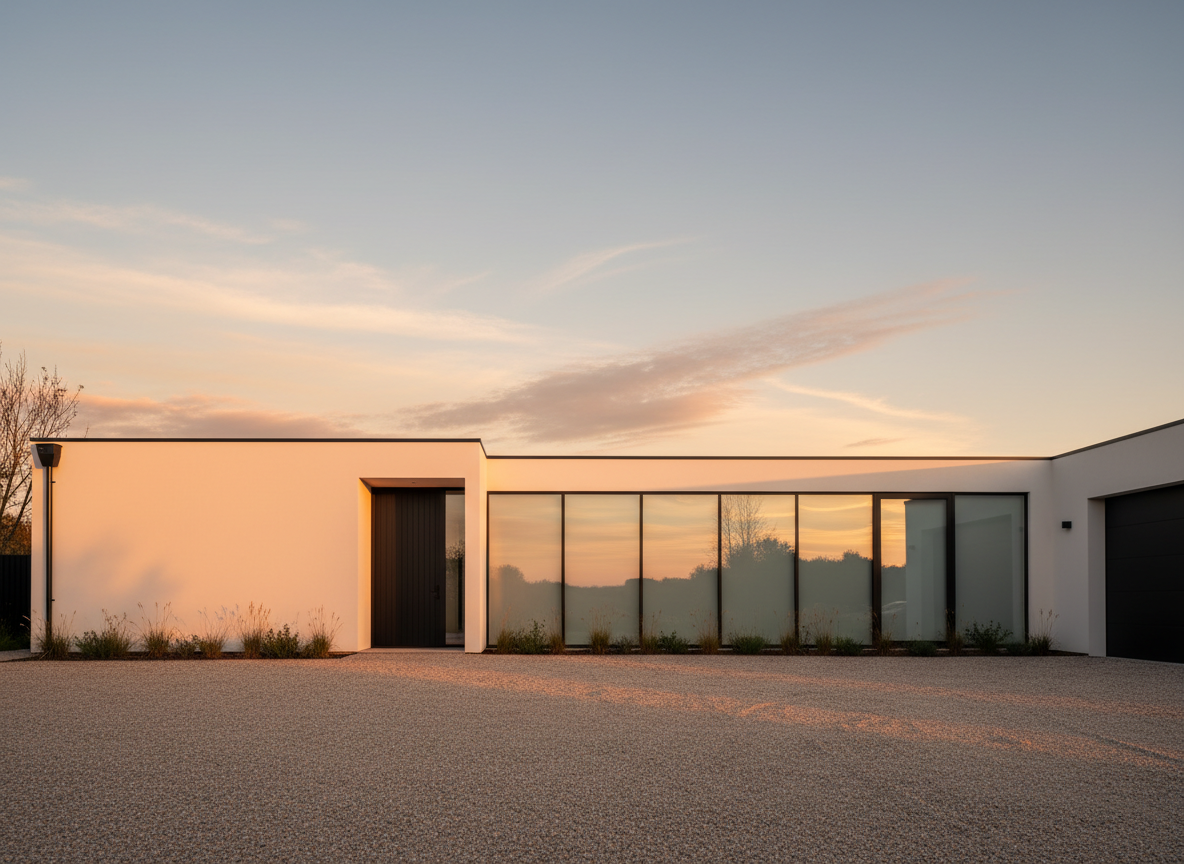
AI sky replacement tool result: a modern white rendered single-storey house with full-height glazing under a golden hour sunset sky, seen across a gravel forecourt. The sky runs from a warm amber and coral band at the horizon up through peach into a calm pale blue overhead, with thin backlit clouds catching the last light. The detail that makes this the strongest frame on the page is the glass: the sunset is reflected in the run of full-height glazing, with the treeline and the warm horizon band visible in the panes, so the new sky exists in the scene rather than only behind it. That single reflection is what a pasted-in sky can never fake. The render on the walls picks up the low warm light and the planting along the base has dropped to a dim evening green rather than staying at midday. The framing came back straight-on rather than the angled view the brief asked for.
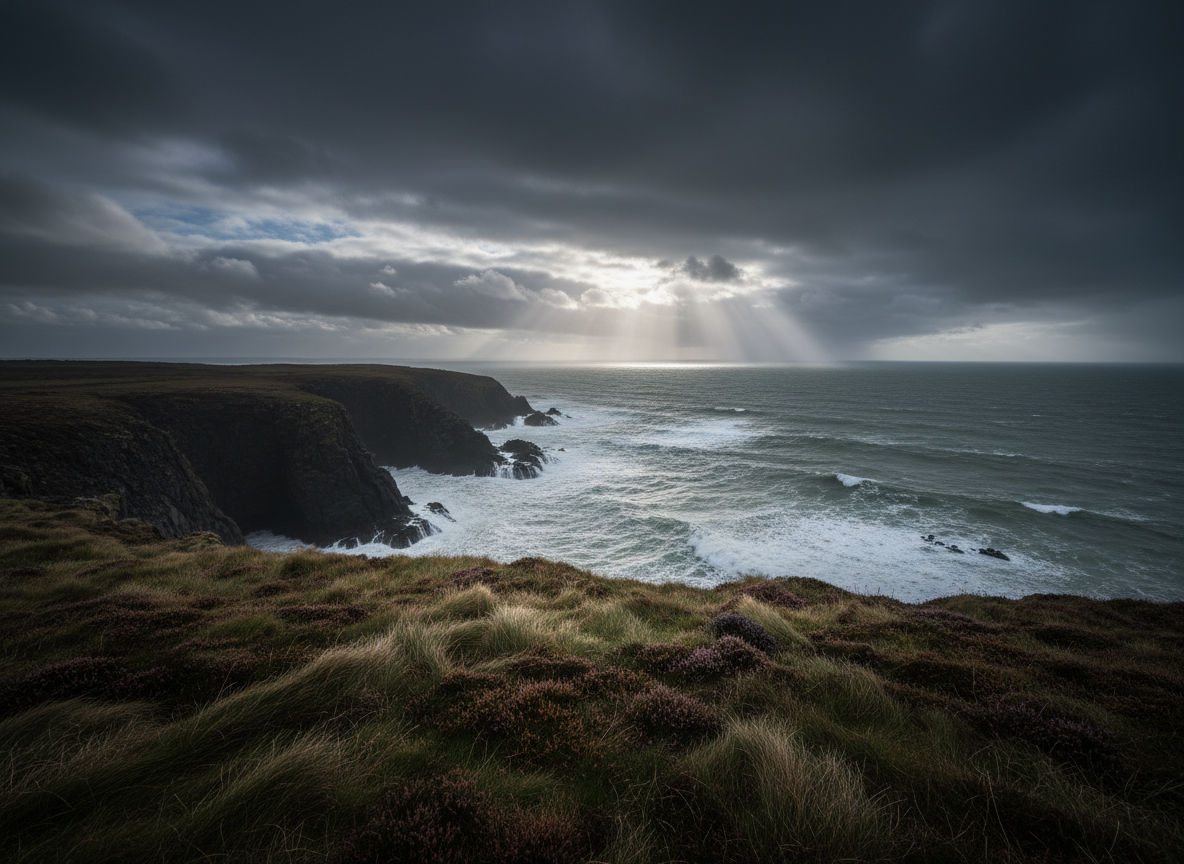
AI sky replacement tool result: a coastal headland under a dramatic storm sky, with heavy layered charcoal cumulonimbus, brighter silver breaks and visible crepuscular rays falling on the water. This is the landscape photographer version of the job — the shot you took on a flat white day, given the weather you waited for and did not get. The cloud has real internal structure and depth rather than a single grey wash, and the light in the scene follows it: the clifftop grass and heather are mostly in shadow, the sea takes the grey-green of the cloud instead of a blue that is no longer there, and the wet rock keeps cool desaturated highlights. The honest weakness is in the foreground, where the grass stays a shade warmer and brighter than a sky this heavy would really allow. It is the same failure mode as the twilight frame: the sky changes fully, the ground follows most of the way.
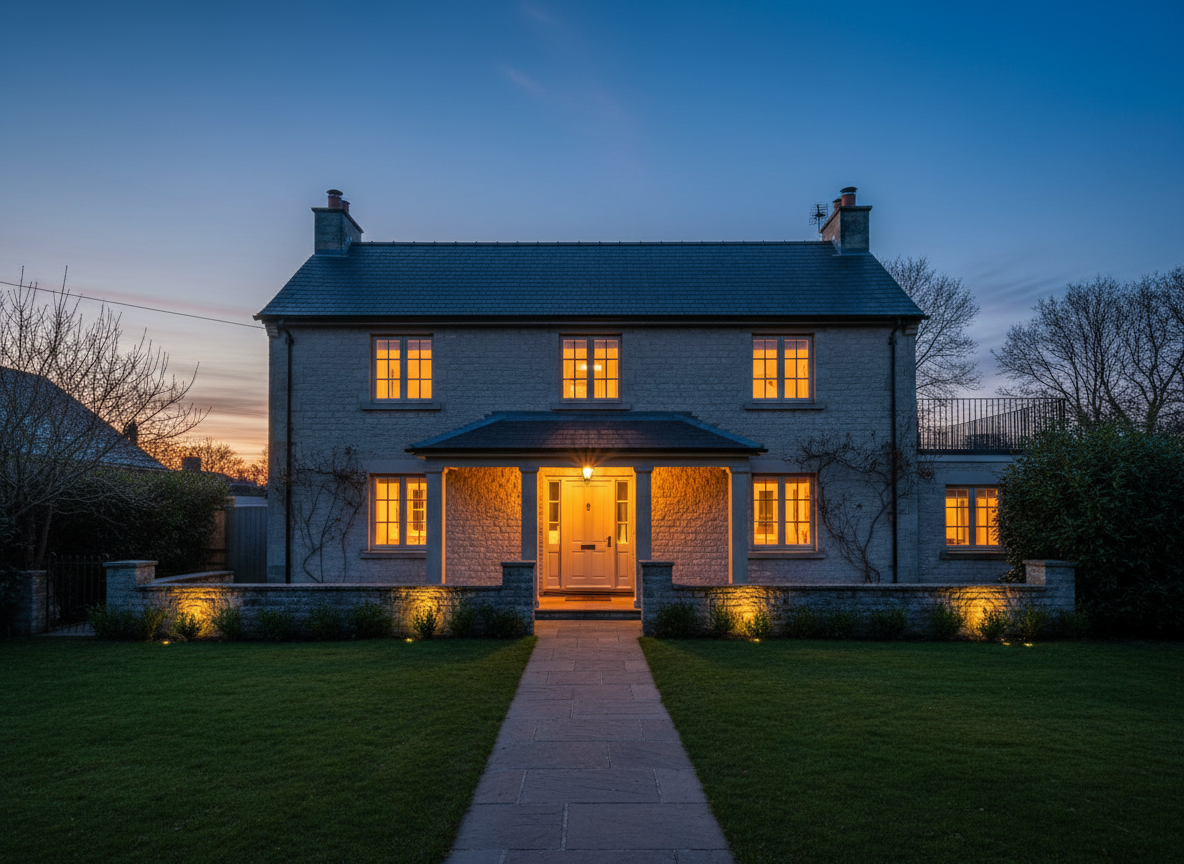
AI sky replacement tool result: a pale stone house at blue hour, with the sky graduating from deep indigo overhead to a soft orange band along the horizon. The window glow is the part that usually gives a fake dusk away and it holds up here: every window is lit a warm amber from inside, stronger downstairs than up, and each glow is contained precisely within its own frame with no orange bleeding onto the stonework. The porch lantern is on, the wall-wash uplighters throw small realistic pools up the stone and into the planting, and the bare tree and the neighbouring roofline at the left read cleanly against the dusk sky. The miss is the lawn: it holds a fairly bright daylight green when a real blue hour would pull it much darker and much cooler. If you are replacing a sky at dusk, that is the first thing to check at full size.
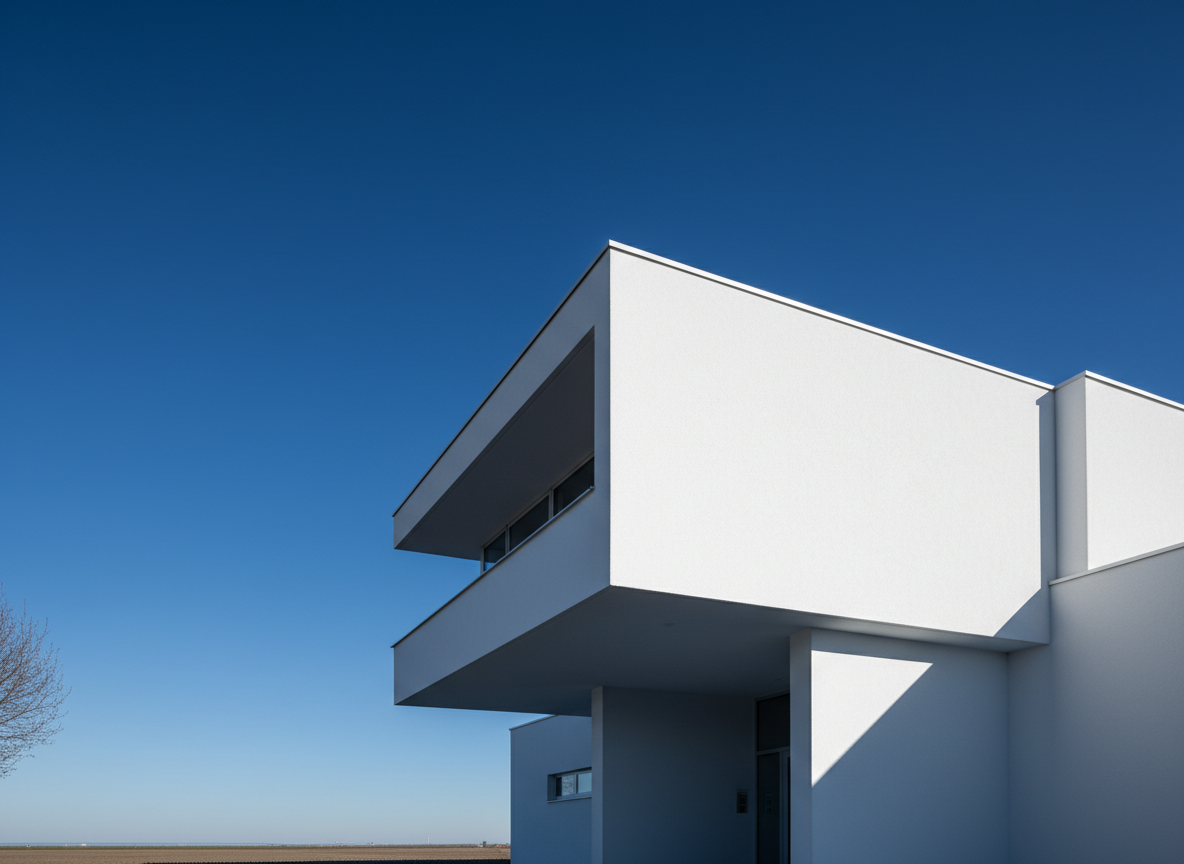
AI sky replacement tool result: a white modernist building against a clear deep blue sky with no cloud at all, graduating from rich blue at the top of the frame to a paler blue at the horizon exactly the way a polarising filter renders a clear day. This is the architectural photography case, where cloud is a distraction and the only job is a clean gradient behind hard geometry. The relight matches it: hard midday sun rakes across the white planes from the right, the cantilever and the entrance recess drop crisp geometric shadows with genuinely straight edges, and the shadowed planes hold a cool blue-tinged white rather than collapsing to grey. Every vertical is truly vertical with no keystoning. The weak corner is the very bottom of the frame, where the ground goes flat and washed out and holds almost no detail.
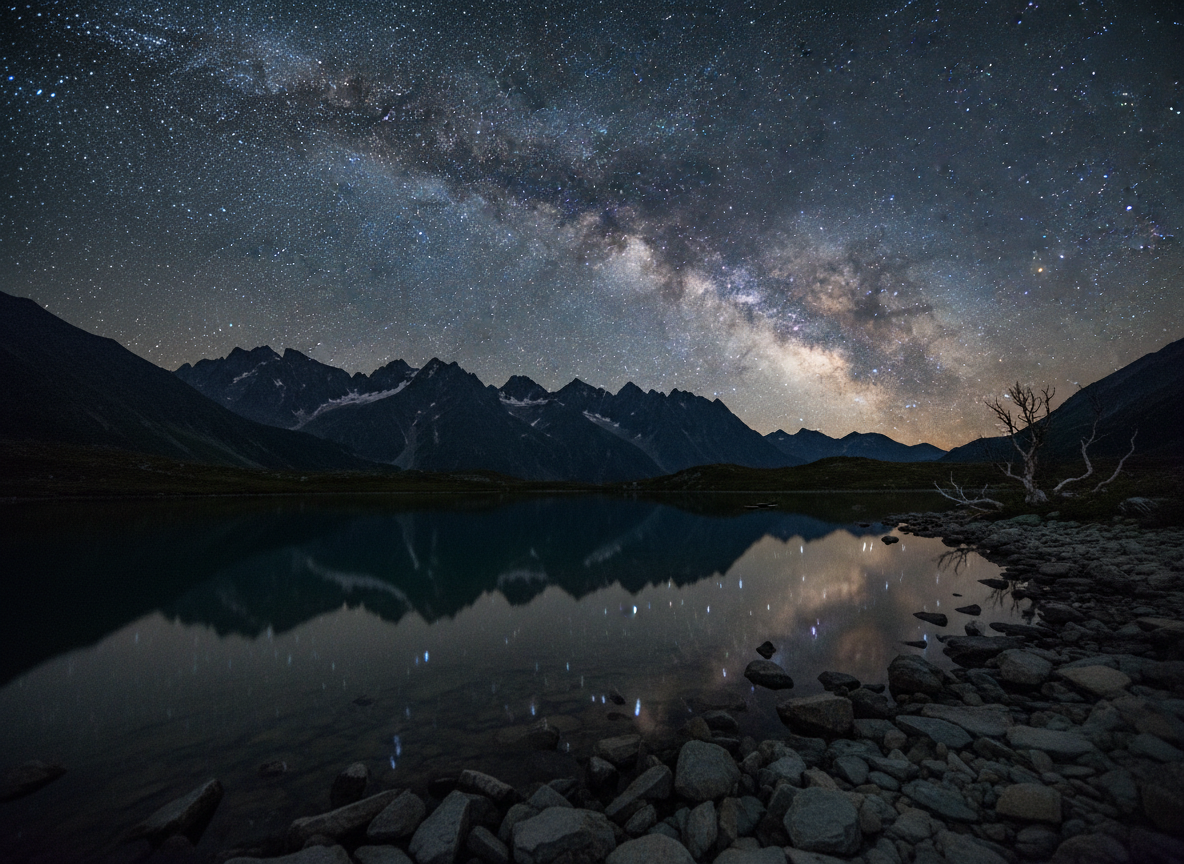
AI sky replacement tool result: an alpine lake under a starry night sky, with the Milky Way arcing across the frame, its dust lanes visible, and a bare dead tree in silhouette at the right. This is the hardest preset on the page because the sky has to be replaced and the whole landscape re-exposed for night at the same time. Mostly it works: the ridgeline is a deep blue-black silhouette with the faintest starlight on the snow, the foreground stones are dim and cool, and there is no artificial light pollution glow along the horizon. The tell is in the water. The lake mirrors the Milky Way band convincingly, but the individual reflected stars come back as large soft discs rather than the fine points they are in the sky above, which reads fine at gallery size and gives itself away at full size. Judge any night sky replacement on the reflection first.
How the AI Sky Replacement Tool Works
Upload a photo with a recoverable sky
Any exterior or landscape shot, from a phone or a camera. A dull grey overcast sky is the ideal input because the detail below it is properly exposed. A sky that blew out to pure white is harder, because where white meets fine twigs there is no edge information left in the file for anything to recover.
Pick a sky whose light is possible
This is the decision that makes or breaks it. A sunset behind a frontage that was shot in flat noon light with shadows falling straight down will always fight itself. Look at where the shadows in your photo point, and choose a sky whose sun could plausibly be in that position. Blue with cloud is the safe default for property.
Check the edge, then check the ground
Open the original and the result side by side at full size. Follow the finest detail in the frame — the bare twigs, the railings, the ridgeline — looking for a fringe. Then look away from the sky entirely and ask whether the grass, the walls and the shadows agree with it. That second check is the one people skip.
What This AI Sky Replacement Tool Nails, and Where It Stops Short
A sky swap is two jobs pretending to be one: cutting the sky out, and making the scene belong under the new one. This tool is close to flawless at the first and about eighty per cent of the way through the second. Knowing which is which tells you what to check.
The edge through bare branches is the standout
Masking a leafless tree against a sky is the reason sky replacement used to be a specialist job. The suburban frame in the gallery has hundreds of fine bare twigs crossing the new sky and every one survives — no halo, no grey fringe, no cut-out outline, no twig ending in mid-air. Rooflines, chimneys, aerials, railings and mountain ridges are easy by comparison, and they are clean too. This is the part of the job that is genuinely solved.
Reflections are handled, and that is rare
The golden hour house is the best frame on the page and the reason is the glazing: the sunset appears in the full-height windows, with the treeline and the warm horizon band visible in the panes. A pasted-in sky can never do that, and it is the first thing an experienced eye looks for. The alpine lake carries the Milky Way band into the water the same way. Where there is glass or water in your frame, this is where the tool earns its place.
The ground light follows, but not all the way
The consistent limitation, and the one worth knowing before you publish. The blue hour house keeps a lawn at daylight brightness and daylight green when a real dusk would pull it much darker and much cooler. The storm coast keeps a foreground a shade warmer than that cloud allows. In both cases the sky is fully replaced and the scene is relit maybe eighty per cent of the way. It reads well at gallery size and less well at full size, so look at the grass, not the sky.
It regenerates, so the subject can drift
The risk that matters most for property work. This is a generative model rebuilding the photograph rather than a mask and a gradient layered over it, which means it can quietly alter something below the horizon while it works on the light. A window proportion, a roof tile pattern, a fence line. Every preset here carries an explicit instruction that the building, the materials, the window count and any visible defect must survive untouched, but you check it, every time.
It gives you the sky you described, roughly
The blue sky frame was asked for soft cumulus and came back with high wispy cirrus. Perfectly good, not what was ordered. Expect the category to be right and the specifics to be approximate, so if you need a particular kind of cloud — flat-bottomed cumulus, a thin high veil, a clear break over one corner — say it in the brief and be prepared to regenerate once or twice to land it.
Night reflections are the weakest point
The starry night preset is the hardest thing on this page, because the sky is replaced and the whole landscape is re-exposed for night at the same time. The Milky Way, the dust lanes and the silhouetted ridge are all convincing. The reflected stars in the lake come back as large soft discs rather than the fine points they are overhead. On any night frame with water in it, judge the reflection before you judge the sky.
Choosing a Sky That Your Photo Can Actually Carry
Most bad sky replacements are not mask failures. They are someone choosing a sky the original photograph could never have been taken under. Four rules that decide it before you press Generate.
Follow the shadows you already have
The shadows in your photograph tell you where the sun was. A sky whose light comes from the opposite side will fight them and no amount of relighting fixes it cleanly. Overcast originals are the easiest input precisely because their shadows are soft and non-committal, which is why grey days swap so well.
Match the drama to the subject
Storm clouds make a coastline magnificent and a family home look grim. Golden hour flatters render, timber and brick and does very little for a grey office block. Clear polarised blue suits hard modern geometry and makes a cottage look sterile. The sky is not decoration, it is a claim about the place.
One hero, not thirty
A listing gallery where every exterior sits under a spectacular sunset stops reading as a record of a property. Run the dramatic sky on the lead image, keep the rest on ordinary blue, and the lead image does more work than it would if everything around it were shouting too.
Change the weather, not the property
Every preset here changes the sky and the light and nothing else. The building, its dimensions, its window count, its materials and any visible crack, stain or damp patch have to survive the edit. A sky used to hide something behind a roofline is not a sky replacement, it is a misrepresentation.
Why Use This AI Sky Replacement Tool
The mask is the hard part, and it is solved
Bare winter branches, foliage, railings, wires and rough mountain ridges all cut cleanly against the new sky. This is the step that meant channel masks, a refine-edge pass and a manual fringe clean-up, and it is the reason a sky swap was billed as retouching rather than done with a slider.
It relights, it does not just paste
A sky pack gives you a sky. It does not warm the render, lengthen the shadows, cool the planting or put the sunset into the windows. Every preset here relights the whole scene to match the sky it just put behind it, which is the difference between a composite and a photograph.
Six skies for six real situations
Blue with cloud for listings, golden hour for the hero exterior, storm for coast and moorland, blue hour with the lights on for a dusk conversion, clear polarised blue for modern architecture, and a full Milky Way for night landscape. Six separate briefs, not six filters over the same idea.
Twenty seconds instead of fifteen minutes
Masking, compositing, colour-matching and relighting a single frame by hand is a quarter of an hour for someone who is good at it. Each sky here takes about twenty seconds, which changes what is worth doing — you can try three skies on the same frame and pick, rather than committing to one.
Property and landscape in one place
Listing frontages and coastal headlands are the same technical job with different taste attached. The presets cover both, and the page is explicit about which skies belong on a property and which ones will make a house look bleak no matter how well the edge is cut.
Honest about what it misses
The lawn that stayed daylight-green under a blue hour sky, the storm foreground that stayed too warm, the reflected stars that came back as discs, and the cumulus that turned up as cirrus. All four are in the captions above. You should know them before your image is published, not after.
AI Sky Replacement Tool FAQ
Related Photo Editing Tools
AI Real Estate Photo Editor
The rest of the listing workflow. Exposure, the window pull, decluttering, day-to-twilight conversion and straightening leaning verticals — the six corrections that come before or after the sky swap on the same set of frames.
AI Background Generator
When the problem is the whole background rather than the sky above it. Build a new setting behind a subject instead of changing the weather over the one you photographed.
AI Object Remover
The tidy-up pass a new sky usually exposes. Once the frontage is under bright blue, the wheelie bin, the parked car and the hose across the drive become the thing you notice first.
Give the Photo the Day It Deserved
Six skies — blue with cloud, golden hour, storm, blue hour, clear polarised blue and a full Milky Way — each one relighting the scene underneath rather than pasting a picture behind it. About twenty seconds a frame, up to 4K. Free to start, from $2.99 for more.
Replace a Sky FreeAn AI Sky Replacement Tool for Property, Architecture and Landscape
Weather is the one thing a photographer cannot book. The viewing is on Thursday, the light is flat and grey, and the frontage that would look welcoming under a blue sky looks tired instead. The landscape you drove two hours for gives you a white sky with no structure in it at all. For thirty years the answer has been to composite a better sky in afterwards, and for thirty years that has been a specialist job, because cutting a leafless tree out of a sky is genuinely difficult and because a pasted sky over an unchanged scene fools nobody. An AI sky replacement tool collapses both halves of that into a single pass of about twenty seconds.
The six presets on this page are written as six different situations rather than six looks. Blue sky with soft cloud is the workhorse and the right default for almost any listing, because it is the sky a buyer expects and it survives being seen at thumbnail size. Golden hour is for the single hero exterior, and it is where the tool shows off — the sunset appears in the glazing, not just behind the building. Dramatic storm is a landscape effect for coast and moorland, and it is the one sky you should keep away from houses. Blue hour with the interior lights on is the dusk conversion agents ask for most. Clear polarised blue with no cloud at all is for modern architecture, where cloud competes with the geometry. And the starry night preset re-exposes an entire landscape for a full Milky Way, which is the hardest thing on the page.
The gallery above is one frame per preset and the captions are honest about all six, because the failure modes of this AI sky replacement tool are consistent enough to be worth learning. The edge quality is the part that is genuinely solved: hundreds of fine bare twigs cross the new sky in the suburban frame and every one survives without a halo or a fringe, which is exactly the work that used to mean a channel mask and a manual clean-up. Reflections are handled too, in the glass of the modern house and the surface of the alpine lake. What follows only partway is the ground. The blue hour lawn stays at daylight brightness and daylight green when real dusk would pull it much darker; the storm coast keeps a foreground slightly warmer than that cloud allows; the reflected stars in the lake come back as soft discs rather than points. The sky changes completely and the scene beneath it comes about eighty per cent of the way.
That leaves a simple working rule. Choose a sky whose sun could plausibly sit where the shadows in your original photograph already point, run it, and then check the result twice: once along the finest detail in the frame looking for a fringe, and once at the grass and the walls and the shadows, asking whether they belong under the sky you just chose. For property work there is a second boundary, and it is the reason every preset here is written the way it is: this changes the weather, not the building. Dimensions, window count, materials, and any visible crack, stain or damp patch must survive the edit untouched, because a listing photograph is something a buyer relies on rather than a piece of advertising art. Swap the sky, relight the scene, leave the place itself alone.