
AI Real Estate Photo Editor
Outsourced listing retouching costs one to three dollars an image and comes back tomorrow. This AI real estate photo editor runs the same six corrections on the photos you already shot — exposure, the window pull, decluttering, day to twilight, sky replacement and straightened verticals — in about twenty seconds each. It fixes the photograph and leaves the property alone. It does not stage empty rooms, and this page is straight with you about the frames that needed a second attempt.
Start Editing FreeTry the AI Real Estate Photo Editor — Free
Upload the listing photo you already have, from a phone or a camera, and pick the fix it needs. Start with exposure and colour, because everything else is judged against them. Then run the window pull if the glass is still white. Check every result against your original at full size before it reaches a portal.
AI Real Estate Photo Editor
Upload a listing photo and pick a fix: exposure, window pull, declutter, twilight, sky replacement or straightening. Up to 4K.
Upload your listing photo, pick the correction it needs, and click Generate
Six Listing Photos, Six Different Fixes
One frame per preset, across the jobs a property retoucher is actually paid for: a dim interior, a blown window, a cluttered family room, a flat daytime exterior, a grey sky and a leaning wide-angle shot. The captions say what each frame gets right and where it falls short. Five landed first time. One needed a second attempt, and windows turned out to be the recurring soft spot.
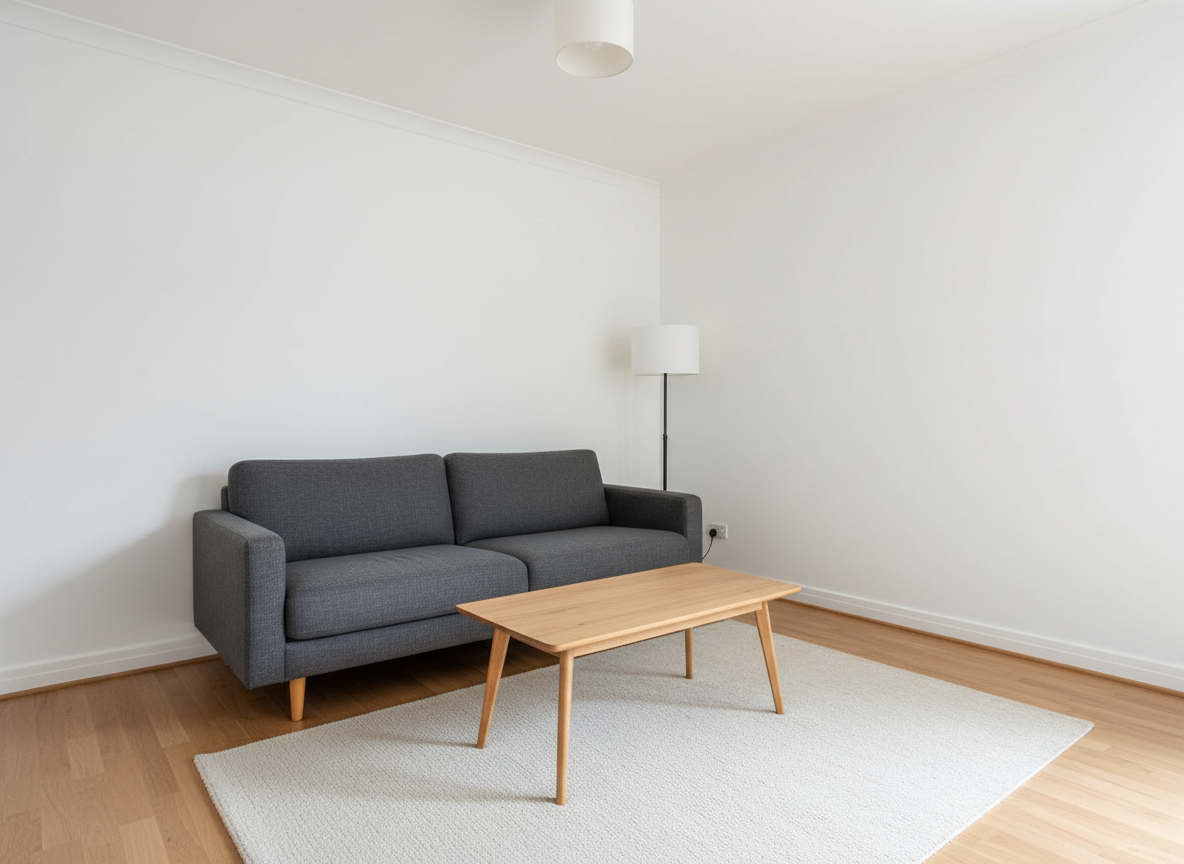
AI real estate photo editor result: a brightened north-facing living room with a grey fabric sofa, a light oak coffee table, a floor lamp and a plain rug, evenly lit from corner to corner. This is the everyday fix and the one most listings actually need. The shadow that would normally swallow the floor behind the sofa and under the table is lifted far enough that the flooring, the skirting board and the far corner all stay readable, without the flat grey wash you get from dragging a shadows slider too far. The white balance is the quieter win: the walls are a genuine neutral white rather than the yellow-green a warm bulb usually leaves behind, and the floor still reads as warm oak rather than being neutralised along with the walls. Every item that was in the room is still in the room, in the same place, at the same size.
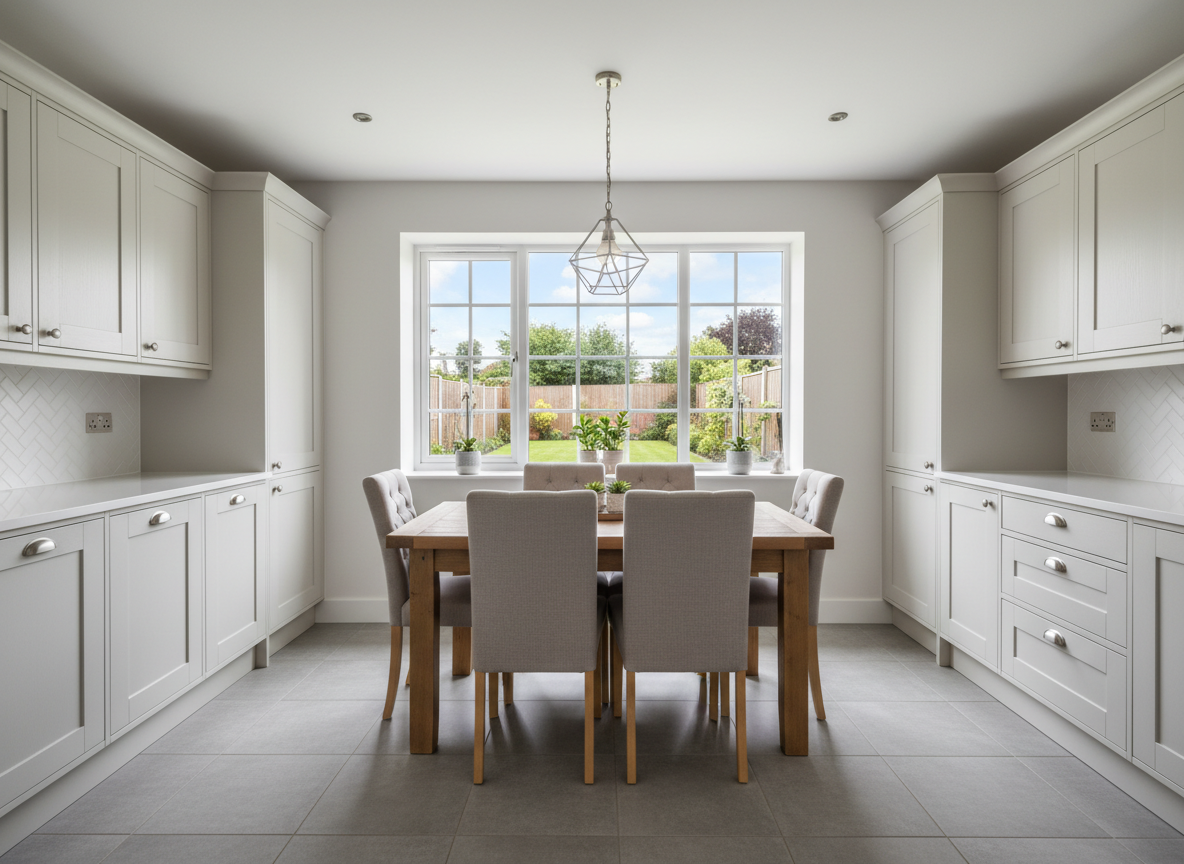
AI real estate photo editor result: a shaker kitchen and dining area with a large garden window behind the table, showing a flawless window pull. This is the frame that decides whether a listing photo looks professional, and it is the strongest result on the page. The interior is correctly exposed — cabinet doors, cup handles, herringbone splashback, the timber of the table — and the window is fully exposed at the same time, so the lawn, the shrubs, the fence line and the blue sky beyond the glass are all clearly visible in natural colour instead of the blown white rectangle a single exposure gives you. Look at the glazing bars and the window reveal: no bright halo, no grey glow, no ghosting along the edges, which is exactly where cheap HDR gives itself away. The daylight falling into the room also matches the weather outside the glass, which is the detail that sells it.
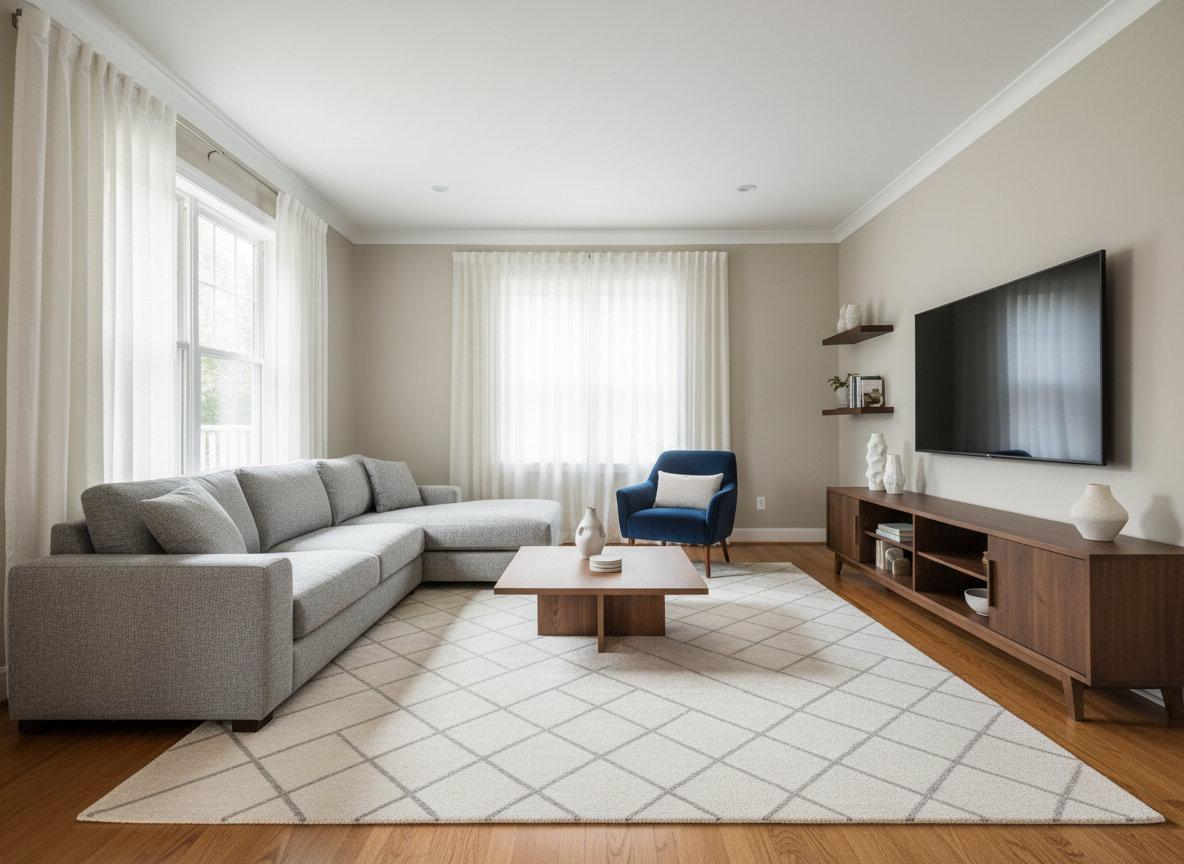
AI real estate photo editor result: a decluttered family living room, keeping its sectional sofa, armchair, media unit, rug and curtains while every piece of everyday clutter is gone. The floor is completely clear, the shelves carry a few objects instead of a crowd of framed personal photographs, and the surfaces underneath everything that was removed are rebuilt with continuous floorboards, continuous shelf timber and continuous wall paint, with no smudged patches and no ghost outlines. This frame took two attempts and the reason is worth knowing: the first result was clean everywhere except for a small waste bin still sitting beside the media unit, despite a general instruction to remove clutter. Naming it in plain words — no waste bin, no basket, nothing on the floor at all — cleared it in one regeneration. Note also the centre window here has gone white, which is the same weakness the empty bedroom shows: when the brief points somewhere else, the model stops defending the windows.
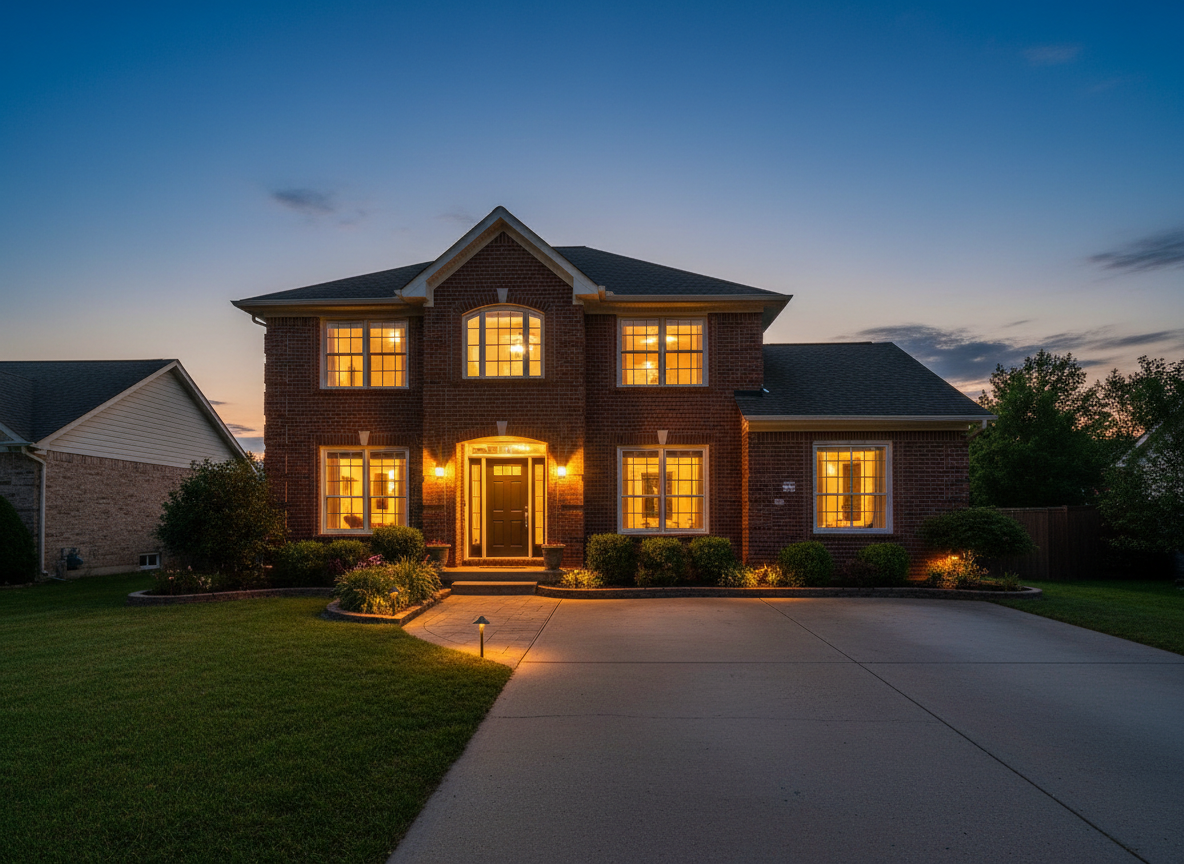
AI real estate photo editor result: a two-storey brick house converted from a plain daytime shot into a warm twilight exterior. Dusk conversion is the effect agents ask for most and the one that most often looks fake, and this is the best frame on the page. The sky runs from a deep indigo overhead to a soft warm orange at the horizon with a few honest wispy clouds, and the light landing on the brickwork agrees with it rather than staying stuck at midday. Every window glows amber and — this is the part cheap twilight edits fail — each glow is contained precisely inside its own frame, with no soft orange bleeding onto the surrounding brick. The porch light and the door sconces are lit, uplighters throw small realistic pools onto the shrubs, the lawn holds a believable dim green rather than going grey, and the driveway is clean and empty with no car and no bin in the frame.
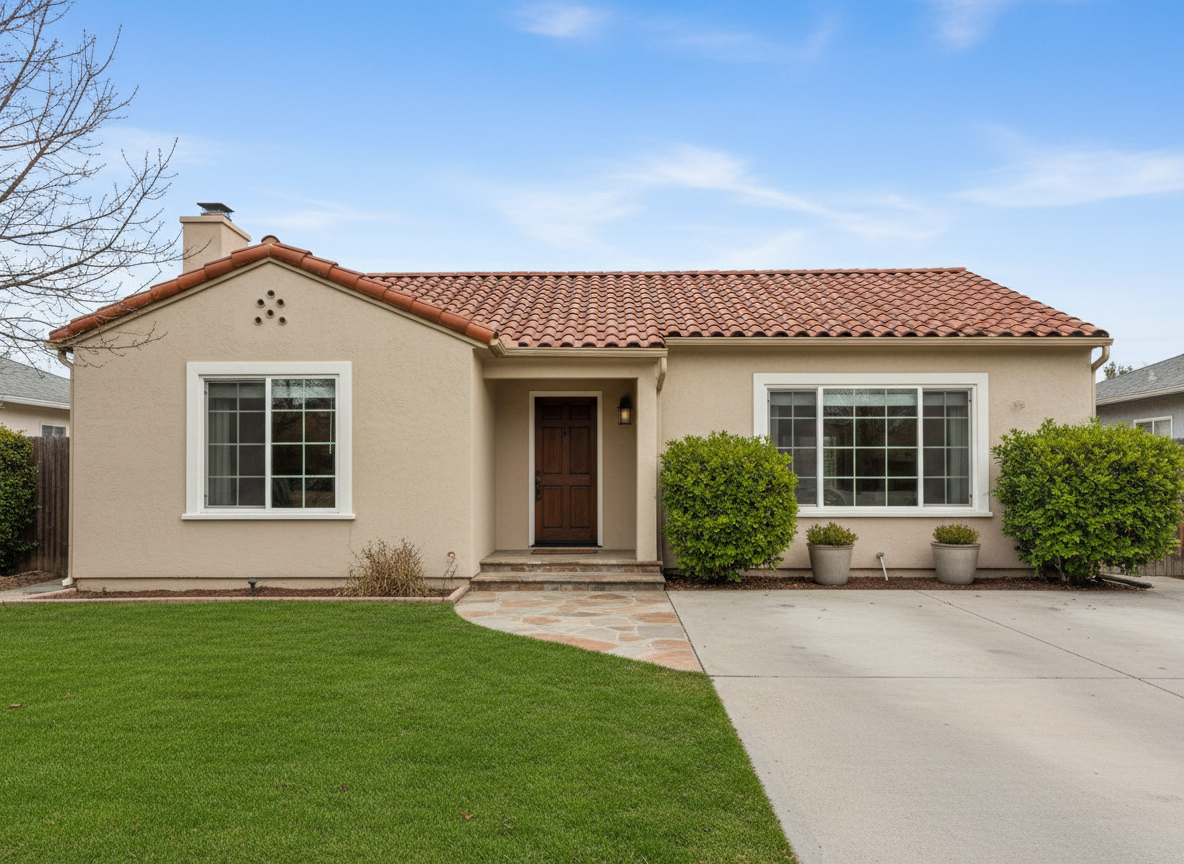
AI real estate photo editor result: a single-storey stucco house after a sky replacement and a lawn correction, with a bright blue sky replacing flat grey overcast. The edge quality is the thing to judge and it holds up: the tile roofline, the chimney and — the real test — the bare tree branches at the top left all meet the new sky cleanly, with no halo, no grey fringe, no cut-out outline and no branch chopped off mid-twig. The tired front lawn is now an even healthy green with natural variation across it rather than a flat painted colour, and the driveway and path are clean with no car, no bin and no hose. The honest weakness is the light: the sky changed but the shadows on the house did not fully follow it, so the eaves and the porch stay softly lit in a way a genuinely sunny day would not allow. It reads well at listing size and slightly less well at full size.
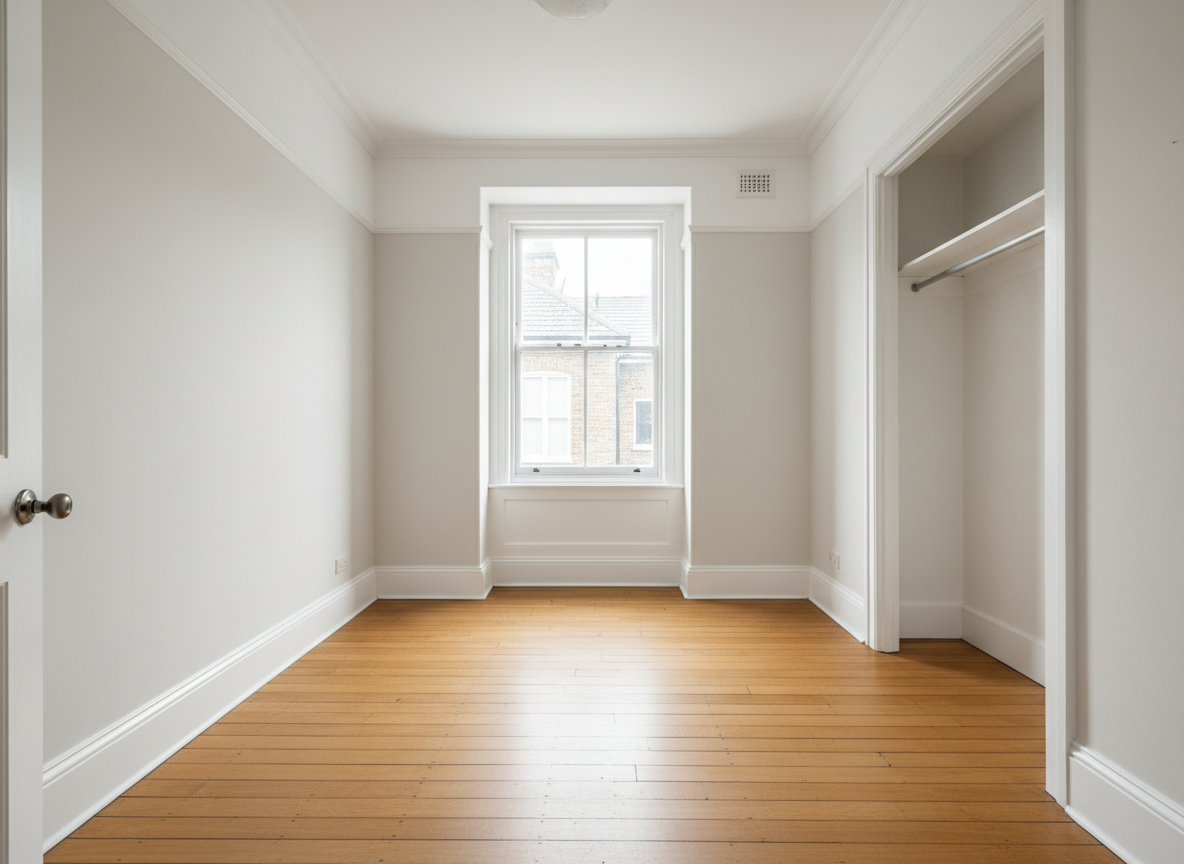
AI real estate photo editor result: an empty unfurnished bedroom with the perspective and lens distortion corrected. Every vertical in the frame is truly vertical — the door edge, the window reveal, the wardrobe opening and all four wall corners — with no leaning walls, no keystoning and none of the outward bulge a wide-angle lens leaves at the edges of the frame, while the skirting and the window sill run level. This frame also demonstrates the discipline this page is built around: the room was empty and it stayed empty. No bed appeared, no rug, no curtains, no plant. That is not a limitation, it is the point, because furnishing an empty room is virtual staging and a staged photo has to be disclosed as one. The genuine miss is the window, where the upper panes have gone white and only the lower half of the neighbouring roofline survives.
How the AI Real Estate Photo Editor Works
Shoot the property properly once
Every light in the house on, blinds open, camera level and at chest height, shot from a corner to show depth, phone braced or on a small tripod. Clear the genuinely temporary mess before you press the shutter rather than after. The upload is the biggest quality lever on this page — no editor recovers detail that was never captured.
Pick the fix the photo actually needs
Exposure and colour first, because everything else is judged against them. Window pull if the glass is still white. Declutter for cables, toys and laundry. Twilight and sky replacement for the hero exterior rather than all thirty frames. Straighten anything shot on a wide-angle lens, which is where leaning walls come from.
Check it against the original at full size
Open your source photo and the result side by side. Count the windows and the cabinet doors. Follow the floorboards, the tile grout and the worktop edge. Check that no crack, stain or damp patch quietly disappeared, and that no furniture appeared in an empty room. Regenerate anything that moved. This pass is the job.
What This AI Real Estate Photo Editor Nails, and What It Breaks
A listing photo is marketing and evidence at the same time, which is a harder brief than any other kind of product photography. Here is where the tool earns its place and where you have to watch it.
The twilight conversion is the standout
Dusk is the effect agents ask for most and the one that most often looks fake, usually because the windows glow but the building is still lit like midday, or because the amber bleeds out of the window frames onto the brick. Neither happened here. The blue hour gradient, the relit facade, the contained window glow, the porch light and the uplighters on the shrubs all agree with each other. This is the frame that would previously have meant a second visit at the right hour, or a paid retoucher.
The window pull is genuinely professional
Recovering a blown window while keeping the interior correctly exposed is the single change that most reliably separates a professional listing photo from a snapshot, and traditionally it means bracketing three exposures and blending them. The kitchen frame in the gallery has a fully readable garden, fence and sky through the glass with a correctly exposed room around it, and no halo, glow or ghosting along the glazing bars, which is exactly where cheap HDR gives itself away.
It regenerates, so it can change the property
The risk that matters. This is a generative model rebuilding the photograph, not a set of sliders adjusting it, which means it can quietly alter a detail of the property while it fixes the light. A cabinet handle, a tile pattern, a floorboard run, a window proportion. Every preset here is written to forbid it and the frames on this page held, but a listing photo is evidence a buyer relies on. Compare against the original at full size, every time, before it goes on a portal.
Windows are the recurring soft spot
The dedicated window pull preset produced the best frame on the page, so the model can clearly do it. But in the declutter frame and the empty bedroom, where the brief was pointing at clutter and geometry, the windows blew out to white without being asked to. The lesson is that this tool defends what you name and lets go of what you do not, so if the windows matter in a frame, say so in the brief rather than assuming they will be held.
It leaves empty rooms empty
The unfurnished bedroom went in empty and came out empty — no bed, no rug, no curtains, no plant. That is deliberate. Adding furniture to an empty room is virtual staging, most multiple listing services require a staged image to be labelled as staged, and blurring the two inside a general purpose editor is how agents end up publishing something they have to withdraw. If you want furniture added, use the staging tool and disclose it.
Small named objects need naming
The declutter frame came back clean apart from a single small waste bin still sitting beside the media unit, despite a general instruction to remove clutter. One regeneration with the object named in plain words cleared it. Expect that pattern: broad instructions get most of the way, and the last stubborn object usually needs to be called out by name. Budget two attempts on a busy room rather than expecting one.
Where the Line Sits Between Editing and Misrepresenting
Property photography is the one branch of commercial imaging where the picture is part of a transaction. These four rules are built into every preset on this page.
Fix the photograph, not the property
Exposure, colour, contrast, sharpness and lens distortion are corrections to how the camera recorded the room. Room size, ceiling height, window count and wall position are facts about the property. The first group is fair game. The second must survive every edit untouched.
Never remove a defect
Cables, laundry and toys are temporary and removing them is presentation. A crack, a stain, a damp patch, missing tiles or a power line across the view are conditions of the property, and editing them out crosses from marketing into misrepresentation. The declutter preset forbids it explicitly.
Label anything staged
Adding furniture to an empty room is virtual staging and most listing services require it to be disclosed. This editor will not do it, by design. Use the staging tool for that job and carry the label through to every portal the image is syndicated to.
Check the current rules for your market
Twilight conversion and sky replacement are common and widely accepted, but some brokerages and portals restrict edits that imply a view or a setting a property does not have. Guidance on AI-edited imagery is changing quickly. Confirm the current rules for your service before a campaign runs.
Why Use This AI Real Estate Photo Editor
Six presets, six real retouching jobs
Brighten and colour correct, window pull, declutter, day to twilight, sky replacement and straighten. These are the six things a property retoucher is actually paid to do, written as six separate briefs rather than six filters, because recovering a window and removing a laundry basket ask completely different things of the model.
Twenty seconds instead of tomorrow
Outsourced listing retouching is a next-day service. That is fine for a planned shoot and useless when a vendor wants the listing live this afternoon. Each fix here runs in about twenty seconds, so a full twenty-five photo set is roughly ten minutes of processing and you review it while it runs.
Cheaper than one listing set
Retouching typically runs one to three dollars an image, which puts a single property somewhere between twenty-five and ninety dollars. Plans here start at $2.99 and you can start free, so the arithmetic usually stops being a decision after the first listing.
Works on phone photos
Most listing photos are taken on a phone, and phones fail in exactly the two ways this tool fixes best: blown windows and leaning walls from the wide-angle lens. Upload straight from the handset, run exposure and straightening, and the difference is usually the whole gap between amateur and professional.
Built to leave the property alone
Every preset carries an explicit instruction that room dimensions, window count, layout, materials, fixtures and any visible defect must survive untouched, and that no furniture may be added to an unfurnished room. A listing photo is evidence, and the guard rails are in the brief rather than in the small print.
Honest about the misses
This page publishes what went wrong: a waste bin that survived the first declutter pass, two frames where the windows blew out because the brief was pointing elsewhere, and a sky replacement whose ground shadows did not fully follow the new sky. You should know all of that before your listing goes live, not after.
AI Real Estate Photo Editor FAQ
Related Property Marketing Tools
AI Virtual Staging
The job this page deliberately refuses. If your room is empty and you want furniture in it, that is staging rather than photo editing, and it belongs there — along with the disclosure that a staged image needs. Fix the light here, stage there.
AI Floor Plan Generator
The other asset every listing needs. Turn a written layout brief into a 2D plan, a coloured marketing plan or a 3D isometric cutaway, so the gallery you have just corrected has a plan sitting alongside it.
AI-Generated Virtual Tours
Where a corrected photo set can go next. Build immersive walk-through scenes for a property, a venue or a development when a flat gallery is not enough to hold a buyer on the page.
Fix the Photos You Already Have
Six corrections: brighten and colour correct, window pull, declutter, day to twilight, sky replacement and straighten. About twenty seconds each, up to 4K, from the phone shot you took this morning. Free to start, from $2.99 for more.
Start Editing FreeAn AI Real Estate Photo Editor for Agents, Hosts and Listing Photographers
Property is the one category where the photograph does the selling before anyone sees the thing itself. Buyers scroll a portal, and a dim living room with a white blaze where the window should be gets scrolled past while the same room, correctly exposed with a garden visible through the glass, gets a viewing request. That gap has always been closed by a retoucher: one to three dollars an image, sent overnight, which works for a planned shoot and does nothing for the vendor who wants the listing live this afternoon. An AI real estate photo editor closes it in about twenty seconds a frame, on the photos you already took, without a second visit to the property.
The six presets on this page are written as six separate jobs rather than six looks. Brighten and colour correct lifts a dim interior and untangles the yellow tungsten and blue daylight casts that fight each other in almost every room shot with the lights on. The window pull is the one that most reliably makes a photo look professionally shot, recovering the garden, the fence line and the sky through glass that came out white while keeping the room correctly exposed around it. Declutter removes cables, toys, laundry and worktop mess while leaving every piece of furniture exactly where it stands. Day to twilight relights an exterior for the blue hour with the interior lights on. Sky replacement swaps grey overcast for blue and relights the facade to match. Straighten and level fixes the leaning walls a wide-angle lens leaves behind.
The frames in the gallery are one per preset and the captions are honest about all six. The twilight exterior is the standout: the blue hour gradient, the relit brickwork and the amber window glow all agree with each other, and crucially each glow stays inside its own window frame instead of bleeding onto the wall, which is what gives a cheap dusk edit away. The window pull is nearly as strong. The sky replacement has clean edges even through bare tree branches, but its ground shadows did not fully follow the new sky. The declutter frame needed a second attempt because a waste bin survived the first one, and the same frame — along with the empty bedroom — let its windows blow out to white, which turned out to be the consistent lesson: this tool defends what you name and quietly lets go of what you do not.
Two boundaries are built into every preset and both are worth stating plainly. The first is that this editor fixes the photograph and not the property. Exposure, colour, contrast and lens distortion are corrections to how the camera recorded the room. Room dimensions, ceiling height, window count, layout, materials and any visible crack, stain or damp patch are facts about the property, and they must survive every edit untouched, because a listing photo is evidence a buyer relies on rather than a piece of advertising art. The second is that this AI real estate photo editor does not put furniture into empty rooms. That is virtual staging, most listing services require a staged image to be labelled as one, and the two jobs are kept on separate pages here for exactly that reason. Use this for the light, the windows, the clutter, the sky and the geometry, run the checking pass against your original at full size, and let the property be the property.