
AI Mirror Frame Design Generator
A mirror is the only thing you will ever hang whose middle is not yours to design — it is a live picture of the room standing opposite it. Everything you actually control lives in the border. This AI mirror frame design generator settles that border in about twenty seconds, and is straight with you about the three things it cannot hold: the dimensions, the fixing, and the fact that the reflection in the render is invented.
Start Designing FreeTry the AI Mirror Frame Design Generator — Free
Choose the kind of mirror first, because a slim arched leaner, a carved gilt overmantel and a frameless bevelled pebble are different objects rather than different colours — they differ in weight, in cost and in what a framer even has to make. Five presets show the mirror in place; the sixth lays it flat and overhead so the moulding profile and the corner joint are the subject. Every preset keeps people, phones and cameras out of the reflection, which is the one thing that ruins a mirror render.
AI Mirror Frame Design Generator
Pick a mirror type, describe the shape, frame material and finish, and get mirror product shots at up to 4K
Mirrors Designed With This AI Mirror Frame Design Generator
These came out of the presets above, flaws included, and the captions say what each one gets right and what it quietly invents. Read them as a set and an odd pattern appears. The frames themselves are excellent — materials, carving, fluting and finish all render convincingly. The reflections are pure fiction in every single one, ranging from a plausible curtain to a sheet of grey fog. And the two most useful pictures on the page are the two where the model ignored the brief: a mirror pointed straight at a door, and a sunburst whose rods refused to be the same length.
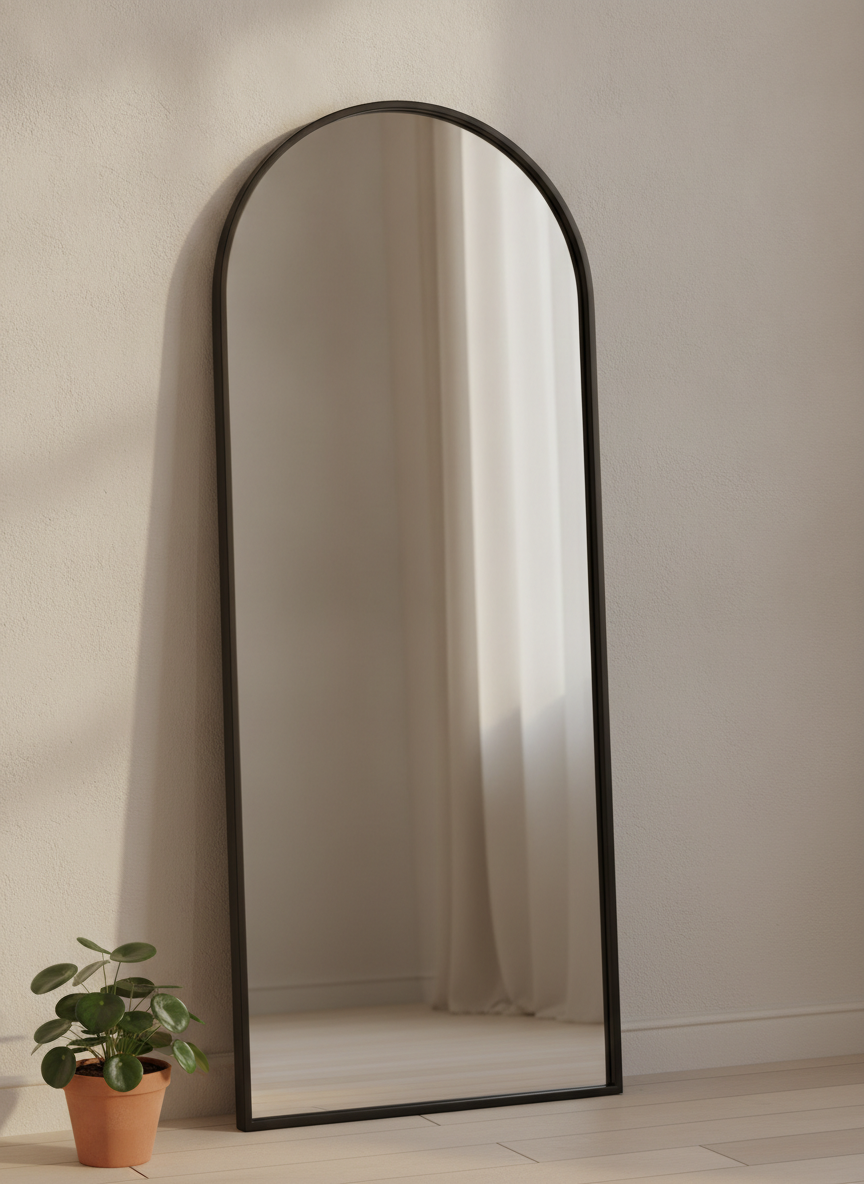
AI mirror frame design generator result: a tall arched mirror in a very slim matte black metal band, leaning against a pale plaster bedroom wall with a small plant at its base. The frame is exactly what was asked for, about two centimetres wide with visible depth at the edge, and the arch is cleanly struck. Two things are worth noticing in the glass. The reflection is a soft linen curtain and a pale wall, which is invented rather than observed, and its floor line sits at almost the same height as the real floor line at the bottom of the picture, which a mirror tilted back against a wall would never actually show. And there is no strap, bracket or fixing anywhere: this is a large sheet of glass balanced on a floor, which is the one thing on this page you should not copy
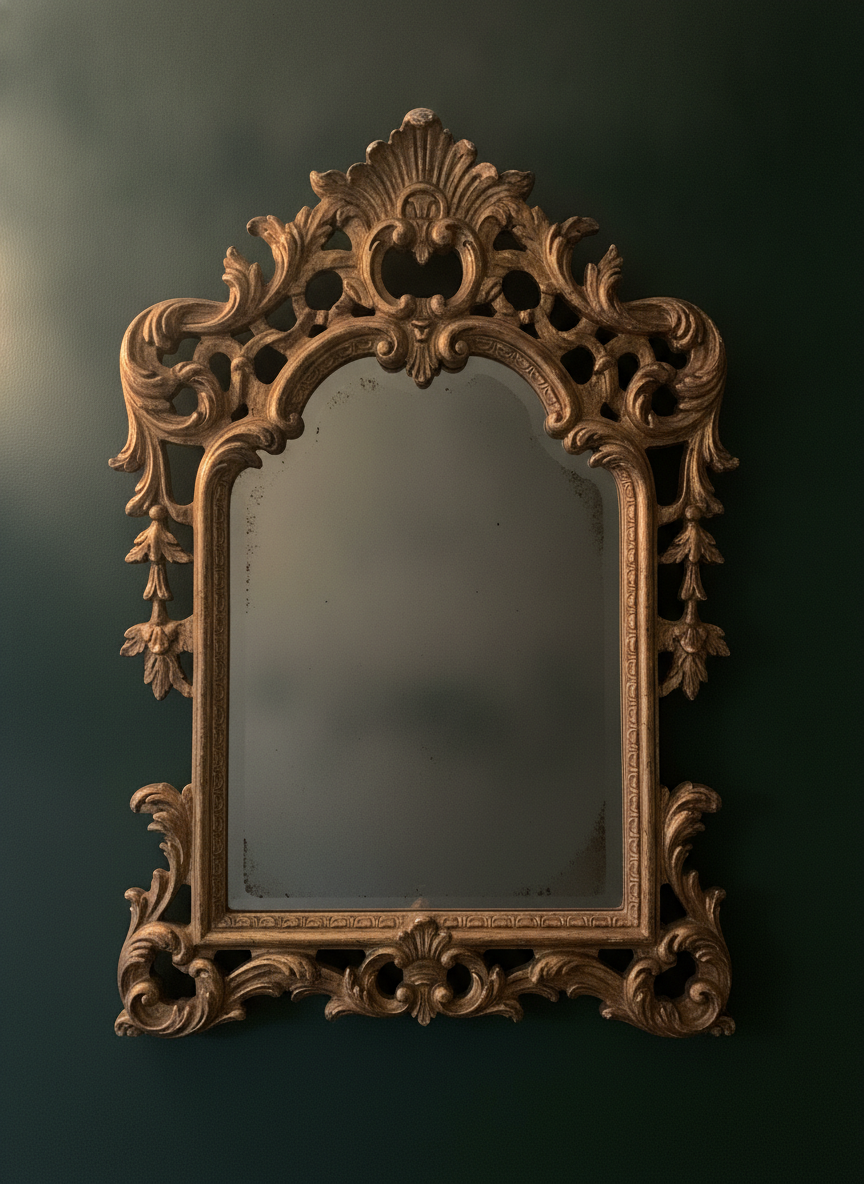
An ornate carved gilt mirror on a deep green hallway wall, scrollwork and acanthus leaves rising to a shell crest, lit by raking lamplight from the left so the relief reads properly. The frame is pierced openwork rather than solid, so the dark green wall shows straight through the carving in a dozen places, which makes the wall colour part of the frame design whether you intended it or not. Two quiet departures from the brief: the antique gold came back as a pale worn gold-beige rather than a deep gilt, and the faint edge darkening that was asked for arrived as heavy speckling right across the face. That second one is a free illustration of the bathroom problem described below, because black speckling is exactly what happens when moisture reaches the silvering. The reflection, meanwhile, is not a room at all. It is fog
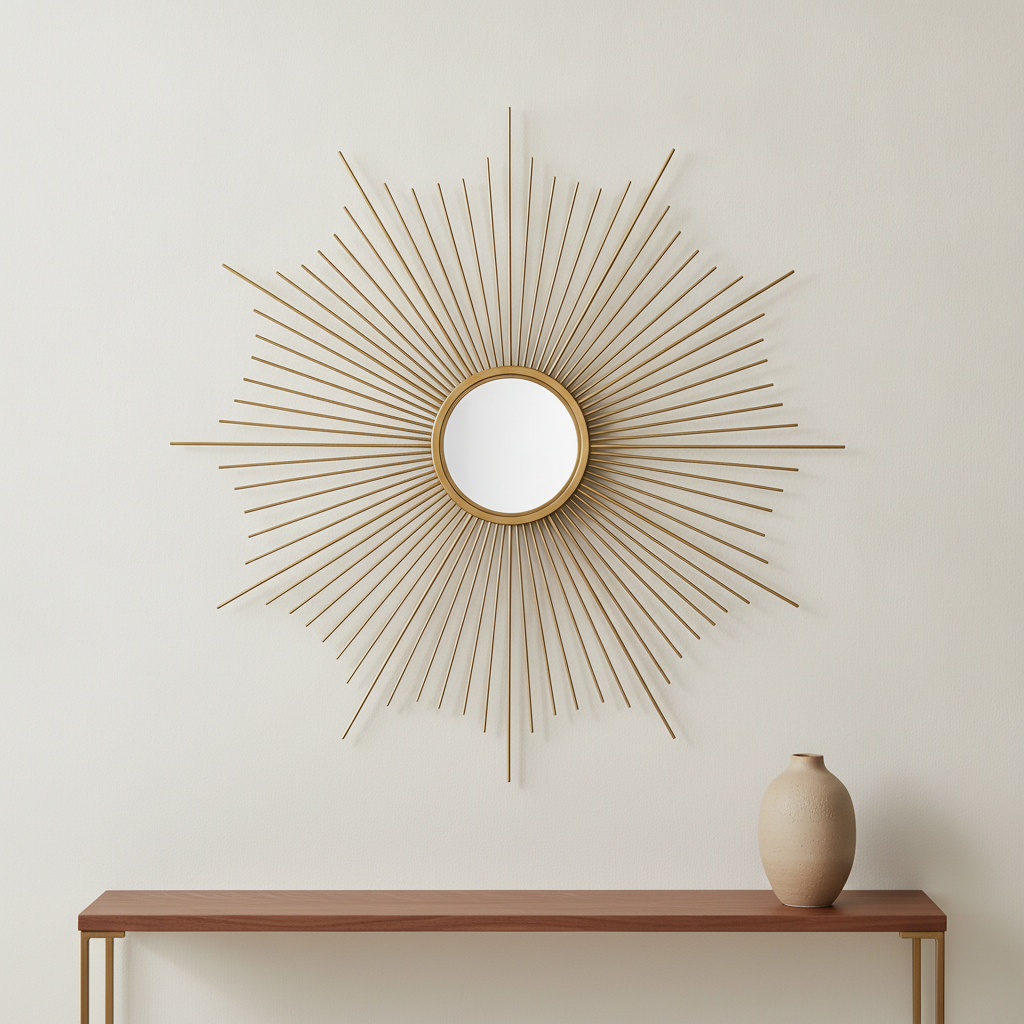
A round sunburst mirror in slender brass rods above a slim walnut console. This is the frame that shows where the model stops following instructions: the preset asked for rods all of the same length, evenly spaced all the way around, and what came back is roughly eighty rods in alternating long and short lengths forming a star silhouette, with the spacing visibly bunching in places near the top left. It looks better than what was asked for, and real sunburst mirrors are made this way, but the point stands that rod count and rhythm are not a specification you can set here. Note the composition too: the mirror sits noticeably left of centre over the console rather than centred on it, which is the proportion rule below being broken in a single picture
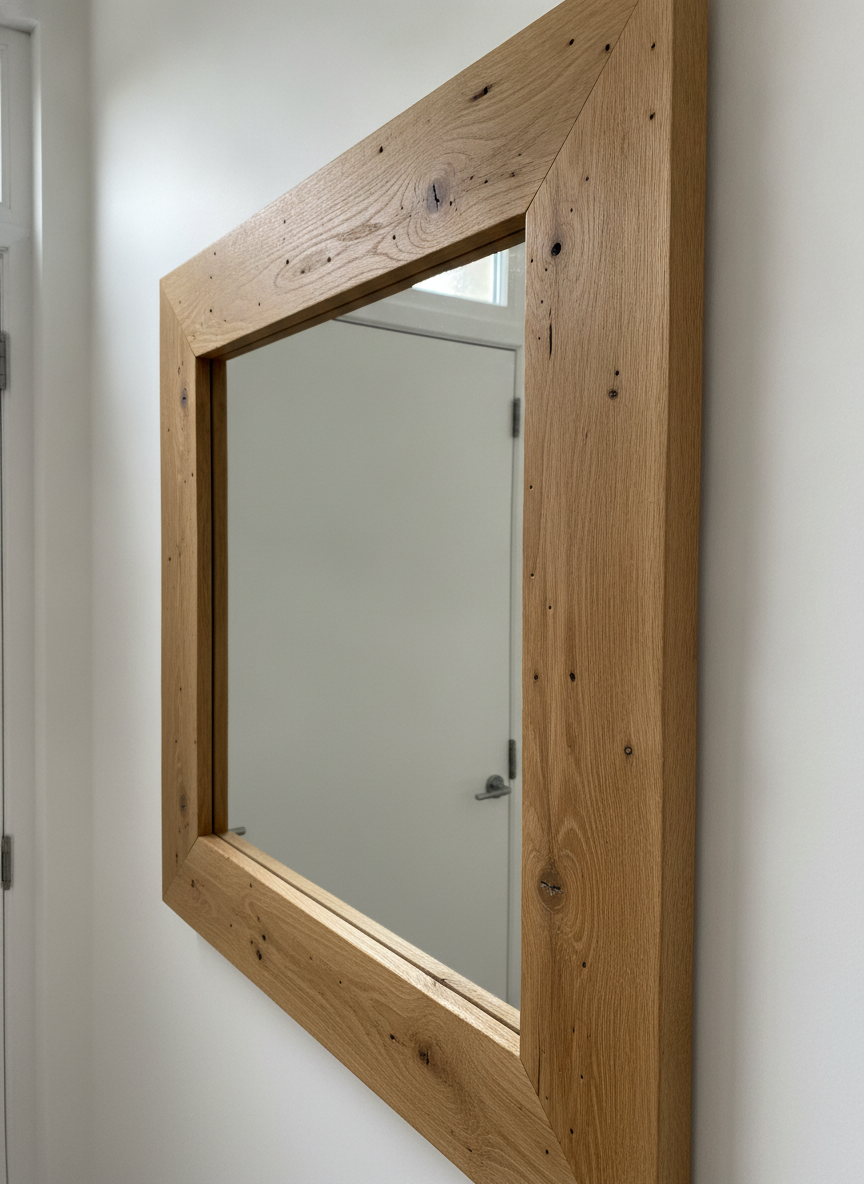
A rectangular mirror in a chunky oak frame in a bright entryway, and the most instructive accident on the page. Three things drifted from the brief. A very slight angle became a steep oblique that crops the object; a flat butt joint came back as a clean forty-five degree mitre; and weathered reclaimed timber with saw marks came back as fresh clean oak with knots. The valuable part is what appeared in the glass without being asked for. The mirror is reflecting a white internal door, complete with its handle and the window above it, which is precisely the mistake this page warns about further down: hang a mirror facing a doorway and you have bought a permanent picture of your hallway door
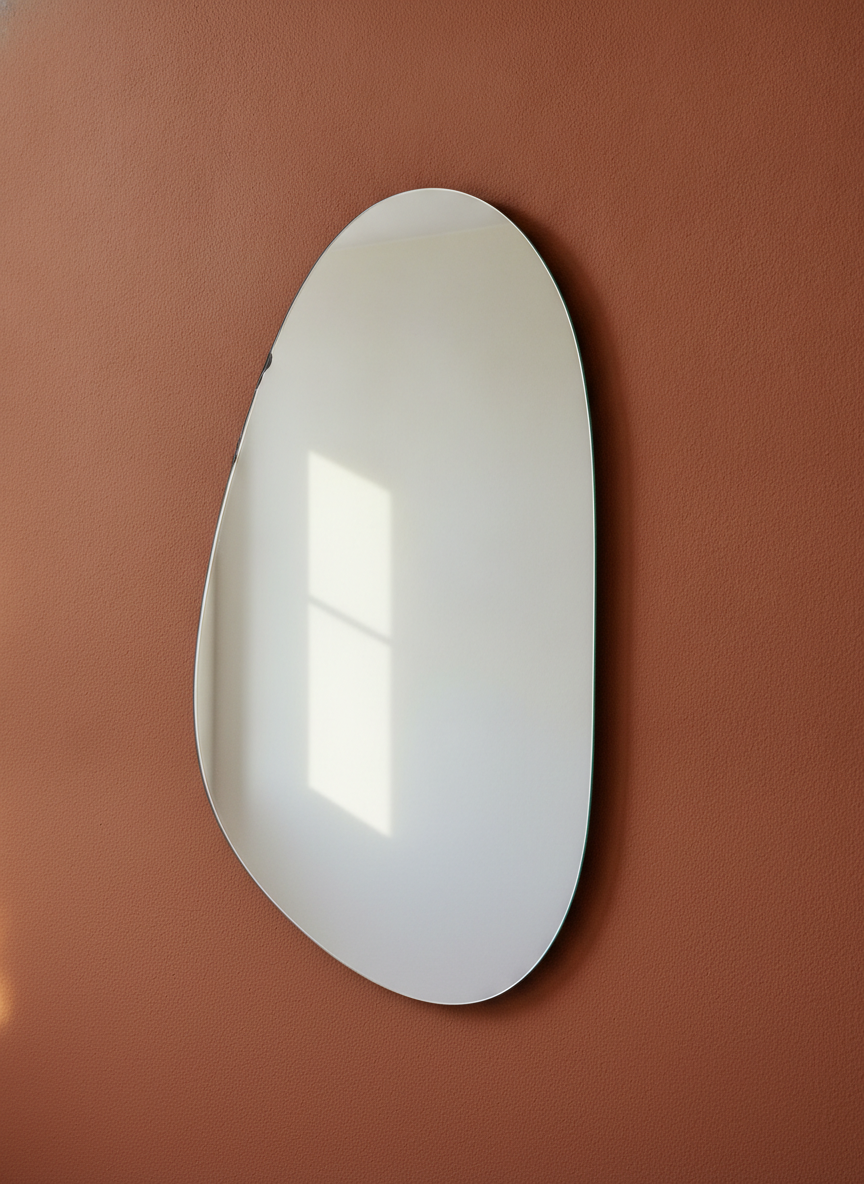
A frameless mirror cut to a soft irregular pebble shape on a deep clay limewashed wall, the polished bevel catching a bright line all the way around the outline. This is the second attempt. The first followed every instruction correctly and was useless: a pale oval on a pale wall with an empty grey reflection, technically obedient and almost invisible as a picture. Naming a deep warm wall colour fixed it, which is the general rule for any pale object. Look closely at the upper left edge and you will find a small metal clip, so the hidden fixing is not actually hidden. The soft rectangle of window light inside the glass is the whole argument for mirrors in one frame: that light is on the opposite wall, and the mirror has brought it here
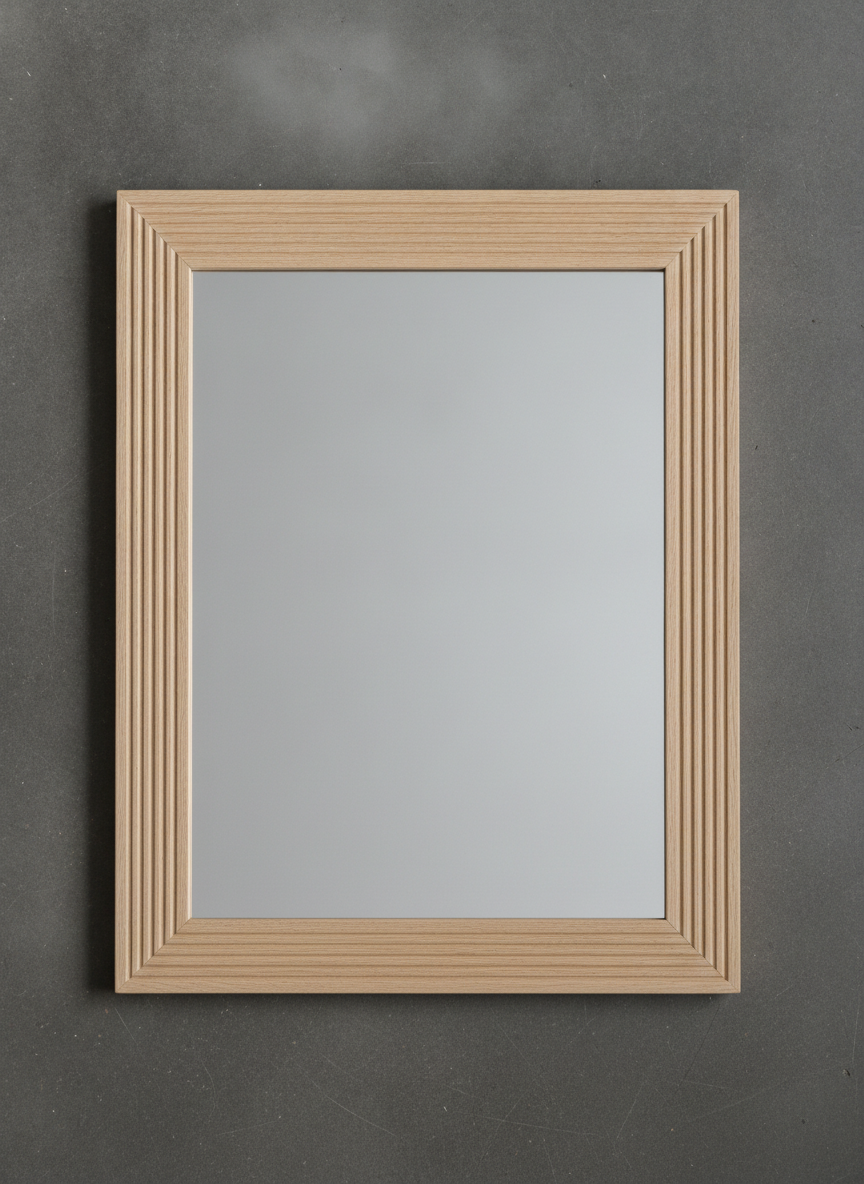
The frame profile view, and the most practically useful image here: the mirror lying flat and face up on dark charcoal concrete, shot from directly overhead, with the glass rendered as a flat neutral grey rather than a reflection. Stripping the reflection out is the point, because it forces the eye onto the only thing you actually control, which is the moulding. The fluting is clean, the corners are properly mitred with the flutes turning the corner, and the pale oak colour is honest. It is still not a technical drawing: the rebate depth that a framer needs is barely readable at this angle, so the dimensions travel beside the picture in writing rather than inside it
How the AI Mirror Frame Design Generator Works
Pick the shape and the build
Arched leaner, carved gilt overmantel, sunburst rods, chunky timber, frameless bevelled shape, or the flat frame profile itself. That single choice decides more than any other — it sets the weight, the cost, the fixing you will need and whether there is a frame to design at all.
Name the material, the width and the finish
Say what the frame is made of and how wide the face reads — a two centimetre matte black band and an eight centimetre waxed oak plank are different pieces of furniture. Then name the finish, because brushed, polished, limed, waxed and gilded all catch light in completely different ways.
Add the numbers the picture cannot hold
Concepts arrive in about twenty seconds at up to 4K. The render settles the look; you write down the four things it never contains — outside dimensions, frame face width, glass thickness and edge treatment, and the fixing — and a framer turns the pair into something you can safely hang.
What a Mirror Render Settles, and What It Invents
Six things decide whether a mirror design becomes an object worth hanging, and an image carries about two of them. The unusual part is that one of the six is actively fictional in every render you will ever make, which is not true of any other product.
The middle is not yours to design
Every other wall object is opaque, so what you draw is what hangs. A mirror is a hole showing the room opposite, which means your entire design lives in a border a few centimetres wide. That is why frame width, profile and finish carry all the weight here — there is nothing else to decide, and a render that spends its energy on a beautiful reflection is decorating something you do not own.
The reflection in the render is fiction
The model paints a plausible room into the glass. It is not your room, not your wall, and not the light you actually have, so it tells you nothing about the finished result. Judge the border and mentally grey out the middle. The corollary is the useful part: two identical mirrors in two rooms look nothing alike, and the difference is entirely what they are pointed at.
A mirror is aimed, not just hung
Hanging position is a targeting decision. Catch a window and you double the daylight and gain a view that changes all day; face a doorway and you have bought a permanent picture of your hallway. Stand where you normally stand and check what actually appears before anything is fixed — ninety seconds of that beats any render.
Glass is heavy and the fixing is structural
Mirror glass runs about 2.5 kilograms per square metre per millimetre of thickness, so a modest 1m by 70cm four millimetre plate is around seven kilograms before the frame. Large framed pieces pass twenty easily. That is a French cleat into studs or masonry, not a picture hook — and a leaning mirror still needs strapping to the wall.
Bathrooms corrode the thing that makes it a mirror
Moisture reaching the silvering is what produces the black speckled edge on every tired bathroom mirror. That is a specification, not a look: sealed backing, a humidity-tolerant frame material rather than raw MDF, and anything lit or demisted treated as an electrical installation with zone and IP rules attached. No render shows any of it.
The deliverable is a profile and four numbers
A framer quotes from a moulding cross-section — face width, rebate depth, corner treatment — plus sight size, outside size, glass thickness and edge finish. A styled interior photograph contains none of them. The flat overhead preset gets you closest, and the numbers still travel alongside the image in writing.
Sizing and Hanging a Mirror, in Numbers
The design is the enjoyable part and the proportions are the part that decides whether it looks deliberate. These are the working rules a framer or an interior designer would apply without thinking about them.
Above a vanity or basin
Roughly the width of the unit below, minus about ten centimetres, so the mirror sits visually inside the furniture instead of overhanging it. On a double vanity, either one wide mirror spanning both basins or two matching mirrors centred on each — the awkward result is one mirror slightly narrower than the pair of basins.
Above a console, sideboard or sofa
Around two thirds of the width of the piece it hangs above, with the bottom edge clearing the surface by fifteen to twenty centimetres so lamps and objects are not half-reflected against the frame. Wider than the furniture reads as a mistake; much narrower reads as an afterthought.
Full length and leaning
Thirty to forty centimetres wide at the absolute minimum and around one hundred and forty centimetres tall to see a whole outfit without retreating across the room. A leaner wants a shallow angle and a frame heavy enough not to slide — and a strap or bracket into the wall behind it, always.
Height and centre line
Centre the mirror at about one hundred and forty-five to one hundred and fifty-five centimetres from the floor, which is average eye level, then adjust for the people who live there. Hanging to suit the wall or to line up with a picture rail is the most common way a well-chosen mirror ends up looking wrong.
Why Use This AI Mirror Frame Design Generator
Six builds, not six colourways
A slim arched leaner, a carved gilt overmantel, a sunburst of brass rods, a chunky reclaimed timber frame, a frameless bevelled shape and a flat moulding profile differ in weight, cost, fixing and craft. Switching preset changes what the object is, not what shade it happens to be.
The fabrication view built in
One preset lays the mirror flat and shoots it from overhead with the mitred corner and the rebate depth visible and the glass rendered as plain grey — much closer to what a framer needs than a styled room shot, and a standing reminder that the reflection in the other five is invented.
The reflection kept deliberately empty
Every preset asks for a quiet, plain reflection and bans people, faces, cameras and phones inside the glass by name. Without that clause a mirror render fills up with a photographer holding a camera, which is the single most common way this subject fails.
Frame profile stated as a spec
The presets name frame width in centimetres, the depth at the edge, the corner treatment and the finish, because those four things are what a maker quotes from and what everybody forgets to say. A frame described only as "wooden" comes back as a different object every time.
Consistent across a whole range
Nano Banana Pro holds a described palette and material across separate generations, so keeping one finish and changing only the shape gives you an arched, a round and a full-length piece that read as a single collection rather than three unrelated mirrors.
Cheap enough to test the whole wall
About twenty seconds per concept and plans from $2.99 means you can try six shapes against the same wall colour, or find which frame reads at thumbnail size in a listing, before anyone cuts glass or commissions a sample.
AI Mirror Frame Design Generator FAQ
Related Wall and Décor Design Tools
AI Wall Art Generator
The same wall, and the exact opposite problem. Wall art is entirely middle — the whole surface is yours to design and nothing ever changes it. A mirror is the frame only, wrapped around a picture the room supplies.
AI Wall Clock Design Generator
The third object on that wall, and the middle ground between the two. A clock gives you the whole face to design, then takes the centre back for a hub and sweeps two opaque hands across whatever you put there.
AI Interior Design Generator
Where to go when the question is the room rather than the object — wall colour, furniture and layout together, including the wall the mirror will be pointed at, which is the decision this page keeps telling you to make first.
Design Your Mirror Frame Now
Six mirror builds, frame materials that render with the right surface, a flat overhead profile view that shows what a framer actually quotes from, and 4K shots in about twenty seconds. Free to start, from $2.99 for more.
Start Designing FreeAbout This AI Mirror Frame Design Generator
An AI mirror frame design generator is worth understanding as a tool that does one part of the job extremely well and no part of the rest, and the division is unusually clean on this particular object. A mirror is four decisions. The first is shape and size, which is mostly proportion arithmetic against the furniture below it. The second is the frame — material, face width, profile, corner treatment and finish — which is the only genuinely visual decision and the one everybody describes badly. The third is the glass specification: thickness, whether the edge is polished flat or bevelled, whether the backing is safety-rated, whether it is sealed against bathroom humidity. And the fourth is the fixing, which is a structural question about your wall rather than an aesthetic one about the mirror. This tool settles the second decision, in about twenty seconds, at up to 4K, from a plain description. The other three are written down beside it, and this page tries to tell you exactly what to write.
What makes a mirror unlike every other product in this series is that the middle of it is not yours. A poster, a clock dial, a mug and a cushion are opaque: what you design is what exists. A mirror is a hole in the wall filled with a live picture of whatever stands opposite it, so your entire design surface is a border a few centimetres wide, and the most consequential decision about the finished object — what it will actually show — is made by where you hang it rather than by anything you draw. That has one direct implication for how you read every image on this page. The reflections are invented. The model paints a plausible room into the glass because a mirror without a reflection does not look like a mirror, and none of it corresponds to your house, your light or your wall. Judge the border, grey out the middle, and treat the reflection as a rendering convention rather than a preview. Two mirrors with identical frames in two different rooms are two completely different objects.
The second thing worth carrying away is that a mirror is aimed rather than merely hung, and it is genuinely the cheapest improvement available in most rooms. Point one at a window and you double the daylight and import a view that changes through the day, which is why the trick shows up in every small flat and dark hallway ever photographed. Point one at a doorway and you have committed to a permanent picture of your hall; point one at a desk and you have given yourself company you did not ask for; put a full-length mirror in the wrong bathroom position and you will discover exactly what it reflects on the day it is fixed. None of that is visible in a render, and all of it is answerable in ninety seconds by standing where you normally stand and holding something reflective at the height you are considering. Do that before you commission anything, because it decides more about the result than the frame does.
Finally, the practical safety and specification notes, because this is one of the few décor objects where carelessness has consequences beyond regret. Mirror glass weighs roughly two and a half kilograms per square metre for every millimetre of thickness, so a modest piece is around seven kilograms before the frame and a large one comfortably exceeds twenty — which means a batten or French cleat fixed into studs or masonry, not a picture hook in plasterboard, and a strap behind anything that leans. Ask for safety-backed glass so a breakage holds together. Treat a bathroom mirror as a different specification rather than the same mirror in a wetter room, since moisture reaching the silvering is what causes the black speckled edge, and anything lit or demisted is an electrical installation with zoning rules attached. Then send your framer the thing they actually quote from: a moulding profile, the sight size and outside dimensions, the glass thickness and edge treatment, and the finish. The image is the approved look. It runs on Nano Banana Pro, it holds a material and palette steady across a whole range so an arched, a round and a full-length piece read as one collection, it is free to start with paid plans from $2.99, and it turns the slowest part of a décor decision into six pictures you can react to before anyone cuts a single piece of glass.