
AI Handbag Design Generator
A handbag is a set of flat panels cut from a hide that is not a rectangle, wrapped around structure you cannot see, and finished with hardware you did not draw but bought. This AI handbag design generator settles the half of that job an image can settle — silhouette, gusset, finish, where the seams fall and how the whole thing stands — and tells you plainly which half it cannot touch.
Start Designing FreeTry the AI Handbag Design Generator — Free
Choose the construction first, then name the leather, the hardware finish and the closure. Every preset is written as real leather goods product photography on a plain ground, because a bag concept you cannot photograph is a bag concept nobody can put in front of a buyer.
AI Handbag Design Generator
Pick a construction, describe the leather, the hardware and the closure, and get bag product shots at up to 4K
Bags Designed With This Generator
Five of these came from the presets above, unedited, flaws included. The third is not a product shot at all but a comparison row of five identical bags in five leather finishes, and it settles more about a bag than the silhouette does. The second and the sixth are worth reading as a matched pair, because between them they demonstrate the single thing this tool cannot do. One asked for a completely unstructured bag and came back taut and full. The other asked for a rigid shell and came back soft and gathered. Read these renders for silhouette, finish, seam position and stance. Treat every claim about structure and every piece of hardware as a question for whoever is going to make it.
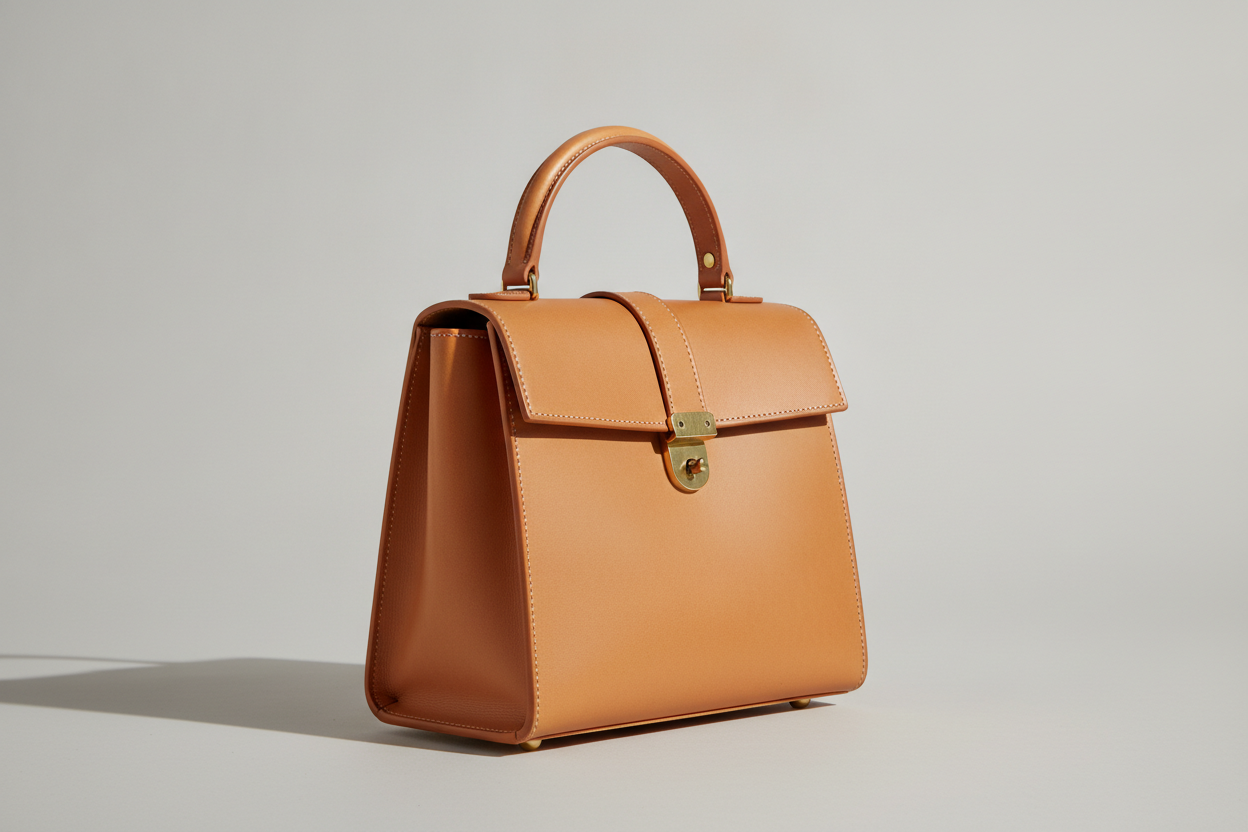
AI handbag design generator result: an unbranded structured top-handle satchel in warm tan leather, shot from a low three quarter angle so the side panel reads clearly. The gusset is the whole point of this frame — a separate panel running up both sides that turns a flat front and back into a bag with volume, and here it is wide at the top and drawn in toward the base, which is a trapezoid rather than the flat-sided rectangle the preset asked for. The stitching and the turned edges are convincing. The feet are not: two small brass domes sit on the lower front face instead of four under the base, where they would actually keep the leather off the floor
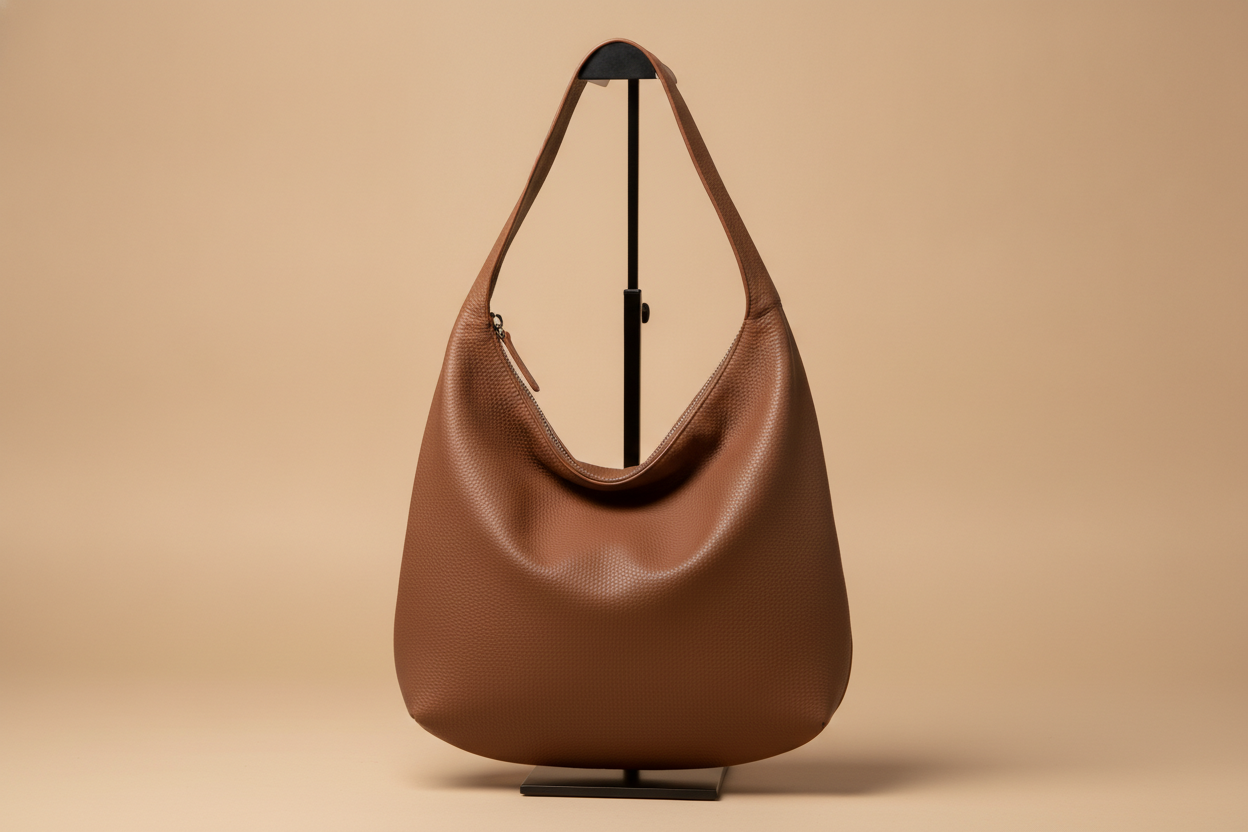
The most instructive failure on the page. This preset asks for a completely unstructured hobo with no interlining, a body collapsing into deep folds under its own weight and creases where the strap meets it. What came back is smooth, taut and full, with one faint crease near the zip. The reason is worth understanding: every hobo the model has ever seen in a product photo was stuffed with tissue before the shutter fired, so a stuffed bag is what unstructured looks like to it. The pebbled grain is a second tell, arriving as an even mechanical dot pattern rather than the irregular pebble of a real milled hide
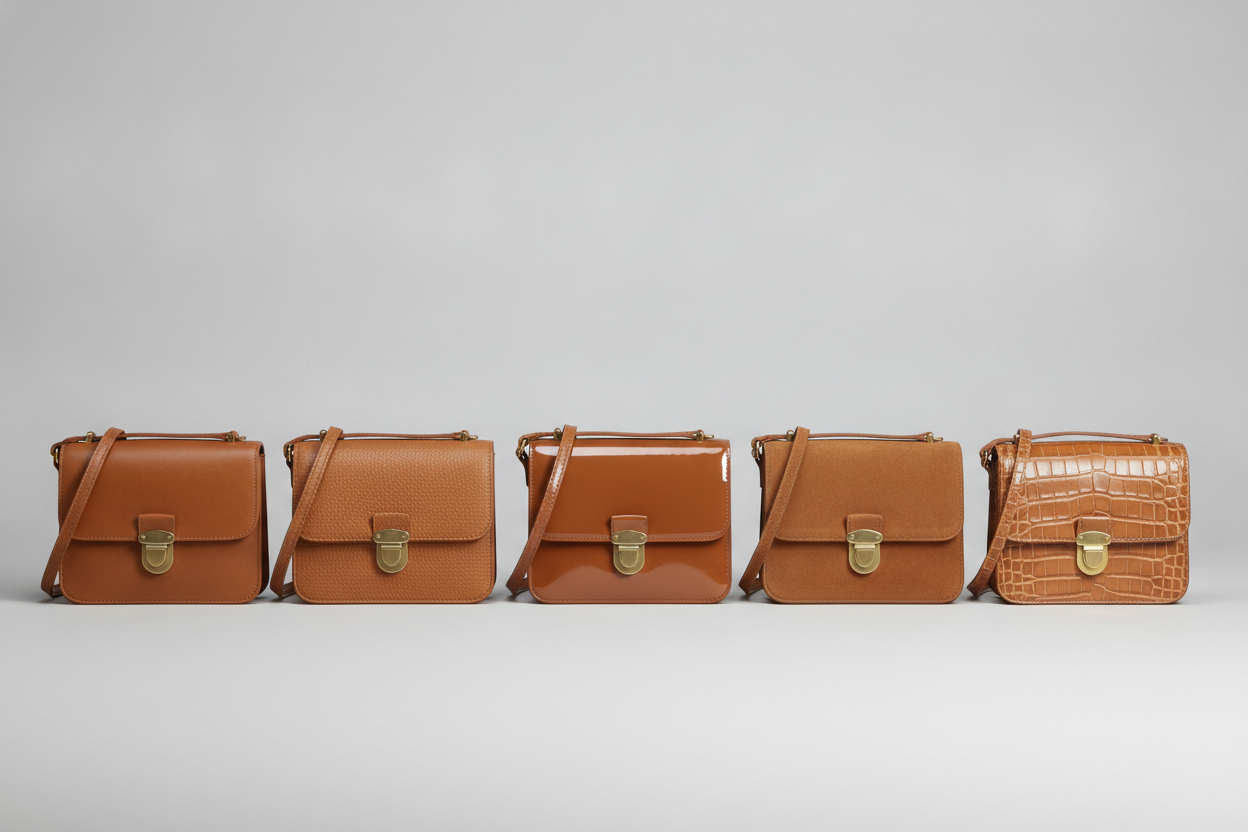
The comparison row, and the frame that earns its place: five identical small flap bags in the same caramel colour with the same brass push lock and the same strap, differing only in leather finish. Smooth calf on the left is the only one where the stitch line and the edge of the flap are legible. The pebbled grain softens them. The patent replaces the flap edge with a specular highlight. The suede swallows the stitching entirely. The embossed crocodile at the right eats the construction whole and has quietly rendered larger than its four siblings. One variable, five outcomes, and it decides how much of your workmanship a customer can even see
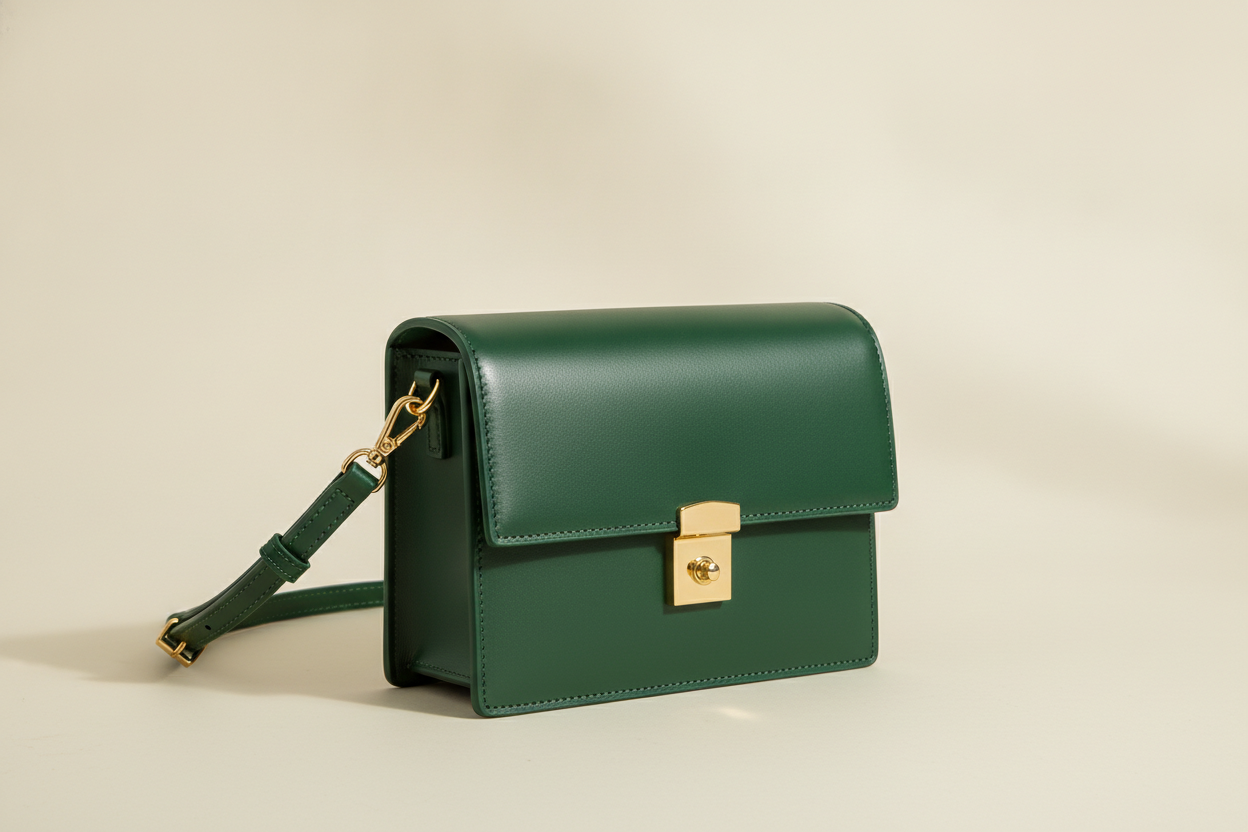
A boxy forest green flap crossbody, and the cleanest object of the six. Two details are worth reading against the brief. The preset asked for sharp corners and the render put a generous roll on the top edge and a radius on every corner, because leather has to turn around something and the model knows it even when the words do not. And the preset asked for raw cut edges finished with a line of matching green edge paint, which is the single most cost-relevant decision in the whole bag; what arrived reads as a turned and stitched edge instead. At this resolution the two are indistinguishable, which is exactly the problem
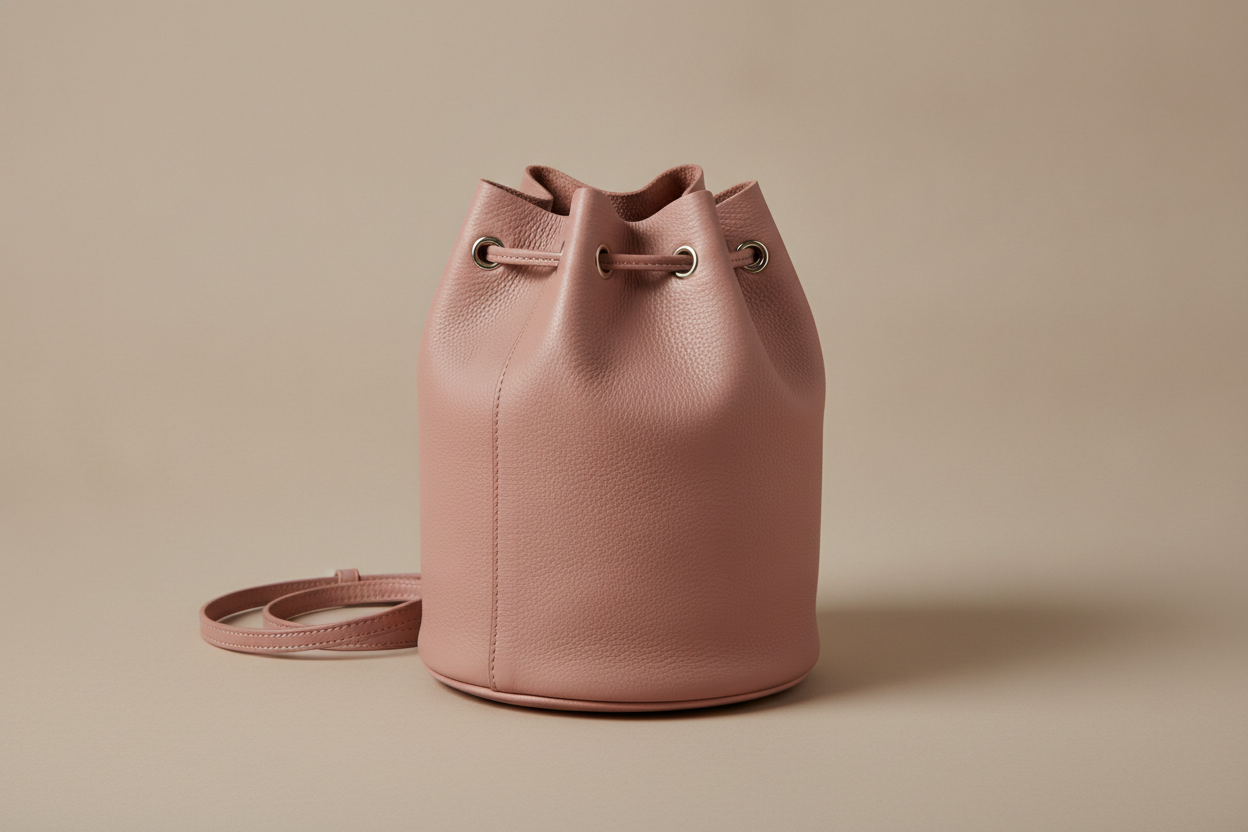
A dusty rose drawstring bucket bag that shows its construction honestly: one wrapped body panel with a visible vertical seam, joined to a round base disc along a seam you can follow all the way around. That is the whole pattern in two pieces. The closure is fiction, though. Three eyelets are visible where the preset asked for six, the cord passes through them and simply ends with no knot, no toggle and no cord ends, and the detachable strap lies on the surface next to a bag that has no D-rings or hardware anywhere to attach it to
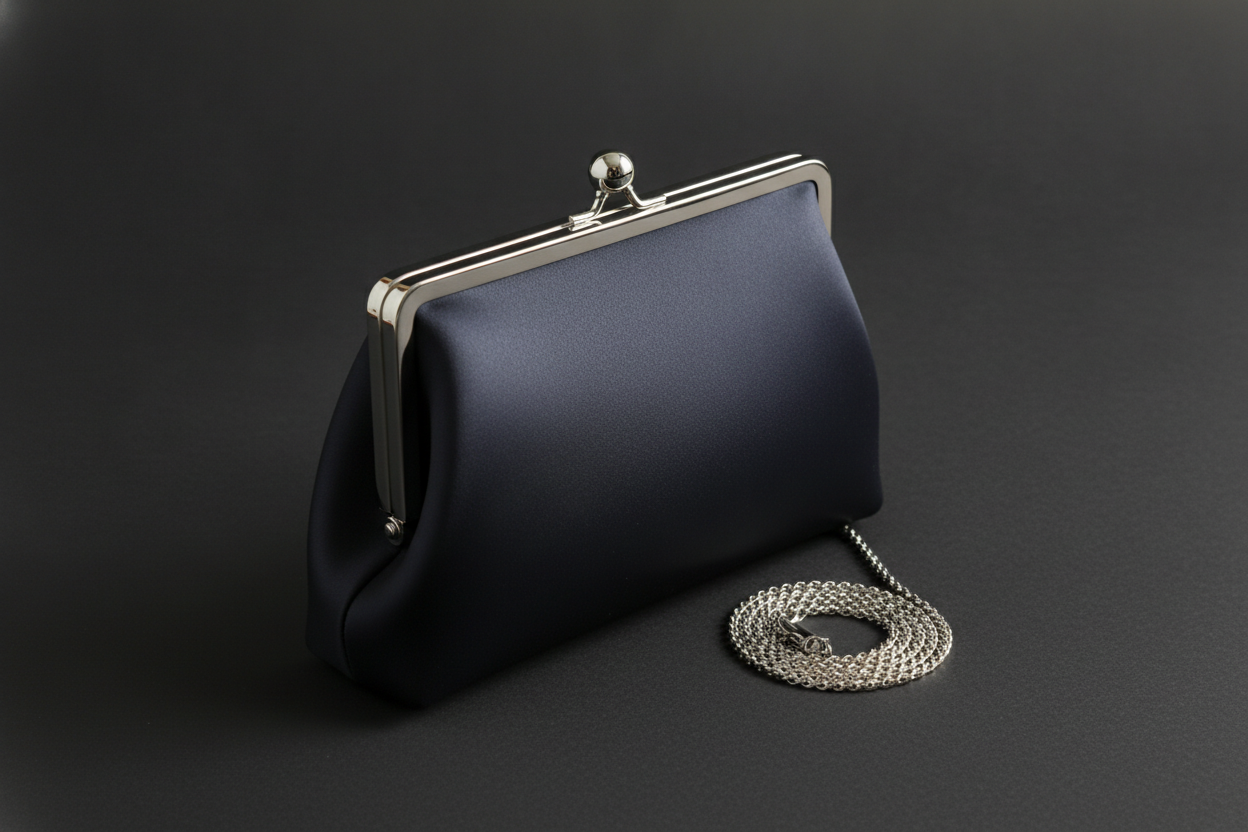
A framed evening clutch, and the exact mirror image of the hobo failure. Here the preset asked for a rigid shell that holds its shape completely, and the body came back soft, gathered and pleating where it meets the metal. Ask for slouch and get tension, ask for rigidity and get drape. The kiss-lock frame itself is beautifully observed, right down to the channel the material is set into and the hinge on the left arm, which is the argument for buying frames rather than drawing them. Two smaller notes: the preset said satin-finish leather and the model heard satin and gave fabric, and the chain lying beside it is a closed loop with no ends, so there is nothing to attach it with
How the AI Handbag Design Generator Works
Pick the construction
A structured satchel, an unstructured hobo, a boxy flap crossbody, a drawstring bucket or a framed clutch. That one choice sets the panel count, whether the bag needs interlining, what closure it can take and roughly what it costs to sample — far more of the design than the colour ever will.
Name the leather, hardware and closure
Say full-grain calf or pebbled or suede, say brass or gunmetal or polished gold, and say turnlock or magnetic snap or zip. The model renders the grain and the sheen that belong to whatever it is told, and finish is most of what makes a concept read as a real bag rather than a shape.
Take the concept to a pattern cutter
Concepts arrive in about twenty seconds at up to 4K. The render settles the look; a pattern cutter derives the flat pieces it implies and adds the four numbers it cannot hold — height, width, gusset depth and strap drop — and tells you what the hide will actually yield.
What a Handbag Render Settles, and What It Hides
Six things decide whether a handbag design works, and an image carries about half of them. Knowing which half is the difference between a concept a factory can sample and a picture of something that will not stand up the way it appears to.
The pattern is flat and the bag is not
Every bag is a handful of two-dimensional pieces — front, back, gusset, base, flap, strap — joined at seams, and the gusset is what converts flat panels into volume. Widen it by two inches and you have changed the product more than any colour decision would. A render shows the assembled result and never the pieces, so read it for where the seams land and let a pattern cutter work backwards.
Structure is invisible and unrenderable
What makes a bag stand up is interlining, stiffener board and foam that nobody ever sees. This is the one property the model gets consistently wrong in both directions: ask for an unstructured slouch and it returns a bag stuffed with tissue, because that is how they are always photographed, and ask for a rigid shell and it returns soft folds. Two of the images on this page are exactly that pair.
Leather is a hide, not a roll
A cowhide is an irregular fifty square feet with a firm backbone, a stretchy belly and scars you have to cut around, so laying out a bag is nesting a puzzle on a defective material. Yield rather than area drives cost, which is why one large panel is disproportionately more expensive than several small ones. No image can show you a yield problem.
Hardware is a catalogue, not a drawing
Clasps, D-rings, sliders, feet, eyelets and zips are bought components, and custom tooling only pays back in the thousands of units. Plating has to match across every part on the bag. Renders here reliably invent shapes that do not exist and, as two of the images show, chains and straps with no ends and nothing to attach them to.
Edge finish decides the price and hides in the frame
A turned edge folds the leather back on itself and is expensive. A raw edge sealed with edge paint is quicker and reads differently up close. That single choice moves the cost of a bag noticeably, and at render resolution the two are simply indistinguishable, so state which one you want in words rather than trusting the picture.
Dimensions and strap drop are not in the picture
A mini bag and a weekender photographed alone on a plain ground are the same image at different pixel counts. Strap drop hides just as well and decides where the bag actually sits on a body, roughly twenty two centimetres for a shoulder bag against fifty five or more for a crossbody. Fix the numbers first and judge the proportions against them.
Why Use This AI Handbag Design Generator
Six constructions, not six colourways
A structured satchel, an unstructured hobo, a flap crossbody, a bucket and a framed clutch differ in panel count, closure and whether the thing needs stiffening at all, so switching preset changes what the object is rather than what shade it happens to be.
A comparison rig built into the presets
One preset renders five identical bags in five leather finishes rather than another hero shot, which answers the question this category actually turns on: how much of your stitching and edge work a customer can still see once the finish is on it.
Written as product photography
Every preset specifies a plain ground, a named camera angle and soft studio light, so concepts arrive looking like the line sheet photo they will eventually need instead of an illustration floating in a gradient.
Trade dress refused by name
The presets ban logos, plaques, monograms and, specifically, the three signature combinations models reach for whenever they hear the word luxury. In the most counterfeited product category in the world that is not a nicety, it is the difference between a concept and a liability.
Consistent across a range
Nano Banana Pro holds a described style across separate generations, so reusing one leather and one hardware finish while changing only the construction gives a family of bags that reads as a single collection rather than six unrelated products.
Cheap enough to try the whole line
About twenty seconds per concept and plans from $2.99 means testing a full season of shapes costs less than the hide for one sample, which is what makes the deciding-what-it-looks-like stage affordable at all.
AI Handbag Design Generator FAQ
Related Design Tools
AI Tote Bag Design Generator
The other half of the bag question. That page owns the flat printed graphic that goes onto a canvas blank; this one owns the constructed leather bag itself.
AI Backpack Design Generator
Panels, straps and technical hardware for packs rather than handbags. Worth a look if the shape you want carries on both shoulders.
AI Fashion Design Generator
Garments rather than accessories. Useful for placing a bag range beside the clothing it is meant to be carried with.
Design Your Handbag Now
Six bag constructions, leathers that render with the right grain, a comparison row that shows what each finish costs you in visible workmanship, and 4K product shots in about twenty seconds. Free to start, from $2.99 for more.
Start Designing FreeAbout This AI Handbag Design Generator
An AI handbag design generator is useful on a narrow and unusually well-defined part of the job, and misleading on the rest, so it is worth being precise about the boundary. A bag is four decisions stacked on top of each other. The first is the pattern, which is the set of flat panels that get cut and sewn, and in which the gusset — the strip running around the sides and base — does more to determine the shape than the silhouette drawing does. The second is structure, meaning the interlining and stiffener board that decide whether the finished object stands up or slumps, none of which is ever visible. The third is hardware, which is not designed but selected from a supplier catalogue. The fourth is finish and decoration, and that is where nearly every brand in this category competes, because the underlying constructions are frequently identical and only the leather, the colour and the hardware differ. A render settles the first and the fourth of those in about twenty seconds. It is actively unreliable on the second and it can only gesture at the third.
That is why the six presets here are constructions rather than colourways. A structured top-handle satchel, an unstructured hobo, a boxy flap crossbody, a drawstring bucket bag and a framed evening clutch differ in how many panels they take, whether they need stiffening at all, what closure they can accept and what they cost to sample. Changing a bag from tan to burgundy is a much smaller decision, though the leather itself is not: a hide is an irregular shape of roughly fifty square feet, firm along the backbone and stretchy at the belly, carrying scars and brand marks that have to be cut around, which means that laying out a bag is nesting an awkward puzzle on a defective material. Yield rather than surface area is what drives the cost of the leather in a bag, and it is why one large uninterrupted panel is disproportionately more expensive than three smaller ones that can be nested into the offcuts. None of that is something an image can show you, but knowing which shapes are expensive to cut changes what you ask for.
Structure is where this handbag design generator is at its weakest, and the two images on this page that demonstrate it are more useful than another polished hero shot would have been. The hobo preset asks for a completely unstructured bag with no interlining, collapsing into folds under its own weight, and what came back is smooth, full and taut. The reason is straightforward once you see it: every soft bag in every product photograph ever taken was stuffed with tissue paper first, because a limp bag does not sell, so a stuffed bag is what unstructured looks like to a model trained on those photographs. The clutch preset asks for the opposite, a rigid shell that holds its shape completely, and it came back soft and gathered at the frame. Ask for slouch and you get tension; ask for rigidity and you get drape. Words describing the build — unstructured, unlined, reinforced — carry almost nothing. Words describing the picture — empty, unstuffed, collapsed, flat — help a little. Nothing gets you all the way there, and structure is the spec you should always write down in text beside the image rather than trusting to it.
One more thing belongs on a page about designing bags, because it does not apply nearly as much to mugs or cutting boards: handbags are the most counterfeited product category in the world, and the protection extends well past the logo. A distinctive silhouette, a signature closure, a recognisable pattern repeat and a particular quilting and chain combination can all be protected as trade dress or registered design, and a bag that merely evokes one of them is a legal exposure rather than a tribute. The presets on this page ban logos, plaques, monograms and stamps item by item, and they refuse three specific signature combinations by name, because luxury handbag is precisely the prompt that sends an image model reaching for the most famous shapes it knows. This tool runs on Nano Banana Pro, which holds a described style across separate generations, so you can reuse one leather and one hardware finish while changing only the construction and get a family of concepts that reads as one collection. It is free to start and paid plans begin at $2.99, which puts a full season of shapes well below the price of a single sample hide.