
AI Fence Design Generator
A fence is a post problem wearing joinery. The slats, the paint and the cap detail are what the household argues about, and none of them decide anything. What decides whether the fence is still standing in ten years is the part nobody photographs: how deep the posts go, how far apart they stand, whether the panels let wind through, and which side of the boundary the whole thing is on. This AI fence design generator settles the visible half in about twenty seconds, and it is straight with you about the half that is buried.
Start Designing FreeTry the AI Fence Design Generator — Free
Choose the material and the infill together, because the two of them decide the privacy, the wind load and most of the price between them. Four presets photograph a finished run, one of them on ground that actually slopes, one shows the posts going into their holes before any panel is fitted, and the sixth draws the whole thing flat as an elevation. Every preset keeps text, logos and people out of the frame.
AI Fence Design Generator
Pick a fence run, describe the material, height and setting, and get fence concepts at up to 4K
Fences Designed With This AI Fence Design Generator
These came out of the presets above with nothing retouched, and the captions say what each one gets right and what it quietly invents. Read them as a set and one pattern repeats: surfaces are superb every time, and anything countable or structural is approximate. Count the pickets, find the posts, and follow the bottom of the fence to where it meets the soil.
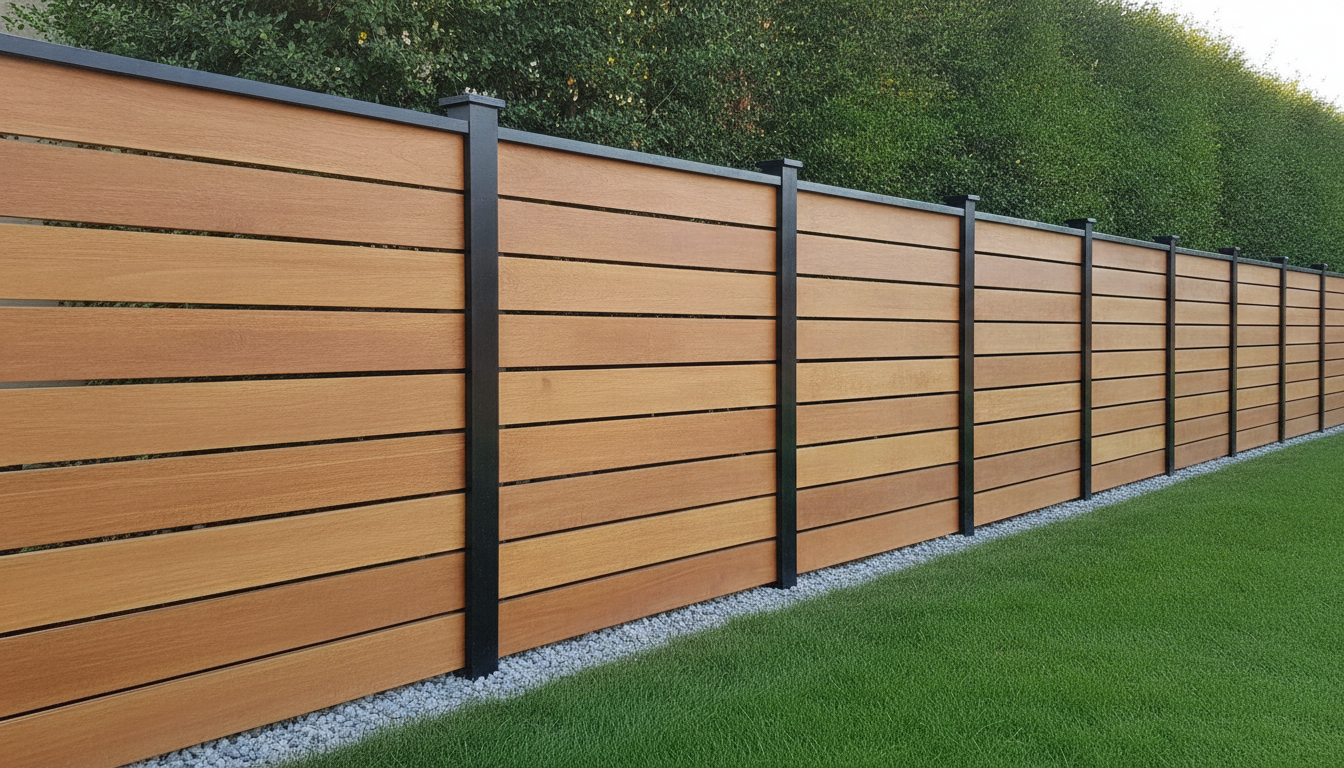
AI fence design generator result: a horizontal slatted boundary fence in warm tan timber running away from the camera along a mown lawn, with slim black posts, black post caps and a black capping rail. The timber is the best thing here, with plausible straight grain and a consistent oiled sheen, and the posts are genuinely present and capped, which is more than most horizontal fences get in a render. Almost nothing else repeats. The bay on the left is far wider than any slat could span, the bays then crowd together faster than perspective explains, and the slat courses do not line up across the posts, so the rhythm jumps at every one. The gaps between slats are inconsistent, showing hedge through some and solid shadow in others. The brief asked for late afternoon side light raking across the slats, and a six foot fence casts no shadow at all on the grass beside it.
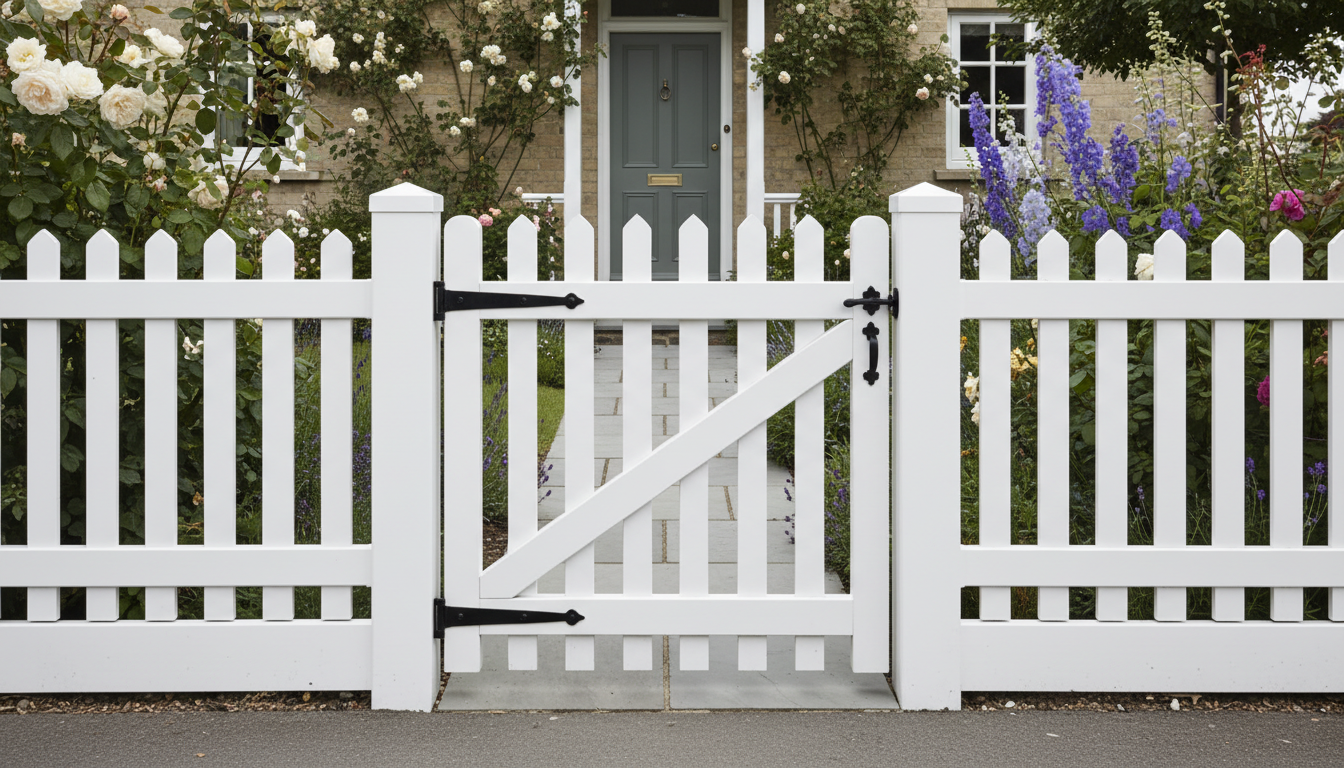
AI fence design generator result: a white painted picket fence and matching gate along the front boundary of a stone house, with roses, delphiniums and a flagstone path running through to the door. This is the strongest image in the set, and the gate is the surprise: two black strap hinges on the left post, a thumb latch on the right, and a diagonal brace running correctly from the bottom hinge corner up towards the latch corner, which is the one piece of gate geometry renders normally get backwards. Look along the run and it comes apart. The fence pickets are pointed and the gate pickets are square topped, so the gate belongs to a different fence. Picket spacing widens and narrows from bay to bay. Neither run has an end post; both simply leave the frame. And the pickets stop in mid air above the pavement with nothing below them, where a real fence has a bottom rail and a measured gap.
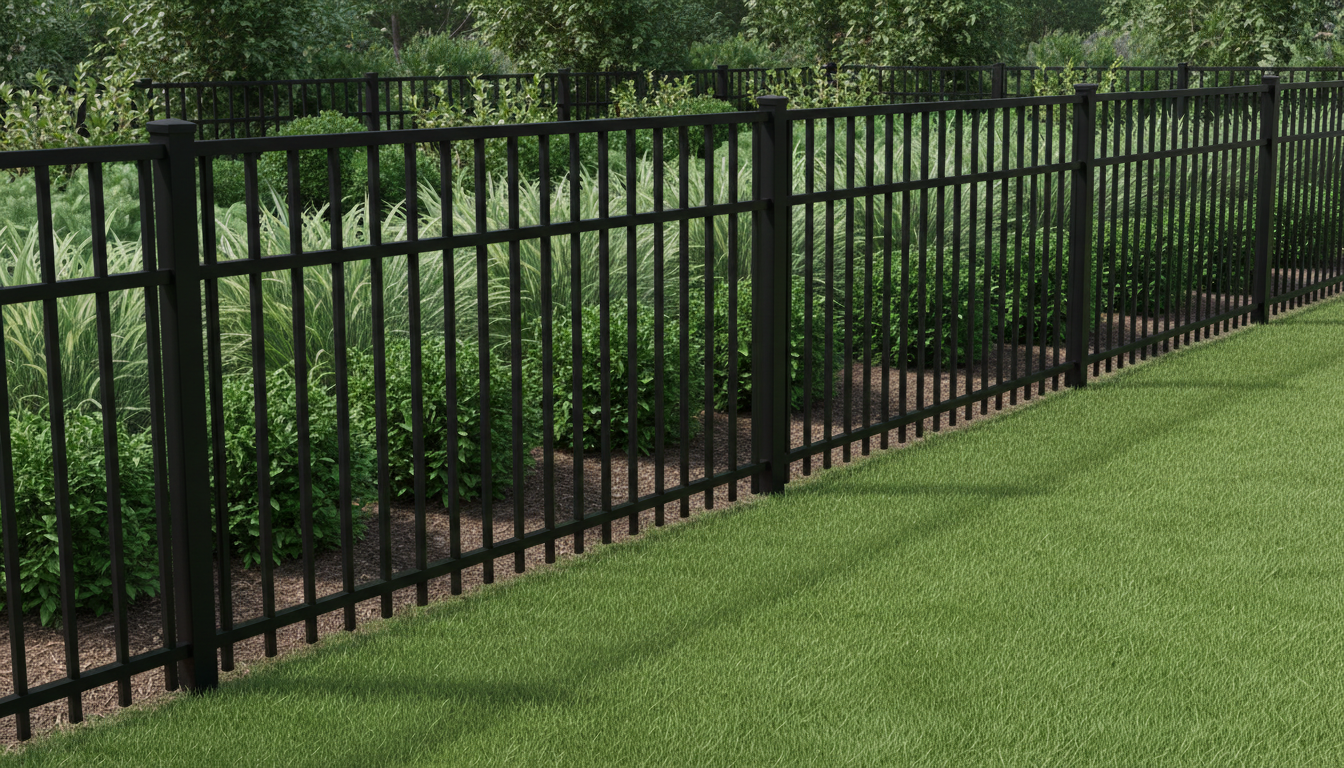
AI fence design generator result: a black powder coated metal fence enclosing a bed of clipped shrubs and ornamental grasses, with a lawn on the near side. The colour, the sheen and the planting are convincing, although the whole frame reads as a 3D render rather than a photograph. Three things give it away. A second identical fence runs behind the planting at a different height and joins nothing, which is the phantom duplicate that turns up whenever a run has to recede. The panels were specified with flat topped pickets between a top and a bottom rail, and arrived with three rails and pickets projecting past both. And the bottom of the fence holds one straight line while the ground rises and falls beneath it, so the gap under the rail swings from nothing to a hand span. In bright even daylight, the pickets stripe no shadow onto the grass at all.
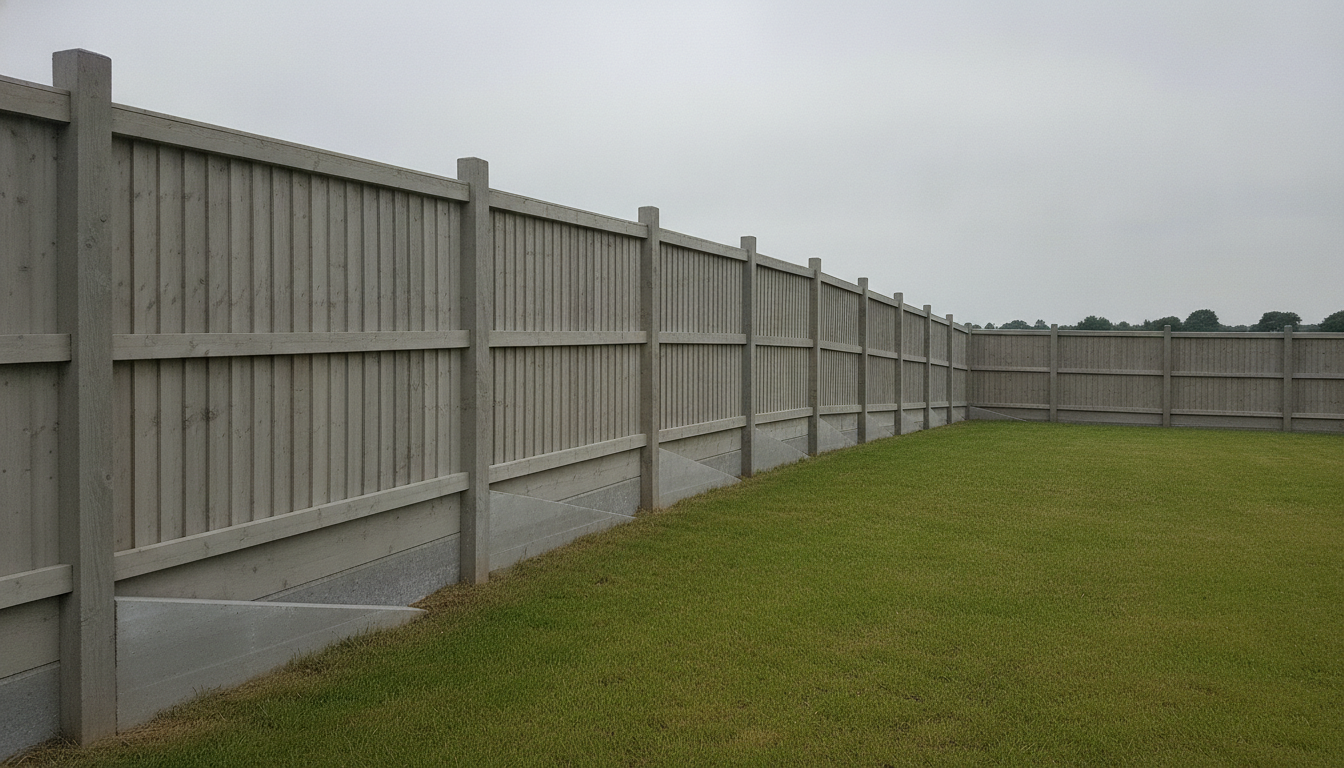
AI fence design generator result: a grey stained close board fence stepping down in level bays, with concrete gravel boards closing the gap below each panel. This preset asks for the one thing every fence gallery avoids, a run on sloping ground, and the answer is the most revealing image on the page. The fence steps, exactly as asked. The ground does not slope. The lawn is flat and the horizon is level, so the model has kept the symptom of a slope while deleting the slope itself and the panels descend for no reason. The gravel boards are the tell: instead of vertical slabs sitting in the line of the fence, they are drawn as concrete ramps wedged against it and spilling out across the grass as a poured apron. Further along, the run breaks and restarts as a separate fence at a different level behind a strip of grey paving.
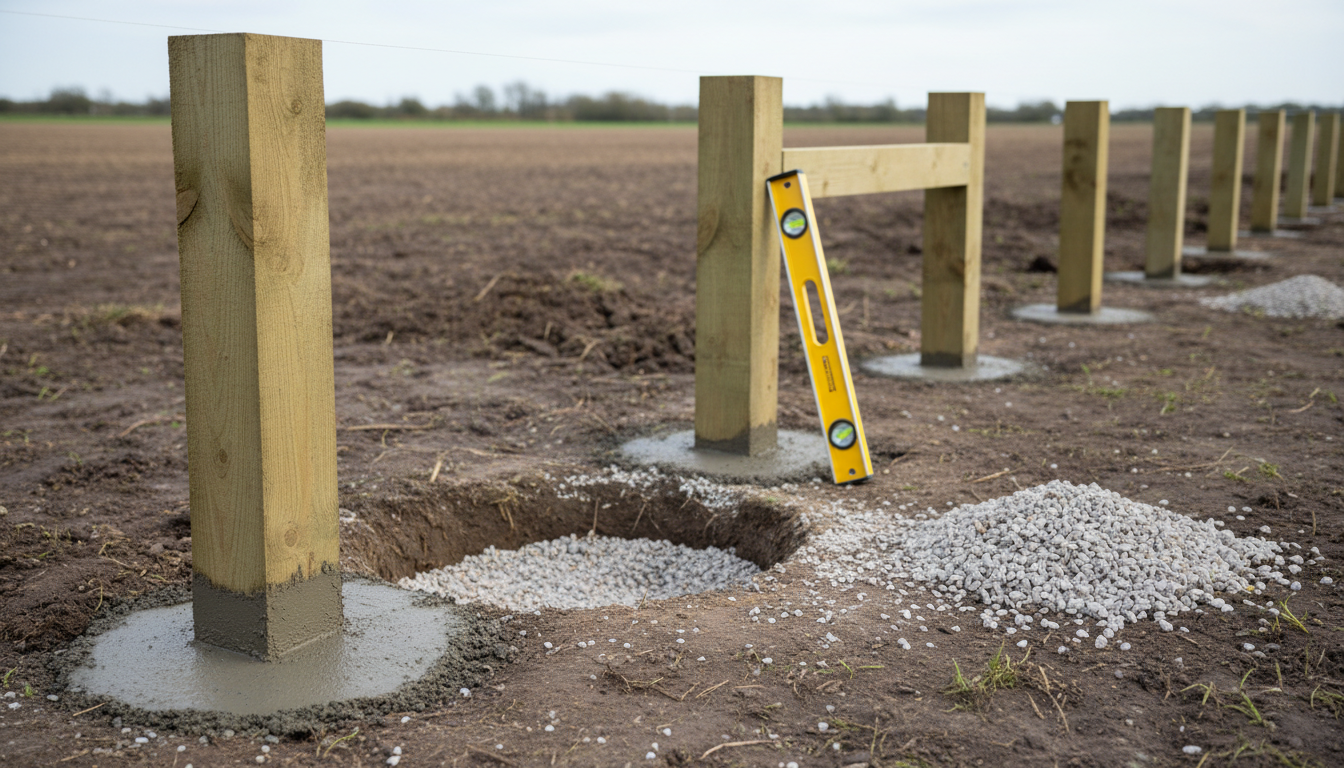
AI fence design generator result: a line of pressure treated fence posts standing in a bare field with concrete around their bases, an open hole, heaps of gravel, a single rail and a spirit level. Half of this is the most useful picture on the page, because practically no design tool will show you a fence with the panels off. The other half is worth arguing with. Not one post is in a hole. The concrete is poured as a flat pancake spread over the surface of the soil and dished in towards the timber, where the real thing is a collar in a hole that goes down a third of the post and is domed so water runs off. The open hole is not on the post line and is not round, and the gravel that should be bedding its bottom is heaped beside it. Post spacing wanders, post heights vary on flat ground, the string line reaches only the first two posts, and the level leans against a post rather than on it, carrying a smudge of unreadable pseudo lettering where a real one has printed markings.
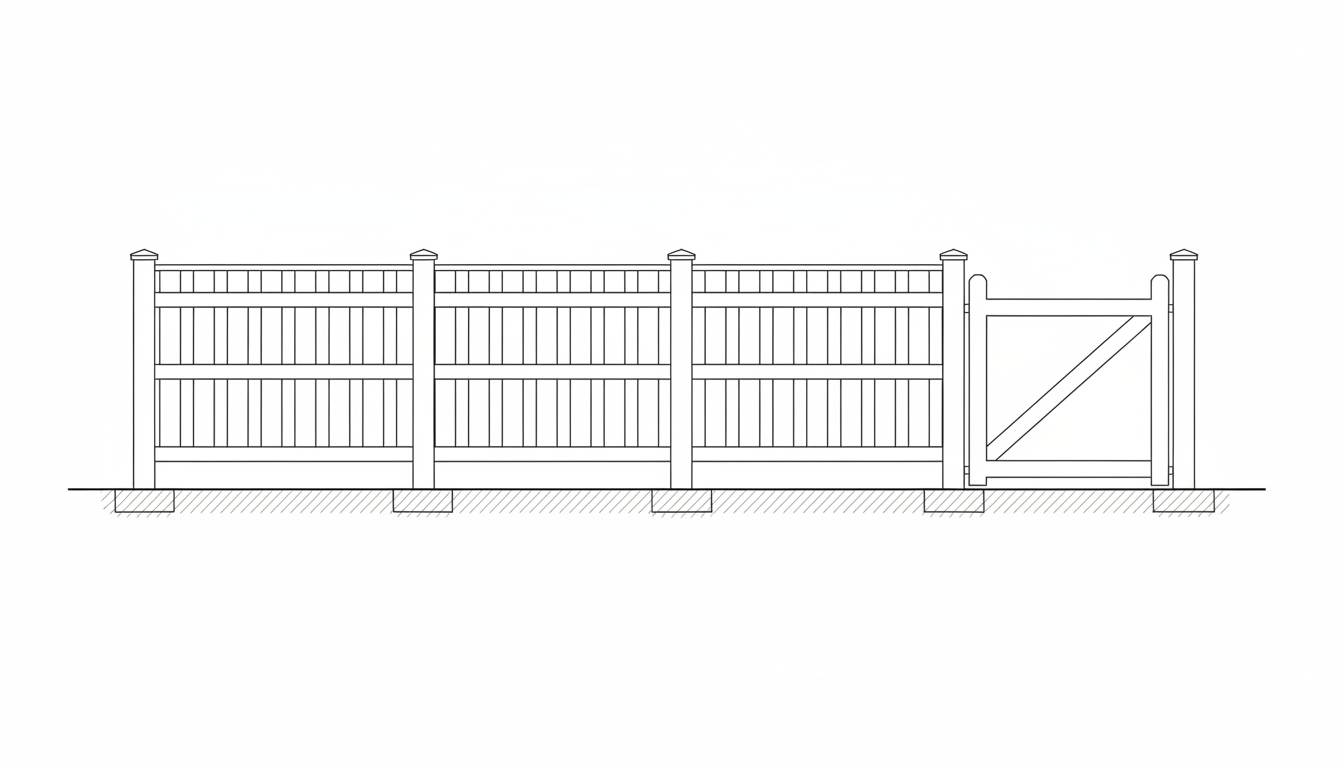
AI fence design generator result: a flat line elevation of a boarded fence with capped posts, three rails to a bay and a braced gate at the right hand end. It is clean, square and completely free of text, which makes it the most useful of the six to hand to a fencer, and it is also the clearest picture of what a render leaves out. One thing genuinely improved here: hatched footings are drawn below the ground line rather than sitting on top of it, which is the first time in this series of pages that has happened. It is still only half right, because the post stops at the ground line instead of continuing down into the footing, so the pad reads as something the fence rests on. The gravel board asked for along the bottom is missing entirely, leaving the whole face floating above the soil, the gate is shorter than the fence and grows odd rounded lugs at its top corners, and the drawing sits small in a sea of white rather than filling the sheet.
How the AI Fence Design Generator Works
Pick the material, then the infill
Cedar, pressure treated softwood, painted timber, composite or powder coated metal, and then solid boards, spaced slats, pickets with gaps or a lattice top. Those two choices carry the character, the privacy and most of the budget, and they are the pair everybody in the household has an opinion about. Say them in the prompt in that order.
Say how tall it is and what the ground does
Height decides whether you need consent at all, and it decides how hard the wind pushes. The ground decides how the run is built: level ground takes plain panels, a slope has to be either stepped down in level bays or raked to follow the fall, and those two look completely different from the street.
Take the post question to a fencer
Concepts arrive in about twenty seconds at up to 4K. The render settles the look; you measure what it cannot hold — the run length, the number of corners, the fall across the site, the ground conditions and where the boundary actually is — and a fencer sets post size, spacing and footing depth from those numbers.
What a Fence Render Settles, and What It Gets Wrong
Six things decide whether a fence design becomes a fence, and an image carries roughly two of them. The awkward part is that the four it drops are the four that decide the price, the lifespan and whether your neighbour agrees to it.
A third of the fence is underground
The working rule is that a third of the post length is buried, so a six foot fence is built from eight foot posts. That buried third, plus the concrete or gravel around it, is a serious share of the labour and almost all of the reason the fence stays vertical. A render photographs the two thirds that are visible and implies the rest is decoration.
Nothing countable comes out right
Pickets, slats, rails, panels and post centres are repeated elements, and repeated elements are exactly what image models approximate. Expect spacing that drifts across the frame, one bay noticeably wider than its neighbour, and a picket gap that changes halfway along the run. Look along a fence rather than at it, and pick one element to follow end to end.
A solid fence is a sail
Wind load is the reason tall solid fences blow over, and it does not scale gently: going from five feet to six collects meaningfully more force and hands all of it to the posts and the footings. Spaced slats, a shadowbox pattern or a lattice top let air through and calm the whole problem down. A render shows you the privacy and never the pressure.
The slope gets flattened
Ask for a fence on sloping ground and a model will usually give you a level fence and bend the ground to suit it, or float the panels above a hillside on nothing. Real answers are stepped bays, which leave triangular gaps that a gravel board has to close, or a raked run whose rails follow the fall. That choice changes the look completely and it is the one thing renders reliably delete.
Gates are drawn, not hung
A gate is a fence that moves, so it needs heavier posts, real hinges, a latch and a diagonal brace running up from the bottom hinge corner, or it drops out of square within a season. Generated gates arrive as a flat rectangle of the same boards with hardware suggested rather than fitted, hinges on the wrong edge, or a brace running the wrong way so it does nothing at all.
The boundary is a legal line, not a look
Which side of the line the fence sits on, which side the posts and rails face, who owns and maintains it, and how tall it may be are all questions with real answers on a deeds plan or a survey, and none of them are in the picture. Building a beautiful fence a foot inside your neighbour boundary is still the fastest way to have to take it down again.
Fence Design in Numbers
The material is the enjoyable decision and the arithmetic is the one that decides whether the fence is still upright after a bad winter. These are the working figures a fencer applies without stopping to think. Check your local rules and your supplier, and treat these as the shape of the problem rather than the rule.
Height and consent
In England, permitted development generally allows two metres in a rear garden and one metre where the boundary adjoins a road used by vehicles. The common United States municipal pattern is around six feet at the rear and sides and three or four feet in a front yard. Corner plots, conservation areas and homeowner associations all narrow that further, so the height is a legal number before it is a design one.
Posts, spacing and depth
Line posts usually stand at six to eight feet on centre, tightening for heavy solid panels and for metal systems built around a fixed panel width. Bury roughly a third of the post length, dig the hole about three times the post width, and where the ground freezes take the bottom of the hole below the local frost depth. End posts, corner posts and gate posts all take more load and get set deeper.
Wind, solidity and slope
Wind load rises sharply with height and with how solid the face is, and it is carried entirely by the posts and their footings. Spaced slats, shadowbox boarding and lattice tops all bleed pressure through the fence instead of collecting it. On sloping ground, a run is either stepped in level bays or raked to follow the fall, and stepping leaves a triangular gap under each bay that has to be closed.
The ground line and rot
Timber fails where air, water and soil meet, which is a band a few inches either side of the ground line, so a concrete collar is domed to shed water and a gravel board or a concrete plinth keeps the boards themselves clear of the soil. Pressure treated timber, a steel post spur or a concrete post all buy time in the same place. Everything above knee height lasts far longer than the bit at your ankles.
Why Use This AI Fence Design Generator
Six runs, not six stains
A horizontal cedar slat screen, a painted picket fence with a gate, a black metal panel system, a stepped fence on a slope, the bare posts going in and a flat elevation differ in cost, trade, lifespan and consent. Switching preset changes what the thing is rather than what colour it is.
One preset stands on a slope
Almost every fence gallery online is photographed on flat ground, which is not where most gardens are. Asking for a stepped run down a fall puts the real question — step it or rake it, and what closes the gap underneath — on screen where a household can look at it.
The posts preset is the unusual one
Practically no design tool will show you a fence with the panels off. Putting posts, holes, gravel and a domed concrete collar on screen turns the buried third of the project into something you can actually discuss with a fencer instead of nodding at.
An elevation view built in
One preset draws the fence flat and square as line work rather than photographing it in a garden, which is far closer to how the idea reaches a contractor, and a standing reminder that the other five are lit interpretations rather than drawings.
Consistent across a whole boundary
Nano Banana Pro holds a described material and palette across separate generations, so keeping the house and the garden and changing only the infill gives you solid, spaced and lattice topped versions that read as one project rather than three unrelated ones.
Cheap enough to end the argument
About twenty seconds per concept and plans from $2.99 means a household, a neighbour and a landscaper can all see six credible fences before anybody is asked to price a run, which is usually what turns a three week decision into an afternoon.
AI Fence Design Generator FAQ
Related Outdoor and Boundary Tools
AI Deck Design Generator
The other half of the same back garden, and the same lesson one layer down. Boards and railing above the joists, and a frame, footings and a ledger nobody photographs below them.
AI Backyard Design
For the garden the fence encloses. Lawn, planting, paving and outdoor living together, which matters because a boundary is read against the whole yard rather than on its own.
AI Exterior Design Generator
For the house the fence stands in front of. Facade materials, cladding and colour, so the front boundary and the building it frames can be argued about in the same palette.
Design Your Fence Now
Six fence runs, timber and metal that render with the right grain and finish, a run that actually stands on a slope, the posts going into the ground, a flat elevation, and 4K images in about twenty seconds. Free to start, from $2.99 for more.
Start Designing FreeAbout This AI Fence Design Generator
An AI fence design generator owns one half of a boundary and no part of the other, and with a fence the split is unusually brutal because a third of the thing is underground. Everything above the soil is appearance: the material and its finish, whether the boards run vertically or horizontally, how much gap is left between them, the height, the cap detail, the post tops, where the gate goes and what colour the whole run is painted or stained. All of that is genuinely visual, all of it is what a household and a neighbour argue about for weeks, and all of it is what this tool settles in about twenty seconds at up to 4K from a plain description. Everything below the soil is engineering and law: post length, hole depth and diameter, frost depth, concrete or gravel, wind load, and which side of a surveyed line the posts are allowed to stand on. None of it is visible in a finished fence and none of it can be inferred from a picture of one.
The failure mode is worth stating precisely, because it repeats across every render in the gallery above. Image models are excellent at fence surfaces. Cedar grain raking in low sun, the chalky flatness of fresh exterior paint, powder coated aluminium against wet planting, the way a spaced slat screen throws a striped shadow onto a lawn — all of it is convincing enough to put in front of a client. What they do not do is repetition, structure or ground. Pickets, slats, rails and post centres are all things you could count, and a generated image hands you a plausible number with spacing that drifts from one side of the frame to the other. Posts disappear entirely under horizontal boarding. Sloping ground is quietly levelled or the fence is floated above it. Gates arrive as rectangles with hardware implied rather than fitted. The reliable test is to pick one repeating element in any render you like and follow it the whole way along, then follow the bottom of the fence to where it meets the soil.
The consequence for a real project is that the picture and the price are only loosely related. A fence is quoted per linear run, and the cost drivers are the number of posts, the height, the ground you are digging into, the number of corners and gates, and whether the site slopes. Crossing rock, tree roots or made ground can cost more than upgrading the entire boarding to cedar. The parts that fail are down there too. Timber posts rot in the few inches either side of the ground line, which is why a fence that looks perfect at eye level snaps off at ankle height in the first serious gale, and why a domed concrete collar or a gravel backfill matters more than any finish decision. Tall solid panels then behave like sails and hand every bit of that wind straight to the same weak point. Every one of those facts is invisible in a photograph of a finished fence, which is exactly why the posts and footings preset on this page exists.
Practically, then, use this AI fence design generator early and use it to end an argument. Generate the horizontal cedar screen, the painted picket run with a gate, the black metal panels and the stepped fence on a slope, describe your actual garden and your actual house in the prompt, and let everybody react. Generate the posts view as well, because it is the one image in the set that starts the conversation a fencer actually needs to have with you. Then measure the things no render can hold — the length of the run, the number of corners and gates, the fall across the site, the ground conditions, the local height limit and where the boundary genuinely sits on the deeds or the survey — write them down beside the picture, and hand over both. It runs on Nano Banana Pro, it holds materials and palette steady across generations so a set of options reads as one project, it is free to start with paid plans from $2.99, and it turns the slowest decision on a boundary into six pictures you can react to in an afternoon.