
AI Wedding Dress Generator
Most brides book six appointments to discover what they actually like. This AI wedding dress generator lets you find that out in an afternoon instead — describe a gown, see it photographed full length in about twenty seconds, then change one thing and look again. Six silhouettes to start from, and an honest account below of what the fabric rendering gets right and where it drifts.
Design a Gown FreeTry the AI Wedding Dress Generator — Free
Pick the silhouette you want to explore, then add your own details in the box — neckline, sleeve, fabric, colour, train length, whether there is any beading at all. Change one thing per generation rather than five, because that is how you find out which detail you were actually reacting to.
AI Wedding Dress Generator
Choose a bridal silhouette, describe the details you want, and see the gown photographed full length. Up to 4K.
Six Silhouettes, Six Different Weddings
One frame per preset, generated with the tool on this page and left exactly as it came back. The captions say what each gown gets right and where it drifted from the brief — including the skirt that arrived in the wrong fabric weight and the hand that went soft mid-turn.
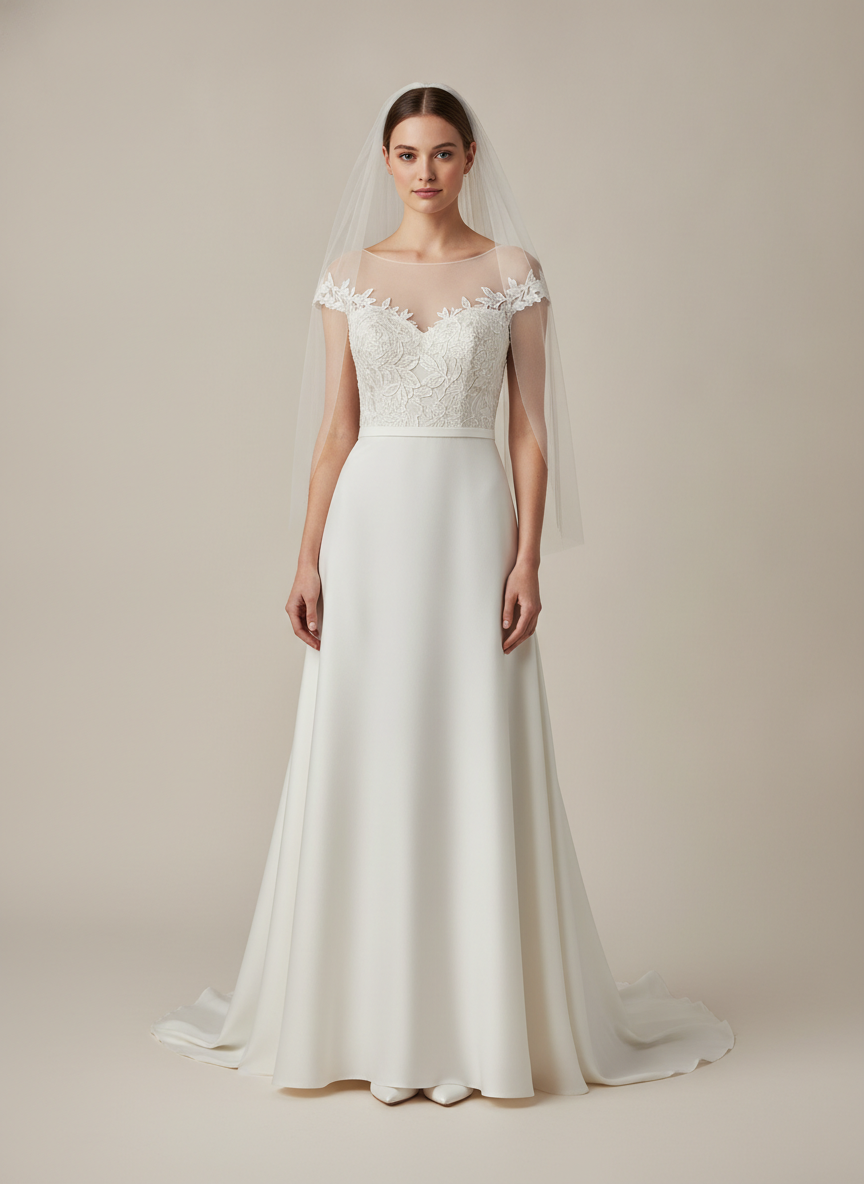
AI wedding dress generator result: a classic ivory A-line gown photographed straight on against a warm neutral backdrop. This is the frame to judge lace on, because corded floral appliqué covers the sweetheart bodice and reads as individual leaves and petals rather than the grey mush that usually stands in for lace. The illusion tulle yoke is the harder trick and it holds: you can see the skin through it, the sprigged appliqué sits along the neckline and shoulder, and the tulle edge disappears the way real illusion netting does instead of stopping at a hard line. A fingertip veil falls either side. The honest deviation is the skirt fabric — the brief asked for silk mikado, which is stiff and holds a sculptural flare, and what came back reads as a softer crepe that falls closer to the body. Right silhouette, different hand.
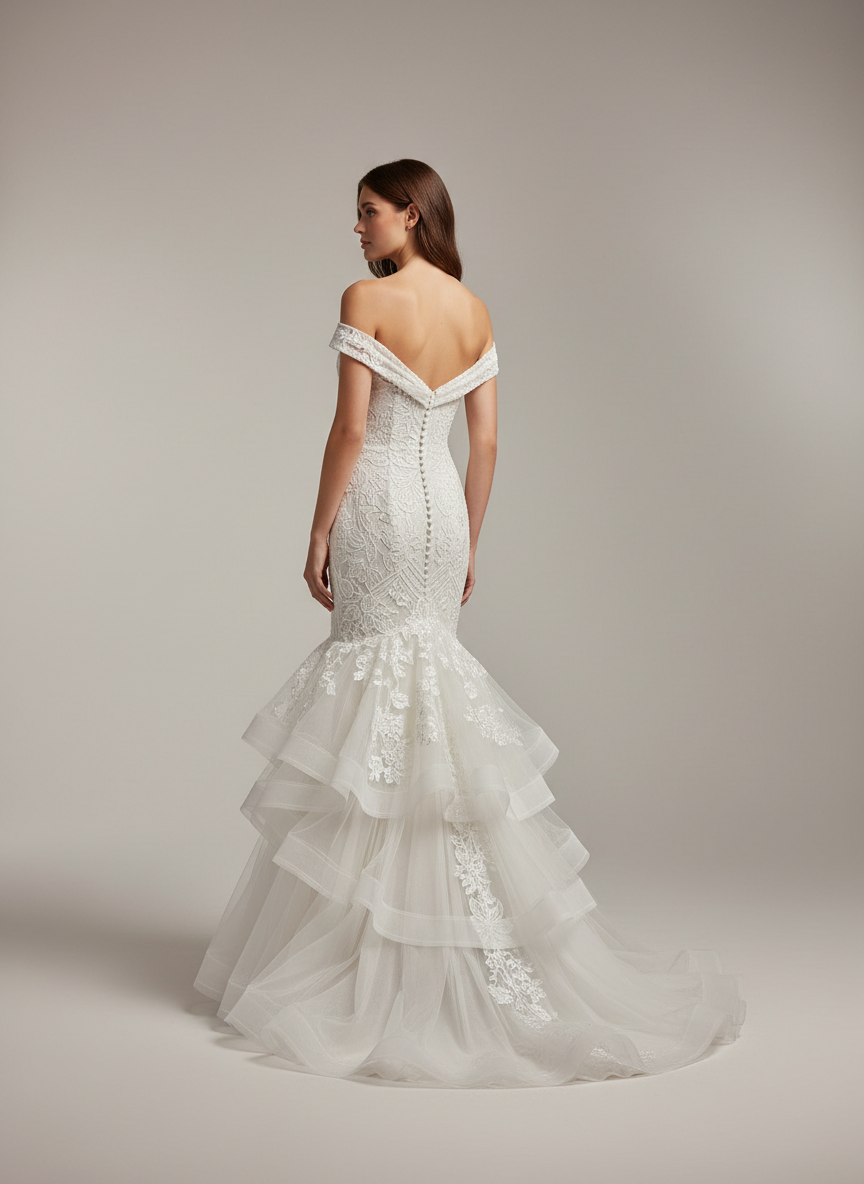
AI wedding dress generator result: a fitted ivory mermaid gown shot from behind, which is the view brides almost never get to see on a website and the one that decides the aisle. The back is the whole point of this frame. A deep V drops between the shoulder blades, an off-the-shoulder band of lace crosses the upper arms, and a long row of covered buttons runs down the spine from the V to below the hip — evenly spaced, correctly diminishing with the perspective, each one a real fabric-covered dome rather than a painted dot. The gown breaks at the knee into tiered horsehair-hemmed ruffles of tulle and appliquéd lace that spill into a train. The lace pattern is mirrored across the centre back seam the way a real cutter would place it. Nothing here is anatomically off.
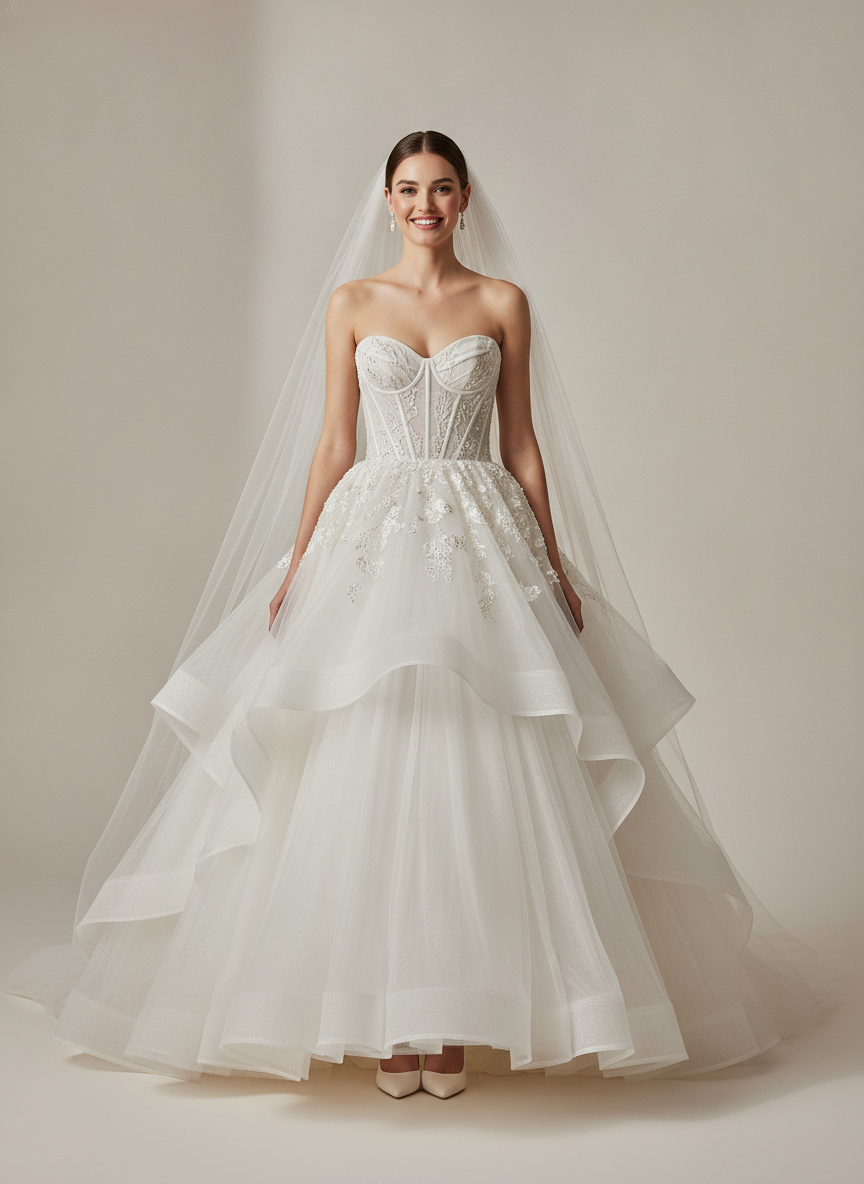
AI wedding dress generator result: a full princess ball gown with a sheer corseted bodice and an enormous tiered tulle skirt, with a cathedral veil falling to the floor on both sides. This is the maximum-volume end of the tool and the frame that tests structure rather than surface. The bodice is the strong part: the boning channels run vertically in the correct places, the sweetheart cups are shaped and seamed like real corsetry, and the sheer panel over the ribs shows the construction rather than hiding it. The skirt has genuine internal volume, with the outer horsehair-edged tiers catching light and the layers beneath going soft and translucent. Two honest misses: the brief asked for hand-sewn crystal and pearl beading and what arrived is three-dimensional floral appliqué scattered over the hip, and the cathedral veil loses its outer edge against a backdrop of almost the same tone.
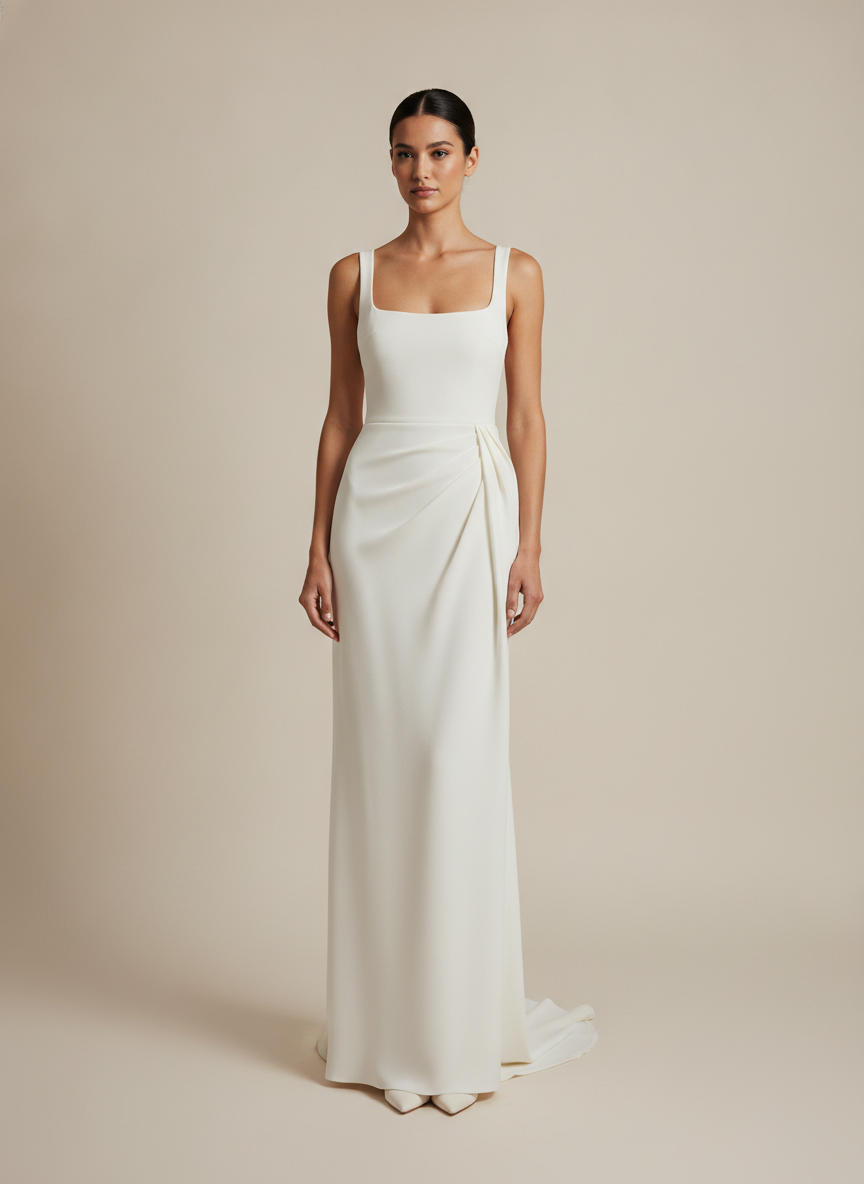
AI wedding dress generator result: a modern minimalist column in heavy matte ivory crepe, and the most technically difficult image on this page despite looking like the simplest. There is no lace, no beading and no embellishment to hide behind, so every flaw would be a flaw in the cut — and there is none. The square neckline is level, the wide straps are the same width and meet the bodice at matching points, the waist seam sits true, and a single sculptural fold is gathered at one hip and released into a straight floor-length skirt with a small sweep train. The fabric behaves like real crepe: heavy, matte, falling in long soft columns rather than crinkling. This is the frame that shows the tool understands garment construction and not just garment decoration. It came back as a front view, so the bare back the brief asked for is not visible.
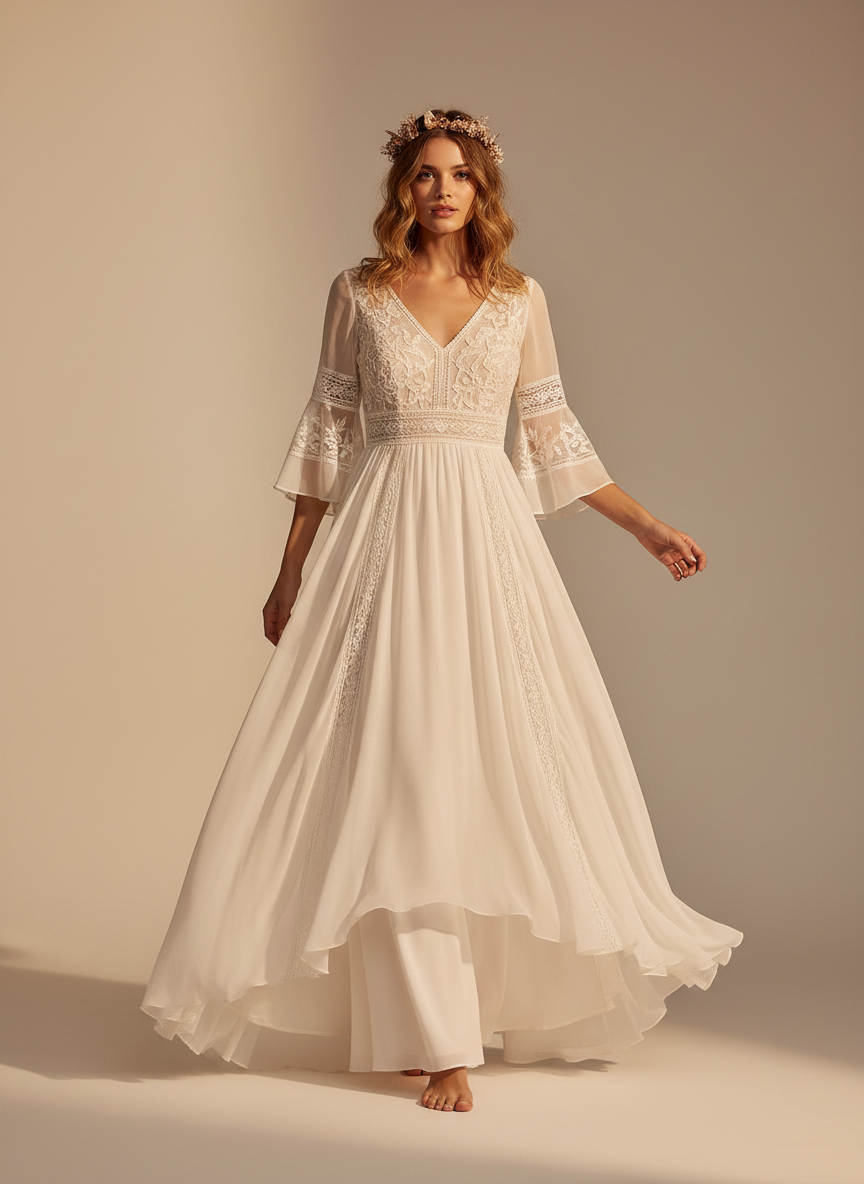
AI wedding dress generator result: a bohemian chiffon gown with an empire waist, a soft V neckline, botanical lace panels running down the skirt and a dried-flower crown, photographed in warmer, more diffuse light than the rest of the set. The movement is what makes it work — the skirt is caught mid-turn with the outer chiffon layer lifting away from the lining, the uneven high-low hem is genuinely uneven rather than symmetrically scalloped, and the model is barefoot, which is the correct styling call for a beach ceremony and not something the brief specified. Two things to note. The sleeves came back as elbow-length bells with lace insertion rather than the full loose sleeve past the wrist that was asked for. And her right hand, the one in motion, has soft indistinct fingers — the one place in these six frames where anatomy goes slightly vague.
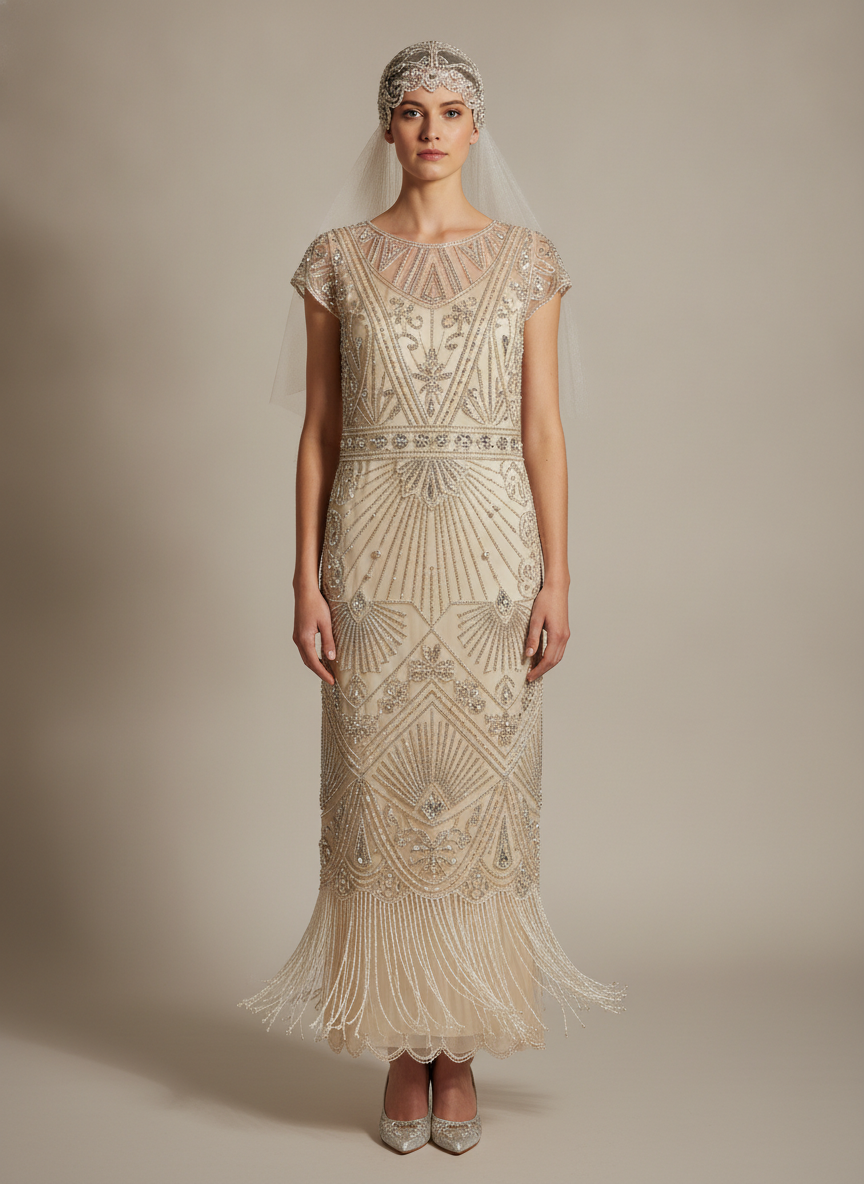
AI wedding dress generator result: a 1920s Art Deco drop-waist column in champagne-ivory georgette, beaded from shoulder to hem and finished with a long beaded fringe, worn with a crystal Juliet cap and short veil. This is the best surface work of the six by a wide margin. The beading is not a texture stretched over a dress — it is thousands of separate bugle beads, seed pearls and crystals laid into real Deco motifs: chevrons at the yoke, a beaded band at the dropped waist, sunburst fans across the hip and hem, each element symmetrical about the centre front and each bead carrying its own specular highlight. The fringe hangs in individual strands with weight. Crucially, the geometric beadwork stays abstract and never drifts into anything letter-shaped, which is the usual failure mode when a generator is asked for dense ornamental pattern.
How the AI Wedding Dress Generator Works
Start from a silhouette, not a picture
Pick one of the six shapes. Silhouette is the decision everything else hangs off, and it is the one that is settled by your venue, your ceremony and how much you intend to dance rather than by taste. Get it wrong and no neckline saves it. Get it right and almost any neckline works.
Add your own details in the box
Neckline, sleeve, fabric, colour, train, beading or the deliberate absence of it. Write it the way you would say it out loud — "square neck, long fitted sleeves, champagne silk, no lace". The preset carries the construction and the photography; your line carries the taste.
Change one thing and generate again
This is the whole method. Keep everything, move the neckline, look. Keep everything, strip the beading out, look. After six passes you will know which single detail you were reacting to in all those saved images, and you can say it in a sentence at your first appointment.
What This AI Wedding Dress Generator Nails, and Where It Drifts
Bridal is an unusually hard subject for a generator, because a wedding dress is almost entirely white fabric and structure, with none of the colour or scenery that normally carries an image. Here is where that goes well and where it does not.
Surface detail is the standout
Lace resolves to individual leaves and petals. Beading resolves to individual beads with their own highlights — the Art Deco frame carries thousands of them laid into real chevron and sunburst motifs, and the fringe hangs in separate strands. Covered buttons down a spine are correctly spaced and correctly foreshortened. This is the part that used to give an AI dress away instantly and it no longer does.
It understands construction, not just decoration
The minimalist crepe column is the proof, because there is nothing to hide behind: level neckline, matched straps, a true waist seam and one deliberate fold at the hip. The ball gown puts its boning channels where a corsetière would put them. Seams, darts and closures land where a real pattern would place them rather than being drawn on as surface pattern.
Fabric weight is the consistent drift
The one limitation to plan around. The A-line was briefed as stiff silk mikado, which flares away from the leg and holds a sculptural line, and it came back reading as a softer crepe falling close to the body. Right silhouette, wrong hand. Because the weight of the cloth is most of what separates two dresses of the same shape, trust the shape and confirm the drape against a real swatch.
It substitutes embellishment freely
Ask for hand-sewn crystal and pearl beading on a ball gown bodice and you may get three-dimensional floral appliqué instead, which is what happened in the gallery frame above. It is beautiful and it is not what was ordered. Expect the category of embellishment to be approximate, and if you need a specific technique — appliqué, embroidery, beading, nothing at all — say so and regenerate until it lands.
Hands still go soft in motion
Across these six frames the anatomy is clean with one exception: the boho gown was generated mid-turn, and the hand that is moving has indistinct fingers. Static poses came back correct every time. If you are generating a gown with movement in it, look at the hands before anything else, and regenerate rather than trying to explain the problem away in the prompt.
White on white needs a watched background
The cathedral veil in the ball gown frame loses its outer edge against a backdrop of nearly the same tone, so the veil simply stops being visible where it should still be reading. If your gown has a veil, a long train or a sheer overlay, ask for a backdrop several shades away from the fabric — a deeper grey or a warm taupe — or you will lose the very detail you generated the image for.
Choosing a Silhouette Your Wedding Can Actually Carry
A dress is not chosen in isolation. It is chosen against a room, a floor, a temperature and a day that runs for fourteen hours. Four things that decide it before you generate anything.
The venue sets the volume
A cathedral train and a full tulle ball gown need aisle width, ceiling height and somewhere to put the skirt when you sit down to eat. In a register office or a small city venue the same gown reads as fancy dress. Measure the aisle before you fall for the volume.
You have to move in it for fourteen hours
A mermaid is cut close from bust to knee and it photographs better than anything else on this page. Try sitting, climbing a step and dancing in one before you commit. A beaded Deco column is heavier than it looks. Chiffon is the one you can genuinely forget you are wearing.
Outdoors punishes the wrong fabric
Grass, sand, heat and wind rule out structured skirts and long unlined trains quickly. Empire-waisted chiffon exists because of exactly this problem, and barefoot on a beach is a real styling decision rather than a stylist's affectation. Generate for the ground you will be standing on.
Simple is harder, not easier
A plain crepe column has nowhere to hide a fitting problem, which is why it is the most demanding dress in any boutique and the one that needs the most alteration time. If the minimalist frame above is the one you keep coming back to, budget for the fittings, not just the gown.
Why Use This AI Wedding Dress Generator
It gives you the vocabulary
The real reason to use one. Most brides arrive at a first appointment with a folder of saved images and no words. Six passes here and you can say "fitted through the hip, breaking at the knee, off the shoulder, no beading" — which is the difference between a consultant guessing and a consultant pulling the right four dresses.
Six silhouettes, not six filters
Classic A-line, mermaid, princess ball gown, minimalist crepe column, bohemian chiffon and 1920s Art Deco. These are the six shapes bridal shops actually stock, briefed separately with their own construction, fabric, styling and light — not one dress with six looks laid over it.
Twenty seconds instead of six Saturdays
Appointments are ninety minutes and take a weekend each. This does not replace trying a dress on, and nothing will, but it moves the discovery part of the process to an afternoon at home so that the appointments you do book are spent on gowns you already know you want to see.
Your details, not just the preset
Every silhouette takes a free-text line on top of it, so you can specify a square neck, long fitted sleeves, champagne rather than ivory, a chapel train instead of cathedral, or no lace anywhere. The preset carries the construction and the photography while you change one variable at a time.
Useful for boutiques and dressmakers too
Independent designers use generated gowns to agree a direction with a client before cutting anything, and small boutiques use them to plan a lookbook shoot. It is a fast way to put a shared image on the table when two people are describing different dresses with the same words.
Original gowns, no house styles
Every preset explicitly forbids labels, tags, boutique signage, logos, monograms and any resemblance to an existing fashion house. What comes back is an original dress in a shared industry silhouette, which is what you want if the image is going to a dressmaker rather than to a shop counter.
AI Wedding Dress Generator FAQ
Related Wedding & Design Tools
AI Fashion Design Generator
The same construction-aware generation applied to everything that is not bridal — ready-to-wear, evening, tailoring and streetwear. Useful for the bridesmaids, the going-away outfit and the rest of the wedding party.
AI Wedding Decoration Generator
The room the dress has to stand in. Ceremony arches, table settings, florals and lighting schemes, visualised before you book a stylist and discover the palette fights your gown.
AI Wedding Photo Generator
Once the gown and the venue are settled, this is how you plan the shot list — the poses, the light and the framing you want your photographer to be looking for on the day.
Find the Dress Before You Book the Appointment
Six silhouettes — classic A-line, mermaid, princess ball gown, minimalist crepe, bohemian chiffon and 1920s Art Deco — each one photographed full length in about twenty seconds, with your own details on top. Up to 4K. Free to start, from $2.99 for more.
Design a Gown FreeAn AI Wedding Dress Generator for Brides, Boutiques and Dressmakers
Choosing a wedding dress is an unusual shopping problem, because almost nobody starts with the words for what they want. You have a folder of saved images and a strong feeling, and the feeling does not tell you whether you are responding to the silhouette, the neckline, the sleeve or the weight of the cloth. That is why the traditional process is six appointments across six Saturdays, most of which are spent discovering what you do not like. An AI wedding dress generator changes the order of that: it lets you do the discovery at home in an afternoon, one variable at a time, and arrive at the first appointment able to describe a dress in a sentence instead of holding up a phone.
The six presets on this page are six different weddings rather than six looks. A classic A-line is the shape that suits the widest range of people and the widest range of venues, defining the waist and skimming everything below it. A mermaid is the most photographed and the most physically restrictive, cut close from bust to knee. A princess ball gown needs aisle width and ceiling height, and it will dominate every frame it appears in. A minimalist crepe column belongs in a city hall or a modern venue and is the most demanding dress in any boutique, because there is nothing to hide an imperfect fitting behind. Bohemian chiffon exists because grass, heat and wind punish structure. And a beaded 1920s Art Deco column is heavy, spectacular and made for an evening reception.
The gallery above is one frame per preset, generated with the tool on this page and left exactly as it came back, because the strengths and weaknesses of this AI wedding dress generator are consistent enough to be worth learning before you rely on it. Surface work is genuinely solved: lace resolves to individual leaves and petals, beading to thousands of separate beads with their own highlights, covered buttons to correctly spaced and correctly foreshortened domes. Construction is understood too — boning channels, waist seams, matched straps and darts land where a pattern cutter would put them. What drifts is fabric weight. A skirt briefed as stiff silk mikado came back as something softer that falls closer to the body, and since the hand of the cloth is most of what separates two gowns of the same shape, that is the thing to confirm against a real swatch. Embellishment gets substituted freely, hands go soft when a pose has movement in it, and white fabric photographed against a near-white backdrop will lose the outer edge of a veil entirely.
So the working rule is a simple one. Treat the silhouette, the seaming and the surface detail as reliable, treat the drape and the specific embellishment technique as a proposal, and treat the whole image as a way of finding words rather than a substitute for a fitting room. Nothing generated here is a pattern, a size or a quote, and no gown on this page resembles a dress you can walk into a shop and buy — every preset explicitly forbids labels, logos, house styles and trade dress, so what you get is an original dress in a silhouette that belongs to the whole industry. Take it to a dressmaker as a starting point, or take it to a consultant so they pull the right four gowns instead of guessing. Then go and put the dress on, because that is still the only part that decides it.