
AI Water Bottle Design Generator
A water bottle is three decisions wearing one shape. There is the vessel — the material and whether it has one wall or two — there is the closure, which is a tooled component rather than a drawing, and there is the decoration, which is where almost every brand actually competes. This AI water bottle design generator is built to settle the vessel and the decoration properly, and to be straight with you about the closure and the numbers no image can carry.
Start Designing FreeTry the Water Bottle Design Generator — Free
Pick the vessel first, then name the colour, the finish and the decoration. Every preset is written as real drinkware product photography on a plain ground, because a bottle concept you cannot photograph is a bottle concept nobody can put on a listing.
AI Water Bottle Design Generator
Choose a bottle archetype, describe the material, colour and finish, and get drinkware product shots at up to 4K
Bottles Designed With This Generator
Six vessels rather than six colourways, generated with the presets above and left unedited, flaws included. Two are worth pointing at. The Tritan preset asked for a soft bite valve and returned a rigid spout, which is a different closure programme entirely. And the glass bottle came back with its silicone sleeve riding so high that the body reads as a jar, with tea coloured liquid inside despite the prompt asking for clear water. Both are proportion and component errors rather than styling errors, and that is the pattern worth internalising: read these renders for finish, material and how decoration sits on a curve, and re-run anything where the proportions matter.
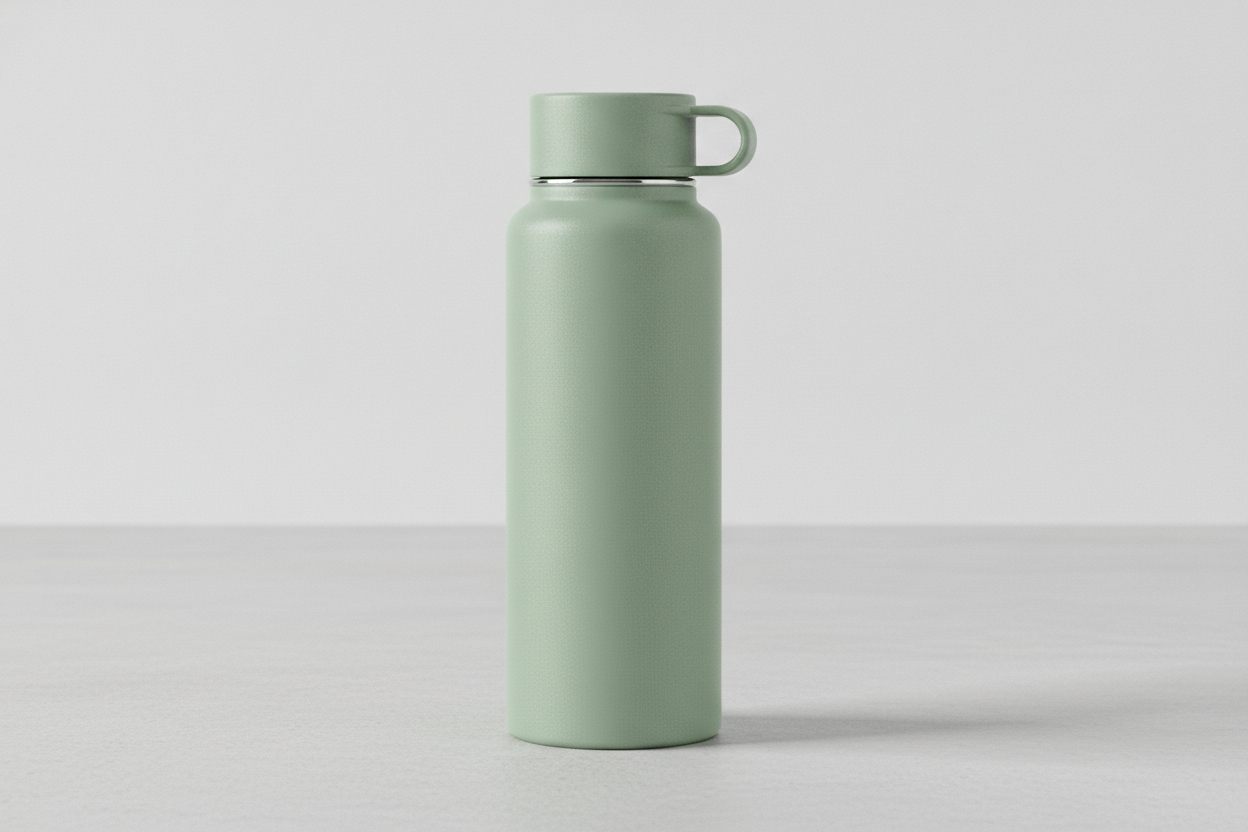
AI water bottle design generator result: an unbranded double wall insulated steel bottle in a matte sage green powder coat, standing on pale concrete with a matching screw lid and a moulded carry loop. The powder coat texture is the detail worth looking at — it reads as a sprayed and cured finish rather than paint, which is what separates a real insulated bottle from a coloured cylinder. What the picture will not tell you is whether this holds 18oz or 32oz
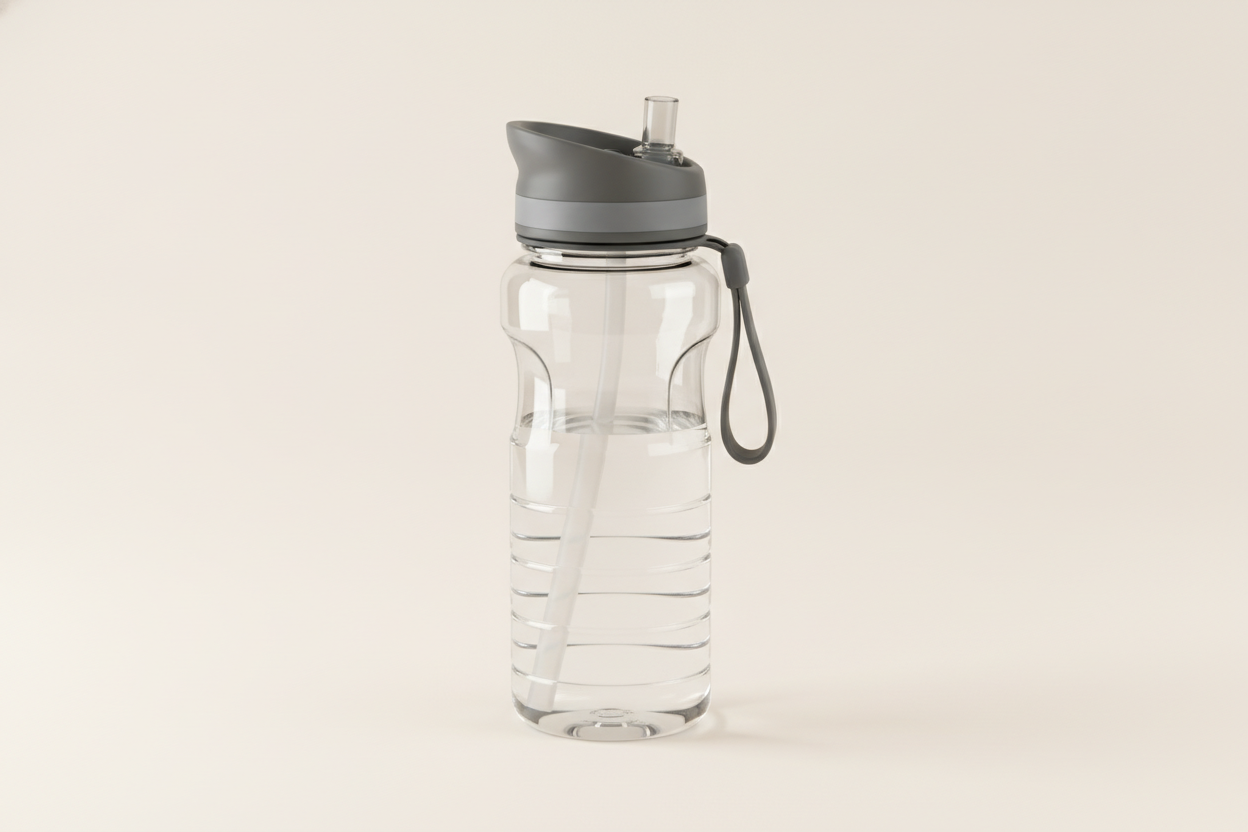
A clear Tritan sports bottle photographed straight on against warm white, with a ribbed lower body, a moulded waist grip, a charcoal flip lid with a rigid spout and a folded silicone carry strap, and the internal straw clearly visible through the wall. The preset asked for a soft bite valve and got a hard spout instead, which is a different lid programme with a different mould, and a useful reminder that the lid is a component you specify rather than a shape you draw
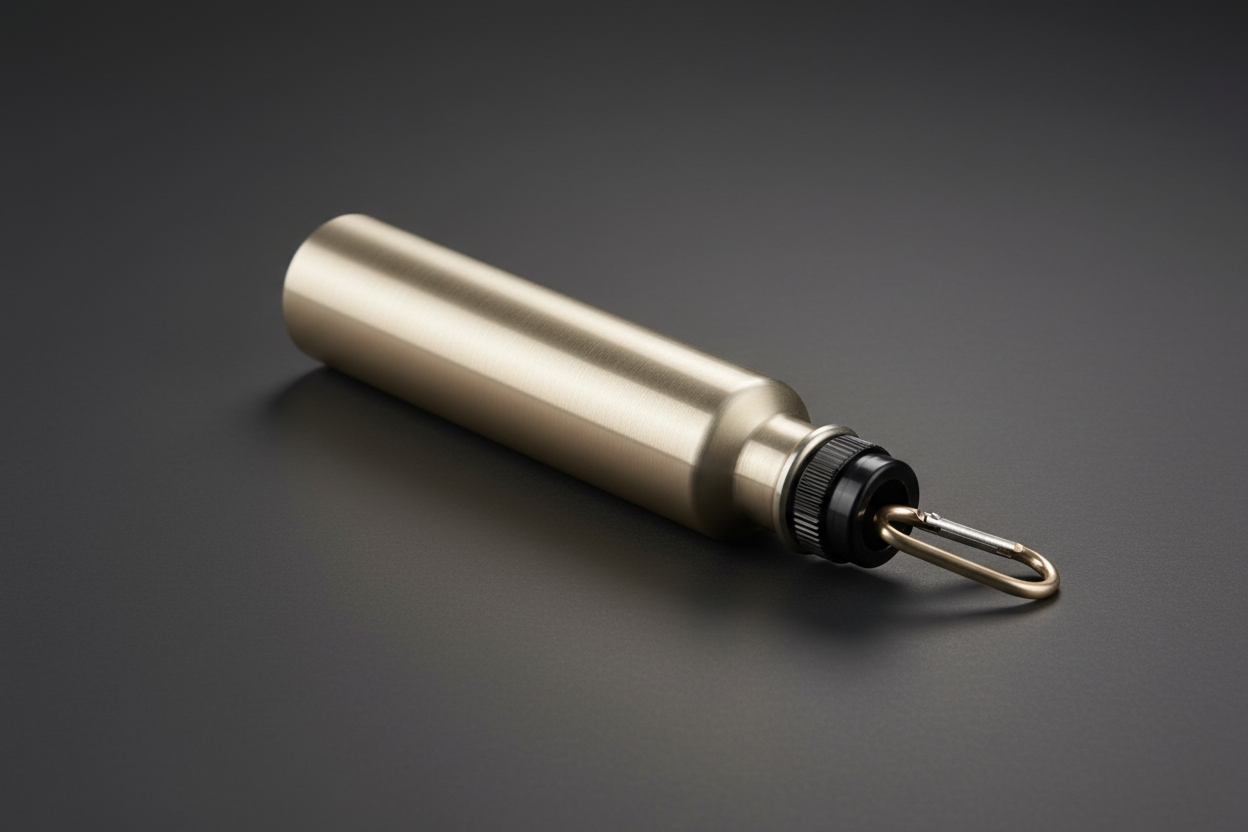
A slim single wall aluminium bottle in a warm champagne anodised finish, lying on its side on dark charcoal with a knurled black sport cap and a small carabiner. The vertical brushed grain running the length of the body is what makes this read as spun aluminium rather than plastic. Note the wall thickness at the mouth — thin, because a single wall bottle is not insulated and never will be
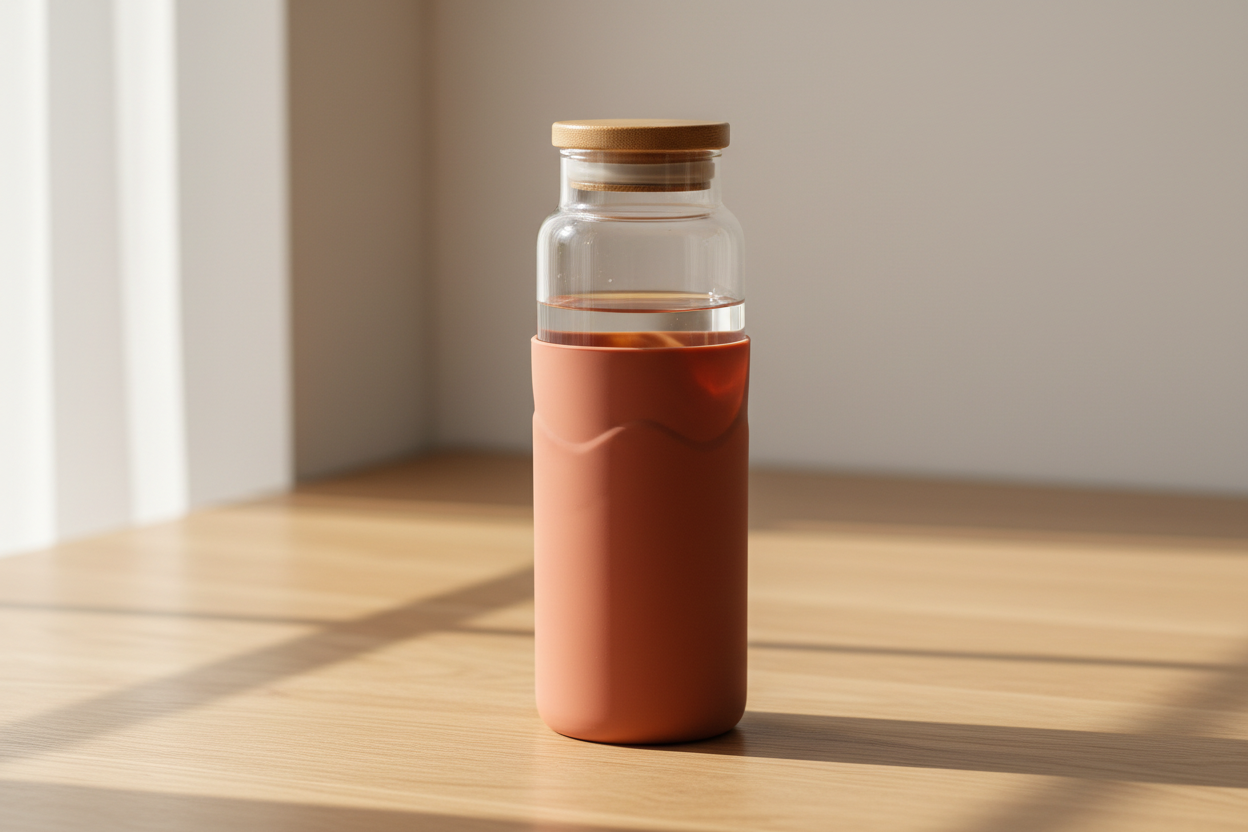
A borosilicate glass bottle in a terracotta silicone sleeve with a bamboo screw lid, shot on pale oak in window light. This is the least accurate of the six: the sleeve rides so high that the glass above it reads as a jar rather than a bottle, and the model filled it with something tea coloured despite being asked for clear water. The materials and the mood are right, the proportions are not, and proportion is the thing a second pass should fix
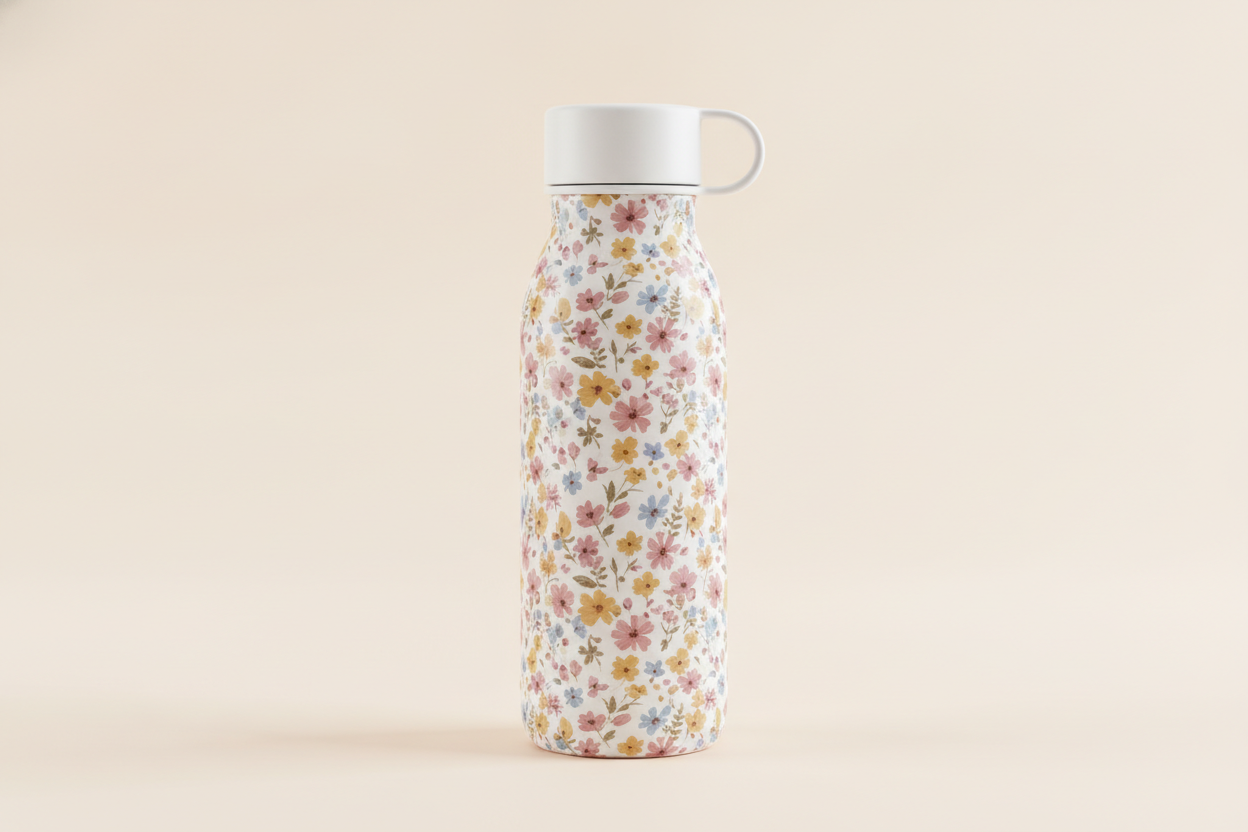
An insulated steel bottle carrying an all-over hand painted wildflower print in dusty pink, ochre and soft blue on an off white ground, photographed against cream paper. The most commercially useful frame of the six: the pattern wraps continuously and curves away at both edges the way a real full-wrap print does, with no visible seam and no distortion at the shoulder where the body tapers in
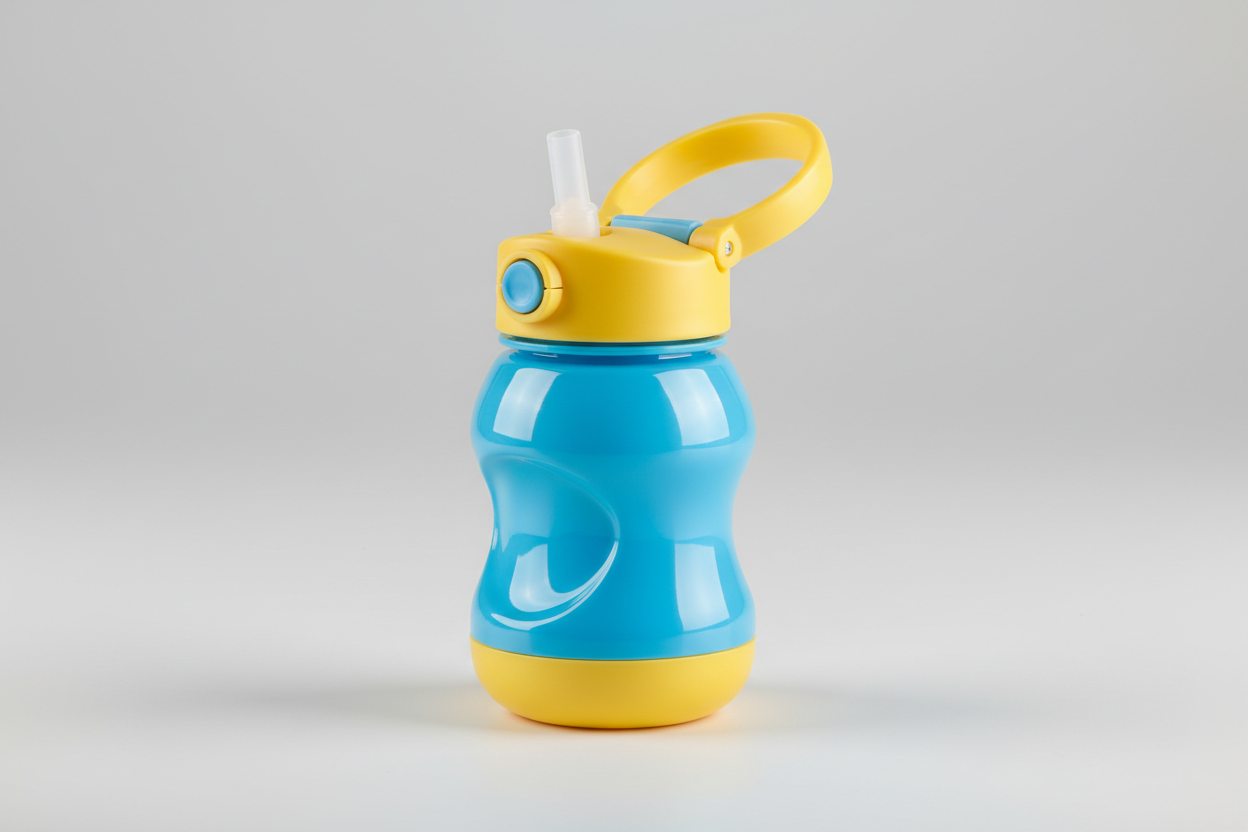
A childrens bottle in glossy sky blue with a yellow flip lid, a folded carry handle, a soft silicone straw and a yellow base cup. The waisted grip came out chunkier than described, which suits the category, and the flip button, hinge and lid lock are all resolved well enough to hand to a moulder as a starting point for the closure
How the AI Water Bottle Design Generator Works
Pick the vessel
Insulated steel, clear Tritan sports, slim aluminium, glass and silicone, full-wrap print or a kids bottle. That one choice sets the material, the wall construction and the entire class of closure that can go on top of it — far more of the design than any colour decision will.
Name the colour, finish and decoration
Say powder coat or anodised or glossy injection moulded, say the colour, and say whether the body is a single flat tone or carries a printed pattern. The model renders the surface that belongs to whichever finish you name, and finish is most of what makes a bottle look like a $40 product or a $4 one.
Take the concept to a supplier
Concepts arrive in about twenty seconds at up to 4K. The render settles what it looks like; a drinkware supplier matches it to a body they already tool, confirms the capacity and the neck finish, and rebuilds your artwork on the correct wrap template for the print method you choose.
What a Bottle Render Settles, and What It Hides
Six things decide whether a water bottle design works, and an image carries about half of them. Knowing which half is the difference between a concept a supplier can quote and a picture of something that cannot be built the way it looks.
The wall decides everything else
Two walls with a vacuum between them means steel, an opaque body and drinks that hold temperature. One wall means the drink can be visible, the bottle is lighter and cheaper, and a cold drink sweats in your bag. This is the first fork in the road and it silently rules out half the looks you might have wanted, so choose it before the styling rather than after.
Capacity is invisible in a render
Photographed alone on a plain ground, an 18oz bottle and a 40oz bottle are the same image. The model has no notion of volume, and capacity sets the diameter, which decides whether the bottle fits a cup holder or a bike cage — a genuine purchase criterion. Fix the capacity in numbers first and judge the proportions against it.
The closure is a component, not a drawing
Neck threads follow manufacturer standards and a lid is a moulded assembly with gaskets, hinges and sometimes a valve, tooled at real cost. Small brands pick from what a supplier already has. Use a render to decide which closure family you want — screw loop, flip straw, chug spout, handle — rather than to invent one.
The print method decides the artwork
Powder coat is one solid colour. Sublimation is photographic but needs a white polymer coated blank and leaves a seam. UV rotary printing is seamless with a narrower gamut. Laser etch is a mark in bare steel, not a colour. The same design has to be built four different ways for those four routes, so name the route before you draw.
A tapered body needs a curved template
Wrap a rectangular pattern around a body that narrows towards the shoulder and it bows and stretches visibly. The correct flat file for a tapered bottle is an arc, not a rectangle. Design the motif at this stage, then rebuild it on the real template for your blank before anything goes to print.
Compliance comes from the supplier
Food-contact safety, BPA-free claims, lid leak testing and drop testing are supplier and laboratory matters that arrive as documents. None of them is visible in an image and none of them is implied by one. Treat the render as the styling half of the brief and keep the compliance half on paper next to it.
Why Use This AI Water Bottle Design Generator
Six vessels, not six colourways
Insulated steel, clear Tritan, slim aluminium, glass and silicone, full-wrap print and a kids bottle differ in material, wall construction and closure family all at once — so switching preset changes what the product is rather than what colour it happens to be.
Written as product photography
Every preset specifies a plain ground, a named camera angle and soft studio light, so concepts arrive looking like the listing photo they will eventually need instead of an illustration floating in a gradient.
Finish named in every prompt
Powder coat, anodised aluminium, borosilicate glass and glossy moulded plastic each render with the surface that belongs to them. That single detail is what makes a concept read as a real bottle rather than a coloured cylinder.
Decoration sits on the curve
The full-wrap preset is written so the pattern wraps continuously and falls away at both edges, which is how you find out whether a motif survives being bent around a body before you pay anyone to print it.
Consistent across a range
Nano Banana Pro holds a described style across separate generations, so reusing one colour and one finish description while changing only the vessel gives you a family of bottles that reads as one collection rather than six unrelated products.
Cheap enough to try a whole range
About twenty seconds per concept and plans from $2.99 means testing a full drinkware line costs less than a single sample from a factory, which is what makes the trying-things stage affordable at all.
AI Water Bottle Design Generator FAQ
Related Design Tools
AI Tumbler Wrap Design Generator
The other half of the job. This page renders the bottle; that one builds the flat seamless wrap file that a sublimation printer actually needs.
AI Mug Design Generator
The same problem on a shorter cylinder with a handle in the way. Useful for keeping a drinkware range consistent across bottles and mugs.
AI Packaging Design Generator
What the bottle ships inside. Worth doing at the same time, because the box is the first thing a customer sees and the last thing most brands design.
Design Your Water Bottle Now
Six bottle archetypes, finishes that render at the right surface, decoration that wraps the way it will in real life, and 4K product shots in about twenty seconds. Free to start, from $2.99 for more.
Start Designing FreeAbout This AI Water Bottle Design Generator
An AI water bottle design generator earns its place on a narrow and unusually well-defined part of the job. A reusable bottle is three decisions wearing one shape. The first is the vessel: what it is made of and whether it has one wall or two, which quietly decides whether the drink is visible, whether it holds temperature, what it weighs and roughly what it costs. The second is the closure, which is a tooled component with gaskets and threads and standards attached to it, and which almost nobody outside a factory designs from scratch. The third is the decoration, and that is where nearly every brand in this category actually competes, because the underlying bottles are frequently the same bodies from the same suppliers wearing different surfaces. A render settles the first and third of those in about twenty seconds. It has nothing useful to say about the second.
That is why the six presets here are vessels rather than colourways. An insulated steel bottle, a clear Tritan sports bottle, a slim anodised aluminium flask, a glass body in a silicone sleeve, a full-wrap printed bottle and a kids bottle with a handle and a straw differ in material, in wall construction and in the entire family of lids that can sit on top of them — which is a real design decision. Changing a bottle from sage green to terracotta is not. Each preset names its finish explicitly, because the model renders the surface that belongs to whatever it is told about, and finish is most of what separates a bottle that looks like a considered product from one that looks like a coloured tube. Powder coat has a fine sprayed texture that catches light softly. Anodised aluminium keeps a directional brushed grain. Borosilicate glass refracts what is behind it. Injection moulded plastic goes glossy and picks up hard highlights on its curves.
Decoration is where this water bottle design generator is most immediately useful and where the hardest constraint lives, so it is worth being blunt about it. There are four common ways to put a design on a bottle and they are not interchangeable. Powder coating gives a single solid colour. Full-wrap sublimation transfers a photographic image onto a polymer coated white blank, which means it needs a light base and leaves a seam where the wrap closes. UV rotary printing wraps continuously with no seam but works within a narrower colour gamut and struggles on a strongly tapered body. Laser etching burns through the coating to expose the steel underneath, which is a mark rather than a colour. On top of that, any body that narrows towards the shoulder needs its artwork built on a curved arc rather than a rectangle, or the pattern will bow once it is applied. Generate the motif here, judge whether it survives being bent around a cylinder, then rebuild it on the correct template for the blank you have chosen.
This tool runs on Nano Banana Pro, the same image model behind the rest of the tools on this site, and the capability that matters most for drinkware is style consistency across separate generations. Describe one colour, one finish and one decorative treatment, reuse that wording, and change only the vessel — that is how six concepts come back looking like a single collection rather than six unrelated products, which is exactly what you need to show a supplier, a buyer or a print on demand storefront. Concepts arrive in about twenty seconds at up to 4K, so a whole range can be tested in an evening. It is free to start and paid plans begin at $2.99, which puts the deciding-what-it-looks-like stage well below the cost of a single factory sample.