
AI Sunglasses Design Generator
A pair of sunglasses is two designs sharing a hinge. There is the front — lens shape, bridge, brow line, material thickness — which is what anyone recognises from across a street and what a render is genuinely good at. And there is the fit, which is three measurements in millimetres and an angle, and which no image contains. This AI sunglasses design generator is built to settle the first one properly and to be honest about the second.
Start Designing FreeTry the Sunglasses Design Generator — Free
Pick the frame archetype first, then name the material, the colour and the lens tint. Every preset is written as real eyewear product photography on a plain ground, because a concept you cannot photograph is a concept nobody can judge.
AI Sunglasses Design Generator
Choose a frame archetype, describe the material, colour and lens tint, and get eyewear product shots at up to 4K
Eyewear Designed With This Generator
Six frame archetypes rather than six colourways, generated with the presets above and left unedited, flaws included. Two things went wrong and both are worth more than a clean set would have been. The sport preset was asked for a single shield lens and returned a half-rim frame with two lenses, which is a different product entirely. And two of the six carry a tiny invented marking on the inside of the left temple — one of them with a CE mark — even though every preset bans lettering outright. That is the whole page in one detail: the model reproduces the little block of text where a real frame prints its lens width, bridge and temple length, because it has seen it a million times, while having no idea what any of those numbers should be. Read these for section thickness, bridge position and how the temple meets the front. Treat every number and every mark on them as decoration.
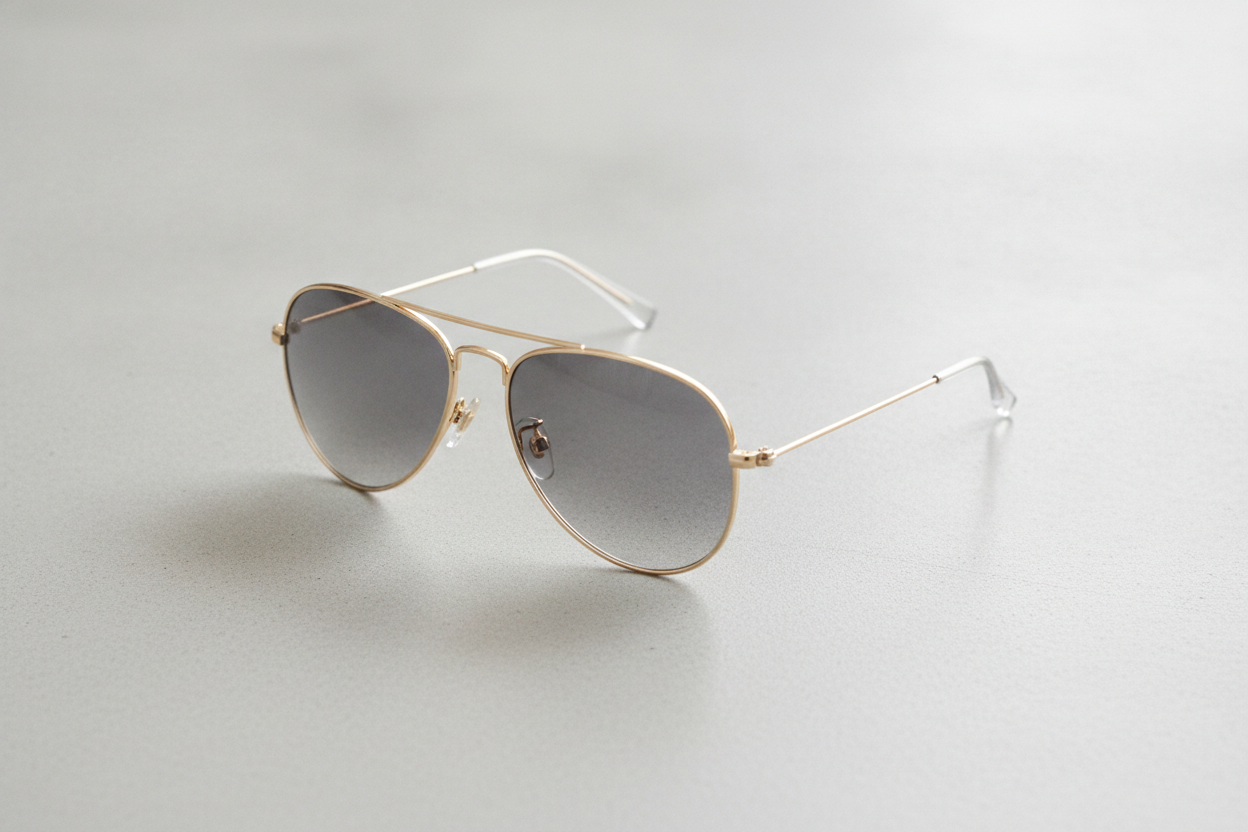
AI sunglasses design generator result: a thin polished gold wire aviator on pale concrete, double brow bar, teardrop lenses in a grey gradient, clear silicone nose pads and clear acetate temple tips. The front is completely resolved here — bridge height, brow bar position, how much lens sits below the pad. What the picture cannot tell you is that this is a 58mm lens rather than a 52mm one, which is the difference between this frame suiting a face and swamping it
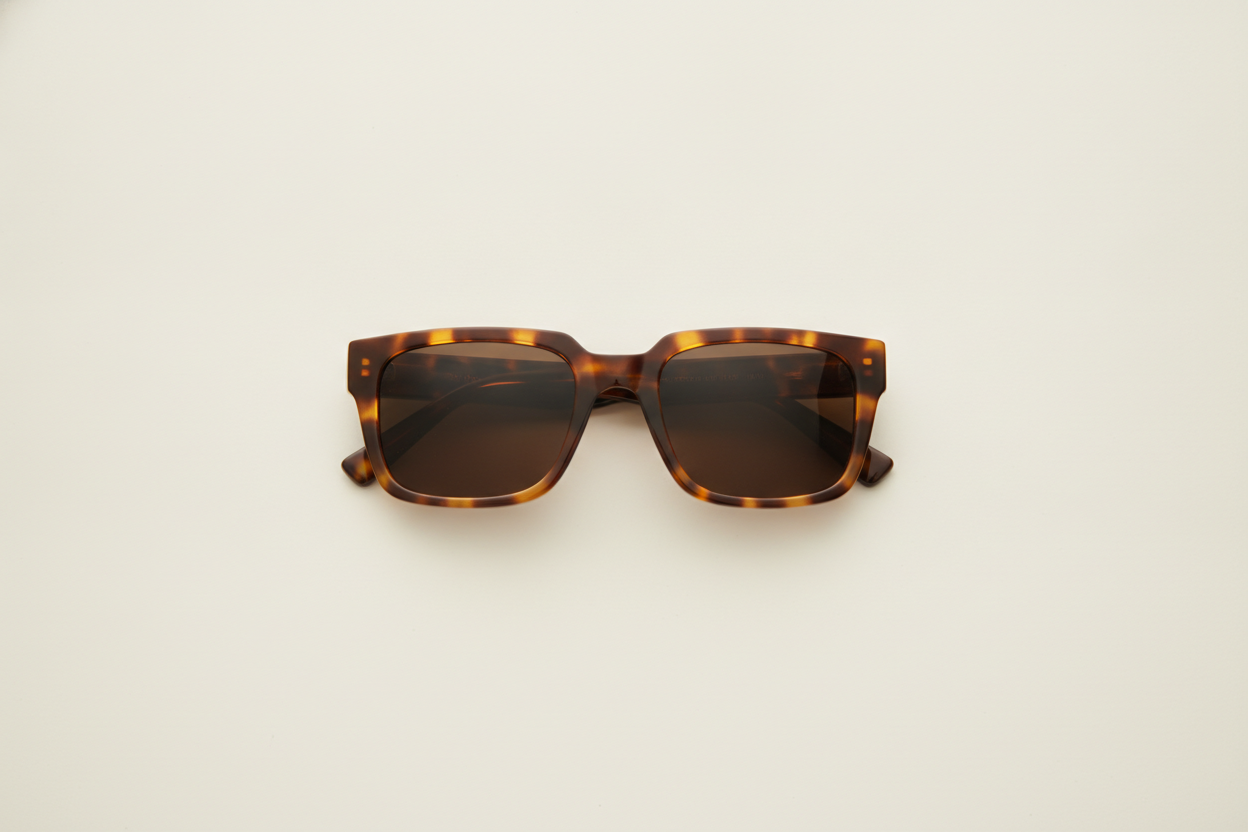
A chunky tortoiseshell acetate square photographed flat from directly above on warm white, temple arms folded behind the lenses and dark brown lenses in front. The section is the whole design in this one: the acetate is heavy at the outer edges and noticeably thinner across the top of each lens, which is what stops a thick frame reading as a costume prop. Small metal rivets sit where the hinges are buried, exactly as they would on a milled acetate front
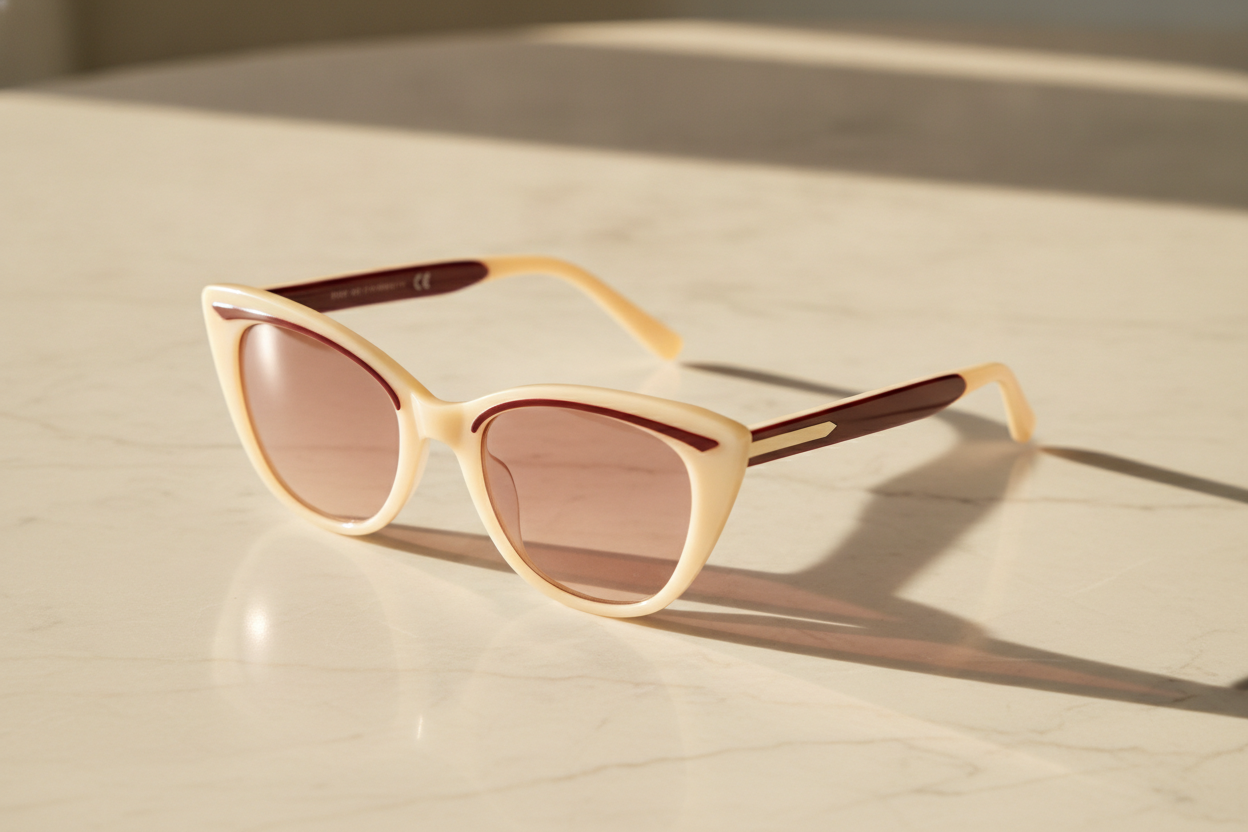
A cat-eye in laminated acetate on marble in raking sunlight, cream outer layer with a deep burgundy inner layer showing as a fine line along the brow and around the lens, rose-brown gradient lenses. Look at the inside of the left temple: the preset banned lettering and the model added the standard frame marking anyway, complete with a CE mark. It is illegible and it is invented — a good reminder that a rendered CE mark is decoration, not conformity, and that the size numbers a real frame carries there are precisely what a render cannot know
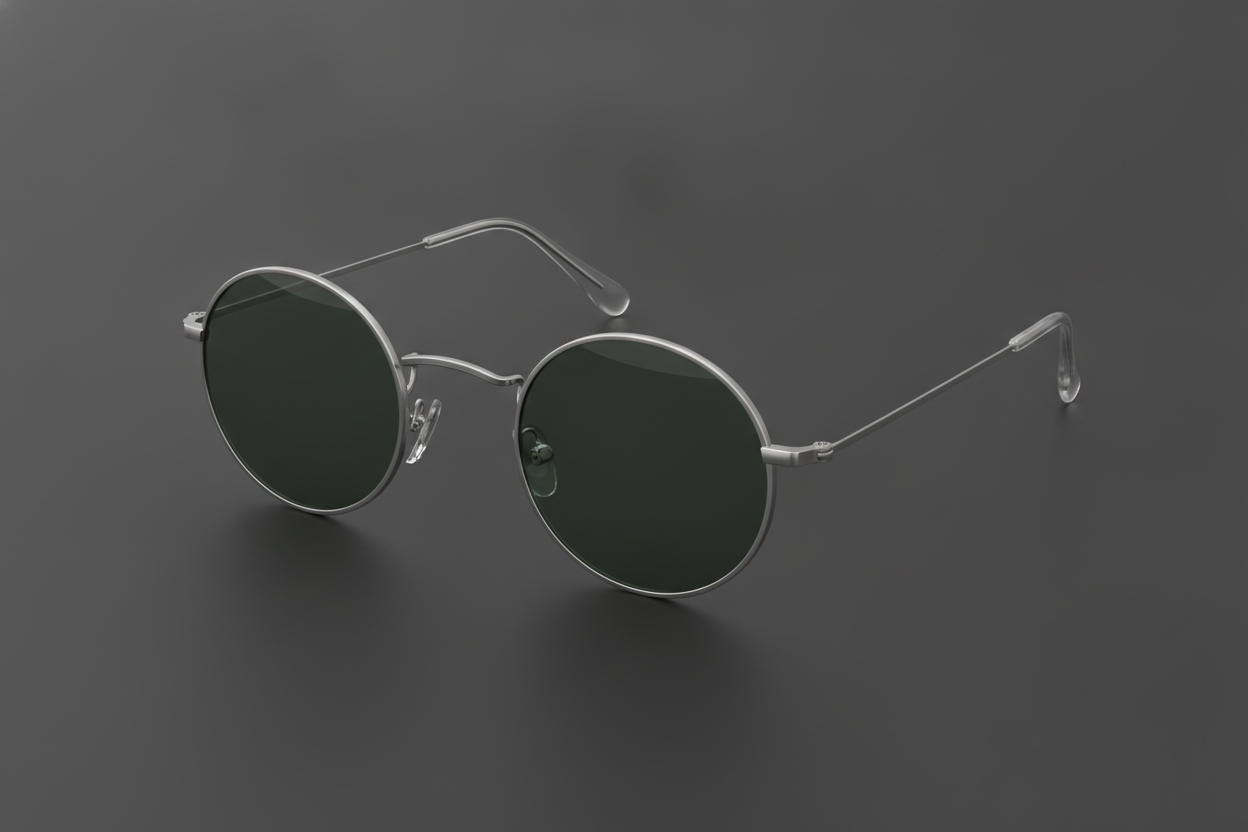
A round wire frame on matte charcoal with the temples open, in very thin brushed silver with flat bottle-green lenses. The cleanest render of the six and the one closest to being manufacturable as drawn: the nose pads sit on their own small arms where an optician can bend them, the hinge and endpiece are legible, and the wire gauge is consistent all the way round. Thin metal is where an image model usually falls apart, and it held here
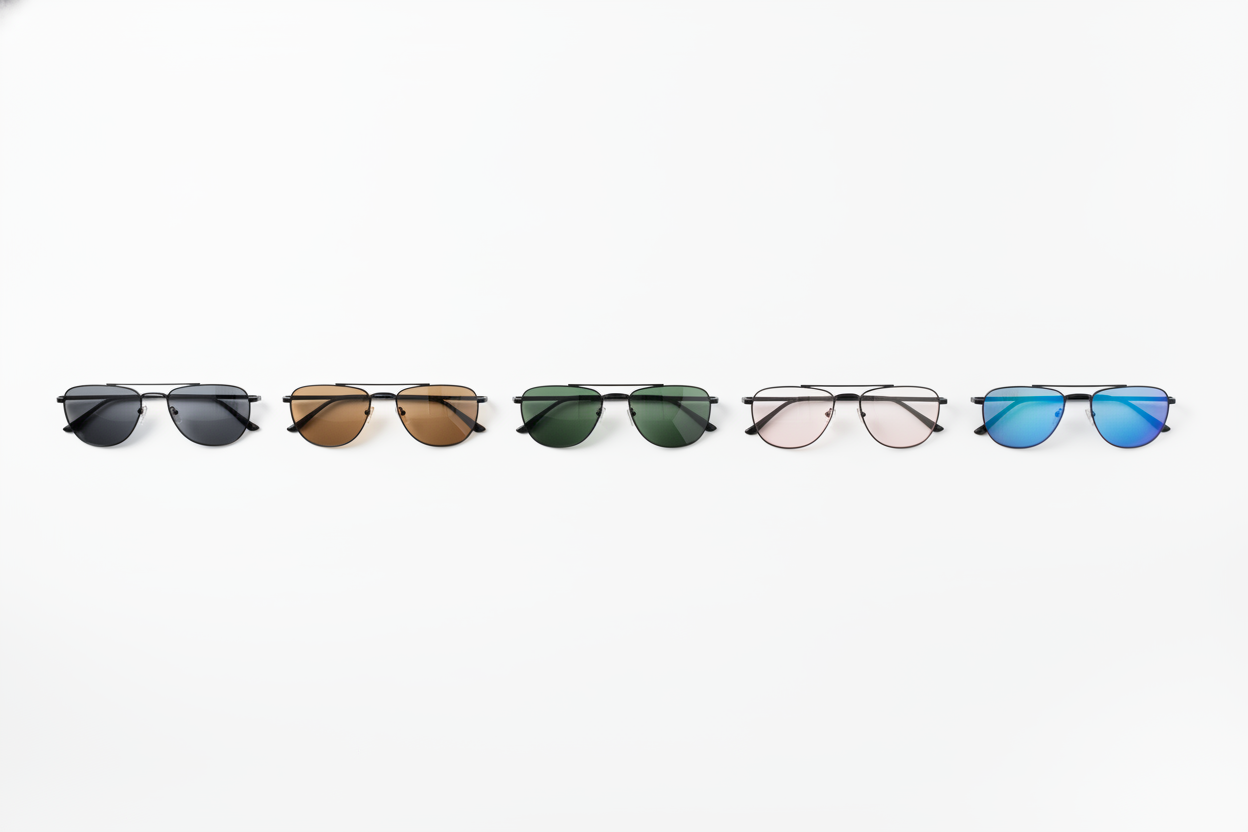
The tint comparison: five identical thin black metal frames in a row on white, differing only in lens tint — neutral grey, amber brown, bottle green, pale rose and blue mirror. This is the single most useful frame on the page, because it shows how little the five have in common. The white ground reads through the brown, green and rose lenses so their colour cast is obvious, the grey is dark enough to turn that same white nearly black, and the mirrored pair shows you a reflection instead of a background — which is the point, since mirroring is a coating on the surface rather than a tint through the lens. Note also that the rose lens barely darkens anything at all. Five lenses, five completely different jobs, and not one of them tells you anything about UV filtering
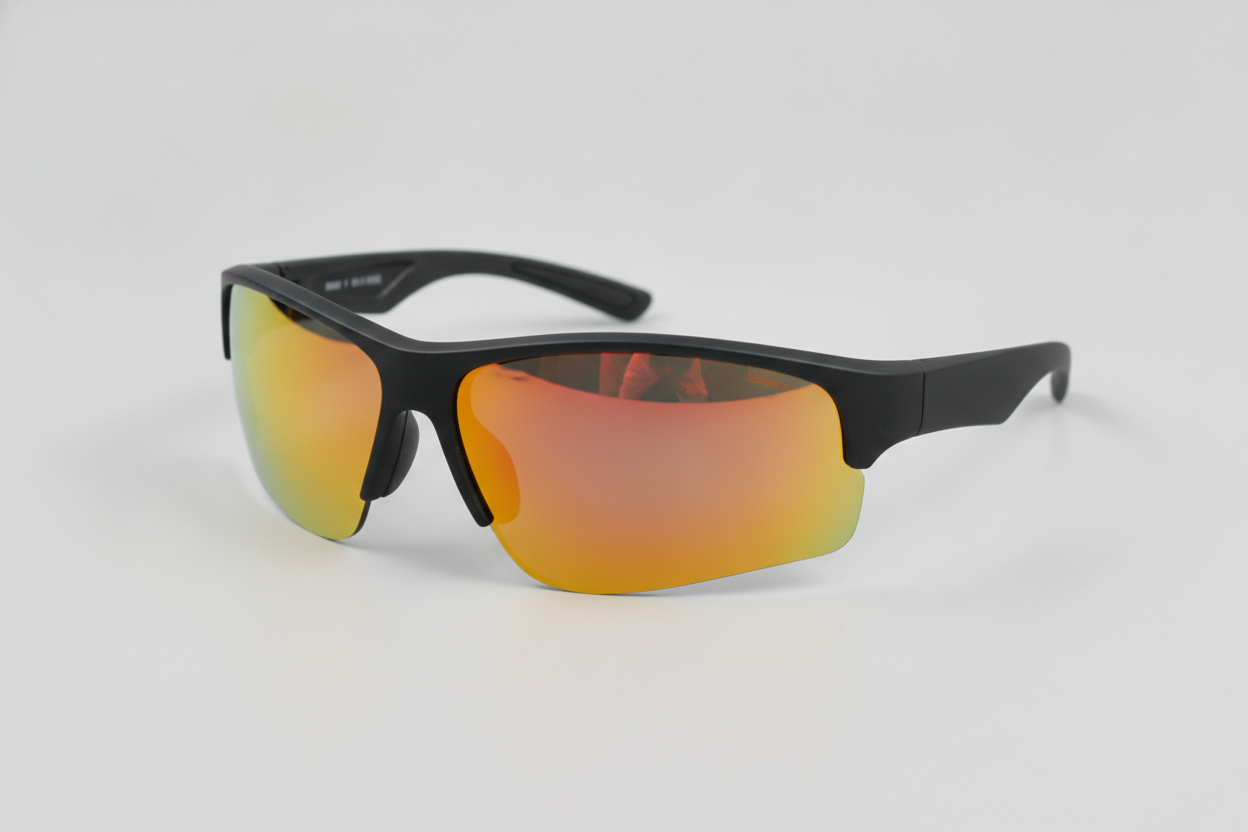
A sport wrap in matte black nylon with a red-orange mirror lens, shot from a front three quarter angle so the wrap and the wide splayed temples are visible. The preset asked for one continuous shield lens across both eyes and what came back is a half-rim frame with two separate lenses, open along the bottom edge — a different product with different tooling, and worth knowing that asking for a shield does not reliably get you one. The invented temple marking is here too, on the same inside-left face as the cat-eye
How the AI Sunglasses Design Generator Works
Pick the frame archetype
Metal aviator, chunky acetate square, cat-eye, round wire, sport wrap or minimal rimless. The archetype decides the silhouette, the mounting system and the material family in one choice — which settles more about the design than any colour ever will.
Name the material, colour and tint
Say acetate or titanium or injected nylon, say the colour and finish, and say the lens tint by name. The model renders a plausible section thickness for whichever material you name, and thickness is most of what separates a luxe frame from a cheap one.
Take the front to a technician
Designs arrive in about twenty seconds at up to 4K. The render settles the front; an eyewear technician turns it into a drawing with the three millimetre measurements, the base curve, the tilt and the hinge, which is what a factory actually builds from.
What a Sunglasses Render Settles, and What It Hides
Six things decide whether an eyewear design is any good, and an image carries about half of them. Knowing which half is the difference between a useful concept and a beautiful picture of something nobody can manufacture or wear.
The front is the design
Lens shape, bridge style, brow line and the thickness of the material around the lens are what people recognise from three metres away, and they are exactly what a render gets right. This is the part worth iterating on here — twenty concepts in an evening, until the silhouette is the one you want to make.
Three numbers decide the fit
Every frame carries a lens width, a bridge width and a temple length in millimetres, printed inside the arm as something like 52-18-145. Add the pantoscopic tilt and the lens height and you have the fit. A render has none of them, which is why a frame that looks perfect on screen can sit on the cheekbones of every face it meets.
Base curve limits the shape
A flat acetate front is around a 4 to 6 base and a face-hugging shield is an 8 base, and you cannot simply bend one into the other. Curvature changes the effective lens width, distorts a shape that looked balanced flat, and rules out thick acetate entirely. Generate a wrap as a wrap from the start.
Tint is a function
Grey is neutral and leaves colours alone, brown and amber lift contrast, green splits the difference, rose is a low-light tint. Mirror and gradient are coatings over a base tint, and polarisation is a separate film that kills reflected glare and has nothing to do with darkness. Name the tint you mean rather than the colour you like.
Dark is not protection
Ultraviolet filtering has no relationship to how dark a lens looks, and a dark lens with poor UV filtering is worse than no sunglasses, because the pupil opens wider behind it. Protection is a specification set by the lens supplier and verified by testing — a filter category and a UV rating in the EU, an impact-resistance requirement in the US — and it is invisible in every render.
The material sets the section
Acetate is milled from a sheet, so it carries colour through the body and allows thick sculptural rims and laminated layers. Metal works as thin wire and brings adjustable nose pads. Injected nylon moulds deep wraps cheaply but limits finish and adjustment. Rimless is a mounting system where the lens itself is structural. Name it, because the model renders the thickness that goes with it.
Why Use This AI Sunglasses Design Generator
Six archetypes, not six colourways
Aviator, chunky acetate square, cat-eye, round wire, sport wrap and minimal rimless differ in silhouette, mounting system and material family — so switching preset changes what the frame is, rather than what colour it happens to be.
Written as product photography
Every preset specifies a plain ground, a named camera angle and soft studio light, so concepts arrive looking like the catalogue shot they will eventually need rather than like an illustration floating in a gradient.
Material named in every prompt
Acetate, wire metal and injected nylon each get rendered with the section thickness that belongs to them. That single detail is what makes a concept read as a real frame instead of a shape with lenses in it.
Tint treated as a spec
Each preset names a lens tint rather than leaving it to chance, so a set of concepts can be compared on shape alone — and so the tint you show is the tint you meant, which matters when the difference is grey against amber.
Consistent across a collection
Nano Banana Pro holds a described style across separate generations, so reusing one material and one tint description while changing only the silhouette gives you six frames that read as a single eyewear collection rather than six unrelated products.
Cheap enough to try a whole range
About twenty seconds per concept and plans from $2.99 means testing an entire capsule collection costs less than a single day of a freelance product designer, which is what makes the trying-things stage affordable at all.
AI Sunglasses Design Generator FAQ
Related Design Tools
AI Jewelry Design Generator
The nearest neighbour in kind: a small worn object where material, finish and section thickness carry the whole design and a render still cannot give you a size.
AI Helmet Design Generator
The other head-worn product whose real specification is a safety certificate rather than a picture. Useful for the same reason and with the same honest limits.
AI Fashion Design Generator
Where the eyewear ends up. Handy for building the looks a frame is meant to sit inside, and for keeping a season of accessories consistent with the clothes.
Design Your Sunglasses Now
Six frame archetypes, materials that render at the right thickness, lens tints named as specifications and 4K product shots in about twenty seconds. Free to start, from $2.99 for more.
Start Designing FreeAbout This AI Sunglasses Design Generator
An AI sunglasses design generator is useful for a specific and unusually well-defined slice of the job. A pair of sunglasses is two designs sharing a hinge: there is the front, which is the lens shape, the bridge, the brow line and the thickness of the material around the lens, and there is the fit, which is three measurements in millimetres, an angle and a curve. The front is what anybody recognises from across a street, it is what makes a frame desirable or forgettable, and it is the part that has always been expensive to visualise — which is why eyewear ideas historically died at the sketch stage rather than at the factory. A render settles it in about twenty seconds. The fit is a different discipline entirely and no image will ever contain it.
That is why the six presets on this page are frame archetypes rather than colourways. A metal aviator, a chunky acetate square, a cat-eye, a round wire frame, a sport wrap and a minimal rimless design differ in silhouette, in mounting system and in material family all at once, which is a genuine design decision; changing a frame from black to tortoiseshell is not. Each preset names its material explicitly, because the model renders the section thickness that belongs to whatever material it is told about, and section thickness is most of what separates a frame that looks expensive from one that looks like a party accessory. Acetate is milled from a sheet and carries colour through its body, so it makes thick sculptural rims and laminated edges possible. Metal works as thin wire and brings adjustable nose pads that let a single shape fit many more faces. Injected nylon moulds a deep wrap cheaply. Rimless is not a material at all but a mounting system in which the lens itself becomes structural.
The lens deserves as much attention as the frame, and it is where this AI sunglasses design generator tries to be more useful than a mood board. Tint is a function rather than a colour: neutral grey darkens everything evenly and leaves colour judgement intact, warm brown and amber raise contrast and depth perception, green sits between them, rose is a low-light tint. Mirroring and gradients are coatings applied over a base tint, and polarisation is a separate film that removes reflected glare from water and road surfaces without changing how dark the lens appears. Most importantly, darkness and ultraviolet protection have nothing to do with one another. A very dark lens that filters little UV is worse than wearing nothing, because the pupil widens behind it. Protection is a specification that comes from a lens supplier and is confirmed by testing — a filter category and UV rating under European personal protective equipment rules, an impact-resistance requirement in the United States — and it is invisible in every image ever rendered.
This sunglasses design generator runs on Nano Banana Pro, the same image model behind the rest of the tools on this site, and the capability that matters most for eyewear is style consistency across separate generations. Describe one material, one finish and one lens tint, reuse that wording, and change only the silhouette — that is how six concepts come back looking like a single capsule collection rather than six unrelated products, which is exactly what a small eyewear brand needs to show a factory, a buyer or a crowdfunding page. Concepts arrive in about twenty seconds at up to 4K, so a whole range can be tested in an evening. It is free to start and paid plans begin at $2.99, which makes the deciding-what-it-looks-like stage cost less than a single hour of the technical drawing that has to follow it.