
AI Leggings Design Generator
Leggings are printed flat and cut apart afterwards, which is why a design that looks right in a square can fall to pieces on a leg. This AI leggings design generator is built around that: six print families that behave differently once they are cut, stretched and sewn — seamless repeat, engineered colour block, ombré, marble, geometric and animal. Describe the print, get photoreal concepts in about twenty seconds.
Start Designing FreeTry the Leggings Design Generator — Free
Pick a print family, then add your own motif, palette and waistband notes. Every preset generates unbranded leggings with a blank waistband, so your own mark goes on afterwards.
AI Leggings Design Generator
Choose a print family, describe the motif, colours and fabric, and get a photoreal legging concept at up to 4K
Leggings Design Concepts Made With This Generator
Six print families rather than six moods, generated with the presets below and unedited — and three of them make the page’s argument better than the copy does. The macro of the side seam was asked for a pattern that does not line up, and it delivered more than that: the triangles come back at a visibly different scale on each side of the stitching, and the waistband is solid on one side of the seam and printed on the other, which is exactly what happens when pattern pieces land on different parts of the printed yardage. The grey colour block pair put its mesh knee panels at slightly different heights on the two legs, a mirrored piece that did not get mirrored. And the folded leopard pair printed its rosettes noticeably smaller on the lower fold than the upper one — the same file, two scales, which is the size-grading problem in one photograph.
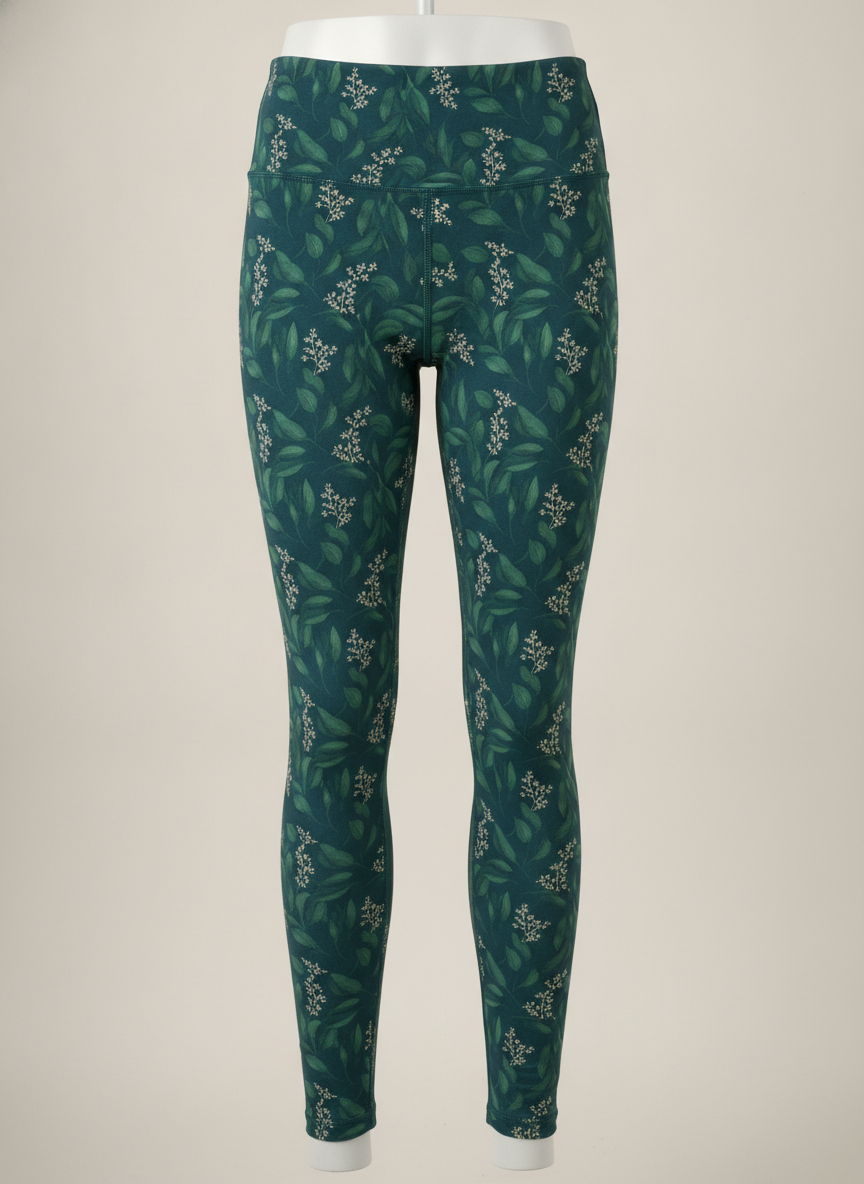
AI leggings design generator result: unbranded high waisted leggings shown front on over a pale studio mannequin, printed all over with a dense repeat of deep green eucalyptus leaves and small cream sprigs on a dark teal ground, the same print carrying across the wide flat waistband
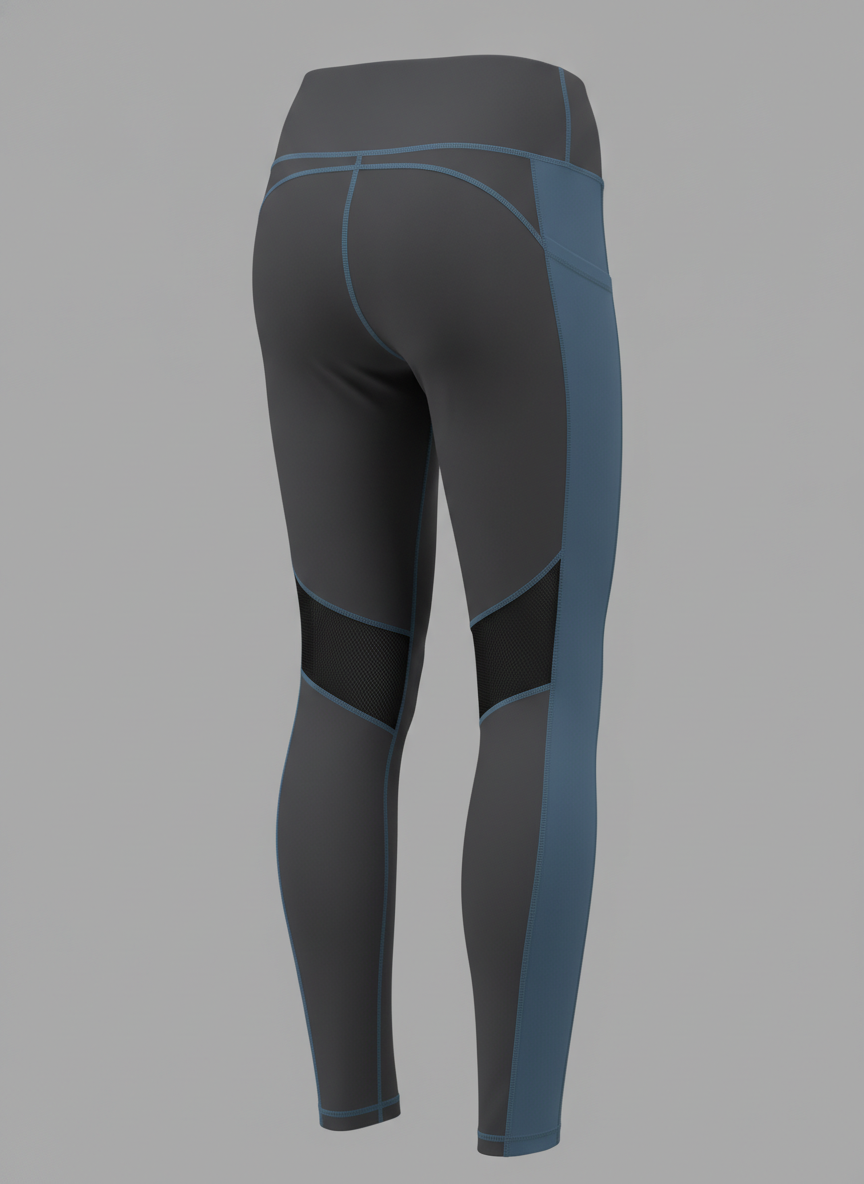
Charcoal grey performance leggings photographed from a three quarter rear angle, a slate blue panel running down the outside of the leg, blue flatlock stitching marking every panel edge, a curved seam across the seat and a black mesh insert behind each knee sitting at slightly different heights on the two legs
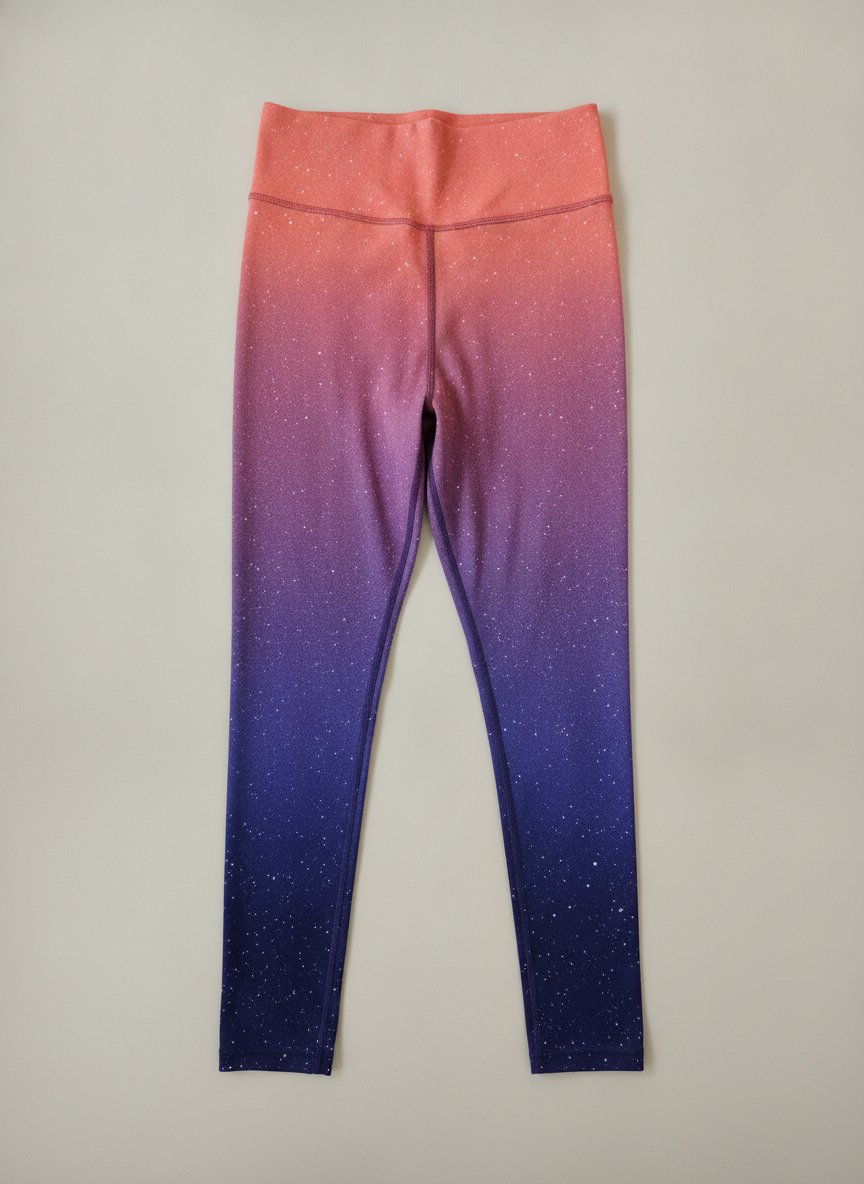
Leggings laid flat and folded once at the hip on a bone coloured surface, printed with an engineered gradient running from warm coral at the waistband through violet to deep indigo at the ankles, scattered with fine white speckles that grow denser towards the hem
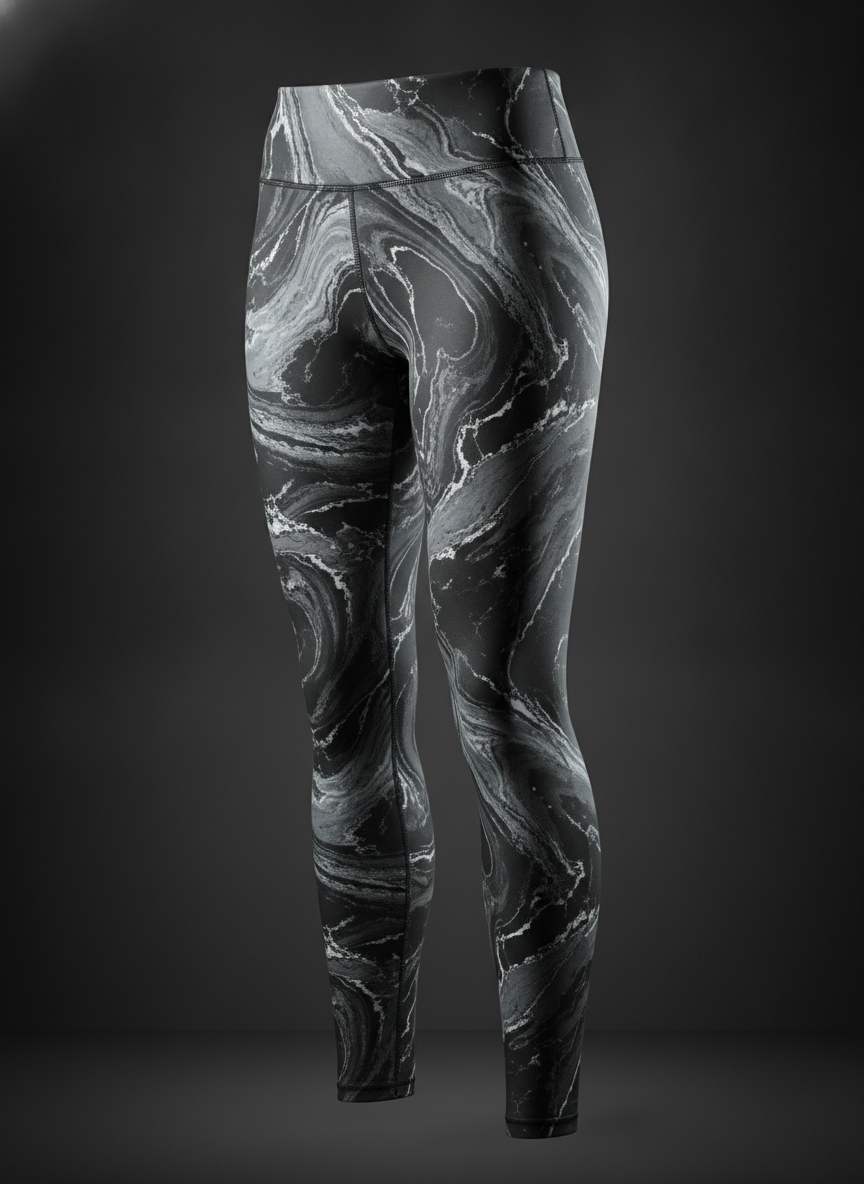
Marble print leggings on an invisible ghost mannequin against a dark graduated background, ink black, storm grey and pearl white veining pouring continuously over the hip and down the thigh with one long satin highlight along the front of the leg
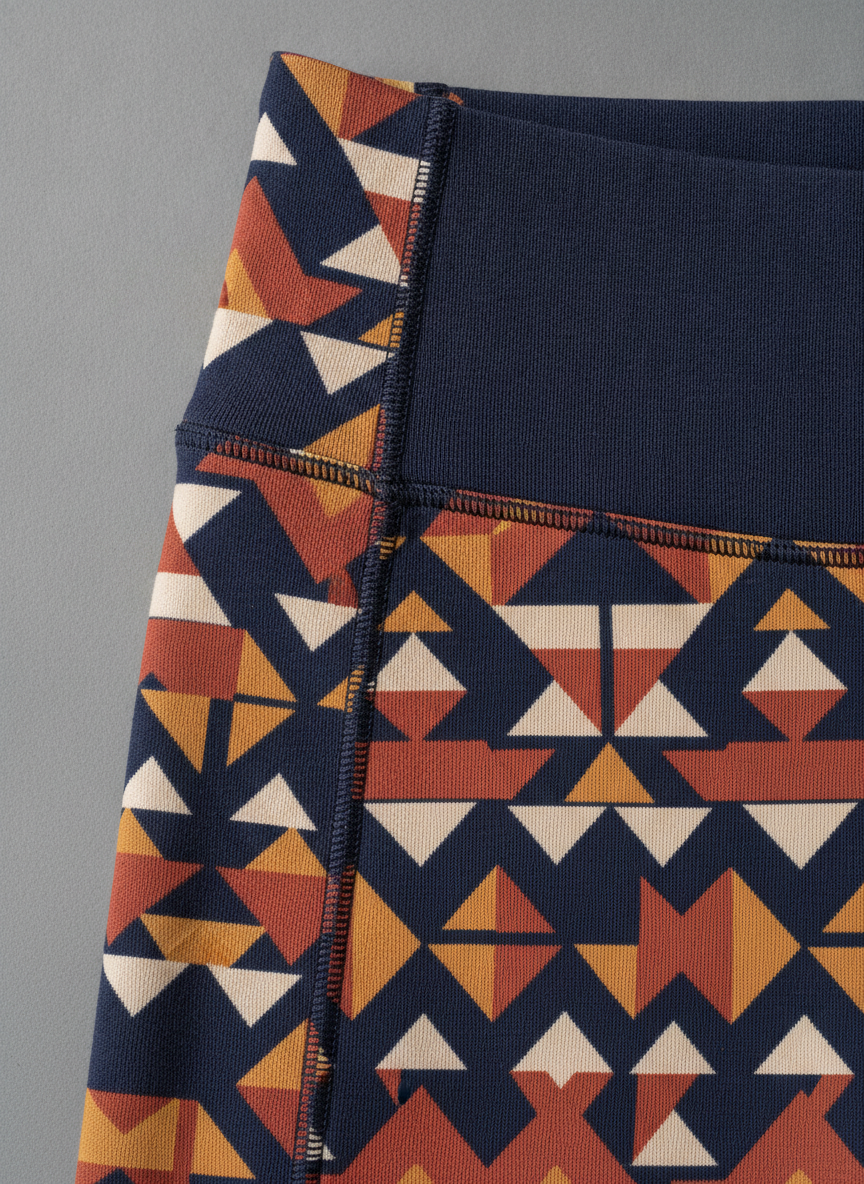
Macro close up of the outside side seam of navy leggings printed with terracotta, mustard and cream triangles, the geometric pattern failing to line up across the flatlock stitching and rendering at a visibly different scale on each side of the seam, with the waistband solid navy on one side of the seam and printed on the other
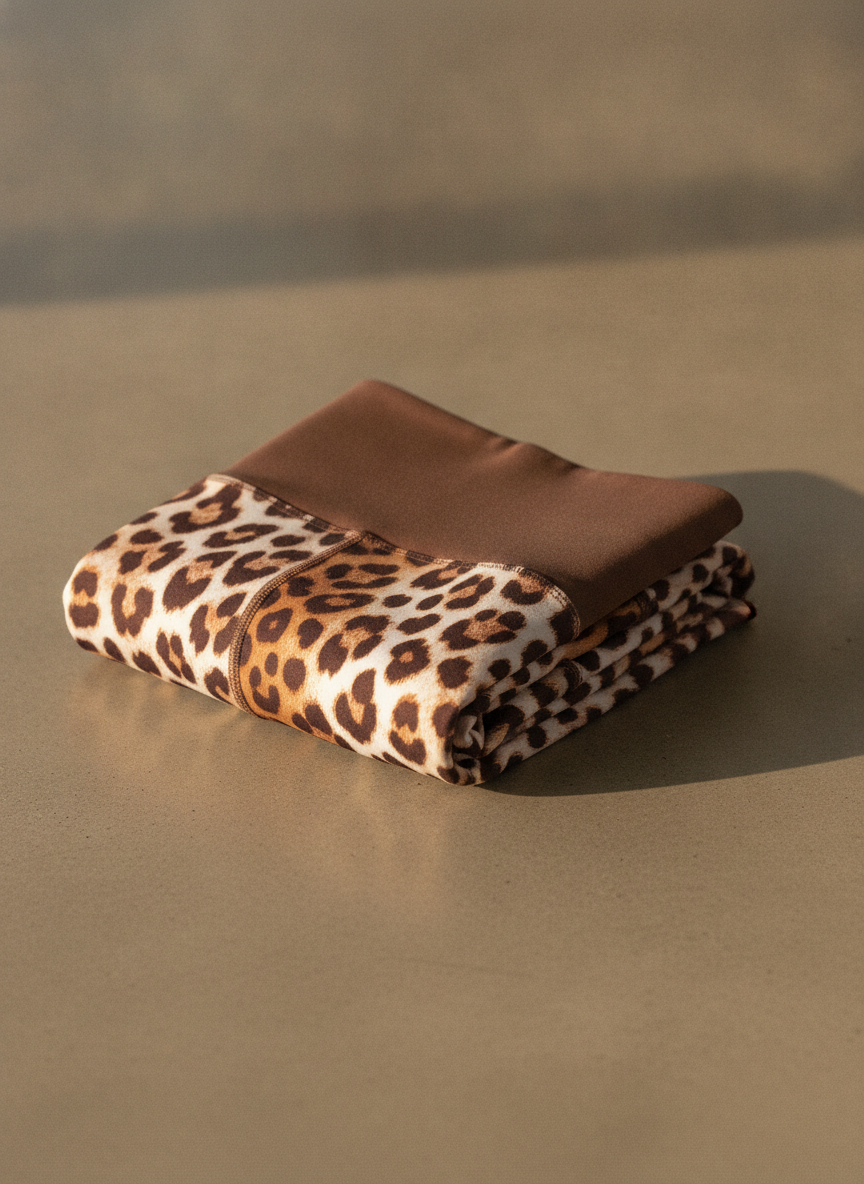
Leopard print leggings folded into a neat rectangle on a warm concrete surface in raking daylight, the cocoa brown waistband turned over to show its plain inner face, the rosettes on the lower fold printing noticeably smaller than those on the top layer
How the AI Leggings Design Generator Works
Pick the print family
Seamless repeat, engineered colour block, ombré, marble, geometric or animal. This decides how forgiving the design is once it is cut into pattern pieces, so it comes first — everything else is decoration on top of it.
Describe motif, palette and fabric
Name the motif and give it a size, name three or four colours rather than a mood, and say what the knit is: matte, brushed, satin sheen, ribbed. Concrete surface words render far better than adjectives like “premium”.
Generate, compare, hand over
Concepts come back in about twenty seconds at up to 4K with the waistband left blank. Download the ones that work, then rebuild the winner as a flat print file at your supplier’s template size.
What Actually Decides a Leggings Design
Six constraints separate a leggings design from a nice square of artwork. They are why this generator is organised by print family rather than by style — and why a design that looks perfect on screen can still come back from the factory looking like someone else’s.
The print is cut apart after it is printed
All-over print is not applied to a finished garment. The artwork goes onto flat fabric first, then the leg, waistband and gusset pieces are cut out of it and sewn together. Whatever you drew gets sliced into leg-shaped chunks by a cutting table that is not looking at your composition, which is why a small dense repeat survives and a single beautiful centred motif usually does not.
Stretch is part of the design
Performance knit is worn under tension, so the print on a body is larger than the print on the fabric — and unevenly so, most across the seat and thigh and least down the calf. Circles become ovals and hairlines disappear. Draw a little smaller and denser than looks right, keep fine strokes out of the widest areas, and set scale numerically rather than by eye on a render.
Seams break a pattern, texture hides one
Every side seam, inseam and gusset edge is a place where two independently cut pieces meet, and a strong directional pattern will not line up across them without engineering the artwork per piece. Organic textures — marble, tie dye, watercolour, terrazzo — have no repeat to break, which is precisely why they dominate print on demand storefronts.
One print file, many sizes
Most suppliers print a single artwork file and cut every size out of it, so the motif is not scaled to the garment: a repeat that reads as medium on an XS reads as small on a 3XL, and an engineered placement design shifts position entirely. If placement matters, ask whether your supplier grades the file per size — many do not — and design something that survives both ends of the range.
You cannot print white
Dye sublimation, the standard process for all-over print leggings, bonds gaseous dye to white polyester. There is no white ink, so every pale element in your design is simply fabric left unprinted, and every dark element is ink laid down. A rich black is heavy coverage: more expensive, prone to banding on cheaper machines, and unforgiving of handling marks. Dark colourways have to work through texture and silhouette instead.
The waistband is its own decision
A high waistband is a separate, usually doubled panel that carries the compression, and it can be cut from the same print, from a solid, or from a contrast fabric entirely. It is also the one part of a legging that customers judge instantly and the place every brand puts its mark — which is why every preset here leaves it a clean unmarked surface for your artwork to go on afterwards.
Why Use This AI Leggings Design Generator
Six print families, not six filters
The presets differ in how the artwork behaves once it is cut — repeat, engineered, organic, panelled — so switching preset changes what is actually makeable, not just the colour scheme.
Unbranded by default
Every prompt bans waistband logos, printed elastic, hem labels and care tags, so concepts arrive clean instead of wearing somebody else’s trade dress.
Knit texture that reads
Matte performance knit, satin sheen, brushed hand, mesh and flatlock stitching all render distinctly, so a fabric decision is visible in the concept rather than described in a caption.
Front, rear and flat lay
One preset shoots from behind for the seat seam and gusset, one lays the pair flat, one crops to the side seam — the views a supplier asks for and most concept decks are missing.
4K downloads for line sheets
Concepts export large enough for a client deck, a wholesale line sheet or a store listing without upscaling artefacts creeping into the knit texture.
Iterate at conversation speed
Twenty seconds per variation means a colourway argument gets settled in the meeting, rather than a week of sampling for options nobody picks.
AI Leggings Design Generator FAQ
Related Design Tools
AI Pattern Generator
The other half of the job: that page designs the seamless tile itself as flat artwork. This one shows you what the tile looks like once it has been cut into a garment.
AI Hoodie Design Generator
The opposite construction — a printed graphic placed on a stock blank, rather than fabric printed first and cut afterwards.
AI Sock Design Generator
Same drawer, different process. Socks are knitted in colour rather than printed, so the design is limited by needles and yarn counts instead of ink.
Design Your Leggings Now
Six print families, real knit texture, blank waistbands and 4K downloads. Free to start, from $2.99 for more.
Start Designing FreeAbout This AI Leggings Design Generator
An AI leggings design generator answers a narrower question than a general image tool, because leggings are made in an unusual order. The artwork is printed onto flat fabric before anything is cut, and the leg, waistband and gusset pieces are then cut out of that printed yardage and sewn together. A leggings design is therefore not a picture you place on a garment — it is a decision about how a piece of artwork behaves when a cutting table takes it apart. That is what the six print families on this page are organised around, and why switching preset changes the construction rather than just the palette.
The most common misuse of a leggings design generator is treating the render as a print file. It is not one, and it cannot be converted into one. Print on demand suppliers and cut and sew factories want flat rectangular artwork at a fixed pixel size and DPI, built to their template; a render is a photograph of that artwork already curved around a leg, foreshortened by the camera and interrupted by seams. Use the concept for the decisions images are genuinely good at — motif, repeat scale, palette, where colour sits, which waistband treatment wins — and then rebuild the winner as flat artwork, or hand the render to a surface designer as a brief. A strong concept plus a correctly built print file is what turns into a sample.
Every preset here generates unbranded leggings. Waistband logos, printed elastic, hem labels, care tags and size tags are banned in the prompt for two reasons: image models are unreliable with small lettering and will misspell a mark, and branding on a real garment is a separate operation with its own tooling and minimums anyway. Leaving the waistband a clean unmarked surface keeps the concept honest and keeps it clear of anyone else’s trade dress — which matters, because distinctive waistband treatments, panel silhouettes and surface prints can all be protected even when no logo is copied. Place your own artwork over the render afterwards in any design tool.
This leggings design generator runs on Nano Banana Pro, the same image model behind the rest of the tools on this site, and it renders textile detail well enough that matte performance knit, satin sheen, brushed hand, mesh and flatlock stitching all read at a glance. Concepts arrive in roughly twenty seconds at up to 4K, large enough for a client deck, a wholesale line sheet or a crowdfunding page. It is free to start and paid plans begin at $2.99, so a full run of colourway options costs less than the first sample you would otherwise have ordered to find out which one was wrong.