
AI Curtain Design Generator
A curtain is the only thing you will design that is lit from behind for half of its life, and never once seen flat. By day it is a filter and your colour washes out; by night it is an opaque wall and the colour comes back. This AI curtain design generator settles the look in about twenty seconds, and is straight with you about the three things no image of fabric can hold: the measurements, the drape, and which of those two lives you are actually looking at.
Start Designing FreeTry the AI Curtain Design Generator — Free
Choose the build first, because tailored pinch pleat linen, a heavy blackout panel, a bold print and a backlit sheer are different products rather than different colourways — they differ in weight, in cost, in how much cloth they eat and in what the light does to them. Four presets show the curtain hanging, one gets close to the heading, and the sixth lays the cloth out flat so the repeat is the subject. Every preset keeps text, logos and people out, which is what ruins fabric imagery.
AI Curtain Design Generator
Pick a curtain type, describe the fabric, colour and heading, and get curtain and drapery shots at up to 4K
Curtains Designed With This AI Curtain Design Generator
These came out of the presets above, flaws included, and the captions say what each one gets right and what it quietly invents. Read them as a set and a pattern appears. The cloth is excellent every time — weave, weight, colour and fold structure are all convincing. The construction is where it drifts: a pinch pleat that arrived as a back tab, a rod that passes in front of its own curtain. And the two most instructive pictures are the two where the model disobeyed the brief and produced the exact failures real curtains have.
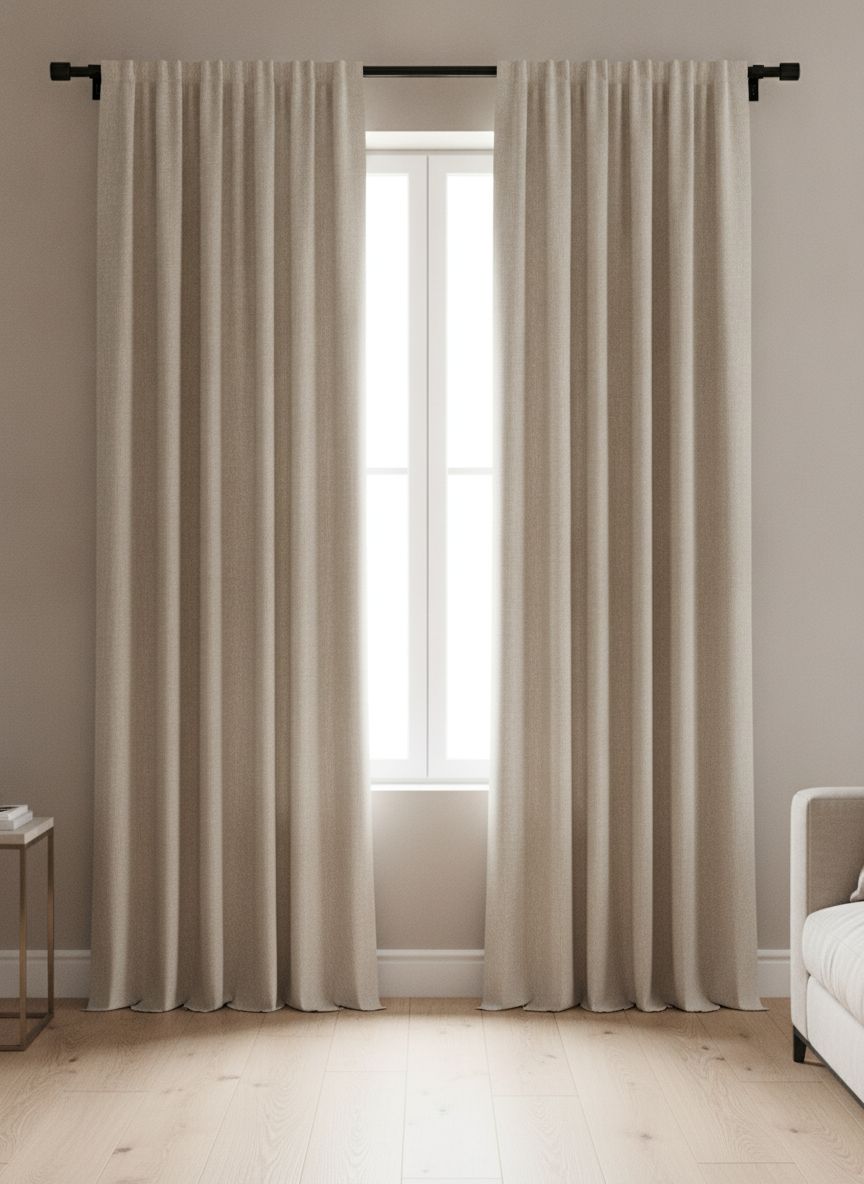
AI curtain design generator result: a pair of floor length oatmeal linen curtains hanging either side of a tall window in a calm living room. It is also a good illustration of the detail these renders almost always drop. The brief asked for a triple pinch pleat, and what arrived is a hidden back tab heading, with the rod passing behind the fabric, no pleat heads at all, and the folds emerging as soft even waves out of nothing. The linen itself is convincing: slubby weave, deep regular folds, a very slight break where it meets the floor. Notice too that both panels are stacked across the glass rather than clear of it, which is what a rod that stops at the window frame gives you, and what it costs is daylight, every morning.
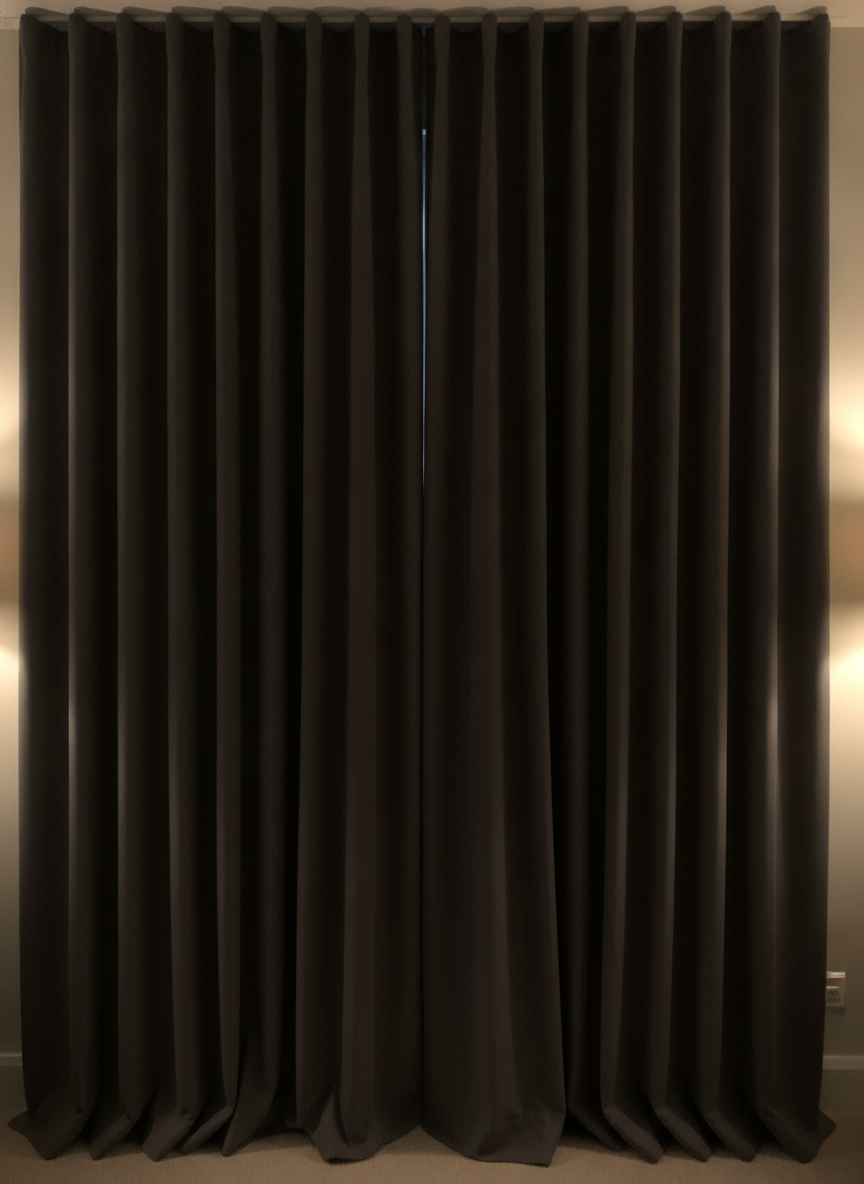
Heavy charcoal blackout curtains closed across a bedroom window at night, lit only from inside the room, and the most useful failure on this page. Everything requested is present: deep saturated colour that reads true under lamplight, generous fullness, closely spaced folds, a soft sheen where the light rakes across the cloth. Everything except the one thing the prompt asked for by name. A bright vertical line of daylight is leaking straight down the centre where the two panels meet. That is an accidentally accurate mistake, because centre leak, side leak and top leak are exactly how real blackout curtains fail, and they are fixed by overlap, returns and a wraparound track rather than by fabric.
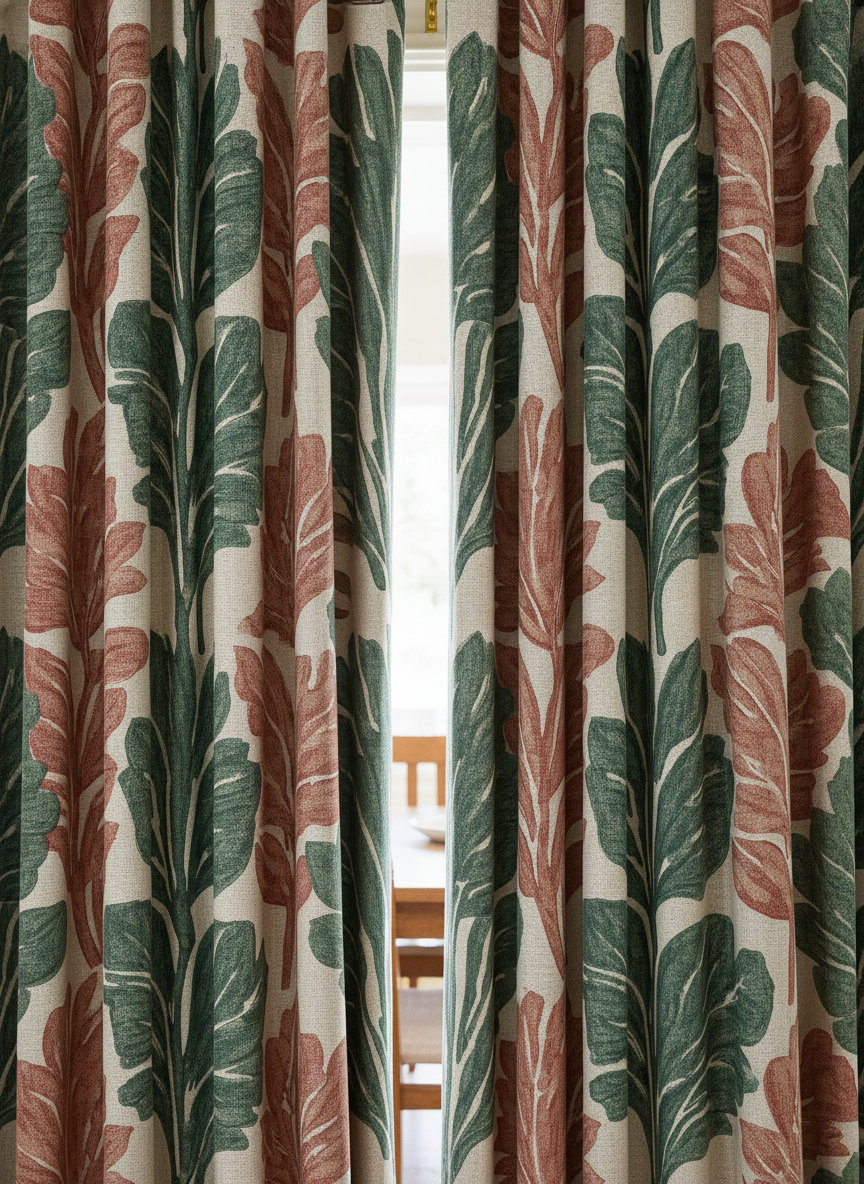
A large scale botanical print in forest green and clay red on a cream ground, shot close so the fabric rather than the room is the subject. This is where an AI curtain design generator quietly flatters you. The leaves stay whole and legible as they cross each fold, shaded but never really cut. On a real gathered curtain at two and a half times fullness, roughly half of that repeat is folded away inside the pleats at any given moment, so the design approved flat is not the design anybody in the room actually sees. The sunlit slice of window in the middle is worth noticing as well, because in the real room that gap is what the eye goes to, not the pattern.

Sheer white voile drawn across a window with strong afternoon sun behind it, which is the entire argument of this page in a single frame. This is what any curtain looks like at two in the afternoon: the colour has washed out to near white, the folds have flattened into faint vertical bands, the weave has become the only visible texture, and a tree outside is readable straight through the cloth as a soft grey silhouette. Nothing that was designed survives. Twelve hours later, with the room lamps on and the darkness outside, the same panel is opaque, saturated and full of shadow. A curtain is not one object, it is two.
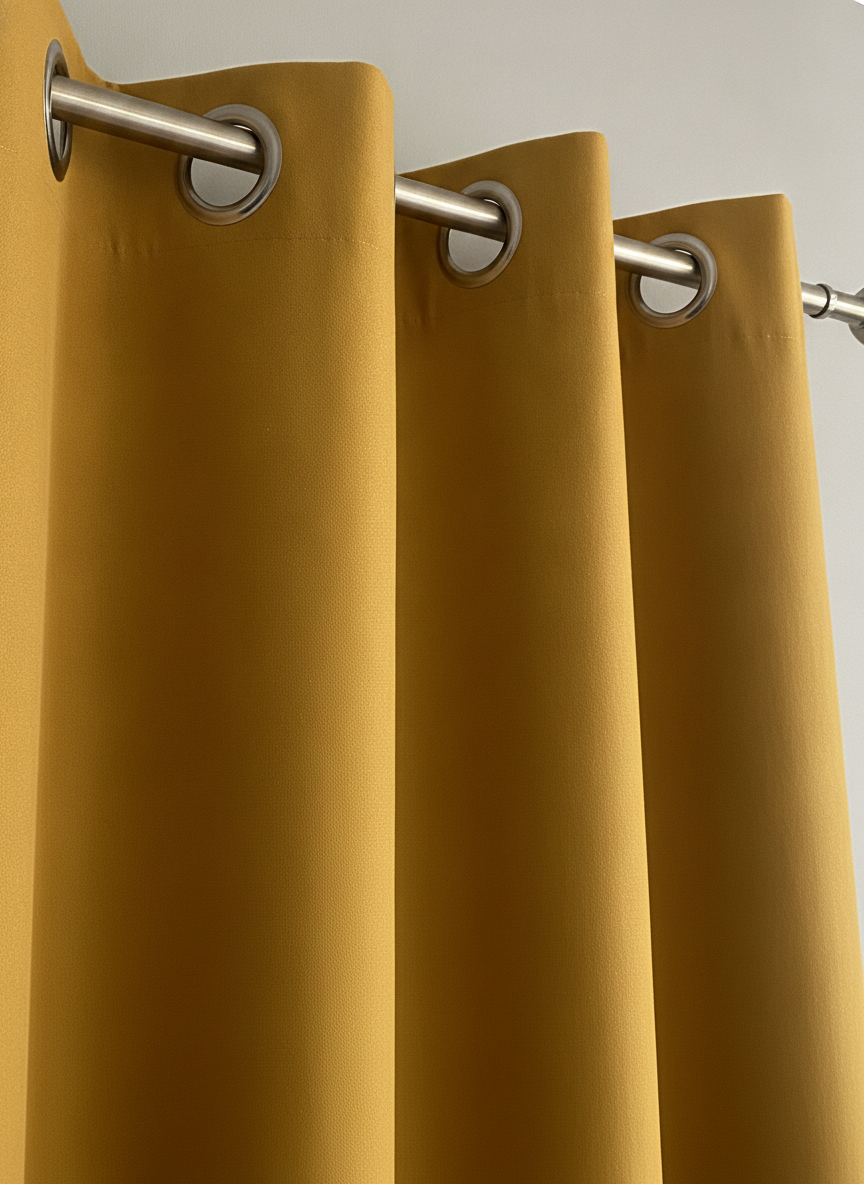
The heading detail: mustard cotton on large brushed steel eyelets, and the most straightforwardly correct image in the set. The eyelets are punched through a reinforced band, the stitch line across that band is visible, the rod passes through the rings, and the panel falls into the deep alternating waves that an eyelet heading forces on it whether you want them or not. The fabric reads as a plausible mid weight cotton rather than a thin one. One thing is wrong if you follow the rod to the right, where it appears to pass in front of the panel and then simply stop, which is the sort of small structural nonsense worth catching before a picture goes to a maker.
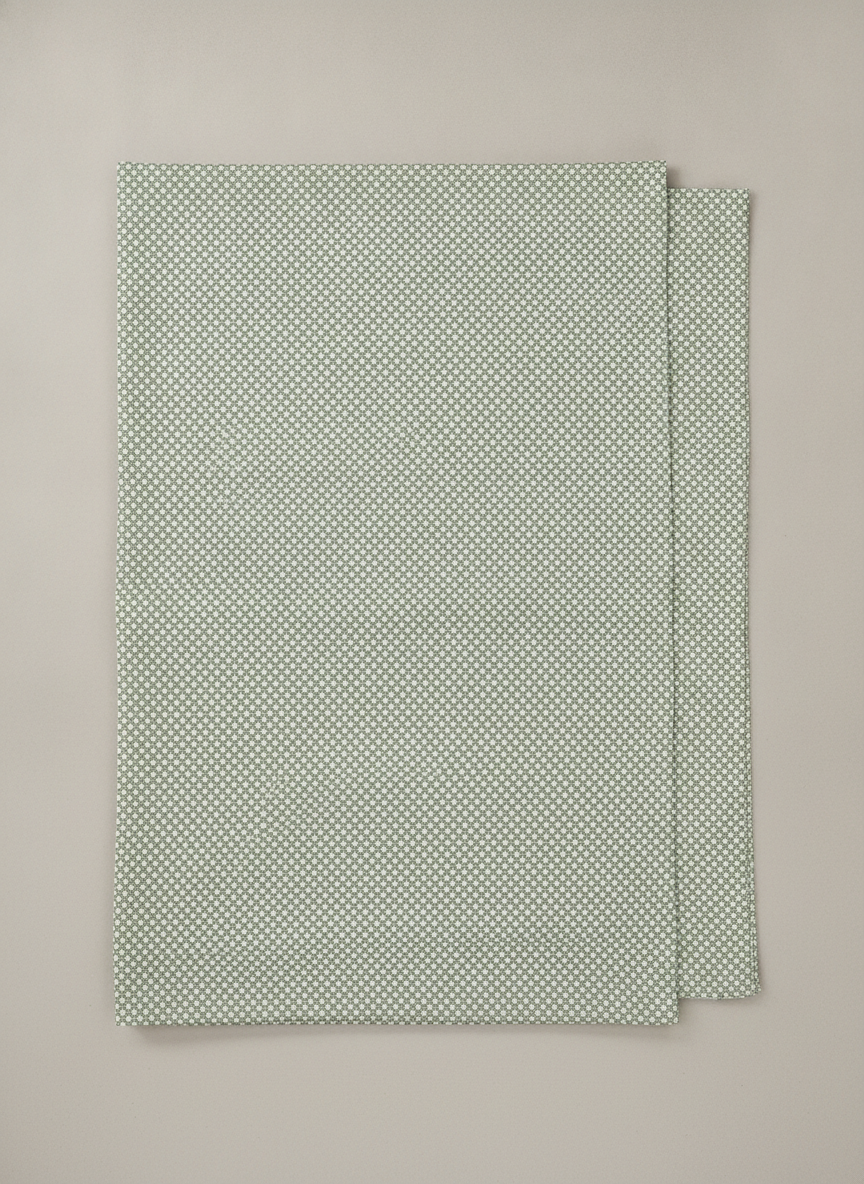
The fabrication view, and the most practically useful picture here: one piece of curtain fabric laid flat and face up on a neutral surface, folded back at one edge so the reverse of the weave shows. A curtain maker can work from this. The full repeat is visible, the density of the small sage and cream geometric is readable, and the design is shown as the design rather than as a lit, gathered, backlit interpretation of it. It is also missing the one thing a swatch must carry. There is no scale reference anywhere in the frame, so a five centimetre repeat and a fifty centimetre repeat produce an identical photograph, and only one of them still reads as a pattern on a three metre drop.
How the AI Curtain Design Generator Works
Pick the build, not the colour
Tailored pinch pleat, heavy blackout, bold print, backlit sheer, eyelet heading, or the flat swatch itself. That one choice decides more than anything else on this page, because it sets the weight of the cloth, how much of it you need, what the light will do to it and whether there is a pattern to design at all.
Name the fabric, the weight and the light
Say what the cloth is and how heavy it is, because the same print on voile, on linen and on velvet is three different products. Then say which light you want to see it in. Backlit daylight and front lit lamplight produce two completely different pictures of one curtain, and only naming it gets you the one you meant.
Add the numbers no picture holds
Concepts arrive in about twenty seconds at up to 4K. The render settles the look; you write down the four things it never contains — track width, finished drop, heading type with its fullness ratio, and lining — and a curtain maker turns the pair into something that actually fits your window.
What a Curtain Render Settles, and What It Gets Wrong
Six things decide whether a curtain design becomes something worth hanging, and an image carries about two of them. The strange part is that one of the six changes every few hours, which is not true of any other product you can design.
It is lit from behind for half its life
By day the sun is behind the cloth and the curtain is a filter: colour desaturates towards white, dark dyes flatten, fold shadows vanish and the weave becomes the loudest texture. At night, lit from inside the room, the same panel is opaque and the colour returns. Every product photograph of a curtain shows one state. Ask for both before you commit to a colour.
It is never seen flat
You design a flat repeat and you hang a gathered one. At two and a half times fullness, more than half of the printed width is folded away inside the pleats at any moment, so scale is the decision that matters most and the one renders soften. Small repeats survive gathering; large motifs get sliced into fragments and read as noise from across the room.
The heading is the design and the cost
Pinch pleat, pencil pleat, eyelet, wave and rod pocket look different, hang differently and consume different amounts of cloth. Eyelets force regular deep waves whether or not you want them; pinch pleats stack tightly and read tailored. Models are unreliable here — the first image on this page asked for pinch pleat and quietly delivered a back tab.
Drape belongs to the cloth, not the picture
How fabric falls is weight, weave and finish, and it is the single thing you cannot judge from a screen. Linen creases and hangs crisp with soft breaks. Velvet is heavy, holds deep columns and eats light. Voile floats and moves in any draught. The same design on those three is three products, and only a hand sample settles it.
Sunlight is a slow destroyer
A south facing window fades dye over months and degrades fibre over years, silk worst of all, then untreated cotton and linen, with solution dyed acrylics and polyesters holding longest. A lining protects the face fabric and doubles as insulation. No render ages, so nothing on this page can warn you that a deep saturated colour is the one that shows fading first.
The deliverable is a swatch and four numbers
A curtain maker quotes from the cloth plus track width, finished drop, heading type with fullness ratio, and lining, with a pattern repeat added if there is one. A styled interior photograph contains none of them. The flat swatch preset gets you closest and still lacks scale, which is why the numbers travel alongside the image in writing.
Measuring and Hanging Curtains, in Numbers
The design is the enjoyable part and the measuring is the part that decides whether it looks deliberate or homemade. These are the working rules a curtain maker applies without thinking about them.
Fullness and fabric quantity
Measure the track or pole, never the window. Multiply by about two to two and a half for pinch pleat, two and a half to three for pencil pleat, and roughly two for eyelet and wave. Most curtain fabric is milled around one hundred and forty centimetres wide, so a wide window means joining several widths per panel, and a patterned cloth needs a full extra repeat added to every drop so the panels can be matched.
Where the pole goes
Fifteen to twenty-five centimetres past the frame on each side, so the open panels stack on the wall instead of across the glass, and ten to fifteen centimetres above the frame, or higher still towards the ceiling if you want the window to read taller. A pole cut exactly to the window is the single most common error, and it costs daylight every day for the life of the curtain.
Drop, and what the hem does
Floating clears the floor by about a centimetre and stays crisp. Breaking adds two or three so the hem just touches. Puddling adds ten to twenty for heavy formal cloth. Sill length finishing just above the sill is correct over a radiator or a worktop. The length that always looks wrong is the accidental one that stops somewhere between the sill and the floor.
Making blackout actually black
Blackout lining stops light through the cloth and nothing else. The leaks are structural: a centre overlap of at least five to ten centimetres where the panels meet, returns that carry each panel back to the wall at the sides, a track wider than the reveal, and a pelmet or ceiling recess to close the gap at the top. Fix the gaps, not the fabric.
Why Use This AI Curtain Design Generator
Six builds, not six colourways
Pinch pleat linen, a heavy blackout panel, a large scale print, a backlit sheer, an eyelet heading and a flat swatch differ in weight, cost, fabric quantity and craft. Switching preset changes what the object is, not what shade it happens to be.
Both lighting states available
One preset puts the sun behind the cloth and lets the colour wash out; another lights the room from inside at night so the colour reads true. Seeing a design in both is the only honest way to approve a curtain, and it is the comparison every catalogue skips.
The fabrication view built in
One preset lays the cloth flat and shoots it from overhead with the repeat, the weave and the selvedge visible and no gathering at all — much closer to what a curtain maker or a print run needs than a styled room shot, and a standing reminder that the other five are folded interpretations.
Pattern scale treated as a decision
The print preset asks for the repeat to be broken up by the folds on purpose, because that is what gathering does to a design. Judging scale against the fold rather than flat on a screen is what stops a bold motif turning into visual noise across a three metre window.
Consistent across a whole range
Nano Banana Pro holds a described palette and cloth across separate generations, so keeping one fabric and changing only the heading gives you a pinch pleat, an eyelet and a wave that read as one collection rather than three unrelated windows.
Cheap enough to test the whole room
About twenty seconds per concept and plans from $2.99 means you can try six fabrics against the same wall colour, or find which print still reads at thumbnail size in a listing, before anyone cuts a single metre of cloth.
AI Curtain Design Generator FAQ
Related Fabric and Interior Design Tools
AI Shower Curtain Design Generator
The same word and a completely different product. A shower curtain is one flat panel at a fixed size, hung on rings, seen straight on and never backlit, so the design survives intact — which is exactly what a window curtain refuses to do.
AI Pattern Generator
Where to go when the repeat itself is the job rather than the window. Seamless tiles that can be printed on any width of cloth, judged flat, before you decide how much of them a set of pleats is going to swallow.
AI Interior Design Generator
For when the question is the room rather than the window treatment — wall colour, furniture and layout together, including the light the curtains will have to live in, which is the thing this page keeps telling you to decide first.
Design Your Curtains Now
Six curtain builds, fabrics that render with the right weight and weave, both lighting states, a flat swatch view that shows what a curtain maker actually quotes from, and 4K images in about twenty seconds. Free to start, from $2.99 for more.
Start Designing FreeAbout This AI Curtain Design Generator
An AI curtain design generator is best understood as a tool that does one part of the job extremely well and no part of the rest, and on this particular product the division is unusually clean. A curtain is four decisions. The first is the cloth — colour, pattern, scale, weave and weight — which is the only genuinely visual decision and the one everybody argues about longest. The second is the heading, which looks like a style choice and is really a cost and a construction choice, because pinch pleat, pencil pleat, eyelet and wave consume different amounts of fabric and hang in different shapes. The third is the measurement set: track width, finished drop, fullness ratio, pattern repeat, lining. And the fourth is the installation, which is carpentry rather than textiles and decides whether a blackout curtain is actually dark. This tool settles the first decision in about twenty seconds at up to 4K from a plain description, gets you a useful look at the second, and cannot touch the other two. This page tries to tell you exactly what to write down beside the image.
What makes a curtain unlike every other product in this series is that it is lit from behind for half of its life. A poster, a mug, a cushion and a rug are opaque and front lit, so the design you approve is the design that exists. Cloth at a window is a filter for as long as the sun is up. Daylight coming through it desaturates the colour towards white, flattens dark dyes, erases the shadows that define the folds and promotes the weave to the loudest texture in the room. Then night falls, the lamps come on, the light arrives from your side instead, and the same panel becomes an opaque wall with true colour and deep shadow. The two states barely look related. The backlit sheer image on this page and the blackout image two frames away are, for design purposes, the same cloth in its two lives, and a design approved in only one of them is half approved. Generate both before you sign anything off, particularly for a deep or highly saturated colour, where the daytime version is much paler than anyone expects.
The second thing worth carrying away is that a curtain is never seen flat. You design a flat repeat and you hang a gathered one, and the gather is not a small distortion. At two and a half times fullness more than half of the printed width is folded away inside the pleats at any given moment, and what a person standing in the room sees is a set of vertical slices of your pattern, curved over each fold, with the rest hidden. That is why scale is the decision that matters most and the one that renders quietly flatter, since a model will happily draw a print onto the surface of the cloth as if it were painted there. Small tight repeats survive gathering and read as texture. Large motifs get cut into fragments, and unless the design is deliberately built to be read in strips, the result is expensive noise. Judge the print on the folded preset rather than the flat one, and judge it from the far side of the room.
Finally, the practical notes, because curtains are one of the few decorative purchases where the measuring costs more than the taste. Measure the track or pole rather than the window, and multiply for fullness. Extend the pole well past the frame on both sides and mount it high, so the panels stack on the wall instead of over the glass. Add a full pattern repeat to every drop of a patterned fabric or the panels will not match. Choose the lining as a specification rather than an afterthought, since it carries the insulation, the light control and most of the protection against fading on a sunny window. And accept that blackout is an installation problem, not a fabric one: the light comes in at the sides, over the top and down the centre join, exactly as the second image on this page accidentally shows. Then send your maker the flat swatch, the finished drop, the track width, the heading and the fullness ratio, and treat the styled image as the agreed look. It runs on Nano Banana Pro, it holds a fabric and palette steady across a whole range so several windows read as one scheme, it is free to start with paid plans from $2.99, and it turns the slowest part of a window decision into six pictures you can react to before anyone cuts a metre of cloth.