AI Cake Topper Generator
A cake topper is the one thing you will ever design where the letters have to hold each other up. It is cut as a single piece, so every letter must physically touch the letter beside it or the word arrives as loose confetti. This AI cake topper generator settles the part a picture can settle — style, material, silhouette and finish — and is straight with you about the cut path, the stroke widths and the name it cannot be trusted to spell.
Start Designing FreeTry the AI Cake Topper Generator — Free
Pick the build first, because a connected script, a plywood botanical and a glitter card number are different objects rather than different colours. Four presets render the finished topper in a cake, one lines up five materials so you can see what each finish actually does, and the last renders the shape flat and alone, which is far closer to what a laser receives. Every preset refuses names, dates, bakery names and licensed characters by name, because a topper is a surface personalisation turns up on uninvited.
AI Cake Topper Generator
Pick a topper build, describe the material, finish and shape, and get cake topper product shots at up to 4K
Toppers Made With This AI Cake Topper Generator
These came out of the presets above, flaws included, and the captions say what each one gets right and what it quietly changed. Read them as a set and a clear pattern appears. Construction and material are excellent, every piece of lettering here is spelled correctly, and the five way comparison even counted itself properly, which is rare. What drifts is everything named as an adjective — matte came back glossy, mirror came back satin, sans-serif came back slab serif — and the spikes, which were asked for as a pair on five frames and arrived as a pair on two of them. Count the spikes in your own renders.
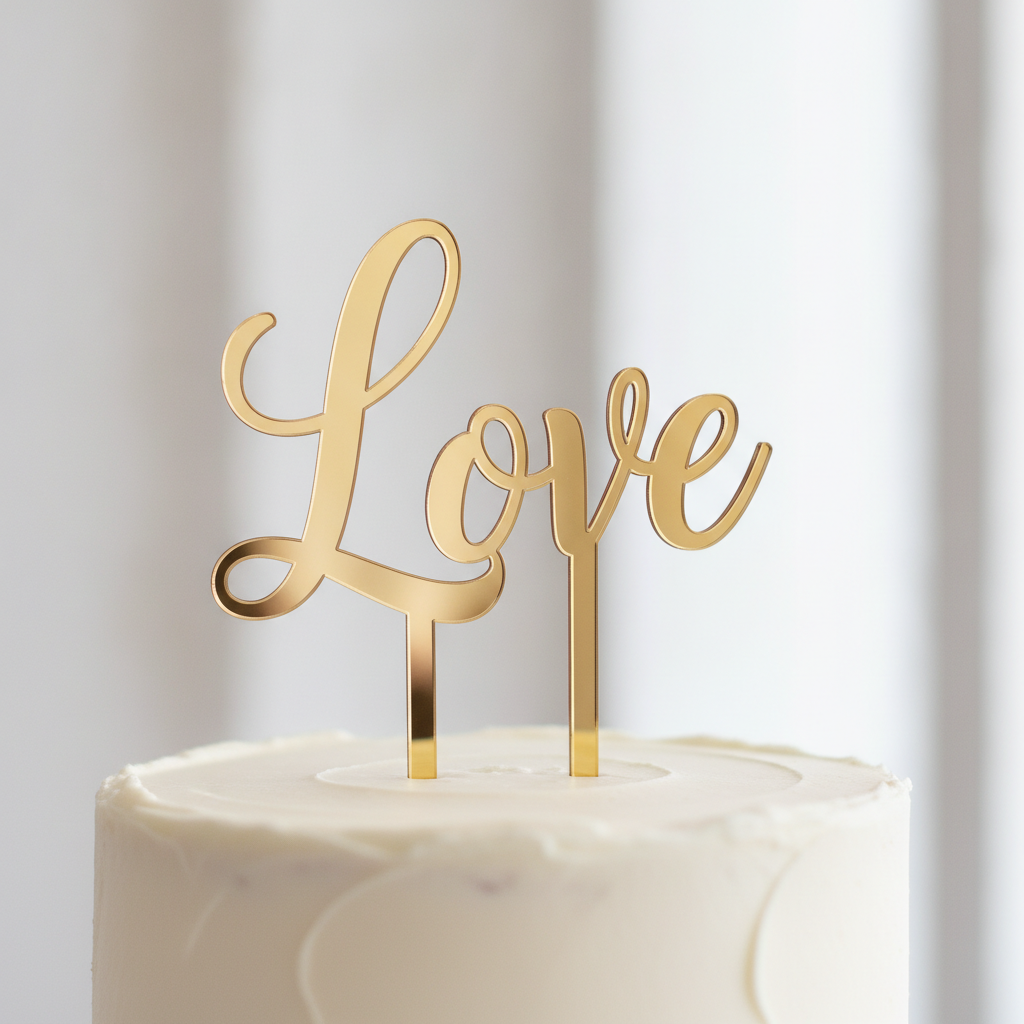
AI cake topper generator result: a mirror gold acrylic topper reading Love in a flowing connected script, standing in the top of a small white buttercream cake. This is the frame that shows the rule the whole category is built on. The o, the v and the e run into one another as a single unbroken ribbon, and the L reaches across with its bottom flourish to meet them, so the finished word lifts out of the sheet in one movement. Look hard at exactly where that flourish meets the rest of the word, because that hairline is the thinnest point in the piece and everything to the right of it hangs off it. Two other things are worth noticing: the spikes came back in mirror gold rather than the clear acrylic that was asked for, and the final e sits out past the right hand spike with nothing underneath it
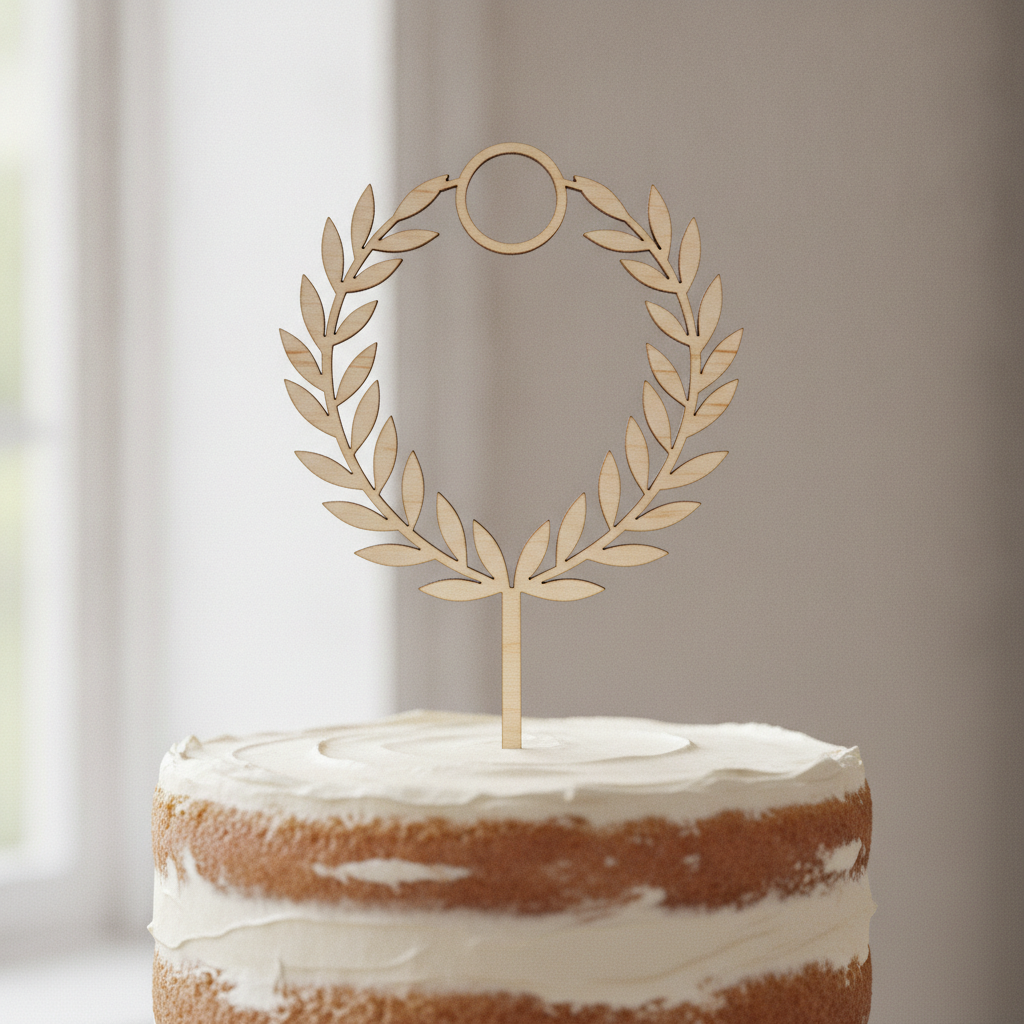
A laser-cut birch plywood laurel wreath standing in a rustic semi-naked cake with the sponge layers showing through a thin scrape of buttercream. The connectivity is genuinely right: both branches run up into the small ring at the top and back down into the stem, so the whole thing is one closed piece with no floating leaves. The two things it did not do are the more useful ones. The prompt asked for the faintly toasted brown cut edge a real laser leaves behind, and the edges came back clean and pale as though the shape had been punched rather than burned. And it asked for two legs and delivered one. A single central stake under a topper this wide is precisely what leans the moment somebody carries the cake across a room
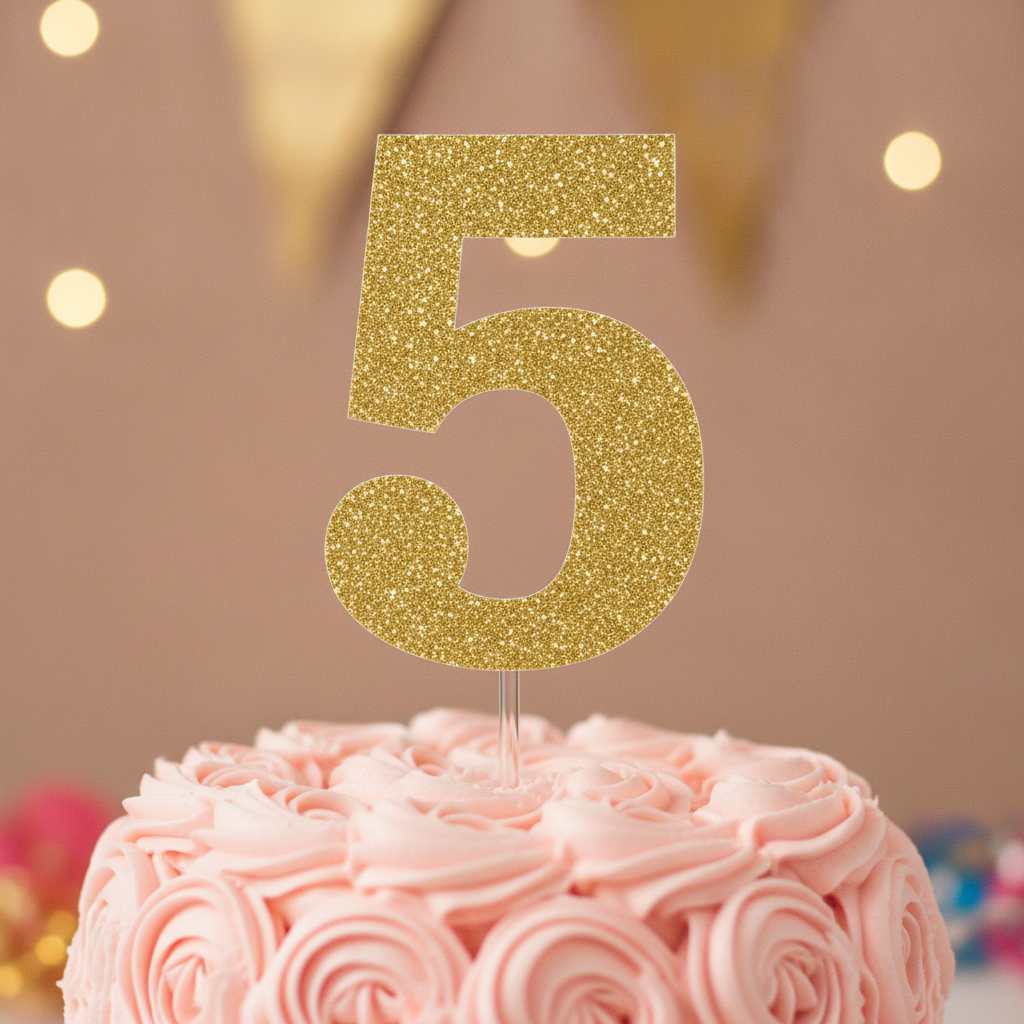
A single large numeral 5 in thick double-sided gold glitter card on a slim clear acrylic stick, standing in a small birthday cake covered in pale pink buttercream rosettes. One digit alone is comfortably inside what this model renders correctly, which is why an age topper is the safest personalised thing on this page and why it is worth steering customers toward numbers rather than names. The glitter card is doing what glitter card does, catching light in fine flecks and reading as far more expensive than it costs, and it is also the one material here that sheds onto the icing if the cut edge is left unsealed
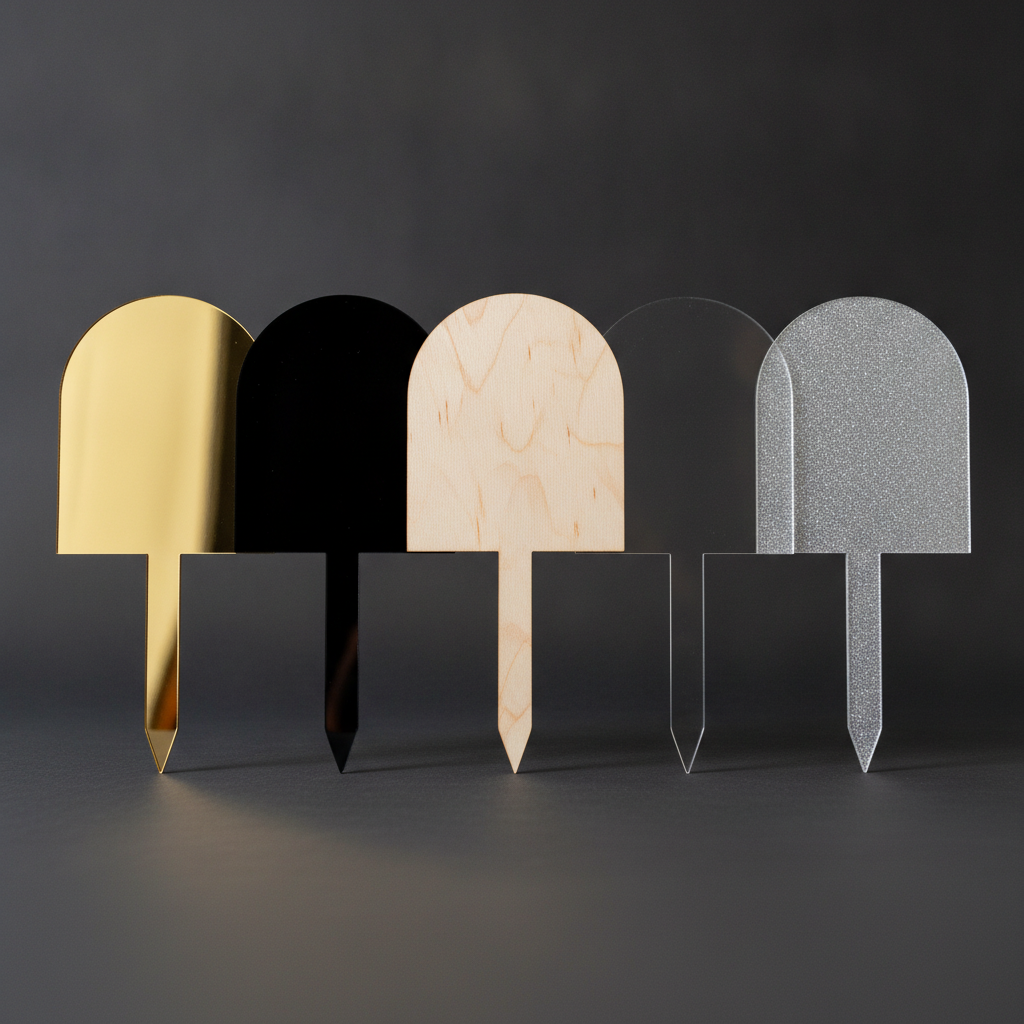
Five toppers of the same arch silhouette standing in a row on charcoal, cut in five materials so that finish is the only thing changing: mirror gold acrylic, black acrylic, natural birch plywood, clear acrylic and silver glitter card. Shot low and from the front, because a finish is a surface property and a surface is invisible from overhead. Two findings sit in one frame. The count is exactly right, five toppers and five different materials in the order asked for, which comparison renders very often get wrong. But the black one was specified as matte and came back glossy enough to reflect the floor, and all five carry a single spike where the prompt asked for two. The clear acrylic is the one to study before you spend money: against this dark ground it is barely there at all, and against a pale buttercream cake it will do exactly the same thing
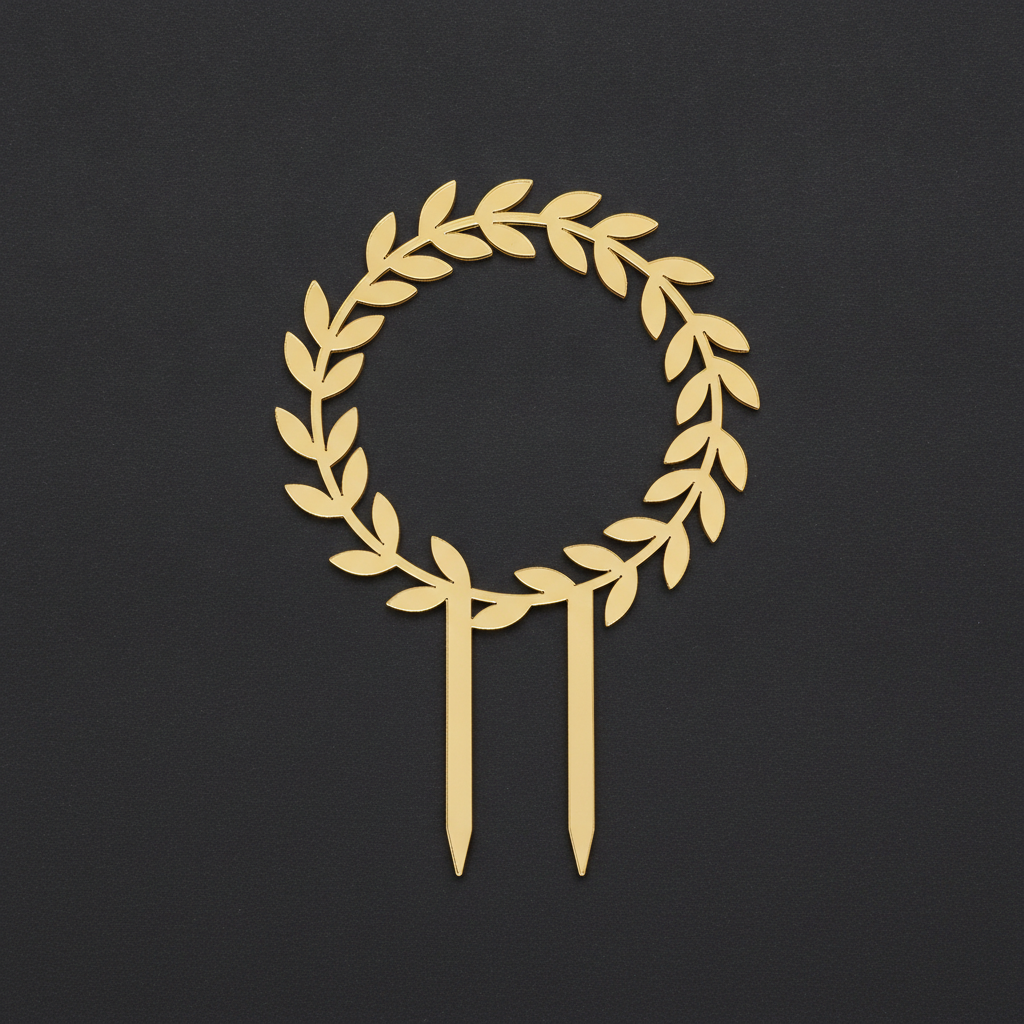
The flat cut shape, and the most practically useful frame on the page: one gold acrylic wreath lying alone on dark charcoal, shot from directly overhead, with no cake, no stand and nothing else in the picture. This is the frame that got the spikes right, two of them, tapered and cut as part of the same piece rather than glued on. The laurel is open at the top and joined at the bottom, so it is still a single connected piece. The gold reads as brushed satin rather than the mirror finish that was asked for, which is the third named finish on this page to be quietly substituted. And it is still a photograph: a laser follows a vector path and there is no path anywhere in a picture, so what you have here is the design approved, not the file cut
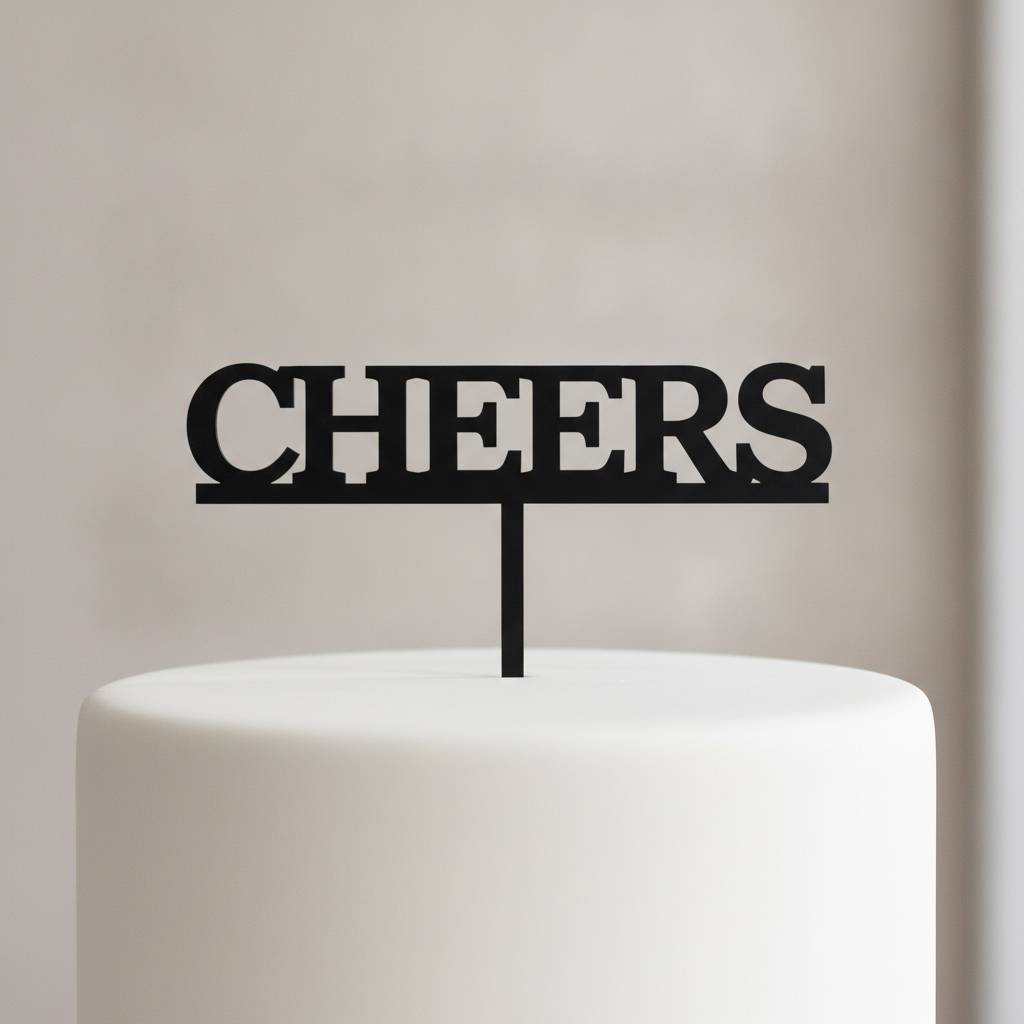
A matte black acrylic topper reading CHEERS in bold capitals, joined along the bottom by one thin continuous bar, standing in a smooth white fondant cake. This is the other half of the connectivity answer and the reason the page carries two lettered frames. Capitals in a plain typeface do not touch each other, so they cannot be cut as a word on their own; the baseline bar turns six separate letters into one piece and gives the spike something solid to hang from. Six letters, spelled correctly, first attempt. The typeface is not what was asked for though, since the prompt said sans-serif and this is a slab serif with heavy bracketed feet, and once again a pair of spikes was requested and one arrived
How the AI Cake Topper Generator Works
Pick the build
Connected script, plywood botanical, glitter card number, the five material row, the flat cut shape, or capitals on a baseline bar. That choice decides whether the topper has lettering at all, whether the letters can hold themselves together, and what the cut edge is going to look like.
Name the material, finish and width
Say the material and the surface first — mirror acrylic, matte acrylic, clear acrylic, 3mm birch ply, glitter card — then the colour, then how wide the finished topper is and what cake it is standing in. Width is the spec everyone forgets and the one that decides whether the design reads at all.
Take the design to a vector, then to a laser
Concepts arrive in about twenty seconds at up to 4K. The render settles what the topper looks like; you rebuild it as a cut path, set any real name in a real font, check every join overlaps, and add the spikes. Then a laser turns the pair into an object.
What a Cake Topper Render Settles, and What It Hides
Six things decide whether a topper design becomes an object somebody can stand in a cake, and an image carries about two of them. Knowing which two is the difference between a design a cutter can quote from and a beautiful picture of something that falls apart on the workbench.
One piece, or no piece at all
The machine cuts a closed outline and everything inside it drops out, so anything not attached to the rest of the design is a separate object. Script fonts solve this by joining letter to letter; block capitals solve it with a baseline bar or a backing plate. The middles of an o, an a, an e and an R are islands that fall out entirely unless the counter is bridged or the letter is redrawn.
Stroke width is a material property
A hairline that looks elegant on screen is a snapped topper in the box. As a working floor, keep strokes at roughly two millimetres or more in 3mm acrylic and nearer three in plywood, and thicken anything long and unsupported such as the tail of a y or the crossbar of a t. The delicate stems in the plywood frame above sit right at that edge, which is exactly why they are worth looking at.
The deliverable is a path, not a picture
A laser reads an SVG or a DXF — a line at a stated speed and power, with cut lines separated from engrave lines. A photograph contains no path. The flat preset here gets you as close as an image can get, and the last step is always rebuilding the shape as a vector at a stated size in millimetres, which is also where the joins get checked.
It has to stand up in a soft cake
Spikes are cut as part of the same piece, not glued on, and they need to sit under the heavy parts of the design rather than at the far ends. Allow twenty five to thirty millimetres below the artwork so they pass through the icing into the sponge, and use two spikes on anything wider than about one hundred and twenty millimetres or the topper leans as soon as the cake moves. Count them in the render: three of the five frames above that asked for a pair came back with one.
Nothing here is a food contact material
Acrylic, plywood, glitter card and the adhesives on them are decorative, not food safe. The trade answer is to keep the topper out of the food — sleeve or wrap the spikes, or seat the design on a food-safe disc — and to say plainly on the listing that it is a decorative item to be removed before serving. Glitter card is the one material that actively sheds, so seal the cut edges.
Size comes from the top tier, not the cake
A topper is measured against the tier it stands in, at roughly two thirds of that diameter and no more, so a six inch top tier takes about one hundred millimetres of width. Toppers are also wider than they are tall, because height makes the cake look like a plinth. And the visible design is measured separately from the spikes, which is the dimension people get wrong on their first order.
Names, Numbers and What the Model Cannot Spell
Personalisation is what this entire market sells, and lettering is the weakest thing this model does. That tension is worth stating plainly rather than hiding, because the boundary is sharp and easy to work with once you know where it runs.
Safe to render
One short common word set large and alone — Love, Cheers, Hello, Baby, Mr and Mrs kept short — and a single numeral for an age. These are a handful of independent shapes rather than a sequence, which is the regime this model handles well. A topper with no lettering at all is safest of all, and botanical and silhouette designs are a large share of the real market.
Keep out of the render
Surnames, unusual first names, two names joined with an ampersand, full dates, long phrases and anything in a fine script at small size. You get dropped letters, doubled letters, flourishes that are not letters, and diacritics added to names that never had any. That last one is the dangerous failure, because it looks correct until you read it character by character.
Do it the way the trade does it
Nobody hand-draws a name. A topper is a licensed font set as live text, converted to outlines, then welded so the joins overlap and the counters are bridged. Use this tool to settle the style, material and silhouette, then type the name in a vector editor where spelling is typed rather than guessed and every join can be checked at high zoom before anything is cut.
Licensed characters find their own way in
A large share of the cake topper market is cartoon and film characters, and essentially all of it infringes. Ask for a themed topper and the model drifts straight to the famous instance, so every preset here refuses licensed characters, cartoon characters and lookalikes by name. Design to the theme — the colours, the shapes, the mood — rather than to the character.
Why Use This AI Cake Topper Generator
Six builds, not six colourways
A connected script, a plywood botanical, a glitter card number, a material comparison, a flat cut shape and capitals on a baseline bar differ in construction, cost and whether the design can physically be cut as one piece. Switching preset changes what the object is rather than what shade it happens to be.
The cut shape built into the presets
One preset renders the topper flat, alone, from directly overhead, with the spikes cut as part of the same piece — because that shape is what you actually have to trace, and it is the thing every styled cake photograph hides behind buttercream and bokeh.
A material row you can actually judge from
Mirror, matte, plywood, clear and glitter side by side at the same silhouette and the same height, shot low from the front where a finish is visible. Clear acrylic vanishing against a pale cake is the mistake this frame exists to stop you paying for.
Personalisation refused item by item
Names, surnames, initials, monograms, ages, dates, bakery names and licensed characters are banned individually rather than with one blanket instruction, which is the difference between a clean design and a concept with an invented surname cut into the middle of it.
Consistent across a whole range
Nano Banana Pro holds a described palette and material across separate generations, so keeping one finish and one silhouette while changing only the build gives you a topper collection that reads as a single line rather than six unrelated products.
Cheap enough to test the whole range
About twenty seconds per concept and plans from $2.99 means you can put six styles in front of a customer, or find which one reads at listing thumbnail size, before buying a single sheet of mirror acrylic or cutting a sample.
AI Cake Topper Generator FAQ
Related Celebration and Cut-File Design Tools
AI Cake Design Generator
The cake underneath, which is a different job entirely. That tool designs the iced object — tiers, buttercream, drips and flowers. This one designs the small cut thing you stand in the top of it, and the two are usually decided by different people.
AI Keychain Design Generator
The nearest neighbour in construction rather than in occasion. A keychain is the same small laser-cut acrylic piece with the same connectivity and stroke width rules, except it swaps two cake spikes for one hole that has to survive a pocket.
AI Sticker Generator
The other product whose deliverable is a cut line. A sticker is kiss-cut vinyl with a contour path around the artwork, so it shares the trace-and-vector step and skips the part where the design has to hold itself together in three dimensions.
Design Your Cake Topper Now
Six topper builds, materials that render with the right surface, a five way finish comparison, and the flat cut shape a laser actually receives — all at up to 4K in about twenty seconds. Free to start, from $2.99 for more.
Start Designing FreeAbout This AI Cake Topper Generator
An AI cake topper generator is very good at one part of this job and quietly misleading about the rest, so it is worth drawing the line before you start. A cake topper is four decisions stacked on each other and only one of them is a picture. The first is what the thing physically is: a connected script cut as one continuous ribbon, an open botanical silhouette, a single numeral for an age, or a row of capitals rescued by a bar along the bottom. The second is material, which decides the price, the finish and how thin the design is allowed to get — mirror acrylic for weddings, matte acrylic for colour, clear acrylic for cakes dark enough to show it, 3mm birch plywood for rustic work, glitter card when the budget is the point. The third is dimension, meaning the finished width measured against the top tier, the height of the visible design, and the length of the spikes below it. Only the fourth, what the topper actually looks like, is something an image can settle, and it happens to be the part everybody argues about hardest and describes worst. That is what this tool does in about twenty seconds.
What makes a topper unlike every other product in this series is that the letters have to hold each other up. Everywhere else, type is printed onto a surface and the surface does the structural work. Here the type is the object. A cutter follows a closed outline and drops out everything inside it, so a word set in a typeface where the letters stand apart is not a topper at all, it is a set of loose letters. That single fact is the reason the default style of this entire category is a flowing connected script, where each letter runs into the next and the whole word lifts out of the sheet in one piece. It is the reason the CHEERS topper in the gallery above sits on a thin baseline bar, which is the fix the trade uses for capitals and which quietly becomes part of the design. And it is the reason the fiddly hour of the job is never choosing a font, it is going through every join at high zoom making sure the strokes genuinely overlap rather than touching at one point, and bridging the islands in the middle of an o, an a, an e or an R so they do not simply fall out on the bed of the machine.
The most useful thing to know about this AI cake topper generator is where its lettering stops, because personalisation is exactly what this market sells. The pattern is consistent and easy to work with. One short common word set large and alone comes back correct almost every time, which is why the gallery uses Love and CHEERS, and a single numeral for an age is safer still. What fails is precisely the commercial heart of the category: surnames, unusual first names, two names joined by an ampersand, full dates and long phrases, all of which come back with dropped letters, doubled letters, invented flourishes, or accents added to names that never carried any. So split the job the way a real workshop already does. Use the generator to settle the style, the material, the silhouette, the width and the mood, get the customer to approve that, and then set the actual name in a vector editor in a real licensed font where the spelling is typed rather than guessed. Nothing is lost by doing it that way, because you were always going to open a vector editor to make the cut file.
The last two things worth carrying away are commercial rather than technical. First, none of these materials is a food contact material, and pretending otherwise is the one genuine risk in an otherwise harmless product. Acrylic, plywood, glitter card and the adhesives that go with them are decorative, so sleeve or wrap the spikes, or seat the design on a food-safe disc, and state on the listing that the topper is decorative and should be removed before the cake is served. Second, a very large share of this market is built on cartoon and film characters and essentially all of it infringes, which is why every preset here refuses licensed characters, cartoon characters and lookalikes by name — design to the theme rather than to the character and you keep the sale without the letter. Beyond those two, this is a genuinely good fit for AI product photography, because a topper shop lives or dies on whether a style reads at listing thumbnail size long before any stock exists. It runs on Nano Banana Pro, which holds a described palette and material across separate generations, so one finish can carry a whole collection; it is free to start and paid plans begin at $2.99; and it turns the slow, expensive, argumentative stage of a physical product — deciding what the thing will actually look like — into six pictures you can put in front of a customer before a single sheet of acrylic is cut.