
AI Amazon Listing Image Generator
A listing is never one picture. It is seven pictures that a shopper reads as a single object while swiping, and the whole thing collapses the moment frame two stops looking like frame one. This AI Amazon listing image generator builds the full set in about twenty seconds each, holds the pure white background and the no text rule perfectly, and this page is straight with you about the two things it broke every time: it changed the product between frames, and it would not fill the frame.
Start Creating FreeTry the AI Amazon Listing Image Generator — Free
Pick the slot you are filling, because a main image and an A plus brand module are governed by opposite rules. The main image preset is written to the marketplace specification: pure white, product centred and filling the frame, and a long explicit ban on the props, borders, badges and lettering that get a main image rejected. Two presets style the product in a scene, one builds a feature layout with the callout plates left deliberately blank for your own copy, one lays out a multi angle grid at a single consistent scale, and one shows the thing in a hand so nobody has to guess how big it is.
AI Amazon Listing Image Generator
Pick a listing slot, describe your real product, and get marketplace ready images at up to 4K
Six Listing Images, Nothing Retouched
These six came straight out of the presets above with no cropping and no cleanup, and the captions say what each one gets right and what it quietly changes. Read them one at a time and most of them are genuinely good. Read them as a set, the way a shopper actually does, and the problem appears immediately.
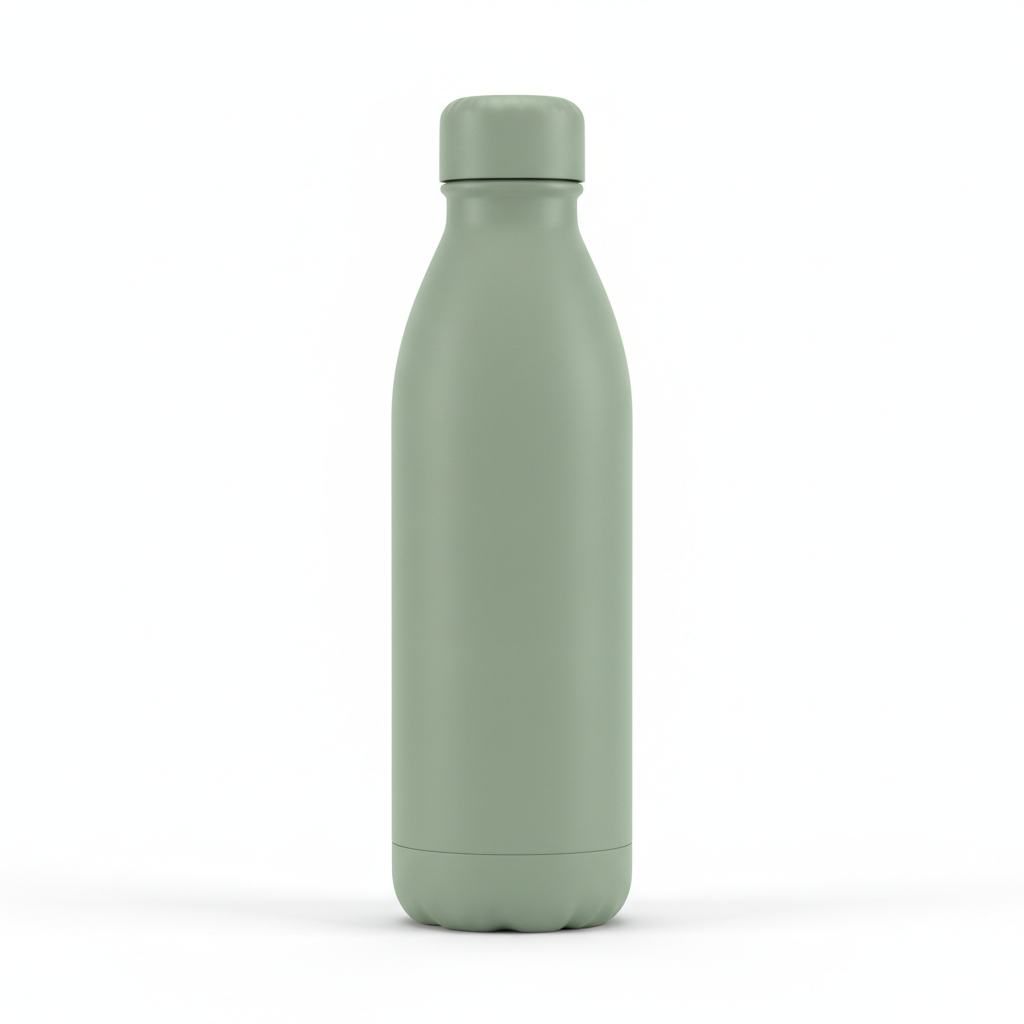
AI Amazon listing image generator result: a matte sage green insulated bottle standing upright, dead centre, on a pure seamless white background with a faint contact shadow under the base and nothing else in the square frame. The parts that matter most all landed. The background is a genuine flat white with no gradient and no visible sweep corner, the product is perfectly upright and perfectly centred, the lighting is soft and even with no blown highlight down the body, and the frame is completely clean: no props, no lettering, no logo, no watermark, no border. That is the entire main image rule set except for one number, and it is the number it missed. The brief asked for the product to fill about eighty five percent of the frame and it came back filling closer to sixty, with a wide margin of dead white all the way around it. On a search results page that is the difference between a thumbnail you can read and one you scroll past. The other slip is the cap, which was specified with a brushed steel collar ring and arrived as a plain green cap with no ring at all, which matters because the next five frames drew it differently again.

AI Amazon listing image generator result: a lifestyle shot with the sage green bottle lying on its side on a light oak kitchen counter, a rosemary plant in a terracotta pot and a round woven placemat beside it, a white subway tile splashback and a stainless range softly blurred behind. As a photograph this is the strongest frame in the set. The morning light is genuinely directional, the depth of field falls off properly behind the counter, the placemat and the herb are exactly the two props that were asked for and nothing else crept in, and the range control panel behind is blurred far enough that no invented lettering survived on it. Two things went wrong and both are instructive. The bottle was described as resting on the counter and the model read resting as lying down, so the hero product is on its side in the one image meant to show somebody using it. And the continuity broke here for the first time: this bottle has a black gasket ring below the cap, a narrower shoulder and a smoother base than the bottle in the main image, so frame one and frame two are already two different products.
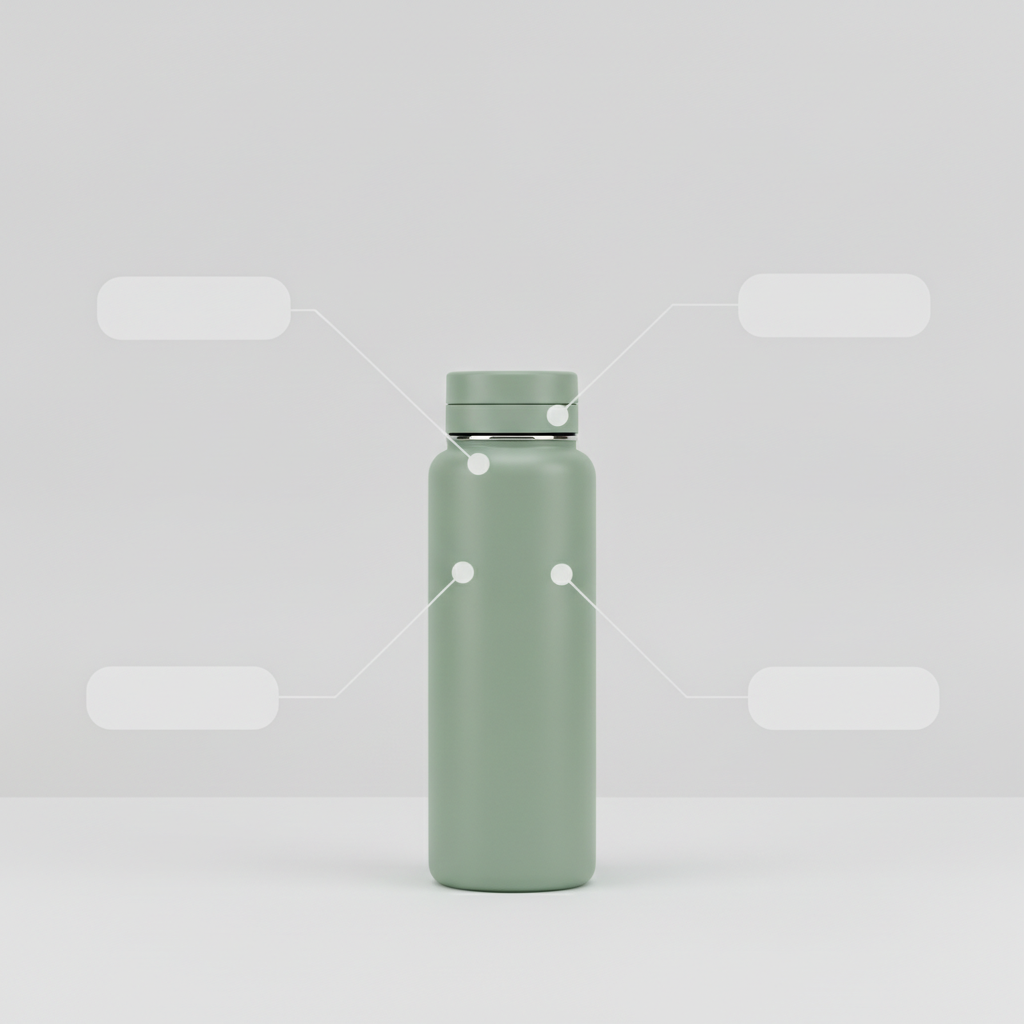
AI Amazon listing image generator result: a feature infographic layout with the sage green bottle centred on a pale grey studio backdrop, four thin white callout lines running from four small dots on the product out to four empty rounded rectangle plates, two on the left and two on the right. This is the frame that proves the workflow. Four plates were asked for and four arrived, evenly balanced two per side, and every one of them is completely blank, which is exactly the point: you add the real feature copy yourself in any editor and you never ship a render full of half legible invented words. The callout lines are clean, thin and consistent, and the leader dots sit on the product rather than floating beside it. Two faults. Two of the four dots are parked on plain body with no feature under them, so half the callouts point at nothing in particular and you will have to move them before the copy makes sense. And the bottle is a third version again, taller and straighter than frame one, now wearing the brushed steel collar that the main image was supposed to have and did not.
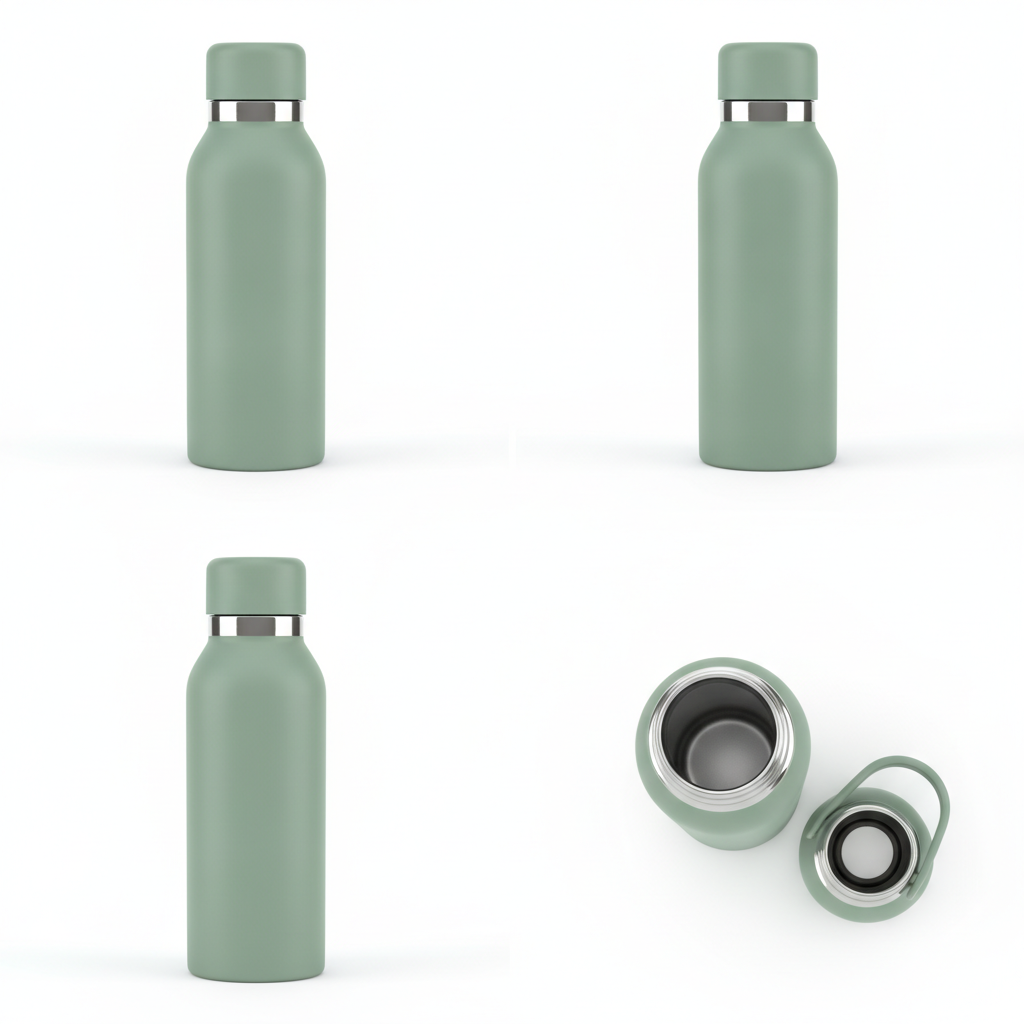
AI Amazon listing image generator result: a two by two multi angle grid on pure white, with three upright views of the sage green bottle and a fourth view showing the bottle tipped over with its cap unscrewed and lying beside it, revealing the polished steel interior of the neck and the inside of the cap. The scale discipline is perfect, which is the hard part of a grid: all four views are rendered at identical size, identical height in their cells, identical lighting and identical white, so the grid reads as one product rather than four photographs stuck together. The open cap view is genuinely useful and shows the steel liner clearly. The failure is the brief itself. Four distinct angles were asked for, front, side, three quarter and top down, and the first three came back as three near identical front views that a customer cannot tell apart, while the fourth is a tipped over view rather than the top down of the open mouth that was requested. A four image grid where three cells carry the same information is three wasted cells on a listing that only gets seven.
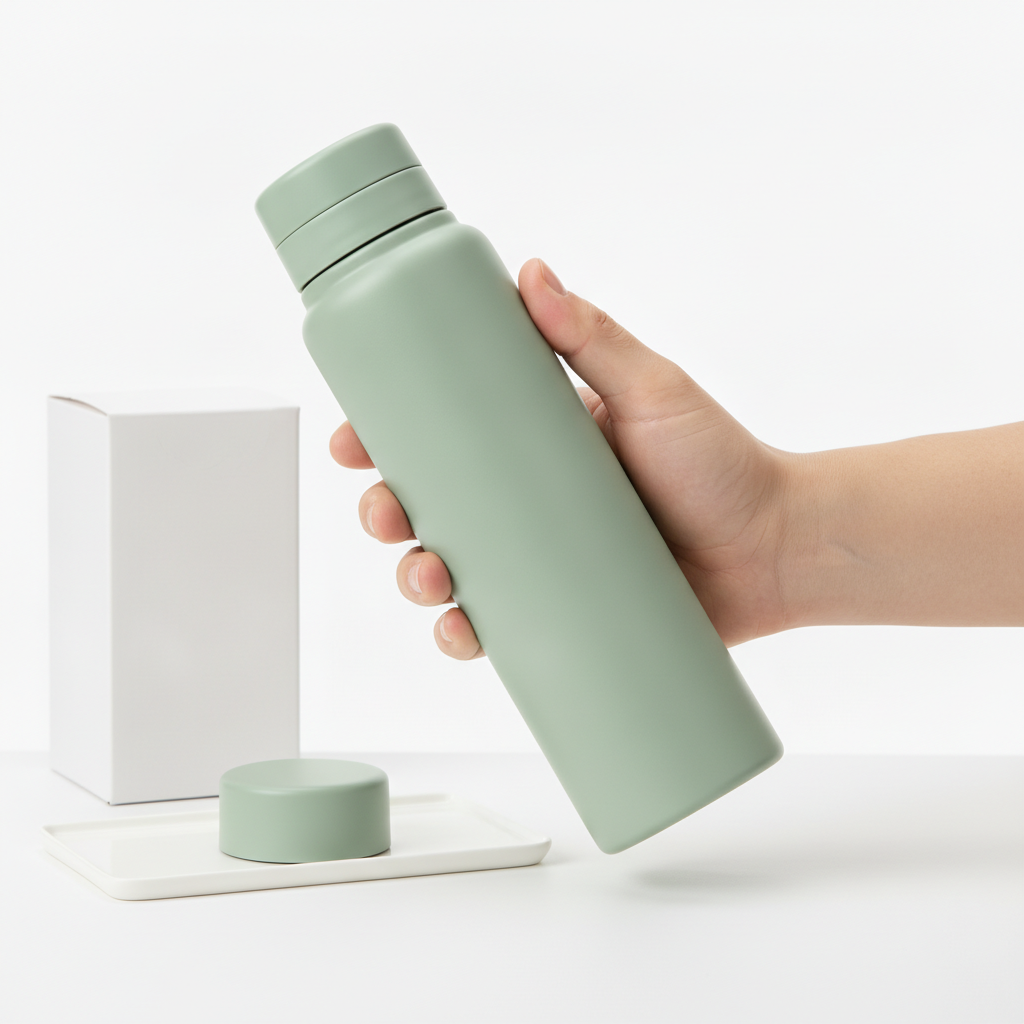
AI Amazon listing image generator result: a scale reference shot with a hand holding the sage green bottle horizontally against a white studio background, a plain white rectangular box standing behind on the left, and a small white tray in the foreground carrying a loose sage green cap. The hand is the surprise. It is anatomically correct, five fingers, natural knuckles, believable skin tone and a plausible grip, which is the single thing this kind of model is famous for ruining, and it gives you a real sense of the diameter. Everything around the hand went wrong. The brief said pure white background and nothing else, and the model invented three props: a packaging box, a tray and a second cap. Worse, the bottle in the hand is still capped, so the frame now shows one bottle and two caps, which is the kind of detail a returns claim is built on. And a main image with a box in it would be rejected outright, so this frame can only ever be a secondary. The lesson is blunt: this model adds objects to fill space, and a marketplace main image is defined by what is not in it.

AI Amazon listing image generator result: an A plus content style flat lay with the sage green bottle lying on rumpled sand coloured linen, a rolled grey hiking towel behind it and a pair of plain black sunglasses to the right, lit by warm low side light that throws long soft shadows across the fabric. This is the best lit frame on the page and the one you would actually put in a brand story module. The linen creases read as real cloth rather than as noise, the towel is genuinely rolled with a visible spiral end, the sunglasses are a plain unbranded shape with nothing written on the arm, and the light is a single warm source with a clean falloff. Every prop asked for arrived and none were added. The continuity problem is at its worst here though. This bottle has concentric rings moulded into its base, no steel collar, a longer neck and a paler green than any of the previous five, so across six frames you can count at least three different bottles. For a lifestyle module on its own that does not matter much. For a listing where a customer scrolls from the main image straight into the brand story, it does.
How the AI Amazon Listing Image Generator Works
Describe the product once, in detail
Write the physical object rather than the mood. Material, exact colour and finish, body shape, what the cap or closure looks like, where the seams and joints fall, what the base does. Then paste that same description into every preset without changing a word. This is the single highest leverage habit on the page, because everything that went wrong in the gallery below came from the model reinventing details you left it free to invent.
Generate the slot you actually need
Main image, lifestyle, feature layout, angle grid, scale shot, brand module. Each preset is written to a different rule set, and the main image preset is the strictest of them because a marketplace main image is defined mostly by what is forbidden. Run two or three variations of each slot and pick per slot rather than accepting the first set, since the cost of another pass is seconds.
Then crop, compare and check continuity
Crop the main image in so the product fills eighty five percent of the frame, because it will not do that on its own. Lay all seven finished images side by side at thumbnail size and look for the drift: a cap that changed, a collar that appeared, a base that grew rings. Regenerate whichever frame is the odd one out. And check that the object you are showing is genuinely the object you ship.
What an AI Amazon Listing Image Generator Settles, and What It Breaks
Every page in this series ends up naming the one thing renders drop. In a cafe it was adjacency, in a shop it was arithmetic. On a product listing it is identity, and identity is the only thing a listing image set is actually for.
The product changes between frames
This is the finding that matters and it is worth stating precisely. Across six generations of one described object the bottle came back with a plain cap and no collar, then with a black gasket ring and a narrower shoulder, then with a brushed steel collar and a taller straighter body, then with a longer neck and concentric rings moulded into the base. That is at least three different products in one set. Any single frame passes inspection. The set does not, and a set is the only thing a customer ever sees. Repeat your physical description verbatim in every preset and expect to regenerate one frame in three.
It will not fill the frame
The eighty five percent fill rule is the one measurable number in the entire main image specification, it was written into the preset in plain words, and the render came back at roughly sixty percent with a wide moat of dead white on every side. This is not a cosmetic complaint. Search results are a wall of small thumbnails and the product that reads at that size wins the click. Every main image this tool produces needs cropping in before it goes live, which takes about ten seconds and is the difference between an asset and a nice picture.
It adds objects to fill empty space
The scale shot preset asked for a hand, a product and a pure white void, and it returned a packaging box, a white tray and a second loose cap that nobody requested, while the bottle in the hand was still capped. A frame showing one bottle and two caps is a returns claim waiting to be filed, and a frame with a box in it is disqualified from the main image slot outright. A marketplace main image is defined almost entirely by what is absent from it, and absence is exactly what this model finds hardest to render.
It reads lifestyle as lying down
Both scene presets put the product on its side. The lifestyle brief said resting on the counter and got a bottle lying flat in the one image whose whole job is showing somebody using the thing, and the brand module did the same. It is a small failure with a simple fix, which is to write the words standing fully upright and vertical rather than any verb the model can read as reclining, but it is consistent enough across this series to be worth knowing before you burn a generation on it.
The text ban held completely
This is the clean win and it inverts what most people expect from AI product imagery. The presets carry the longest text ban of any page in this series, naming wrap labels, neck labels, embossed wordmarks, barcodes, capacity markings, care symbols, packaging print, swing tags and any lettering on a callout plate. Across all six frames, not one letter, not one numeral, not one logo, not one watermark. The four callout plates in the infographic came back perfectly blank, which is exactly what you want, because you type the real copy yourself and never ship an invented word.
The hand was right, which nobody expects
Hands are the classic failure mode and the scale shot returned a genuinely correct one: five fingers, natural knuckles, a plausible grip around the body, believable skin tone and no melted extra digit anywhere. It reads instantly as a real size reference. Worth knowing because the scale slot is one of the most under used on any listing, most sellers skip it, and it answers the single most common pre purchase question there is, which is how big is this thing really.
Amazon Listing Images in Numbers
The styling is the enjoyable part and these are the parts that decide whether the listing goes live. Marketplace requirements are updated regularly, so treat these as the shape of the problem and confirm the current figures in seller help before a launch.
The main image rules
Pure white at RGB 255, 255, 255. Product filling at least eighty five percent of the frame. Whole product in shot, in focus, professionally lit. No text, no logos, no watermarks, no borders, no badges, no props, no accessories that do not ship in the box. Square aspect ratio is the safe choice. That eighty five percent figure is the one this tool misses every time, so plan on cropping.
Pixels and file format
1600 pixels on the longest side is the threshold that enables hover zoom, which is worth real conversion on anything considered. 2000 by 2000 is the practical default, 10000 is the ceiling. JPEG or PNG, sRGB colour. Keep the file small enough to load fast on mobile, since that is where most of the traffic and almost all of the impatience is.
The seven slots and what goes in them
White main image, lifestyle in use, two or three feature infographics, a size or scale reference, a what is in the box shot, and a closer that answers your worst review. Seven is what most buyers see. Sellers routinely perfect slot one and leave slots five to seven empty, which is the cheapest conversion left anywhere on the listing.
Accuracy is a policy requirement
The images have to show the item the customer receives. A render that invents a finish, a closure or a moulded detail your factory does not make is a misrepresentation, and it comes back as suppressed listings and returns rather than as a stern email. Use generated imagery to design and to prototype freely, and to publish only where the picture is genuinely the product.
Why Use This AI Amazon Listing Image Generator
Presets written to the specification
The main image preset is not a style, it is the marketplace rule set written out in full: flat white at RGB 255, product upright and centred, one soft contact shadow, and an explicit ban on the props, borders, badges, inset panels and lettering that get a main image pulled.
Callout plates left deliberately blank
The infographic preset builds the leader lines, the dots and four balanced empty plates and writes nothing on them. You add the real feature copy in any editor, which means you never ship a listing carrying a misspelt invented word, and it is the correct division of labour rather than a limitation.
A grid at one consistent scale
The multi angle preset renders four views in one square at identical size, identical distance and identical lighting. Scale discipline across a grid is the part that usually falls apart, and it is the part this preset holds, so the four cells read as one object rather than four photographs.
The slot most sellers skip
A hand holding the product answers the one question every product page gets asked, which is how big is it really. The scale preset returned an anatomically correct hand with a natural grip, and that slot sits empty on the majority of listings you are competing against.
Honest about what it cannot do
This page names the fiction: a product that changed at least three times across six frames, a main image that filled sixty percent of the frame when eighty five was written into the brief, three props invented in a shot specified as an empty white void, and a lifestyle hero lying on its side.
Cheap enough to fill every slot
About twenty seconds per image and plans from $2.99 means the seven slot listing you have been meaning to finish stops waiting on a photography quote. Free to start, up to 4K, and enough headroom to crop the main image to the fill it needs.
AI Amazon Listing Image Generator FAQ
Related E-Commerce Image Tools
AI Product Photo Generator
The general purpose version of this page, without the marketplace rule set bolted onto the presets. Use it when you are exploring how a product could be shot rather than filling a specific listing slot to a specification.
AI Infographic Generator
For the feature callouts once you know what they say. The layout preset here deliberately leaves every plate blank, which leaves the actual infographic, with real legible copy on it, as a separate job with its own rules.
AI Image Generator for E-Commerce
The wider store view, covering hero banners, category imagery and marketing creatives rather than the seven images inside one product detail page. The useful companion once the listing itself is finished.
Build Your Listing Set Now
Six listing assets, a pure white main image with a single soft contact shadow, a warm morning lifestyle shot, a four plate feature layout with every plate left blank for your own copy, a two by two angle grid held at one consistent scale, a hand held scale reference, and an A plus brand module on rumpled linen in low afternoon sun. All square, all at up to 4K, all in about twenty seconds each. Free to start, from $2.99 for more.
Start Creating FreeAbout This AI Amazon Listing Image Generator
An AI Amazon listing image generator is aimed at a much narrower job than a general product photo tool, and the narrowness is the point. A product detail page is not a gallery, it is a sequence with slots, and each slot is governed by a different rule. The first image is bound by a specification that is mostly a list of prohibitions: flat white at RGB 255, 255, 255, the product filling at least eighty five percent of the frame, and no text, no logo, no watermark, no border, no badge, no colour block, no prop and no accessory that does not ship in the box. The last image is bound by nothing except taste, which is why a brand story module can be a moody flat lay in raking afternoon light. The six presets on this page are written to those different rule sets rather than to six different aesthetics, which is the difference between assets you can upload and pictures you liked.
The clearest finding on this page is one that only appears when you stop looking at images one at a time. Every individual frame in the gallery above is convincing, and several are better than convincing. The main image is a clean flat white with perfect centring and a correctly weighted contact shadow. The lifestyle frame has genuinely directional morning light and a depth of field that falls off like a real lens. The infographic returned four balanced callouts with four perfectly blank plates. The scale shot returned an anatomically correct hand, which is the thing this class of model is most notorious for ruining. And yet laid out as a set of six the illusion collapses immediately, because the product is not the same product. Frame one has a plain cap and no collar. Frame two has a black gasket ring and a narrower shoulder. Frames three and four have a brushed stainless collar and a taller straighter body. Frame six has a longer neck and concentric rings moulded into the base. At least three different bottles, from one description, in one sitting. A listing image set is a continuity exercise before it is a photography exercise, and continuity is exactly what a model that treats every generation as a fresh invention will not give you for free.
The second finding is smaller, entirely fixable, and will cost you money if you do not know about it. The eighty five percent frame fill is the only measurable number in the whole main image specification. It was written into the preset in plain language and the render came back at roughly sixty percent, floating in a wide moat of dead white. Search results are a wall of small thumbnails, the product that reads at thumbnail size gets the click, and a product occupying sixty percent of its tile loses to one occupying eighty five every time. The fix is a ten second crop and the failure was completely consistent, so build the crop into your process rather than hoping for a better generation. The related failure is that this model fills empty space by inventing objects. Asked for a hand, a product and nothing else against pure white, it produced a packaging box, a tray and a second loose cap while the bottle in the hand was still capped, which is both a disqualified main image and a frame that shows one bottle with two lids.
What went right is worth stating just as plainly, because it is most of the work. The text ban held perfectly. These presets carry the longest and most explicit prohibition on lettering of any page in this series, naming wrap labels, neck labels, embossed wordmarks, barcodes, capacity markings, care symbols, packaging print, swing tags and any writing on a callout plate, and across all six frames there is not one letter, one numeral, one logo or one watermark anywhere. That single result is what makes a free AI Amazon listing image generator usable at all, because a main image is rejected for any text whatsoever, and an infographic full of misspelt invented words is worse than shipping no infographic. The four blank plates in the feature layout are the whole workflow in one frame: the tool builds the composition, the leader lines and the balance, and you type the real benefit copy yourself in whatever editor you already use.
The last thing to carry away is a policy point rather than a craft one, and it applies on every marketplace rather than only on the biggest. Listing images have to show the item that actually arrives in the box. A generated render that invents a closure, a finish or a moulded detail your factory does not produce is a misrepresentation, and the consequence is not a warning email, it is a suppressed listing and a stack of returns. So use this AI Amazon listing image generator for what it is genuinely excellent at: designing the shot before you brief a photographer, building infographic and A plus layouts you fill with your own copy, testing whether a stark white hero or a warm lifestyle hero converts better on your category, and filling the empty back half of a listing while a photography quote sits in your inbox. Take the composition, the lighting and the layout from here. Take the product itself, on the frame a customer buys from, off a photograph of the real unit.